👗 DIY Edith Bunker Costume: Easy Ways to Get It Perfectly Right
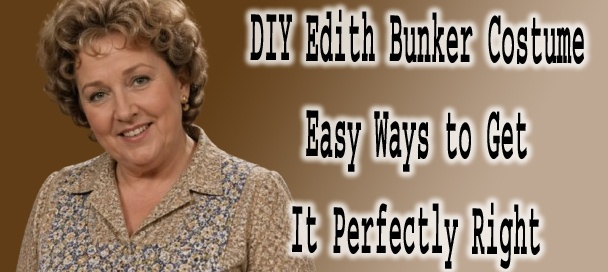
Complete DIY Edith Bunker Costume featuring polyester house dress, floral smock apron, clip on earrings, brown plastic reading glasses, and soft set hairstyle inspired by Jean Stapleton in All in the Family.
She Was Always in the Kitchen. The Kitchen Was Always Better For It.
There is a moment early in almost every episode of All in the Family where Edith Bunker moves through the frame carrying something. A plate, a pot, a dish towel, a cup of coffee for a man who did not deserve it as completely as he received it. She is wearing her smock apron over her house dress, moving with the purposeful efficiency of a woman who has fourteen things happening at once and has organized them all in her head without writing any of them down. She is humming. She is paying attention to everything. She appears, to the casual observer, to be simply a woman doing housework. She is in fact the emotional and moral center of one of the most important television programs ever made and Jean Stapleton knew it from the first episode and played it accordingly every single week for nine seasons.
Jean Stapleton's Edith Bunker is one of the most underestimated performances in American television history, and that underestimation was partly by design. Norman Lear and the writing staff built Edith to appear simple, to seem like the kind of woman who could be talked over and around and past, and Stapleton took that construction and turned it inside out with a subtlety that rewarded close attention in a way that Archie's bluster never quite needed to. Edith was not simple. Edith was patient, which is a completely different thing and considerably more powerful.
She had been listening to Archie Bunker for decades and she had formed her own views about everything he said and she expressed those views at the precise moment of her own choosing with a directness and a warmth that consistently stopped him cold. She was the smartest person in that house and the show knew it and she knew it and the audience knew it and Archie almost knew it which was the source of more genuine comedy and genuine tenderness than any other dynamic the show produced.
The DIY Edith Bunker Costume works because it is built from the same thrift store logic as the DIY Archie Bunker Costume, and together they tell the complete story of one of television's great marriages Every piece of it is findable for almost nothing. The polyester house dress in a muted earth tone print. The smock apron worn over it because there is always something on the stove. The simple clip on earrings for going out. The brown plastic reading glasses sitting on the end table by the piano. The specific quality of warm, patient, absolutely undefeatable goodness that Stapleton brought to the character and that anyone willing to commit to the role for an evening can access with practice and genuine affection for the source material.
What makes the DIY Edith Bunker Costume particularly brilliant as a couples costume alongside Archie is the dynamic it creates in any room. Archie is loud and present and immediately readable. Edith is warm and patient and slightly in the background until she is not, and when she is not she is the most interesting person in the conversation. That dynamic, his performance and her substance, is the entire emotional architecture of All in the Family and wearing it together for an evening is a more sophisticated act of cultural appreciation than it appears to be from the outside.
Norman Lear said in interviews that Edith Bunker represented something he had seen in the women of his own family, a combination of apparent deference and actual strength that was both a product of its era and a quiet rebuke to what that era assumed about women in domestic roles. Jean Stapleton understood that completely and built a performance that honored it without ever once making it a thesis statement. Edith was never making a point. She was just being herself, which turned out to be more than enough.
👗 Step 1: Create the Base
The foundation of the DIY Edith Bunker Costume is a polyester house dress or shirtwaist dress in a muted earth-tone print, and it remains one of the best thrift store costume opportunities in the Halloween catalog. The specific visual language of early 1970s domestic women's clothing, the small busy abstract or geometric prints in warm muddy tones, the polyester blend fabric that held its pattern through a hundred washings, the practical straight or slightly A line silhouette designed for a woman who spent her day moving rather than being observed, exists in abundance in every thrift store in America and has for decades because these garments were made to last and they did.
You are looking for a dress in tan, warm brown, muted olive, dusty rose, or any of the soft earth tones that defined budget friendly early 1970s women's clothing. The pattern should be small and busy rather than bold and graphic, the kind of print that reads as textured rather than decorative from any distance. Abstract florals, small geometric repeats, the kind of pattern that was chosen because it was available and practical rather than because anyone particularly loved it. Solid colors are less accurate to the character and less immediately readable as the era.
The fit should be practical and comfortable, the silhouette of a woman dressed for a full day of housework rather than an occasion. A shirt waist dress with a simple collar and short or three quarter sleeves is the most period accurate option and the most commonly available in thrift store women's sections. The length should fall below the knee, the modest practical hemline of a woman of Edith's generation who dressed the way she had always dressed and saw no compelling reason to change. If the dress runs slightly long, leave it. If it runs slightly short, a slip worn underneath adds the coverage that keeps the silhouette correct.
The smock apron goes over the dress from the moment you arrive and stays there for most of the evening because Edith was almost always wearing hers. More on that in the details section where it belongs, but the dress and the apron together are the complete base of this costume and neither one works as well without the other.
Find other Easy DIY Costume Ideas Here
🧵 Step 2: Add the Details
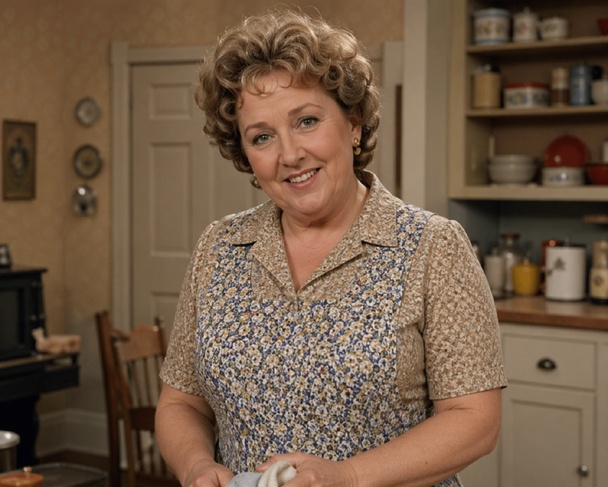
Complete DIY Edith Bunker Costume inspired by Jean Stapleton in Norman Lear's All in the Family featuring polyester house dress, floral smock apron, clip on earrings
The smock apron is the heart of the DIY Edith Bunker Costume, and it should be treated as the primary detail rather than an accessory, as it is central to the character's visual identity. Edith wore her smock apron the way other people wear a personality, constantly and without thinking about it, because she was always cooking or cleaning or setting the table or doing something for someone and the apron was the physical evidence of that perpetual useful motion.
The cobbler smock apron, the style that goes over both shoulders and provides coverage at the front and back rather than simply tying around the waist, is what you are looking for and thrift stores are where you will find it. Check the housewares and kitchen sections rather than the clothing racks because these aprons are often sorted with kitchen items rather than garments. The print should be floral, the kind of cheerful busy floral that appeared on every kitchen apron in America from approximately 1955 through 1980, in colors that do not necessarily match the dress underneath because Edith was not coordinating her apron with her outfit. She was cooking dinner. The apron was clean and it was there and that was sufficient.
Craft stores carry new smock aprons in floral prints at minimal cost if the thrift store search comes up empty, and they are worth the small investment because the apron transforms the entire costume in a way that is difficult to achieve through any other single piece. Without it the dress reads as a vintage costume. With it the dress reads as Edith Bunker, a specific and immediately recognizable human being, which is the difference between a costume and a character.
The dress and apron combination together tell the complete story of where Edith spent most of her time and what she was doing there, and the details of the character that emerge from that domestic landscape, the warmth, the competence, the endless patient service, the quiet strength, are all contained in that simple layered image of a woman in a printed house dress with a floral smock apron over it moving through a kitchen that she ran completely.
💄 Step 3: Makeup & Hair
The makeup for the DIY Edith Bunker Costume is minimal by both necessity and deliberate choice, and that simplicity is itself worth noting. Edith Bunker was not a woman who spent time in front of a makeup mirror. She was a woman who had things to do and people to feed and a husband whose chair needed to have the television remote within reach and a son in law whose political views required regular patience and a daughter whose happiness mattered more than anything else in the world. Makeup was not a priority and the face should reflect that honestly rather than apologetically.
A light even base in a warm neutral tone is all the foundation this costume requires. Nothing that looks applied, nothing that looks deliberate, the kind of skin that simply looks like the face of a woman who washed it this morning and did not think about it again. A very light warm blush on the cheeks, blended thoroughly so it reads as color rather than product, is both period accurate and practically useful for photographs. No eye makeup beyond perhaps a single coat of brown mascara on the upper lashes, the kind of minimal effort that represents the outer boundary of Edith's daily beauty routine. No liner, no shadow, nothing that draws attention to the eyes in a theatrical way.
Lip color should be a soft neutral pink or barely there coral, the kind of lipstick that was applied quickly in the bathroom mirror before company arrived rather than carefully in front of a lighted vanity. A balm or tinted moisturizer rather than a proper lipstick finish is correct. The overall impression should be a woman who looks exactly like herself, which in Edith's case was warm and open and completely genuine, a face that invited confidence rather than admiration.
The hair is one of the most recognizable elements of the character and Jean Stapleton wore it in a specific style throughout the run of the show that is both period accurate to early 1970s middle aged domestic women's fashion and entirely achievable at home without professional assistance. Edith's hair was a short to medium length set style, the kind of hair that was washed and set on rollers or with a hood dryer and then combed out into a soft wave or curl that held its shape for several days at a time. It was not a glamorous style. It was a practical one, the hair of a woman who went to the beauty parlor every two weeks because that was what women of her generation and her neighborhood did, and who maintained the set between appointments with a few carefully placed pin curls at night.
To approximate this style, work with whatever natural texture your hair has and encourage it toward a soft wave rather than fighting it toward anything precise. If your hair is straight, a set of medium sized rollers worn for an hour on slightly damp hair and combed out gently after removal gives you the soft wave volume that reads as the era immediately. If your hair has natural wave or curl, a light smoothing with a brush while blow drying on medium heat followed by finger shaping into the soft rounded style is sufficient. The finished style should sit close to the head with a gentle wave or soft curl, no height at the crown, no dramatic volume, the hair of a woman who values neatness over fashion and achieves it reliably without fuss.
A light mist of firm-hold hairspray, the kind commonly found in early 1970s bathrooms, sets the style and keeps it in place through an active evening.
The brown plastic reading glasses are the final detail of this section and they belong here because they are as much a hair and face detail as an accessory. A pair of thick framed brown plastic reading glasses, the drugstore variety with the lenses popped out for comfort, worn low on the nose and removed and replaced with the specific distracted efficiency of someone who only puts them on when they actually need them, is the detail that makes All in the Family viewers do a double take. They go on when Edith sits down at the piano. They come off when she gets up to answer the door or respond to something Archie has said that requires her full attention. That on and off quality is part of the performance and it is worth practicing before the evening begins.
🎀 Step 4: Accessories
The accessories for the DIY Edith Bunker Costume are few and each one is chosen with the same practical logic that governed every aspect of Edith's approach to her own appearance. She was not a woman who thought about accessories. She was a woman who owned a few things and wore them when the occasion called for them and put them away again when it did not.
The smock apron is covered thoroughly in the details section and remains the primary identifying accessory of the entire costume, worn consistently throughout the evening because Edith was consistently in the kitchen or moving between the kitchen and the living room with something in her hands. Keep it on. Take it off only if the evening moves to a context where Edith herself would have taken it off, which is to say almost never.
The clip on earrings for going out are the detail that completes the dressed up version of Edith, the woman who put herself together for church or a visit or an occasion that required something beyond the everyday domestic presentation. They should be simple and small, a button or small dome style in gold tone or pearl, the kind of earring that was considered appropriate and modest and required no further thought. Thrift store jewelry cases are loaded with exactly these and they cost almost nothing. Clip-ons rather than pierced because Edith's generation frequently did not have pierced ears and the clip-on is itself a period specific detail that adds authenticity without effort.
A simple structured handbag in a neutral brown or tan, carried on the arm rather than the shoulder, is the going out accessory that completes the picture when Edith leaves the house. The kind of bag that was bought to last and has lasted, with a simple clasp closure and no decorative detail. Thrift stores carry these in abundance and the right one announces itself immediately when you find it.
A dish towel tucked into the apron strings or carried in one hand is the prop that completes the domestic picture and gives the hands something to do throughout the evening. Edith almost always had something in her hands and a dish towel is both period accurate and practically useful as a prop for the kind of warm bustling physical energy that defined the character's movement through every space she occupied.
🕺 Step 5: Movement and Presence
Edith Bunker's physical presence is one of the most distinct and rewarding in American television to study, as Jean Stapleton built it from choices that appear simple but are remarkably precise. Edith moved through the world with a specific quality of warm purposeful energy that was never hurried exactly but was always in motion, always oriented toward something that needed doing or someone who needed something.
The walk is the starting point and it is worth practicing. Edith had a slightly forward leaning gait, the posture of someone perpetually on their way to do something useful, with small quick steps and arms that moved naturally at her sides or were occupied with whatever she was carrying. It was the walk of a woman who covered a lot of ground in a small house over the course of a day and had developed an efficient relationship with movement as a result.
The hands are almost never empty and almost never still. Edith's hands were the physical expression of her character's essential nature, always doing something, always oriented toward usefulness, always in service of someone else's comfort or need. A dish towel, a plate, a cup, the smock apron strings being untied and retied, these are all available to you as physical business throughout the evening and they communicate the character instantly to anyone watching.
The voice is the element that most people reach for first and it is worth a careful note. Edith's voice was high and slightly breathy and had a specific Queens inflection that Stapleton developed with great precision, but the voice alone without the warmth underneath it becomes caricature immediately. What made Edith's voice work was that it carried genuine feeling in every register, the excitement, the confusion, the patient explanation, the occasional quietly devastating observation that arrived without warning and landed with complete accuracy. A reasonable approximation of the vocal quality is more than enough. What matters more is the warmth and the sincerity that the voice was always carrying.
The moment worth practicing is the Edith pause, the specific beat that Stapleton used before delivering a line that reframed everything that had just been said. Archie would finish a pronouncement and there would be a half second of Edith processing it with complete genuine attention and then she would say something that was either entirely beside the point or precisely the point in a way nobody expected, and the timing of that pause was everything. It is available to you all evening and it will produce genuine laughter from anyone who knows the show.
For the couples dynamic with Archie, everything discussed in the Archie Bunker article about their physical relationship applies here from Edith's perspective. He talks. She listens with complete genuine attention. She responds at the moment of her own choosing. She is almost always right. He almost knows it. That dynamic photographed together, his forward bluster and her patient warmth, is the complete story of one of television's great marriages in a single frame.
📸 Step 6: Capture the Moment
The photography guidance for the DIY Edith Bunker Costume follows the same domestic interior logic as the Archie Bunker article, since both inhabit the same visual world and are best photographed in similar settings. The Bunker living room and kitchen at 704 Hauser Street in Queens were deliberately ordinary spaces and almost any lived-in domestic interior replicates their register with minimal adjustment.
The essential photograph for Edith is in the kitchen or in motion between the kitchen and the living room, apron on, something in her hands, the expression of warm purposeful engagement that defined the character in motion. Natural window light in a kitchen setting is both practically available and visually correct, the kind of warm domestic light that the show's interior photography captured in its best moments. Shoot at eye level with the standard lens and allow the domestic environment to be visible in the background rather than shooting against a blank wall, because context matters for this costume in a way that it does not for every other entry in this catalog.
The piano shot is the optional photograph that rewards the effort of setting it up if a piano is available anywhere near the event. Edith seated at the piano with the brown plastic reading glasses on, hands on the keys, the expression of someone about to play something she genuinely loves, is the opening credits image that every viewer of the show carries in their memory and it produces an immediate and deeply satisfying recognition response in anyone who sees it.
For the couples photograph, the kitchen or living room transition is the ideal setting with Edith slightly in motion toward the kitchen and Archie settled in his chair in the background. That spatial relationship, her movement and his stillness, her orientation toward usefulness and his orientation toward comfort, is the physical language of their entire marriage and it reads in a photograph the way it read on screen, with affection and humor and the specific warmth of two people who have been doing this together for a very long time.
Edit with the same warm indoor tones recommended for the Archie Bunker article, slightly increased contrast, nothing bright or aspirational. The Bunker household was warm and lived in and the photographs should feel exactly that way.
🏆 Why Go DIY?
The DIY Edith Bunker Costume matters because Jean Stapleton's performance matters, and because Edith Bunker represents something in American television worth celebrating. She was a woman written to appear as background and played as foreground by an actress who understood completely what she had been given and honored it with nine seasons of precise, warm, deeply intelligent work. The Emmy voters recognized it three times. The audiences recognized it every week for five years of top rated television. The cultural conversation around the show has spent fifty years recognizing Archie's complexity while Edith's equal and opposite complexity waited patiently for its due, which is itself the most Edith thing imaginable.
Building this costume from a thrift store house dress and a floral smock apron is an act of genuine creative economy that Edith herself would have appreciated. She was a woman who made things work with what was available, who found sufficiency in simplicity, who understood that the value of a thing had nothing to do with what it cost. The entire costume can be assembled for under fifteen dollars at any Goodwill in America and it will be more immediately recognizable and more culturally resonant than costumes that cost fifty times as much, which is both a testament to the power of the character and a practical argument for the thrift store as a costume resource.
Together with the DIY Archie Bunker Costume, this ensemble achieves something that very few couples costumes manage, a complete and fully realized portrait of a marriage, with all of its friction and tenderness and daily negotiation and underlying love, told entirely through clothing and presence and the specific physical dynamic of two people who have been doing this together for decades. Norman Lear put that marriage on television because he believed American audiences were ready to see themselves reflected honestly and he was right. Wearing it for an evening is a way of acknowledging that he was right and that what Stapleton and O'Connor built together in that Queens living room was something that has earned its place in the permanent record of American culture.
Put on the apron. Find the reading glasses. Set the table for people who will not always say thank you. Be the smartest person in the room about it. That is Edith Bunker and it is more than enough.
🕸️ Related Costumes to Try
DIY Jeannie Costume
DIY Lovey Howell Costume
DIY Holly Golightly Costume
DIY Jane Eyre Costume
Further Reading & Resources
📖 Read: Edith’s Best and Funniest Moments from All In The Family
🔍 More: Edith Bunker - Wikipedia
ML Lamp is the owner of Kilroy Was Here. After his 20 years of working in Las Vegas in the entertainment promotions field, Mr. Lamp retired in 2002 from his job to pursue his passion for collectibles. Now as a guest speaker and author he’s living the dream, and sharing his warmth with You.