Incredible Shrinking Man Special Effects: The Movie
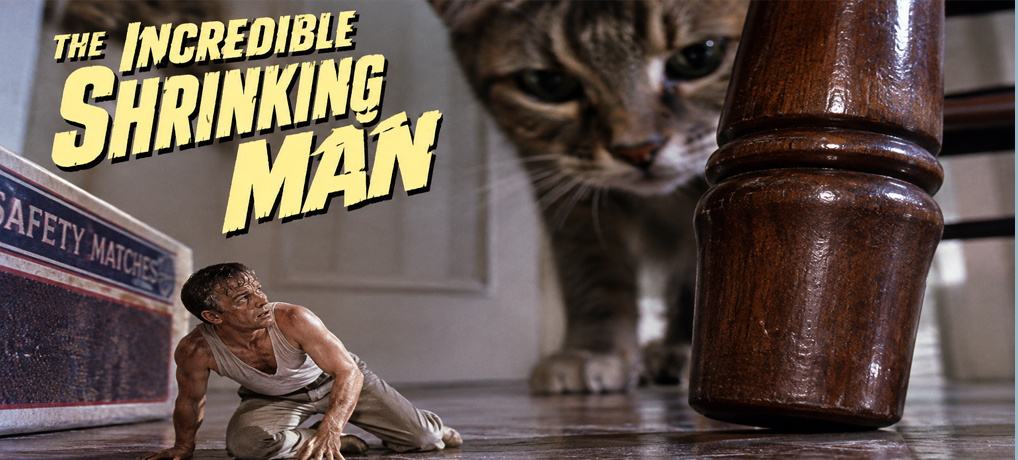
The Incredible Shrinking Man special effects turned ordinary furniture, household objects, and a family cat into enormous threats through clever scale and practical effects.
A house cat in a doorway. For the man standing across the room, it might as well be a lion. A basement staircase becomes a cliff. A single drop of water, falling from a leaking pipe, becomes a flood. It's capable of sweeping a man off his feet. This is the world Scott Carey inhabits in The Incredible Shrinking Man. It's the 1957 Universal-International release built around one deceptively problem. How do you convince an audience that an ordinary man is shrinking, day by day, until his own living room becomes a wilderness he cannot survive. Incredible Shrinking Man special effects remain some of the most resourceful practical work to come out of 1950s science fiction.
This article looks at how those effects were constructed, who built them, and why they still hold up nearly seventy years later.
Making a Man Only Six Inches Tall
The challenge facing Universal's effects department was straightforward to describe. It was enormously difficult to solve. A single actor, Grant Williams, needed to appear to shrink continuously across the film. He went from ordinary height down to a few inches tall. Meanwhile, he still had to interact believably with a world that stayed exactly the same size around him. Universal's technicians reportedly spent roughly eight months developing new photographic processes before filming even began.
Production was reportedly delayed twice while those techniques were worked out. Once shooting started, the set was closed to anyone not directly connected with the production. Cast and crew were required to carry special passes just to gain access. That level of secrecy reflected how much the studio was banking on the effects actually working.
Incredible Shrinking Man Special Effects: The Crew Behind the Illusion
Much of the credited effects work fell to cinematographer Clifford Stine. He received the screen credit "special photography" for his work on rear projection and process photography. Stine had built a career handling exactly this kind of optical problem for Universal. His job on this film was to project pre-filmed background footage behind Grant Williams during live shooting.
That let the actor perform in front of a world already captured at a different scale. Working alongside him were Roswell A. Hoffmann and Everett H. Broussard. Hoffmann specialized in composite optical work and had trained under Universal's earlier effects veteran John Fulton. Broussard was part of the same effects unit. So many of the film's shots combined multiple photographic elements into a single frame. Because of that, sorting out which technician handled which specific effect has always been difficult, even for film historians.
Oversized Props and the Giant Sewing Pin
The most visible tool in the film's arsenal was simple in concept. Build the world enormous, and let an ordinary sized actor look small standing next to it. Furniture, clothing, and household objects were constructed at several times their normal scale. Some of the film's most memorable inch-high sequences were shot using nothing but these giant props, no optical trickery required at all.
The best known example is the twelve-foot-long sewing pin Scott wields as a spear during his climactic fight with the basement spider. It was built at true giant scale so Williams could physically wield it on camera. A mousetrap, a matchbook, and a spool of thread all received the same oversized treatment. That gave the household hazards Scott faces real, touchable weight rather than an effect added afterward.
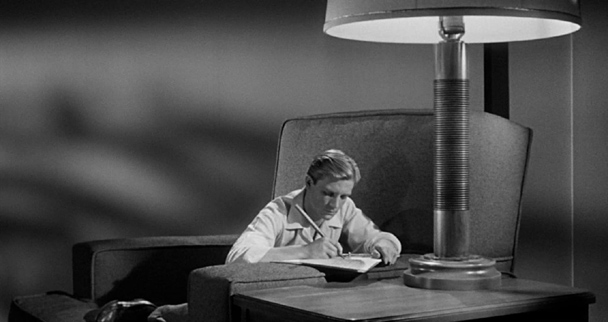
Oversized props were essential to The Incredible Shrinking Man special effects, making ordinary household objects tower over Scott Carey as he continued to shrink.
Building the Dollhouse and the Giant Basement Set
Entire environments had to be rebuilt at enlarged scale as well. The dollhouse where Scott takes shelter partway through the film was constructed to oversized specifications on one of Universal's largest sound stages. That same stage had previously housed the giant opera house sets built decades earlier for The Phantom of the Opera. The basement sequence, filmed near the end of the story once Scott has shrunk past the size of an ordinary insect, used its own greatly enlarged set.
It gave Williams room to climb, crawl, and run through a space built specifically to dwarf him. These full-scale, walkable environments let Williams perform real physical action rather than simply reacting to something added in post-production. That physical grounding is a large part of why the illusion still convinces audiences today.
Black Velvet Photography and the Roots of Green Screen
Before blue screen or green screen existed in anything like their modern form, Universal's effects crew relied on black velvet trick photography. This isolated Grant Williams from his background. Scenes such as Scott's encounter with the strange mist aboard his brother's boat were filmed with Williams positioned against a black velvet backdrop. That allowed the footage of the actor to be cleanly combined with separately filmed background plates during compositing. It is effectively the direct ancestor of the chroma key techniques used throughout modern film and video production. It solves the same basic problem, isolating a foreground subject so it can be placed convincingly into a different scene, using only the tools available in 1956.
Split-Screen and Rear Projection Working Together
Split screen photography allowed the crew to combine two separately filmed elements, an ordinary sized environment and a reduced-scale Scott, within a single frame. They did this by masking off portions of the film during exposure. That let footage shot at different scales occupy the same image without visibly overlapping. Some of Scott's scenes with his wife were filmed this way. The two actors were shot separately, from different distances and set scales, and the resulting footage was spliced together to sell the size difference.
Rear projection, Stine's specialty, solved a related but distinct problem. It let Williams perform live in front of previously filmed footage projected onto a screen behind him. This was especially useful for placing Scott convincingly into exterior or full sized settings that would have been too costly to rebuild as physical oversized sets.
Grant Williams and the Physical Cost of the Performance
None of these techniques would have worked without an actor willing to sell them physically. Grant Williams paid a real price for that commitment. Production records and later interviews describe him picking up blisters, scratches, and at least one deep leg wound. These came from climbing through the film's oversized sets. He also suffered eye irritation serious enough to require two separate hospital visits, all within less than two weeks of shooting the giant-prop sequences. That hands-on physical toll is a major reason Incredible Shrinking Man special effects still feel convincing. The danger reads as genuine because, to a real extent, it was.
The Cat Became a Monster
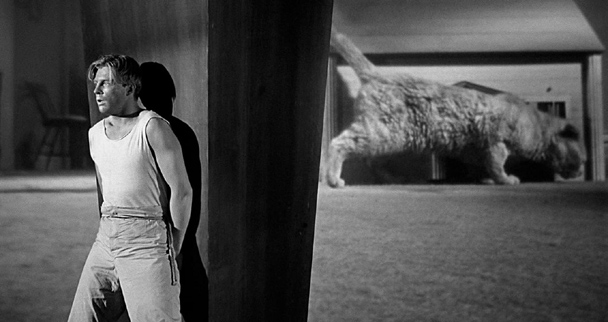
The Incredible Shrinking Man special effects transformed an ordinary house cat into a terrifying predator as the shrinking Scott Carey searched for a place to hide.
One of the film's most effective sequences turns the family's pet cat, named Butch in the story, into a genuine predator. It uses little more than camera placement and editing to do it. The cat was played primarily by a Hollywood animal actor known as Orangey, a prolific feline performer who appeared in hundreds of films across his career. Closely matched cats can be difficult to direct on cue, so the production reportedly used roughly twenty nearly identical cats across the sequence to get the shots it needed.
To keep Grant Williams's frightened reactions properly timed against footage of the cat, which was often filmed separately, director Jack Arnold used a metronome on set. It gave Williams a steady beat to react against, so his fear would line up convincingly once the two elements were edited together.
The Basement Spider Showdown
That same technique, careful timing between separately filmed elements, reaches its fullest expression in the film's famous basement spider sequence. By this point in the story, Scott has been reduced to a fraction of an inch. The basement, an unremarkable space under ordinary circumstances, becomes a sprawling and genuinely hostile wilderness. It was built at oversized scale specifically for this sequence. The spider was composited against footage of Williams using the same synchronized timing techniques used for the cat scenes.
The giant sewing pin gave Williams an actual weapon to physically use rather than simply mime. The sequence ties together nearly every technique in the film's toolkit. Oversized sets, composite photography, and Williams's committed physical performance combine into the film's most enduring set piece.
Solving the Giant Water Drop Problem
Not every effect came from careful engineering. According to Jack Arnold's own account, the production struggled to create a convincing giant drop of water for a scene involving a leaking pipe in the basement. The solution came from an unusual source. Arnold recalled that as a child he had once mistaken condoms for balloons and filled them with water. The same trick was used here.
The effects crew ordered roughly a hundred gross of them and rigged them on a treadmill so they could be dropped on cue to look like a bursting pipe. It is a small, almost accidental piece of engineering next to the film's more elaborate composite work. It is a good reminder that practical effects work often came down to whatever solved the problem in front of the crew, however improvised the answer turned out to be.
Behind the Camera: Jack Arnold and Richard Matheson
Director Jack Arnold was already known at Universal for genre pictures like Creature from the Black Lagoon and Tarantula. He brought a steady visual sense to a film that could easily have become a simple novelty built entirely around its effects. The screenplay was based on Richard Matheson's own novel, published around the same time as the film's production. Matheson was credited on the script alongside Richard Alan Simmons, who reworked Matheson's original flashback structure into a more conventional chronological narrative.
Producer Albert Zugsmith had originally hoped to cast Dan O'Herlihy in the lead role. O'Herlihy turned it down after recently playing another isolated character in Robinson Crusoe, not wanting to be typecast. That opened the role for Grant Williams instead. By Arnold's own later account, he had to fight the studio to keep the film's unusual, downbeat ending intact. He said it was the one genuine dispute he had with Universal on the entire production, a fight he ultimately won after the ending tested well with preview audiences.
More Than a 1950s Creature Feature
What ultimately separates The Incredible Shrinking Man from most other effects-driven films of its era is what it does with all that technical inventiveness once the tricks are in place. As Scott shrinks past the point where any rescue seems possible, the film shifts from survival thriller into something closer to philosophical meditation. It closes on a lengthy interior monologue in which Scott comes to see his shrinking not as an ending but as a different way of existing. He finds himself within a universe far larger and stranger than he had ever considered.
That closing passage is widely regarded as the reason the film outlasted most of its contemporaries. It gives its technical achievements genuine emotional and philosophical weight rather than leaving them as spectacle for its own sake. The film's place in film history was later formalized when it was selected for preservation in the National Film Registry by the Library of Congress, as a work of cultural, historical, and aesthetic significance.
The Incredible Shrinking Man – The Criterion Collection
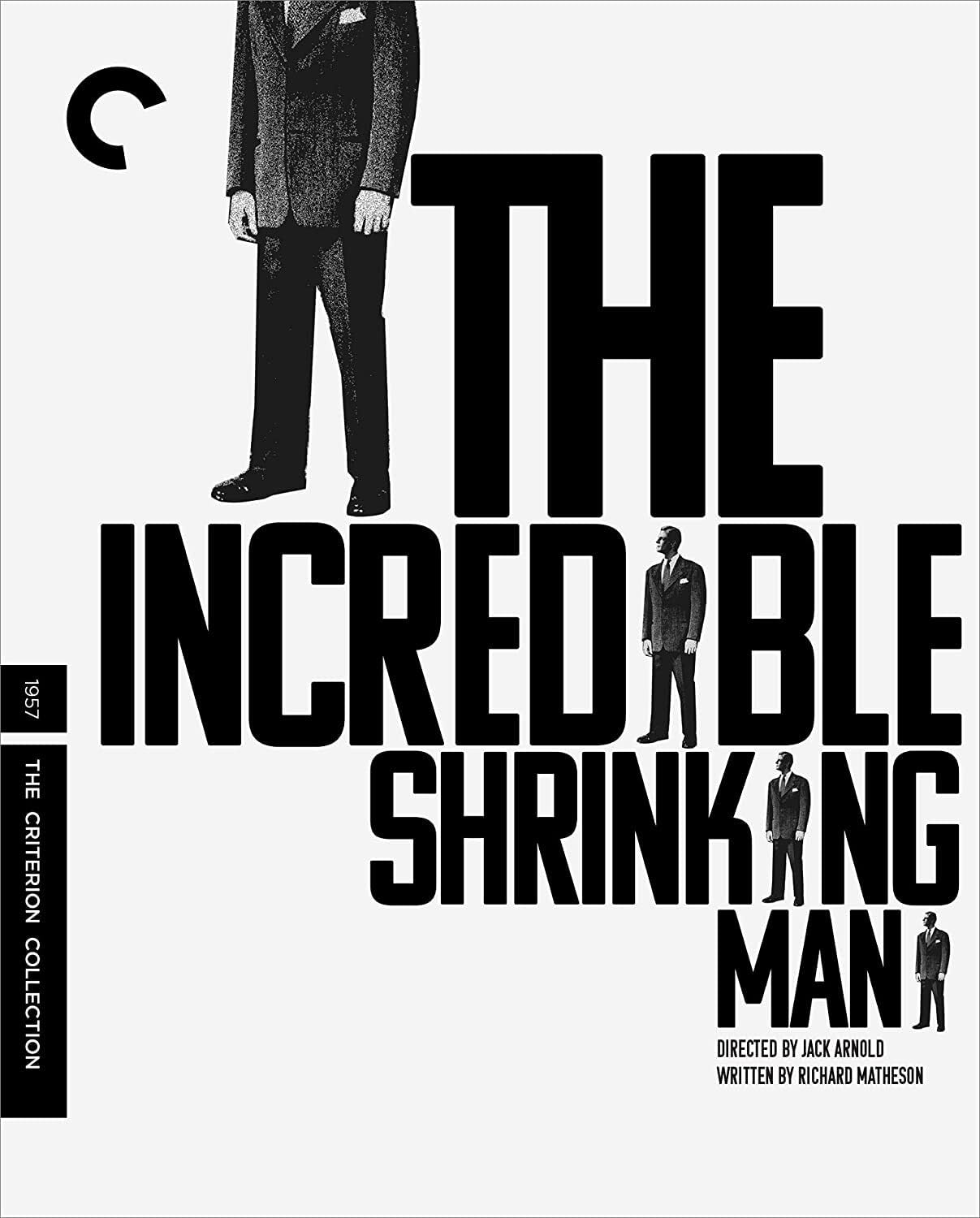
The Incredible Shrinking Man Criterion Collection Blu-ray explores the movie's groundbreaking special effects
Product Description:
If our look at Incredible Shrinking Man special effects made you wonder how filmmakers turned ordinary furniture, household objects, a house cat, and even a spider into gigantic threats, this Criterion Collection Blu-ray belongs on your shelf. Jack Arnold's 1957 science-fiction classic stars Grant Williams as Scott Carey, a man who begins mysteriously shrinking after exposure to a radioactive cloud. The filmmakers combined oversized sets and props with ingenious optical techniques to create one of the most convincing effects films of the 1950s.
Key Features:
• New 4K digital restoration with uncompressed monaural soundtrack
• Special program devoted to the film's effects with Craig Barron and Ben Burtt
• Audio commentary with genre-film historian Tom Weaver and David Schecter
• Interviews and programs featuring Jack Arnold, Richard Christian Matheson, Joe Dante, and Dana Gould
• Includes the 1969 8 mm home-cinema version, trailers, teaser narrated by Orson Welles, booklet essay, and additional archival material
Why This Works:
For anyone interested in Incredible Shrinking Man special effects, the real attraction of this edition is Criterion's dedicated examination of how the illusions were created. After seeing Scott surrounded by gigantic furniture and battling everyday objects that suddenly dwarf him, you can go behind the scenes with effects experts Craig Barron and Ben Burtt to understand how those shots worked. It makes this Blu-ray both a great horror and science-fiction collectible and a fascinating companion to our article about creating convincing scale with practical props and camera tricks.
Buy on Amazon
Why It Still Matters
- Nearly every effect was built physically, through oversized props, enlarged sets, and in-camera compositing, rather than added afterward.
- Clifford Stine, Roswell A. Hoffmann, and Everett H. Broussard solved distinct problems, rear projection, composite optical work, and general effects support, that together built the illusion.
- Grant Williams physically performed within giant sets and paid a real physical price doing it.
- A metronome, of all things, helped keep the cat and spider sequences believably synchronized.
- Even the giant water drop effect came from improvisation rather than elaborate engineering.
- Jack Arnold fought to protect the film's philosophical ending, and that fight is a large part of why the film is still remembered.
Final Thoughts
Picture Scott Carey one final time, standing in a basement that now stretches out around him like an entire continent, a giant sewing pin in his hands, a spider somewhere nearby. Every part of that image, the oversized prop, the enlarged set, the carefully timed composite photography, was built by a small Universal crew in 1956. They had no digital shortcuts available. In at least one case, they relied on a bag of water-filled condoms standing in for expensive engineering.
Incredible Shrinking Man special effects proved that a convincing illusion of scale does not require impossible technology. It requires patient, resourceful problem solving and an actor willing to climb through giant sets and get hurt doing it. The film remains proof that practical ingenuity, paired with a story willing to ask bigger questions once the tricks are done, can outlast almost any special effect built after it.
Further Reading & Resources
📺 See: The Incredible Shrinking Man (1957) - The Movie Database (TMDB)
🔍 The Incredible Shrinking Man (1957) - Letterboxd

ML Lamp is the owner of Kilroy Was Here. After his 20 years of working in Las Vegas in the entertainment promotions field, Mr. Lamp retired in 2002 from his job to pursue his passion for collectibles. Now as a guest speaker and author he’s living the dream, and sharing his warmth with You.