The House That Dripped Blood Review: A Wicked Amicus Horror Classic
My Rating: ⭐ ⭐ ⭐ ⭐ ⭐ 4.7/5
Some houses have a past. This one has four. The House That Dripped Blood review starts with a simple question. What happens to the people who rent a lovely old country house that nobody seems to keep for long? Amicus Productions answered that question in 1971 with a wicked little anthology. It boasts a cast that reads like a horror hall of fame, including Peter Cushing, Christopher Lee, Jon Pertwee, and Ingrid Pitt.
The House That Dripped Blood Review
The House That Dripped Blood opened in Britain on February 21, 1971, and reached American theaters that April. It was directed by Peter Duffell, making his feature film debut. The stories came from Robert Bloch, the author of the novel that became Alfred Hitchcock's Psycho, with uncredited help from writer Russ Jones.
The setup is wonderfully simple. A famous horror film actor has vanished. Inspector Holloway of Scotland Yard arrives in a quiet English village to find out what happened. His search leads him to the house the actor had been renting, and to a local estate agent who knows far too much about the place.
As Holloway digs, he learns that previous tenants have met strange fates of their own. Each one becomes a tale, and each tale becomes a small nightmare. The house sits at the center of all of them, calm and handsome and quietly guilty.
First, a confession about the title. There is almost no blood in this movie. Duffell never liked the name. He wanted to call it Death and the Maiden, but producer Milton Subotsky chose the more lurid title for the posters. In the United States the film carried a PG rating, which tells you everything about its approach.
That restraint is the point of this The House That Dripped Blood review. The film is not a gore show. It is a polished, spooky, often playful collection of stories told with British manners and a wicked grin.
Four Nightmares Under One Roof
Anthology films live or die on variety, and this one serves up four very different flavors. Each segment introduces a new tenant, a new problem, and a new kind of fear. The framing story with Inspector Holloway ties them together.
The first tale, Method for Murder, stars Denholm Elliott as a horror novelist. He moves into the house with his wife to write in peace. Soon he starts seeing the strangler he has created on the page. It is a tight psychological story about a writer who may be losing his grip.
The second, Waxworks, belongs to Peter Cushing. It is quiet, sad, and quietly unsettling. The third, Sweets to the Sweet, gives Christopher Lee a cold, troubling role as a widowed father. The fourth, The Cloak, closes the film on a lighter note with Jon Pertwee and Ingrid Pitt.
The stories never cross over. The house is the only thing they share. That gives the film the feel of a stack of old horror paperbacks, each with its own cover and its own sting in the tail.
The endings are the payoff, so they stay secret here. It is worth knowing, though, that the original American poster gave away three of the twists at once. Collectors who own that one sheet own a famous spoiler in poster form.
Peter Cushing and the Wax Museum
Peter Cushing plays Philip Grayson, a retired stockbroker who moves to the house for some peace and quiet. He wants music, books, and a gentle walk into town. Instead, he wanders into a small wax museum and stops cold in front of one figure.
The waxwork is Salome, and her face looks exactly like a woman Grayson once loved and lost. He cannot stop thinking about her. Before long, an old friend played by Joss Ackland arrives for a visit and finds himself drawn to the same figure.
This is the most melancholy story in the film. It is less about scares than about longing, loneliness, and the danger of living in the past. Duffell shoots it with soft light and long silences. The wax museum itself is wonderfully creepy, with stiff figures staring out from the shadows.
Cushing gives the segment real weight. His wife Helen was gravely ill during this period, and he would lose her early in 1971. Knowing that, his portrait of a gentle man haunted by a lost love becomes hard to watch without a lump in the throat.
Some viewers find the wax effects a bit dated, and they are. It hardly matters. Cushing and Ackland play every moment completely straight, and their sincerity carries the story home.
Christopher Lee Gets a Very Strange Daughter
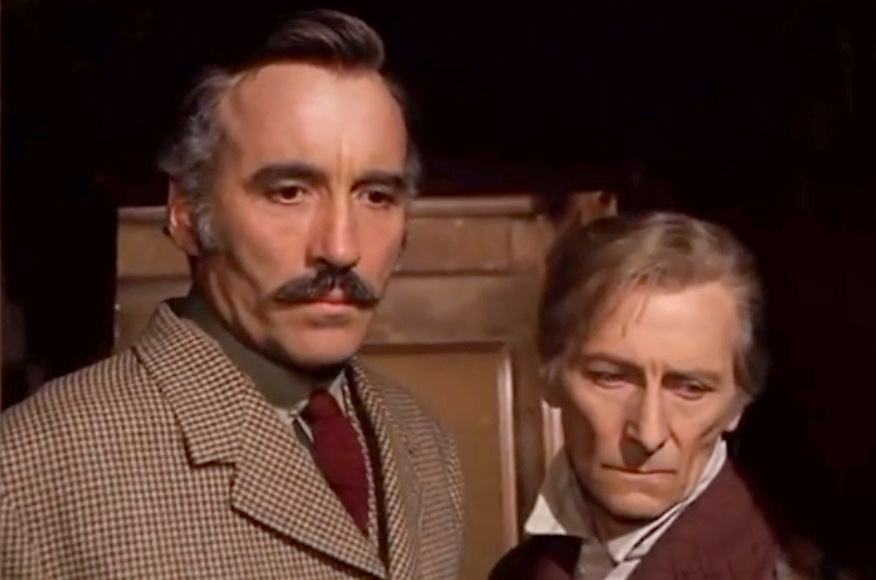
The third story is the darkest of the four. Christopher Lee plays John Reid, a stern widower who moves into the house with his young daughter, Jane. He hires a kind, patient nanny, played by Nyree Dawn Porter, to look after the girl.
Something is clearly wrong in this household. Reid will not let Jane have dolls or ordinary toys. He keeps her away from other children and treats her with icy suspicion. At first, the nanny assumes he is simply a cold and cruel father.
The story slowly turns that assumption on its head. It becomes a tale of witchcraft, fear, and secrets hidden behind good manners. Chloe Franks is excellent as Jane, sweet on the surface and deeply unnerving underneath.
Lee is unusually restrained here. There are no fangs, no cape, and no thundering villainy. He plays a frightened man pretending to be in control, and that tension drives the whole segment. It is one of his most interesting performances of the period.
Collectors love one tiny detail in this story. Lee is shown reading The Lord of the Rings, his favorite book. Three decades later he would appear in Peter Jackson's film adaptation as the wizard Saruman.
This segment is often called the best of the four, and it is easy to see why. It has the strongest sense of dread and the cruelest ending.
Jon Pertwee Finally Gets to Be the Vampire
The final story brings back the missing actor at the center of the mystery. Jon Pertwee plays Paul Henderson, a vain horror movie star who rents the house while filming a vampire picture. He is fussy, pompous, and very unhappy with his cheap costume.
So Henderson goes shopping. In a strange little costume shop, he buys an old black cloak that looks far more authentic. The shopkeeper, played by Geoffrey Bayldon, seems a bit too pleased to let it go. Once Henderson puts it on, odd things start to happen.
Ingrid Pitt plays Carla, his glamorous co star. Pitt was already a horror favorite after Hammer's The Vampire Lovers and Countess Dracula. She brings warmth, mischief, and genuine menace to the role.
Pertwee was playing Doctor Who on BBC television at the time, and he clearly has a ball here. His actor complains about modern horror films and how they have lost their class. It is a sly joke inside a horror film that was openly poking fun at its own genre.
This segment is played more for laughs than shivers, and some fans call it a misstep. I disagree. After the cold cruelty of the Lee story, a dose of comedy is welcome. It also gives the framing story a clever final turn.
The Amicus Alternative to Hammer Horror
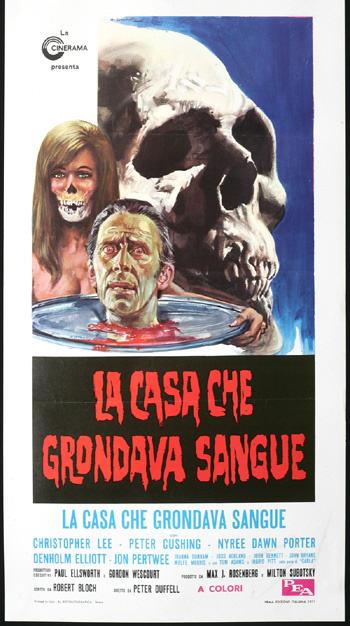
In the 1960s and 1970s, British horror meant Hammer Films to most moviegoers. Hammer specialized in lush gothic period pieces full of Draculas, Frankensteins, and heaving castles. It owned that territory, and everyone knew it.
Amicus Productions took a different road. The company was run by two Americans, Milton Subotsky and Max Rosenberg. They worked on tighter budgets and chose a format that suited them perfectly, the horror anthology.
Their run of portmanteau films began with Dr. Terror's House of Horrors in the mid 1960s and continued with Torture Garden in 1967. After The House That Dripped Blood came Tales from the Crypt and Asylum in 1972, Vault of Horror in 1973, and From Beyond the Grave in 1974.
The anthology approach had real advantages. A big name actor could film one segment in just a few days. That meant Amicus could fill its posters with stars like Cushing and Lee without paying for weeks of their time. The budget for this film was only about £208,000.
Amicus also tended to set its stories in the modern world. Instead of Transylvanian castles, you get cozy English villages, country cottages, and rented houses. The horror arrives in places that feel familiar, which can make it even more unsettling.
Amicus borrowed Hammer's stars, but it never simply copied Hammer's style. It found its own voice, and The House That Dripped Blood is one of the clearest examples of that voice.
Why the House Works
The house in this movie is not a crumbling gothic ruin. It is a handsome, ordinary looking country home with neat gardens and comfortable rooms. You could imagine a family moving in without a second thought.
That ordinariness is its secret weapon. The house never needs to drip blood or howl in the night. It simply waits. Each new tenant arrives hopeful, and each one brings their own weaknesses through the front door.
The estate agent, A.J. Stoker, puts it best in his own way. He suggests the house reflects the personality of whoever lives there. A writer gets a writer's nightmare. A lonely man gets a lonely man's obsession. A frightened father gets exactly what he fears.
That idea gives the film a surprising unity. The stories are unrelated, yet they feel connected by the same patient intelligence. The house becomes a kind of character, almost a judge, quietly delivering a sentence to each guest.
Some critics argue the house barely matters in some segments, especially the wax museum tale. That is fair. Still, the framing story keeps returning to its doorstep, and by the end its reputation is firmly established.
Why Watch The House That Dripped Blood Today?
The cast alone is reason enough. Few horror films can offer Peter Cushing, Christopher Lee, Ingrid Pitt, Jon Pertwee, and Denholm Elliott in a single package. Cushing and Lee never share a scene, but each gets a full story to shine.
The atmosphere holds up well too. Duffell came from television, and he keeps every segment brisk and clean. Nothing overstays its welcome. Each tale runs roughly twenty minutes, which makes the film easy to enjoy in one sitting.
The anthology format also suits modern viewing habits. If one segment does not grab you, another is only a few minutes away. It feels a bit like watching four episodes of a classic horror series, with a mystery tying them together.
Most importantly, it is fun. This The House That Dripped Blood review keeps coming back to that word. It is spooky without being cruel, clever without being smug, and playful without losing its bite. It makes a perfect choice for an October night with friends or family.
Younger viewers who have only seen modern horror may be surprised by how much the film gets from so little. A wax face, a forbidden doll, and an old black cloak do more work here than gallons of fake blood ever could.
The House That Dripped Blood Blu-ray
Collectors have good choices for this one. In the United States, Scream Factory released the film on Blu-ray for the first time on May 8, 2018. The picture quality was a major leap over the older DVD releases.
The Scream Factory disc is loaded with extras. It includes a new commentary by film historian Troy Howarth and an older commentary with Peter Duffell and author Jonathan Rigby. There is also a new interview with second assistant director Mike Higgins.
The vintage featurette A Rated Horror Film is another highlight. It includes interviews with Duffell, Geoffrey Bayldon, Ingrid Pitt, and Chloe Franks. Trailers, radio spots, and a still gallery round out the package.
In the United Kingdom, Second Sight Films issued a limited edition Blu-ray in 2019. It came in a rigid slipcase with new artwork by Graham Humphreys and a 40 page booklet. A standard edition followed in January 2020.
Keep regions in mind before you buy. The Scream Factory disc is Region A, while the Second Sight releases are Region B. American collectors will usually want the Scream Factory edition unless they own a region free player.
For serious Amicus fans, the Second Sight limited edition is the prettier shelf piece. For everyday viewing, the Scream Factory disc is excellent and easy to find.
Final Thoughts 4.7/5
This one earns a 4.7 out of 5 from Kilroy. Wrapping up The House That Dripped Blood review, the verdict is clear. Like most anthologies, it is a little uneven, but the uneven parts never sink the ship.
The Christopher Lee segment is chilling. The Cushing story is tender and haunting. Denholm Elliott's opening tale is a smart warm up, and Jon Pertwee's finale sends you home grinning. The house ties it all together with quiet menace.
It loses a few tenths for some dated effects and a framing story that could use a bit more bite. Everything else works beautifully. This is Amicus at its stylish best, and it belongs on the shelf of any classic horror collector.
Turn down the lights, settle into your own comfortable old house, and press play. Just be careful what you bring home from the costume shop.
ML Lamp is the owner of Kilroy Was Here. After his 20 years of working in Las Vegas in the entertainment promotions field, Mr. Lamp retired in 2002 from his job to pursue his passion for collectibles. Now as a guest speaker and author he’s living the dream, and sharing his warmth with You.