🎞️ Son of Frankenstein Review: The Monster Returns for One of Universal’s Best Sequels
My Rating: ⭐ ⭐ ⭐ ⭐ ☆ 4.6/5
This Son of Frankenstein review returns to 1939, when Universal decided the Monster still had one more story in him. Boris Karloff came back for the last time. Basil Rathbone moved into the family castle. Bela Lugosi showed up with a broken neck and a grudge. The result is one of the grandest, strangest, and most entertaining monster movies Universal ever made.
Son of Frankenstein Review: The Frankenstein Monster Wasn’t Finished Yet
By 1939, Universal had already given audiences Frankenstein and Bride of Frankenstein.
Either one could have ended the story.
Universal had another idea.
Bring back the Monster.
Bring back Boris Karloff.
Add Basil Rathbone.
Add Bela Lugosi.
And introduce one of the most memorable characters in the entire Frankenstein series.
His name is Ygor.
Universal Pictures released Son of Frankenstein on January 13, 1939, after preview screenings earlier that month. Rowland V. Lee directed and produced it. It runs 99 minutes. Today it turns up in Universal’s Classic Monsters home video collections.
This Son of Frankenstein review stays spoiler free.
Welcome Back to Castle Frankenstein
Years have passed since the events that made the Frankenstein name infamous.
Now Wolf von Frankenstein, son of Henry Frankenstein, arrives at the family estate with his wife Elsa and their young son Peter.
Josephine Hutchinson plays Elsa, the Baroness who is not thrilled about her new home.
Wolf hasn’t come to create another monster.
At least that’s the plan.
In a Universal horror movie, inheriting the Frankenstein estate is probably the first sign that your plans are about to change.
The household staff fills in the edges. Emma Dunn plays Amelia, the servant. Edgar Norton plays Benson, the butler. Perry Ivins plays Fritz.
Basil Rathbone Is the Son of Frankenstein
Basil Rathbone plays Wolf von Frankenstein.
Most movie fans remember Rathbone as Sherlock Holmes, but he’s perfectly at home inside Universal’s Gothic world.
Fun timing note. His first Holmes picture, The Hound of the Baskervilles, arrived later that same year.
Wolf wants to restore respectability to the Frankenstein family name.
Unfortunately, his father’s laboratory is still there.
So are his father’s secrets.
And somebody else has been waiting among the ruins.
Then Wolf Meets Ygor
Enter Bela Lugosi.
Not as Dracula.
Not as a polished aristocrat.
Not even as the movie’s traditional mad scientist.
Lugosi plays Ygor, a broken-necked grave robber living around the ruins of Frankenstein’s laboratory.
And he nearly steals the entire movie.
Ygor was not even in the first script. He was added during rewrites, and the part kept growing once filming began.
Bela Lugosi Is Fantastic as Ygor
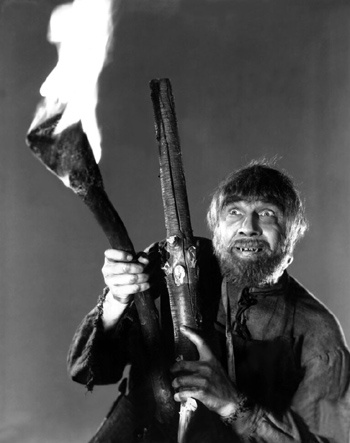
If you only know Bela Lugosi as Dracula, Son of Frankenstein is required viewing.
Ygor is dirty, hunched, manipulative, bitter, and considerably smarter than people assume.
His neck was broken during a hanging.
The hanging didn’t work.
Ygor survived.
He hasn’t forgotten the people responsible.
That’s about all you need to know before watching.
Here’s the backstage twist. Universal cut Lugosi’s salary and planned to use him for about a week. Director Rowland V. Lee kept him on set for the whole shoot instead.
Lee later said Lugosi stole the show. Critics in 1939 agreed and singled out his performance.
Boris Karloff Returns as the Monster
Boris Karloff puts on the Monster’s boots for the third and final time in a feature film.
He had already defined the character in Frankenstein and expanded it in Bride of Frankenstein.
Here the Monster is different again.
He doesn’t dominate the movie through dialogue.
The script rewrites made the Monster mute again. The talking Monster of Bride of Frankenstein was gone.
Instead, Karloff returns to physical performance. Movement, expressions, reactions, and that unmistakable silhouette.
Nobody else wore that makeup quite like Karloff.
This Was Karloff’s Last Frankenstein Monster
That makes Son of Frankenstein particularly important.
Karloff would remain one of horror’s greatest stars, but this was his final feature-film performance as Frankenstein’s Monster.
He felt the character had nowhere left to grow. So he walked away from the role.
Other actors would inherit the role.
The Monster would continue.
But the original Karloff era ends here.
For Universal horror fans, that alone makes the movie essential.
Ygor and the Monster Make a Strange Pair
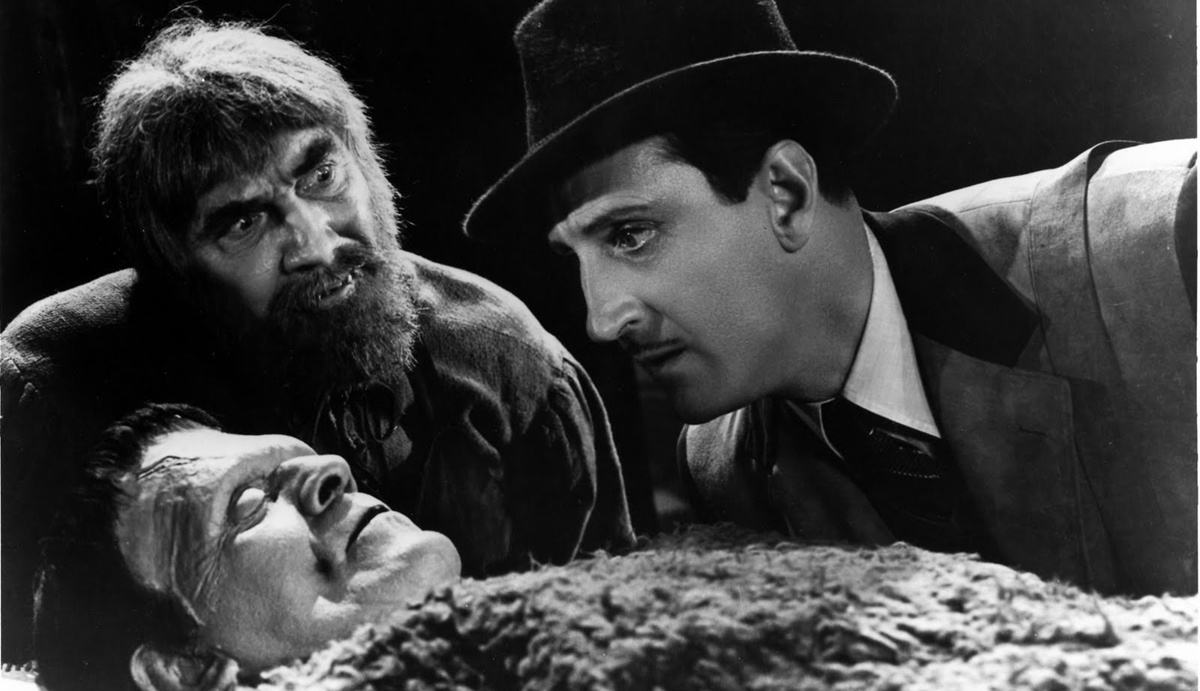
One of the smartest ideas in Son of Frankenstein is the relationship between Ygor and the Monster.
Ygor doesn’t simply stumble across Frankenstein’s creation.
He understands that having an enormous, nearly indestructible friend can be useful.
Especially when you’ve spent years remembering the people who tried to hang you.
Lugosi and Karloff barely need conventional conversation to make their scenes work.
Lionel Atwill Is Inspector Krogh
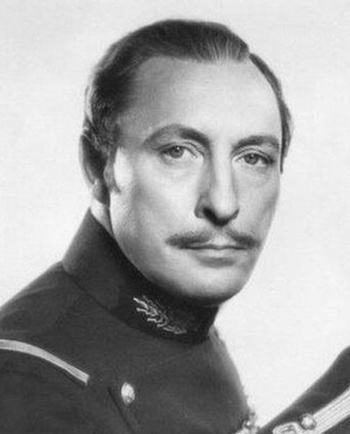
Then we get Lionel Atwill as Inspector Krogh.
Krogh has a personal history with the Frankenstein Monster.
He’s also missing an arm because of it.
That gives him considerably more reason than most policemen to be suspicious when another Frankenstein arrives in town.
Atwill plays him with exactly the kind of stern authority this movie needs.
Lawrence Grant plays the Burgomaster, who shares the village’s nerves. Watch for a young Ward Bond as a gendarme at the gate.
Inspector Krogh’s Artificial Arm Is Unforgettable
Krogh’s wooden artificial arm becomes one of the movie’s great character details.
He adjusts it.
Moves it.
Uses it while telling stories.
And the movie finds both menace and dark humor in the way Atwill handles it.
It’s the sort of odd little detail Universal horror did extremely well.
You remember Krogh long after the movie ends.
The Villagers Haven’t Forgotten the Frankenstein Name
Wolf may want a fresh start.
The village isn’t interested.
His father created a monster.
People died.
The Frankenstein name became something the locals feared.
Now the mad doctor’s son has arrived and moved directly back into the family estate.
You can’t really blame the neighbors for being nervous.
The Frankenstein House Is Completely Insane
Forget cozy Gothic architecture.
The Frankenstein estate looks like somebody designed a mansion after having a fever dream.
Huge rooms.
Massive doors.
Long staircases.
Enormous empty walls.
Strange angles.
Furniture sitting in spaces large enough to park cars.
It doesn’t look realistic.
It looks fantastic.
Universal art director Jack Otterson designed those towering sets.
This Movie Is German Expressionism on Steroids
The exaggerated production design gives Son of Frankenstein a visual identity completely different from an ordinary period drama.
Otterson borrowed openly from German silent cinema, with its slanted shapes and stark light.
Shadows stretch across walls.
Doorways tower over characters.
Staircases cut through enormous spaces.
People sometimes look tiny inside their own rooms.
The movie doesn’t attempt to make Castle Frankenstein believable.
It makes it unforgettable.
Frankenstein’s Laboratory Is Still Down There
Eventually, Wolf discovers what every audience member already suspects.
His father’s experiments haven’t completely disappeared.
The old laboratory remains hidden among the ruins.
Equipment still exists.
Secrets remain buried.
And once a Frankenstein starts poking around an old laboratory, family history has a nasty habit of repeating itself.
Wolf Wants to Clear His Father’s Name
Wolf’s motivation makes the story more interesting than simply having another mad scientist decide to create life.
He’s living underneath his father’s reputation.
If he can prove that Henry Frankenstein’s work wasn’t madness, perhaps he can restore honor to the family.
It’s understandable.
It’s also exactly the kind of reasoning that gets people into trouble in Frankenstein movies.
Basil Rathbone Slowly Gets Pulled In
Rathbone gets to take Wolf from confident aristocrat to a man increasingly consumed by the situation surrounding him.
He begins believing he can control events.
That’s another dangerous phrase in a Frankenstein movie.
The further Wolf moves into his father’s world, the harder it becomes to simply walk away.
Bela Lugosi and Boris Karloff Finally Share Frankenstein’s World
Lugosi and Karloff were already two of Universal horror’s biggest names.
Seeing them together here is part of the movie’s appeal.
But Son of Frankenstein doesn’t simply rely on their reputations.
Karloff’s Monster and Lugosi’s Ygor have a genuine relationship within the story.
The result helped give Universal another pair of characters audiences would remember for generations.
Ygor May Be Lugosi’s Best Role After Dracula
Dracula will always be Bela Lugosi’s signature character.
But Ygor deserves to stand very close behind him.
There’s no elegant cape.
No hypnotic stare across a drawing room.
No aristocratic manners.
Lugosi disappears underneath tangled hair, rough clothing, a twisted posture, and that unforgettable broken neck.
It’s one of the best demonstrations of what he could do when Hollywood gave him something interesting to play.
Ygor proved so popular that Lugosi played him again in The Ghost of Frankenstein in 1942.
The Monster Looks Slightly Different This Time
Karloff’s Monster retains the essential Jack Pierce design, but the character’s appearance continues to evolve.
The heavy boots remain.
The flattened head remains.
The unmistakable silhouette remains.
But costume and makeup details give this version its own look.
The most obvious change is the shaggy fur vest the Monster wears this time.
By 1939, Frankenstein’s Monster wasn’t simply a movie character anymore.
He was becoming an icon.
Jack Pierce’s Makeup Changed Horror Forever
Makeup artist Jack Pierce created one of the most recognizable faces in movie history.
The flat head.
Heavy brow.
Scarred features.
Neck electrodes.
Even people who have never watched the original Frankenstein recognize the image.
Eight years after the first film, Karloff could still walk onto a set in Pierce’s makeup and immediately become the Monster.
Lee even considered shooting in color. Test footage of the makeup looked poor in color, so the idea was dropped.
Universal Horror Was Coming Back
Son of Frankenstein arrived at an important moment.
Universal’s first great horror cycle had slowed during the middle of the 1930s.
Then audiences showed renewed interest in the studio’s monster pictures.
The spark came in 1938. A Los Angeles theater packed its seats for weeks with Dracula, Frankenstein, and Son of Kong on one bill.
Universal noticed and reissued Dracula and Frankenstein as a double feature across the country.
Universal realized those old monsters still had life in them.
Literally, in Frankenstein’s case.
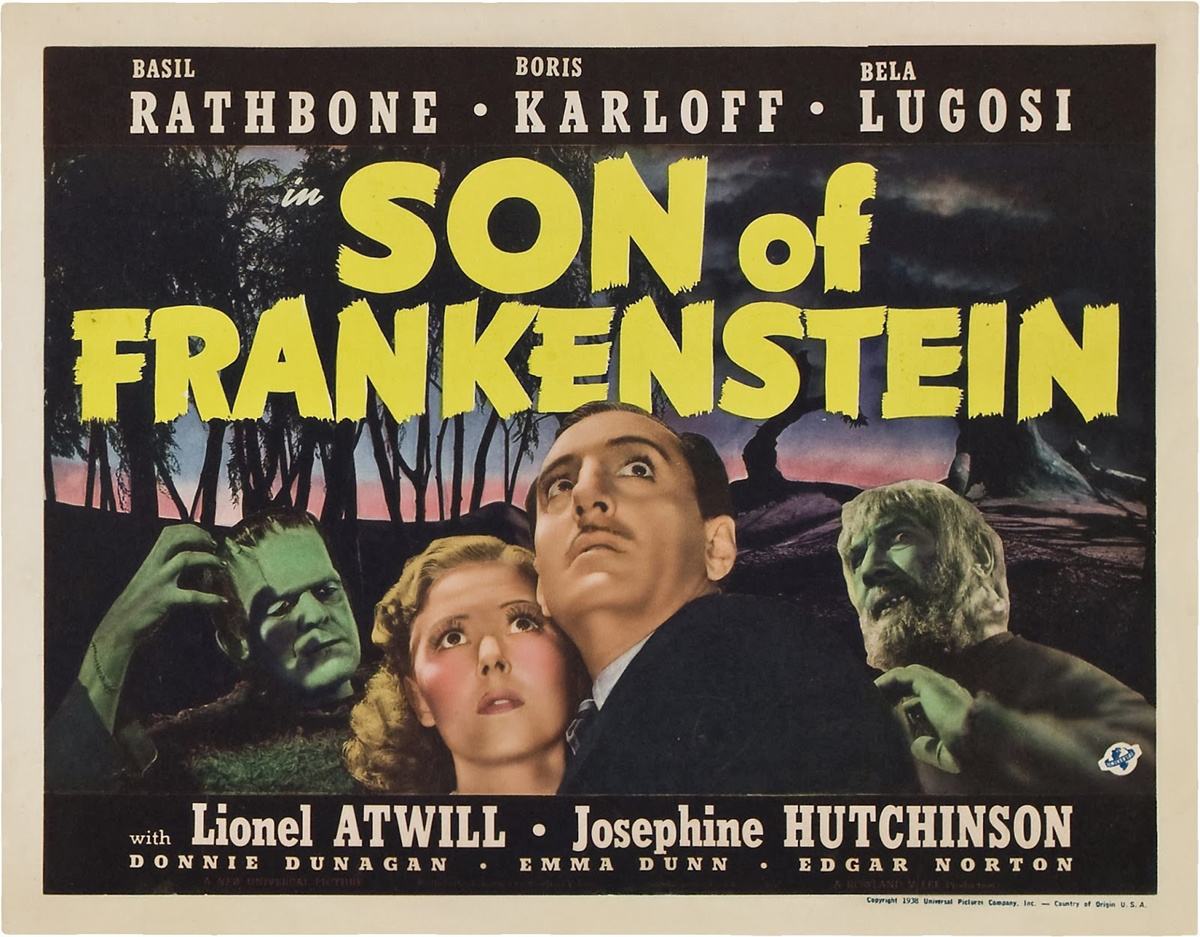
Son of Frankenstein helped launch another wave of Universal horror films.
It was a box office hit. The Hollywood Reporter said its openings in key cities beat any previous horror film.
This Is a Bigger Movie Than You Might Expect
At around ninety-nine minutes, Son of Frankenstein is considerably more substantial than many Universal horror pictures of the period.
The sets are enormous.
The cast is strong.
The photography is elaborate.
George Robinson handled the cinematography, and Frank Skinner wrote the score.
The story takes its time establishing Wolf, Ygor, Krogh, and the Monster.
Universal wasn’t treating Frankenstein’s return like a cheap afterthought.
They gave him a proper comeback.
The budget started at $250,000. It finished around $420,000 after Lee began shooting before the script was even done.
Young Peter Frankenstein Adds Something Different
Donnie Dunagan plays Wolf’s young son Peter.
Having a child inside Castle Frankenstein changes the atmosphere.
Peter doesn’t carry the same fear of the Frankenstein legacy as the adults around him.
To him, the enormous mysterious figure connected to his family isn’t necessarily the legendary monster everyone else sees.
That innocence creates some of the movie’s most memorable interactions.
Dunagan had a famous encore. He later voiced young Bambi in the 1942 Disney film.
There’s More Dark Humor Than You May Remember
Universal’s Frankenstein movies were never completely humorless.
Son of Frankenstein continues that tradition.
Inspector Krogh’s mannerisms, Ygor’s personality, and some of the character interactions provide moments of dark comedy without turning the movie into a spoof.
The horror remains serious.
The characters are simply allowed to be entertaining.
The Movie Looks Gorgeous in Black and White
This is one of those movies that makes an argument for black-and-white horror all by itself.
Deep shadows.
Bright faces emerging from darkness.
Huge black spaces surrounding characters.
Fog.
Stone walls.
Expressionistic architecture.
Color wouldn’t necessarily improve any of it.
The shadows are doing too much work.
Mel Brooks Was Paying Attention
If parts of Son of Frankenstein feel strangely familiar, there’s a good reason.
Decades later, Mel Brooks’ Young Frankenstein would lovingly borrow from the visual world and characters of Universal’s Frankenstein films. Son of Frankenstein provided especially obvious inspiration.
Inspector Krogh alone should make Young Frankenstein fans smile.
Kenneth Mars built his one-armed inspector in the 1974 comedy right on top of Atwill’s performance.
Sometimes parody is the greatest compliment a movie can receive.
Don’t Look Up Where the Story Goes
The basic setup is all you need.
Wolf Frankenstein returns home.
He meets Ygor.
His father’s laboratory still exists.
The Monster isn’t quite as gone as everyone thought.
From there, let Universal do the rest.
There’s no reason to spoil nearly ninety years of Gothic fun just because the movie is old.
Why Son of Frankenstein Sometimes Gets Overlooked
It has a difficult position in the series.
The original Frankenstein is legendary.
Bride of Frankenstein is legendary.
Then comes movie number three.
That’s a hard act to follow.
Some 1939 critics even missed James Whale, who directed the first two films.
But Son of Frankenstein has something neither previous movie possesses:
Basil Rathbone, Bela Lugosi’s Ygor, Lionel Atwill’s Inspector Krogh, and the final feature-film appearance of Boris Karloff as the Monster.
That’s one impressive third movie.
Does Son of Frankenstein Still Work Today?
Absolutely, if you enjoy classic horror.
The movie has atmosphere everywhere you look.
Rathbone gives the story energy.
Atwill gives it personality.
Karloff remains the definitive Monster.
And Lugosi gives one of the best performances of his career.
More importantly, Son of Frankenstein doesn’t feel like Universal simply repeating the first two movies.
It expands the Frankenstein family and creates characters of its own.
That’s the real takeaway from this Son of Frankenstein review. The third film earns its place beside the first two.
Who Should Watch Son of Frankenstein?
Watch it if you enjoy Universal Monsters, Boris Karloff, Bela Lugosi, Basil Rathbone, Gothic castles, and mad laboratories. It’s also for fans of German Expressionist visuals, classic black-and-white horror, and old-fashioned monster movies.
And if you’ve only watched Frankenstein and Bride of Frankenstein, don’t stop there.
There’s still one more Karloff Monster waiting for you.
Final Thoughts 4.6/5
This one earns a 4.6 out of 5 from Kilroy. Wrapping up this Son of Frankenstein review, the film stands as a lavish, moody, and wildly entertaining third chapter. It gives Karloff a proud farewell and hands Lugosi the role of a lifetime.
“Bela Lugosi’s unforgettable Ygor powers this towering, brilliantly shadowed Frankenstein sequel.”
ML Lamp, Kilroy Was Here Shop
Son of Frankenstein had an almost impossible job.
It had to follow two movies that helped define American horror.
Instead of simply copying them, it gives us a new Frankenstein, an unforgettable police inspector, and enormous Expressionist sets. It also gives us Karloff’s final feature-film performance as the Monster and one of Bela Lugosi’s greatest characters.
Ygor alone would make the movie worth watching.
Put Lugosi beside Karloff, Rathbone, and Atwill and you’ve got one of the strongest casts Universal ever assembled for a monster movie.
Son of Frankenstein isn’t merely the movie that came after Bride of Frankenstein.
It’s the movie that proved the Monster still had plenty of life left in him.
The Frankenstein family should have learned one simple lesson by 1939. If you inherit a castle and discover an old laboratory underneath it, sell the place.