When Wisconsin Built a Giant Spider: Bill Rebane’s Regional Monster Movie
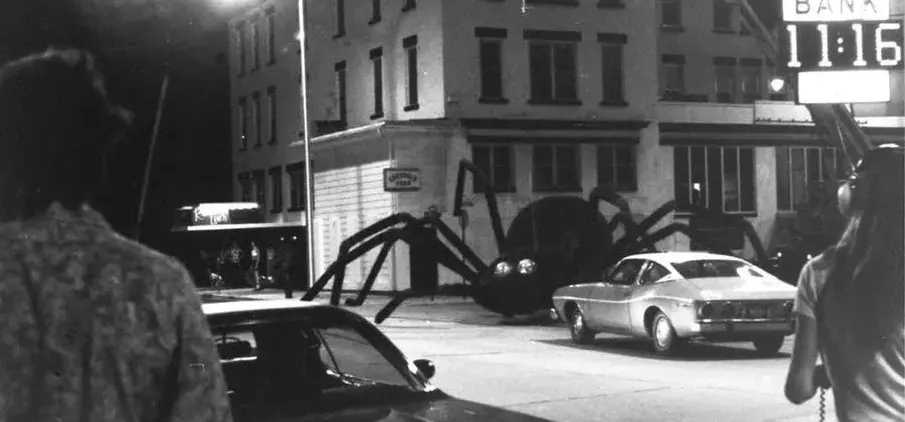
In the summer of 1975, a giant hairy spider crawled down Main Street in Merrill, Wisconsin. Under the fur was a Volkswagen Beetle. Inside the Volkswagen were local kids pulling levers. Behind the camera was Bill Rebane, a Latvian immigrant who decided a movie studio could live on a farm near Gleason. The result was The Giant Spider Invasion, a $300,000 monster movie that played theaters across the country and simply refused to die.
Here is how a Northwoods crew, a few Hollywood veterans, and a furry car made a monster movie legend.
Bill Rebane: From Riga to the Northwoods
Bill Rebane was born Ito Rebane on February 8, 1937, in Riga, Latvia.
He came to the United States in 1952. He was 15 years old.
He studied at the Art Institute of Chicago and went to work in the Chicago film business.
His first brush with feature filmmaking was an odd one. He started a science fiction picture in the early 1960s that ran out of money. Herschell Gordon Lewis later finished it and released it as Monster a Go-Go in 1965.
Not exactly a triumphant debut. But Rebane kept going.
During the 1960s he also arranged co-productions for Studio Bendestorf in Germany, a studio he held an interest in. He opened offices in Chicago and Hollywood to do it.
Then came the fishing trip.
Rebane discovered northern Wisconsin while fishing, and the place stuck with him. In the late 1960s he bought a farm near Gleason and moved his family there.
Gleason sits in Lincoln County. One local writer who grew up there put the population at roughly 200 people.
Most people would never pick it as the home of a movie studio.
Bill Rebane did.
The Shooting Ranch: Wisconsin’s Own Movie Studio
The farm raised cattle and horses. It also became home to The Shooting Ranch, Rebane’s own film studio.
It is widely described as the first full time feature film studio in the Midwest. The property eventually grew to about 200 acres.
The Shooting Ranch turned out hundreds of commercials, industrial films, and corporate image films. That steady work kept the lights on between features.
Fans who have studied the Rebane operation describe a complete setup. There was post production, sound recording, lodging for actors, and even a restaurant.
The logic was simple. If you own the studio, the beds, and the kitchen, a small budget goes a lot further.
Why Bill Rebane Stayed in Gleason
Rebane did not treat Wisconsin as a cheap backdrop. He treated it as home base.
His first science fiction feature from the ranch was Invasion from Inner Earth (1974). His wife Barbara wrote the screenplay. It was shot in 1973 under the working title The Selected.
He also pushed the state for years to take film production seriously. Wisconsin created the Wisconsin Film Office in 1986. Rebane’s efforts, going back to 1969, are credited with helping make that happen.
That is a regional filmmaker in the truest sense.
He did not leave for Hollywood. He tried to bring Hollywood north.
Making The Giant Spider Invasion on a Shoestring
The story idea came from Richard L. Huff, who produced the film with Rebane. Huff and actor Robert Easton were assigned the script.
The working title was The Great Spider Invasion.
The script was not finished when cameras rolled. Creative differences left the crew with pages of dialogue instead of a full screenplay.
Rebane’s fix is a Northwoods legend. He reportedly locked Easton in a cabin and expected 10 to 15 pages a day.
No pages, no supper.
That is one way to beat writer’s block.
The film was shot in about six weeks in Gleason, Merrill, and Tomahawk. Scenes were also filmed at the University of Wisconsin-Stevens Point.
The budget was $300,000. Jaws was in production around the same time with a far bigger budget.
Former Madison mayor William Dyke served as an uncredited executive producer. He helped raise money and find a distributor. Dyke later became a Wisconsin circuit court judge.
Jack Willoughby handled the cinematography. Barbara Rebane worked as script girl. Bill Rebane even composed the music.
The Hollywood Veterans Who Came North
Rebane may have been shooting in the woods, but his cast came with real Hollywood and television credits.
- Steve Brodie as Dr. Vance, the NASA scientist
- Barbara Hale as Dr. Jenny Langer, the astronomer
- Alan Hale Jr. as Sheriff Jones
- Robert Easton as farmer Dan Kester
- Leslie Parrish as Ev Kester
- Bill Williams as Dutch
- Kevin Brodie as Dave Perkins
- Dianne Lee Hart as Terry
- Paul Bentzen as Billy
- Christiana Schmidtmer as Helga
Barbara Hale was Della Street on Perry Mason. Alan Hale Jr. was the Skipper on Gilligan’s Island.
Bill Williams was Barbara Hale’s real life husband. Kevin Brodie was Steve Brodie’s son.
A family affair in more ways than one.
Fifty years later, Rebane still praised that cast. He told Madison Magazine they were seasoned pros who helped any way they could, despite all the trouble on set.
The Spider Was a Volkswagen
Now for the real star of the show.
Special effects artist Bob Millay was hired to design the spiders. A welder named Carl Pfantz built the metal framework.
There were two big spiders, both built with metal tubing.
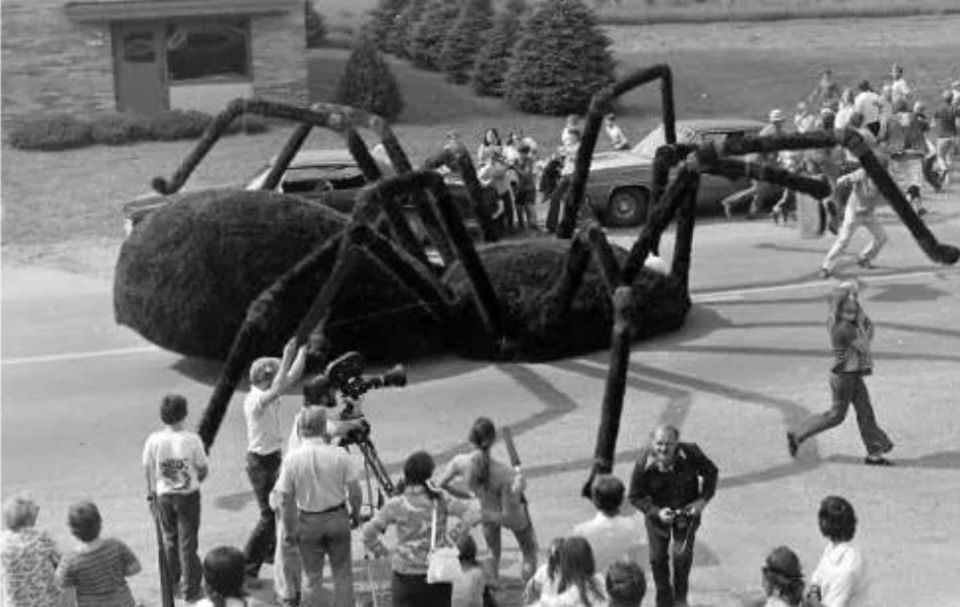
One was built on the chassis of a Volkswagen Beetle. It could be driven right across the Wisconsin countryside.
The other could be lifted by a crane. That let the crew set it on top of buildings, cars, and anything else that needed squashing.
Cover the frame in black fake fur. Add long legs and glowing red eyes. Now you have a monster.
A cheap monster. But a monster.
How the Bill Rebane Spider Crew Brought It to Life
The drivable spider needed a crowd inside.
Accounts vary on the exact head count. Rebane remembered a driver plus six kids working the legs. One local who was eaten on camera recalled eight people inside.
The Merrill Historical Society breaks down the jobs. Four people worked the legs with levers. One pumped blood out of the fangs. One pulled the victim inside.
The blood was Karo syrup and red food coloring. It ran through garden hoses taped along each fang.
Very sticky in a Wisconsin summer.
Rebane said it was about 100 degrees under that fur. Many of the operators were teenagers, and some were UW-Stevens Point students.
The smaller spiders needed no hoses at all. Real tarantulas were trucked in from Arizona to play the hatchlings.
Not every effect went smoothly. For one explosion shot, the crew packed a prop with gunpowder and tried to light it with matches.
A whole box of matches later, nothing happened. Rebane called off the shot.
Then it blew.
Two crew members had their hair singed and were treated at the hospital for burns.
Practical effects were very practical in 1975.
Rebane was smart about how he showed the beast. He often kept it in silhouette or used quick cuts. That kept the Volkswagen from looking too much like a Volkswagen.
When the Whole County Joined the Cast
This is where The Giant Spider Invasion becomes a true regional movie.
The end credits thank a long list of local partners. They include the towns of Merrill and Gleason, Lincoln County, and the Marathon County Sheriff’s Department in Wausau.
Nicolet College in Rhinelander and UW-Stevens Point get thanked too. So does American Motors, which supplied vehicles.
Locals filled the crowds and the victim list.
Russ Yanda was 16 when the spider ate him on Main Street in Merrill. That scene was shot right in front of the Cosmo Theatre.
The Cosmo has shown movies since 1929 and is still family owned. Years later, it screened the film for a holiday food drive. Audience members laughed as they spotted themselves and their friends on screen.
The Cosmo has also screened the film to raise money for the restoration of a historic church in Gleason. Rebane was involved in that church project too.
The spider’s rampage at a local carnival pulled even more neighbors into the frame.
Rebane also had a reputation for giving young people a chance. Pat Burg of the Merrill Historical Society said he was always willing to show newcomers how filmmaking worked.
Ask around Lincoln County and somebody’s uncle was inside that spider.
Or under it.
Or running from it.
From Lincoln County to Drive-In Screens
A movie made in Gleason still had to get out of Gleason.
The film was produced under the Transcentury Pictures and Cinema Group 75 banners. Group 1 International Distribution Organization handled distribution.
It opened in October 1975. Box office trackers list a limited domestic opening on October 24, 1975, with a PG rating.
The film arrived when creature features still ruled the drive-ins. A giant furry monster on a one sheet fit that market perfectly.
The poster art promised a bigger, city sized attack than the farm country movie actually delivers. Nobody seemed to mind.
It worked. The film landed among the top 50 grossing pictures of its year.
Variety reported 1976 rentals in the United States and Canada of $2,347,000. Rebane and others have claimed lifetime grosses anywhere from $15 million to $22 million.
The money did not flow back to Gleason the way he hoped. Rebane later said he never saw a fraction of it. He called it one of the most pirated movies ever made.
Group 1 president Brandon Chase did collect an Outstanding Executive Achievement award from the Academy of Science Fiction, Fantasy and Horror Films.
Critics were less kind. The Los Angeles Times review in February 1976 knocked the script and direction but admitted the spiders were scary.
Stephen King gave it a nod in his 1981 book Danse Macabre. He pointed out there is really only one giant spider, but said it is a real beauty.
Then came television. The film aired nationally on ABC in 1977 and later turned up on The CBS Late Movie.
It traveled overseas too. Original Japanese release posters still turn up with collectors today.
How a Regional Monster Movie Became a Cult Favorite
Plenty of 1975 monster movies vanished. This one kept crawling.
On May 31, 1997, it landed on Mystery Science Theater 3000. It was episode 810, in the show’s eighth season on the Sci-Fi Channel.
Mike Nelson and the robots tore into it. A whole new generation discovered the Volkswagen spider.
Rebane found the episode strange. He accepted it anyway, because it made his film popular all over again.
In 2003, the Wisconsin Film Festival in Madison booked the movie. It sold out the Bartell Theatre.
In May 2005, Madison hosted a Bill Rebane Film Festival at the Orpheum Theatre. The hosts were Michael J. Nelson and Kevin Murphy from MST3K.
The two men who mocked the movie on TV said they admired how Rebane pulled a cast and crew together to get it made at all.
That is the kind of respect money cannot buy.
In 2009, Rebane received a Wisconsin Filmmaker Lifetime Achievement Award at the Madison Horror Film Festival.
RiffTrax gave the film a live show on August 15, 2019.
Home video kept it alive between screenings. Retromedia released a DVD in 2002. MVD released a director’s cut in 2009. VCI Entertainment brought it to Blu-ray in 2015.
It is also listed among the most enjoyably bad movies in The Official Razzie Movie Guide.
In cult movie circles, that is practically a medal.
What Happened to the Giant Spider Props
Movie props usually end up in a dumpster. These came close.
In 2008, Rebane put a spider up for auction on eBay. Nobody met the $25,000 minimum bid.
Over the years, the shells of the two big spiders resurfaced. One turned up in a Gleason junkyard. In 2012, film historian Bill Dexter set out to restore them.
Then in 2013, one spider shell was reported stolen. Weeks later, a recycling facility said it had been brought in as scrap metal.
A movie monster sold by the pound.
That one still hurts.
A surviving spider found a home at the Merrill Historical Society. Its exhibit, Bill Rebane’s Hollywood Midwest, opened in October 2022 with Rebane in attendance. Brandon Johnson curated the show.
The exhibit includes a recreation showing the spider without its fur. Visitors can see where the operators crammed in to work the legs.
Foreign language posters and a vintage projector on loan from the Cosmo round out the display.
In November 2024, Julien’s Auctions offered the film rights, including remake and sequel rights. The lot included the original 35mm negative. A giant spider prop went up for auction too, with an estimate of $20,000 to $30,000.
The Bill Rebane Spider Rides Again
Most directors never revisit a 50 year old film.
Bill Rebane did.
The 50th anniversary started with a screening at the Gerold Opera House in Weyauwega in October 2024. Actor Dan Davies hosted, and Rebane made an appearance.
That night led to a bigger idea. Rebane wanted to fix flaws that bugged him for decades, including cuts that made the story harder to follow.
The new version keeps the original film and adds 20 to 25 minutes of fresh footage. The new scenes were shot to look like 1975.
Davies plays a small town TV anchor on a fictional station called WSOS-TV. His newscasts track the spider panic across the north woods.
Golden Icon Productions of Wausau began filming the new footage in July 2025. The shoot took place in the Hayward area.
The reimagined edition premiered in late June 2026 at Rogers Cinema in Stevens Point. Waupaca and Marshfield hosted events that same weekend.
Rebane, now 89, was scheduled to take questions alongside Davies. The enhanced edition then hit the road, with an October 2026 premiere booked at the Rivoli Theatre in La Crosse.
The Milwaukee Independent Film Society also announced a Pace-setter Award for Rebane at its September 2026 short film festival.
Fifty years later, Wisconsin is still lining up for the spider.
Collecting The Giant Spider Invasion
For collectors, this film is a fun regional target. Here is what to watch for.
- Original 1975 release posters, including Japanese editions that dealers list in the $100 to $150 range
- Older home video releases on tape, so check the label and year on your copy
- The 2002 Retromedia DVD
- The 2009 MVD director’s cut DVD
- The 2015 VCI Entertainment Blu-ray
- The MST3K episode on DVD in Rhino’s Volume 10 set from 2006, and the Volume 10.2 reissue from 2008
- Signed items from Rebane’s anniversary screening appearances
The Rhino set has its own story. The original Volume 10 was recalled over a rights dispute involving Godzilla vs. Megalon. The reissue swapped in The Giant Gila Monster.
Check the condition. Check the label. Check whether your disc is the theatrical cut or the director’s cut.
They are not the same disc.
And if you live in north central Wisconsin, check the basement. Somebody’s dad worked that spider.
Final Thoughts on Bill Rebane’s Giant Spider
Bill Rebane did not have Hollywood money. He had a farm, a welder, a Volkswagen, and a county full of willing neighbors.
That turned out to be enough.
The Giant Spider Invasion is not a polished film. It is something rarer. It is proof that a regional filmmaker could build a studio in the woods and put a monster on screens nationwide.
Fifty years on, the spider still draws a crowd.
Not bad for a Beetle in a fur coat.