🤠 Gene Autry Biography: A Trusted Hero Who Shaped Western Entertainment
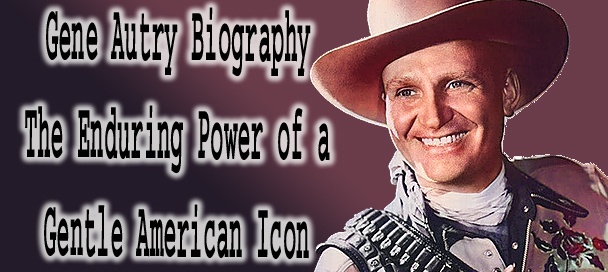
Gene Autry in classic western attire during the height of his film career.
Gene Autry was one of the rare entertainers who became a genre unto himself. At a time when the American West was already sliding into nostalgia, he gave it a steady voice and a reassuring face. To millions, he was not just a movie star or a singer, but a symbol of fairness, restraint, and plain decency, dressed in a clean shirt and a white hat.
Gene Autry was a pioneering American entertainer whose career spanned radio, film, television, and recorded music. Best known as the original singing cowboy, he starred in dozens of western films, recorded major hit songs, and helped define a moral code for screen heroes. His influence extended beyond entertainment into broadcasting and professional sports ownership. Autry remains one of the most commercially successful and culturally trusted figures of twentieth-century popular culture.
Born Orvon Grover Autry, he rose during the depths of the Great Depression, when audiences wanted heroes who solved problems without cruelty and spoke softly without weakness. His success came not from swagger, but from consistency. Whether on screen, on the radio, or on record, he offered the same calm presence, the same moral center, and the same promise that order could be restored without chaos.
Unlike many stars of his era, Autry’s appeal crossed age and class without strain. Children trusted him, adults respected him, and studios relied on him. He became the most commercially successful singing cowboy of all time, yet never leaned on spectacle to hold attention. His legacy rests on something quieter and harder to fake: credibility earned over time.
📌 If You Only Read One Thing...
Gene Autry’s success was never built on flash or rebellion. He earned loyalty by offering audiences something rare in entertainment: a hero who stayed the same, year after year, without apology.
👶 Early Life
Summary: Gene Autry’s early life shaped his steady work ethic and grounded persona long before fame arrived.
Gene Autry was born Orvon Grover Autry on September 29, 1907, in Tioga, Texas, a small railroad town shaped by work routines and long stretches of quiet. His parents divorced when he was young, and much of his childhood was unsettled, split between relatives and modest living arrangements. Stability came later, not as an inheritance, but as something he learned to build for himself.
As a teenager, Autry found steady ground working for the St. Louis–San Francisco Railway, first as a telegraph operator and later in other rail jobs. The railroad exposed him to a wider world while reinforcing habits of punctuality and self-reliance. Music entered his life informally, shaped by local traditions, church songs, and the popular ballads passed from one worker to another during long hours on the job.
Autry’s early musical efforts were unpolished but sincere. He sang for coworkers, performed at local gatherings, and began to see music as more than a pastime. These years did not carry the drama of sudden discovery or early fame. Instead, they formed the practical foundation of a performer who learned patience first, and ambition later.
Summary: Radio introduced Autry to a national audience and established his identity as a singing cowboy.
Gene Autry’s transition from local performer to national figure began on the radio, where his plainspoken style fit the medium perfectly. In the late 1920s, he found work singing on regional broadcasts, performing simple western ballads that stood apart from the louder novelty acts of the day. His voice was unforced and direct, and listeners responded to the sense that he was singing to them, not at them.
His break came when he joined the National Barn Dance on WLS in Chicago, one of the most influential radio programs in the country. The exposure gave Autry a weekly audience and a clear identity as a singing cowboy, even before Hollywood took notice. Sponsors valued his reliability, and stations trusted him to keep audiences steady rather than chasing attention with gimmicks.
Radio also taught Autry discipline. Live broadcasts left no room for excess or correction, and he adapted by keeping performances tight and consistent. By the early 1930s, he was no longer just another voice on the air. He had become a recognizable presence, setting the tone for a new kind of western entertainer built on sincerity rather than bravado.
📌 Fun Fact
Gene Autry once held ownership stakes in more radio stations than any other entertainer of his era.
🎬 TV and Movie Career
Gene Autry on Letterman
Summary: His film and television work defined the musical western and expanded seamlessly into early TV.
Gene Autry’s film career began in the early 1930s, when studios were still learning how to shape sound pictures around musical performers. His first significant screen appearance came in In Old Santa Fe in 1934, produced by Mascot Pictures, where his natural presence quickly stood out. Republic Pictures soon recognized his value and built an entire production line around him, releasing a steady stream of modestly budgeted westerns designed to play reliably in small-town theaters across the country.
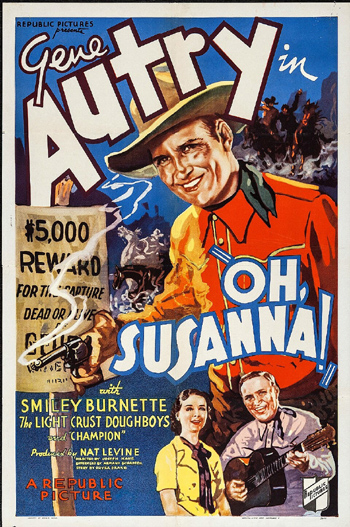
Poster for Oh, Susanna! (1936), featuring Gene Autry in one of his early singing cowboy films.
Throughout the 1930s and early 1940s, Gene Autry starred in dozens of films that followed a clear moral structure. Titles such as Tumbling Tumbleweeds, The Big Show, Ride, Ranger, Ride, and Back in the Saddle paired straightforward storytelling with musical interludes that felt organic rather than forced. His frequent screen partner, Smiley Burnette, provided comic relief, while supporting players like George “Gabby” Hayes, Pat Buttram, and Sterling Holloway helped define the tone of the singing cowboy western. These films rarely relied on violence, favoring resolution through dialogue, loyalty, and quiet authority.
Autry’s screen persona was deliberately consistent. He played variations of the same character, a principled man who respected the law but understood human weakness. This approach distinguished him from more aggressive western heroes and placed him in contrast to contemporaries such as John Wayne, whose roles often leaned harder and more confrontational. At the same time, Autry’s success opened the door for similar performers, most notably Roy Rogers, who would later become his friendly rival within the genre.
World War II interrupted Autry’s film career when he enlisted in the U.S. Army Air Forces, where he served as a transport pilot. Upon returning, he resumed acting but faced a changing entertainment landscape. The postwar audience was aging, and theatrical westerns were beginning to lose ground. Autry adapted by shifting his focus to television, where his values translated smoothly to the smaller screen.
The Gene Autry Show debuted in the early 1950s and ran for several seasons, bringing his familiar character into American living rooms. Unlike many former film stars, Autry embraced television rather than resisting it. He expanded his presence further by producing and starring in Annie Oakley, which introduced a younger audience to Gail Davis in the title role and reinforced Autry’s influence behind the camera as well as in front of it.
By the time he stepped away from regular acting, Autry had appeared in more than ninety films and helped define the structure of the musical western on both radio and screen. His work bridged eras, from early sound cinema to network television, without abandoning the traits that made him trusted by audiences. In an industry built on reinvention, his career stands out for doing the opposite: refining a single identity until it became iconic.
🎶 Music Career
Summary: Autry’s music career produced enduring hits, including some of the most played Christmas songs ever recorded.
Gene Autry’s music career was the foundation beneath everything else he built. Long before his face was familiar on screen, his voice carried his reputation. He recorded steadily from the late 1920s onward, favoring western ballads, folk tunes, and sentimental songs that felt personal rather than staged. His delivery was relaxed and conversational, closer to a campfire performance than a theatrical one, which helped define what audiences came to expect from a singing cowboy.
During the 1930s, Gene Autry became one of the best-selling recording artists in the United States. Songs such as That Silver-Haired Daddy of Mine, Back in the Saddle Again, and South of the Border were major hits, selling millions of copies and receiving heavy radio play. Back in the Saddle Again in particular became inseparable from his public identity, serving as both a signature song and a statement of values rooted in loyalty, restraint, and self-respect.
Autry’s recording success was not limited to western material. He had a strong instinct for songs that carried emotional weight without drifting into melodrama. This instinct served him especially well when he turned to holiday music, a move that would cement his place in American popular culture beyond the western genre.
In 1947, Autry recorded Here Comes Santa Claus (Right Down Santa Claus Lane), which he co-wrote after reportedly watching a Christmas parade. The song became an instant standard and remains one of the most played holiday recordings of all time. He followed it with Rudolph the Red-Nosed Reindeer, recorded in 1949, which reached number one on the charts and became a defining Christmas song for generations of children. Unlike novelty recordings that faded with time, Autry’s Christmas songs endured because they were performed with the same sincerity he brought to his western ballads.
Additional holiday recordings such as Frosty the Snowman, Up on the House Top, and Santa Claus Is Comin’ to Town helped round out a Christmas catalog that continues to resurface every year without reinvention. Few artists have achieved that kind of seasonal permanence, and fewer still did so without chasing trends.
By the end of his recording career, Gene Autry had sold tens of millions of records across multiple decades. His influence on country and western music was quiet but lasting. He proved that a singer did not need vocal showmanship to command attention, only clarity, warmth, and trust.
Summary: As a baseball owner, Autry brought credibility and long-term stability to a major league franchise.
Gene Autry’s baseball career unfolded far from the stage and the soundstage, yet it reflected the same patience and long view that defined his entertainment work. In 1960, he became the first former movie star to own a Major League Baseball franchise when he was awarded an expansion team by the American League. The club debuted in 1961 as the Los Angeles Angels, sharing the city with the Dodgers and immediately drawing national attention.
Gene Autry was not a ceremonial owner. He involved himself in league meetings, personnel decisions, and the long-term stability of the franchise. Early Angels teams featured players such as Bob Rodgers, Leon Wagner, and Bo Belinsky, whose colorful personalities helped the club establish an identity despite uneven performance on the field. The team played its first seasons at Wrigley Field in Los Angeles before relocating to Dodger Stadium.
In 1965, the franchise moved to Anaheim and was renamed the California Angels, signaling a broader regional identity. Autry remained a steady presence through multiple eras of the team’s history, overseeing changes in management, stadium development, and league structure. Under his ownership, the Angels gradually matured from an expansion novelty into a respected American League club.
One of Autry’s most lasting baseball contributions came later, when he approved the signing of free agent Nolan Ryan in 1979. Ryan’s years with the Angels included multiple no-hitters and cemented the team’s credibility on a national level. Autry’s willingness to invest in talent, even late in his life, showed that his competitive instincts had not faded.
By the time of his death, the franchise had evolved again, becoming the Anaheim Angels, and later the Los Angeles Angels of Anaheim. Through every name change, Autry’s influence remained foundational. He brought stability, legitimacy, and quiet confidence to a team that continues to trace its origins back to a singing cowboy who understood that building something lasting takes time.
🕊️ Later Years
Summary: His later years focused on stewardship, business leadership, and quiet influence.
In his later years, Gene Autry gradually stepped away from performing, choosing instead to manage the business interests he had spent decades building. He remained active behind the scenes in broadcasting, music publishing, and sports ownership, with a particular focus on the Angels organization and his radio holdings. Public appearances became less frequent, but his influence continued to circulate through reruns, recordings, and annual holiday airplay.
Autry divided his time primarily between California and Arizona, favoring a quieter life that reflected the values he had always projected on screen. He avoided nostalgia tours and rarely sought the spotlight, preferring to let his earlier work speak for itself. When he did appear publicly, it was often in connection with charitable efforts, industry honors, or baseball-related events.
Health concerns increased with age, though he remained mentally sharp and engaged in decisions well into his nineties. Gene Autry died on October 2, 1998, at the age of ninety-one. His passing marked the end of an era, but not the disappearance of his presence. Each December, his voice returns to radios and living rooms, unchanged, steady, and familiar, just as it had been for generations.
📎 Did You Know?
Gene Autry is the only entertainer to achieve a number-one hit across radio, film, records, and television, a feat unmatched by any other performer.
🏆 Legacy
Summary: Gene Autry’s legacy is built on consistency, trust, and lasting cultural presence.
Gene Autry’s legacy rests on trust earned slowly and kept without strain. He established a moral code for the western hero that avoided cruelty and excess, shaping how generations understood the genre. His influence reached beyond his own films and recordings, setting expectations that later performers, from Roy Rogers to television-era western leads, would either follow or react against.
His commercial achievements were vast, yet rarely loud. Autry was the first entertainer to have a number-one hit on record, radio, film, and television, a distinction that reflected breadth rather than novelty. He also helped formalize the image of the singing cowboy as a stable cultural figure, one that blended music, storytelling, and character into a single, recognizable identity.
Beyond entertainment, his ownership of the Angels and his investments in broadcasting showed a long-term vision uncommon among performers of his time. He built institutions that outlasted his direct involvement, favoring continuity over personal branding. Honors followed naturally, including multiple inductions into halls of fame across music, film, and sports.
Perhaps most telling is how his work continues to function without explanation. His Christmas songs return each year without marketing, his films remain accessible to children without revision, and his name still carries a clear meaning. In an industry built on reinvention, Gene Autry remains remembered for consistency, and that consistency is his lasting mark.
🗣️ Why They Still Matter
Gene Autry still matters because his work requires no reinterpretation. His films remain accessible, his music continues to return each holiday season, and his public image has aged without contradiction. In a culture that constantly reinvents its heroes, Autry endures by having needed no reinvention at all.
ML Lamp is the owner of Kilroy Was Here. After his 20 years of working in Las Vegas in the entertainment promotions field, Mr. Lamp retired in 2002 from his job to pursue his passion for collectibles. Now as a guest speaker and author he’s living the dream, and sharing his warmth with You.