Halloween Horror Film Locations Hidden Across the Heartland
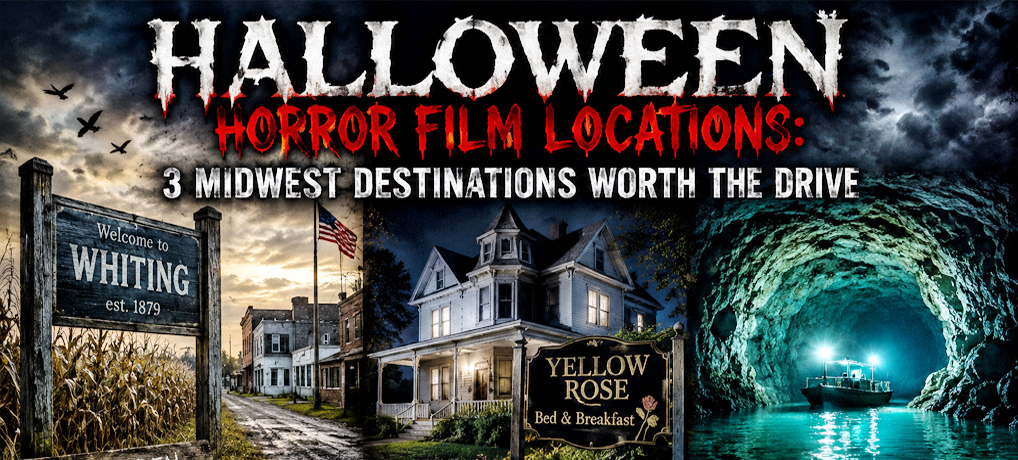
Most horror film tourism points you toward Hollywood backlots, New England coastal towns, or the infamous streets of New Orleans. The Midwest rarely makes that list, and that is a genuine oversight. Spread across Iowa, Missouri, and Minnesota, there are real verified filming locations from films that frightened audiences, challenged their casts to the point of breakdown, and in one case launched the career of one of Hollywood’s most enduring action heroes. These are not reconstructed sets or approximate locations. These are the actual places where the cameras rolled, some still standing almost exactly as they appeared on screen, one operating as a bed and breakfast where you can sleep in the room where it all happened.
Halloween horror film locations in the Midwest require a different kind of traveler than the tourist who books a Salem witch tour and calls it a season. These destinations reward the curious, the patient, and the genuinely devoted fan who wants to stand in the actual geography of a film they love. Each entry below includes honest ratings, verified location details, and the full story of what was filmed there and why it matters.
🎬 Film Recognition: How well known the film is and how strongly the location is associated with it.
📍 Location Accessibility: How easy it is to visit, whether it is open to the public, and what the visitor experience looks like.
🔍 Then vs Now: How recognizable the location is today compared to how it appeared on screen.
⭐ Worth the Trip: The overall verdict for a dedicated horror film tourism visit.
Each category is rated one to five. Five means essential. One means it is mostly gone and mostly not worth the drive.
🎬 #1 🇺🇸 Children of the Corn (1984)
Hornick, Salix, Whiting, and Sergeant Bluff, Iowa
🎬 Film Recognition: ⭐⭐⭐⭐⭐
📍 Location Accessibility: ⭐⭐⭐⭐
🔍 Then vs Now: ⭐⭐⭐⭐
⭐ Worth the Trip: ⭐⭐⭐⭐
About the Film
Children of the Corn, released on March 9, 1984, is based on Stephen King’s 1977 short story of the same name, which first appeared in Penthouse magazine before being collected in King’s Night Shift anthology. The film was directed by Fritz Kiersch in his feature directorial debut and written by George Goldsmith. It tells the story of Burt Stanton, played by Peter Horton, and his girlfriend Vicky, played by Linda Hamilton, who are driving across the Midwest when they encounter a murdered boy in the road and find themselves trapped in the fictional Nebraska town of Gatlin.
Children have been convinced by a fanatical child preacher named Isaac, played by John Franklin, to kill every adult in the community in service of a demonic entity called He Who Walks Behind the Rows. Malachai, Isaac’s violent red-haired lieutenant played by Courtney Gains, and the children Job and Sarah, played by Robby Kiger and Anne Marie McEvoy, round out the central cast. Veteran character actor R.G. Armstrong appears as the one adult survivor they find in town.
Peter Horton was coming off the short-lived television series Seven Brides for Seven Brothers when he took the role of Burt, and the film was not his biggest moment. That belonged entirely to his co-star. Linda Hamilton, then primarily known for television work, made Children of the Corn in the spring of 1983. Seven months later, in October 1984, The Terminator opened in theaters and Hamilton became one of the most recognizable faces in Hollywood as Sarah Connor.
The timing meant that Children of the Corn, which opened in March 1984, was already in theaters when Terminator fever hit, and Hamilton’s presence in both gave the film a cultural second life it might not otherwise have enjoyed. John Franklin and Courtney Gains, both making their acting debuts, created two of the more genuinely unsettling child villain performances in the genre. The film was made on a budget of three million dollars and grossed more than fourteen million, spawning a franchise of sequels and remakes that continues to this day.
The Iowa Filming Locations
Here is the detail that surprises most people: the fictional town of Gatlin, Nebraska was actually the small towns of northwest Iowa. Principal filming took place across four communities, Hornick, Salix, Whiting, and Sioux City, with additional exterior work in Sergeant Bluff. Stephen King set his story in Nebraska, but Iowa’s flat agricultural landscape, rural architecture, and tall cornfields gave the production team exactly what they needed, and the Sioux City area delivered it in abundance.
Whiting is the most intact filming location and the one most worth the visit. Main Street in Whiting is described by locals who were present during filming as nearly identical today to how it appeared in 1984. The flagpole at the intersection of Whittier and Blair Streets, which featured in the film’s chase sequence, still stands in the middle of the intersection exactly where it appeared on screen.
The Whiting Office of the Sloan State Bank at 524 Whittier Street is still recognizable. Many Whiting school students served as extras during production, giving the town a personal connection to the film that has only deepened over the forty-plus years since. In July 2024, Whiting hosted a weekend celebration for the film’s fortieth anniversary through a group called On Set Cinema, with outdoor screenings and location tours that drew fans from across the region.
The farmhouse used as the primary residential location was filmed in Hornick and is reportedly still standing according to local sources. The cornfield scenes featuring the distinctive crosses were shot just outside Hornick on farmland that belonged to a local family. The church, school, and gas station locations are spread between Salix and Hornick. The hotel exterior was filmed in Sergeant Bluff. The school exterior specifically, contrary to some published accounts, is the school in Salix rather than Hornick, a detail confirmed by local residents who attended school there.
Some locations have changed or disappeared. The interior shots filmed on Jones Street in Sioux City are gone, as that house is no longer standing. Several locations were edited together in post-production in ways that compress the geography, meaning Peter Horton’s chase scene jumps between Whiting and Salix streets in a way that would be disorienting to anyone trying to follow the exact route on foot. The brick garage in Whiting where the children first spot Burt and Vicky’s car driving into town, photographed by location hunters as recently as 2020, was completely demolished and is now an empty lot.
Can You Visit?
Yes. The towns are small, rural, and require careful planning. There is no organized film tourism infrastructure in place, no signs marking locations, and no visitor center dedicated to the production. What there is, is a genuinely preserved small-town Midwest landscape that looks remarkably close to how it appeared in the film, particularly in Whiting.
Come with a printed location map from an online resource, drive slowly through Whiting’s Main Street, and stand at the flagpole intersection. The cornfields surrounding the area are active agricultural land and should be observed from public roads rather than entered. The drive through northwest Iowa in October, when the corn is still standing in the fields and the light goes flat and gray, produces exactly the atmosphere the film was built around. That part costs nothing.
Halloween Verdict
Iowa’s most significant horror film location is also one of the most authentic film tourism experiences available anywhere in the Midwest. The towns are not performing their connection to the film. They simply are what they are, small agricultural communities that look almost exactly as they did when a film crew showed up in 1983 and used them as the backdrop for one of Stephen King’s most enduring adaptations. Whiting’s Main Street alone justifies the drive for any serious fan of the film. Go in October. The corn helps.
🎬 #2 🇺🇸 The Abyss (1989)
Bonne Terre Mine, Bonne Terre, Missouri
🎬 Film Recognition: ⭐⭐⭐⭐
📍 Location Accessibility: ⭐⭐⭐
🔍 Then vs Now: ⭐⭐⭐⭐
⭐ Worth the Trip: ⭐⭐⭐⭐
About the Film
The Abyss, released on August 9, 1989, was written and directed by James Cameron, who had already made The Terminator and Aliens and was building toward what would become one of the most extraordinary careers in Hollywood history. The film stars Ed Harris as Virgil Bud Brigman, the foreman of a deep-sea oil platform called Deep Core, and Mary Elizabeth Mastrantonio as Dr. Lindsey Brigman, the platform’s designer and Bud’s estranged wife.
Michael Biehn, who had worked with Cameron on both Terminator and Aliens, plays Lieutenant Hiram Coffey, a Navy SEAL whose mental deterioration under pressure becomes one of the film’s central threats. When an American nuclear submarine mysteriously sinks in the Caribbean, the Deep Core crew is recruited to assist with the search and recovery operation. Deep beneath the ocean, they encounter something that changes everything they understand about what might be living in the darkness below.
The Abyss – Trailer (1989)
The Abyss is notorious in Hollywood history for the conditions under which it was made. The cast and crew privately referred to the production as The Abuse. Forty percent of principal photography took place in two massive water tanks constructed inside an unfinished nuclear reactor facility in Gaffney, South Carolina. The cast spent months working in water, often for eighteen-hour days, learning to dive, enduring decompression between takes, and operating in conditions that wore them down to breaking points.
Mary Elizabeth Mastrantonio had a full emotional breakdown on set and famously walked off during the filming of the resuscitation scene, shouting that they were not animals. Ed Harris has publicly refused to discuss the production in interviews for decades, saying simply that he is not talking about The Abyss and he never will. Cameron himself nearly drowned when his oxygen supply failed during an underwater sequence. The film won the Academy Award for Best Visual Effects and was nominated for three additional awards. It grossed ninety million dollars against a budget of approximately forty-five million.
The Missouri Filming Location
While the majority of The Abyss’s underwater sequences were filmed in South Carolina, additional underwater scenes were filmed at Bonne Terre Mine in Bonne Terre, Missouri, approximately an hour south of St. Louis. The connection makes complete sense once you understand what Bonne Terre Mine is. Originally a lead mine operated from 1860 until its closure in 1973, the mine was allowed to flood when the pumps were turned off, and the lower levels filled with crystal-clear water over time, creating what became known as the largest underground lake in the world.
James Cameron’s production team recognized immediately that this extraordinary subterranean environment, with its vast caverns, eerie industrial remnants, and waters of remarkable clarity, was precisely the kind of otherworldly underwater setting the film required for its more atmospheric sequences.
Bonne Terre Mine has attracted extraordinary visitors beyond Cameron’s film crew. The legendary marine explorer Jacques Cousteau arrived planning to spend half a day filming a documentary segment and stayed for five days, unable to leave the environment he found there. The mine features 28 established dive trails through seventeen miles of clear water, 100 feet of depth in some sections, and remnants of mining equipment including ore carts, rail systems, and the tools of a century of underground labor that are now permanently part of an extraordinary underwater landscape.
Can You Visit?
This requires an important caveat. As of February 2025, Bonne Terre Mine was closed due to legal issues involving its ownership and operation. Before planning any visit, check the current status through the mine’s official website at bonneterremine.com or through recent news sources to confirm whether tours have resumed. When operating, the mine offered walking tours, pontoon boat tours through the underground lake, and guided scuba diving experiences for certified divers.
The diving experience in particular was described by National Geographic as one of the top ten adventures in America. The water stays at approximately 58 to 60 degrees Fahrenheit year-round, requiring a dry suit for divers. The site is listed on the National Register of Historic Places. If the mine has reopened by the time you plan your visit, it is one of the most genuinely unusual experiences available anywhere in the Midwest, film connection or no film connection.
Halloween Verdict
Bonne Terre Mine earns its place on any serious list of Midwest film locations because the location itself is extraordinary independent of its connection to The Abyss. An underground lake of this scale, in a former lead mine that has been flooding since 1973, visited by Jacques Cousteau, filmed by James Cameron, and accessible to recreational divers through guided tours, is not a thing that exists anywhere else. Check the current operating status before you go. If it is open, go. The film is worth knowing before you get there, but the mine will impress you regardless.
🎬 #3 🇺🇸 Voice of Shadows (2024)
James A. Thompson House, Lanesboro, Minnesota
🎬 Film Recognition: ⭐⭐⭐
📍 Location Accessibility: ⭐⭐⭐⭐⭐
🔍 Then vs Now: ⭐⭐⭐⭐⭐
⭐ Worth the Trip: ⭐⭐⭐⭐
About the Film
Voice of Shadows is a 2024 gothic horror thriller written and directed by Nicholas Bain, a St. Paul native who developed the concept during the COVID lockdowns after hearing a friend’s story about receiving calls on a landline from someone who should not have been calling. Bain described the film as a story about cults, faith, and trying to get ahead from a working class position, positioning it as more psychological thriller than straight horror. The film stars Guillermo Blanco as Gabriel, a devout Catholic man haunted by a traumatic past.
Corrinne Mica as Emma, his girlfriend who stands to inherit a mysterious estate from her great-aunt Milda, played by Jane Hammill, provided she and Gabriel agree to abide by an increasingly strange set of stipulations. Bee Vang, who appeared in Clint Eastwood’s Gran Torino, plays Father James. Martin Harris, who has appeared in Red Notice and Amsterdam, plays Ernesto. As Gabriel and Emma settle into the estate, supernatural occurrences begin accumulating and a powerful evil they do not yet understand begins to awaken around them.
Voice of Shadows premiered to a sold-out audience at the St. Mane Theatre in Lanesboro in October 2023 and subsequently screened at the Twin Cities Film Festival. The film won the Best Visual Effects award at the 2024 Los Angeles Crime and Horror Film Festival, with effects work by Jeff Sardar, whose credits include Dungeons and Dragons: Honor Among Thieves, Transformers: Rise of the Beasts, and Ant-Man and the Wasp: Quantumania. It is currently streaming on Amazon Prime Video, Tubi, Apple TV, and Google Play, making it the most immediately accessible film on this list for visitors who want to watch it before making the trip.
The Minnesota Filming Location
Director Nicholas Bain originally planned to film in Columbia before choosing Minnesota, and within Minnesota, he was scouting various houses and bed and breakfasts when the owners of the James A. Thompson House in Lanesboro reached out and invited him to look at the property. Bain drove to Lanesboro, spent the night, and recognized immediately that he had found exactly what the film required.
The James A. Thompson House, built in 1870 as a two-story Italianate brick mansion perched on a bluff above the Root River, with sweeping views of the surrounding Driftless Region landscape, is one of those properties that looks like it was designed specifically to appear in a gothic horror film. Bain used it for approximately seventy percent of the movie’s filming, including virtually all of the interior sequences that define the film’s escalating atmosphere of dread.
What makes this entry unique among all Midwest horror film locations is that the James A. Thompson House is currently operating as a bed and breakfast. Marti and David Gray, the owners who welcomed Bain and his production team for the multi-week shoot, continue to welcome overnight guests. The house has three guest rooms, each with queen beds, private bathrooms, and views of either the Root River or Sylvan Park below the bluff.
Staying overnight at the James A. Thompson House means sleeping in the actual rooms where Voice of Shadows was filmed, walking the same hallways, and sitting in the same parlors where the production built its gothic atmosphere. This is the most accessible and most intimate film location experience on this list by a significant margin.
Can You Visit?
Yes, and you can do considerably more than visit. Book one of the three guest rooms at the James A. Thompson House and stay overnight in the actual filming location. Reservations should be made well in advance, particularly for October visits when the Lanesboro area draws visitors for fall foliage along the Root River and the Driftless Region. Lanesboro itself is a small and exceptionally charming southeast Minnesota town with strong arts programming, good dining for its size, and access to the Root River State Trail for hiking and cycling.
The surrounding Driftless Region landscape, with its unusual bluffs, valleys, and river bottomland that was untouched by the last glaciation, is some of the most distinctive scenery in Minnesota and is particularly beautiful in October. Watch the film on any of the streaming platforms before you arrive. Then check in. Turn the lights down. And pay attention to the phone.
Halloween Verdict
Voice of Shadows is the least well-known film on this list, but it earns the highest location accessibility rating by a considerable margin because you can actually stay in the filming location overnight. No other horror film tourism destination in the Midwest offers anything close to this level of direct immersion. The film is worth watching before you go, and the James A. Thompson House is worth staying in regardless of the film. The combination of both, in October, in a town as quietly beautiful as Lanesboro, makes for one of the most unusual and memorable Halloween experiences available anywhere in the region.
Three States, Three Films, One Road Trip Worth Taking
Three states. Three very different films. Three locations that reward the traveler who takes horror seriously enough to want to stand in the actual geography where it was made.
The Iowa locations from Children of the Corn are the most historically significant entry on this list, representing arguably the most famous horror film ever shot in the Midwest. Whiting’s Main Street, with its flagpole still standing in the intersection forty years after the cameras left, is a time capsule that requires no imagination to appreciate. The surrounding cornfields do the rest of the atmospheric work without any assistance.
Bonne Terre Mine in Missouri is the most extraordinary location in purely physical terms, an underground lake of staggering scale in a flooded lead mine that attracted James Cameron, Jacques Cousteau, and competitive wakeboard athletes, and which offers the possibility of diving deeper into the earth than most people will ever experience in their lives.
Check the current operating status before making the drive, but if it is open, make the drive. The James A. Thompson House in Lanesboro, Minnesota is the most intimate and most immediately accessible of the three, a bed and breakfast where you can spend the night in the exact rooms where Voice of Shadows was filmed, in a town so genuinely lovely that the film location is almost secondary to the experience of simply being there in October.
None of these destinations will be crowded. None of them have merchandise stands or official film tourism infrastructure. What they have is authenticity, the particular quality of a real place that was chosen because it already looked like the thing a filmmaker needed, and which has continued being that place ever since the crew packed up and left. That is the best kind of film location, and the Midwest has more of them than anyone gives it credit for.
🕸️ Related Articles
Amazing Halloween Towns
Ultimate Dangerous Halloween Vacations Guide
7 Most Haunted Halloween Vacations in America (If You Dare)
Ultimate Guide to Zombies in Pop Culture – From Screen to Scream!