The Night the Monster Left the Screen
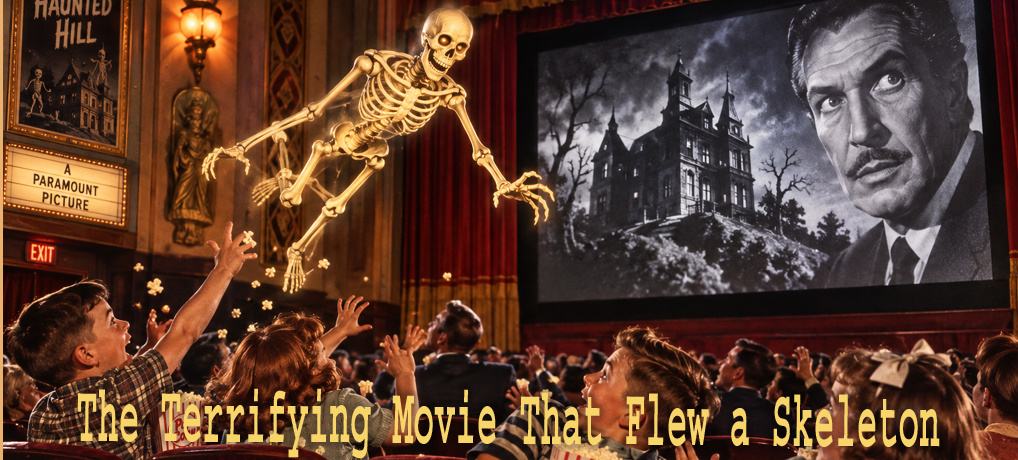
It is 1959. You are sitting in a neighborhood movie theater. The seats smell like popcorn and cigarettes. The screen is enormous. The lights went down forty minutes ago.
House on Haunted Hill is reaching its climax. Something terrible is happening on screen. A skeleton rises from a vat of acid. The audience grips their armrests.
Then something happens that nobody in a movie theater had ever quite experienced before.
A glowing plastic skeleton appears from a black box beside the screen. It begins to move. It sails out over the heads of the paying customers. It travels the length of the theater on a wire. People scream. People laugh. Some people throw popcorn at it.
William Castle called it Emergo. He considered it one of the finest ideas he ever had. The audiences who lived through it never forgot it.
House on Haunted Hill Was More Than a Horror Movie
House on Haunted Hill was released in February 1959 through Allied Artists Pictures. It was produced and directed by William Castle. It starred Vincent Price. The budget was approximately two hundred thousand dollars.
It eventually grossed around four million dollars. That is twenty times its production cost. By any measure, it was a remarkable success.
Castle was not a subtle man. He was a showman who had worked his way up through cheap B-movies and understood exactly what audiences wanted. He wanted people to talk about his films before they saw them, during them, and long after they left the theater.
The premise of House on Haunted Hill was simple and perfect. An eccentric millionaire named Frederick Loren offers five strangers ten thousand dollars each. The condition is equally simple. They must spend one night in a supposedly haunted house. They must survive until morning. The doors will be locked at midnight. Each guest receives a small coffin containing a loaded pistol.
Vincent Price played Loren. That casting alone was enough to make the film worth seeing.
Vincent Price Invites Five Strangers to Spend the Night
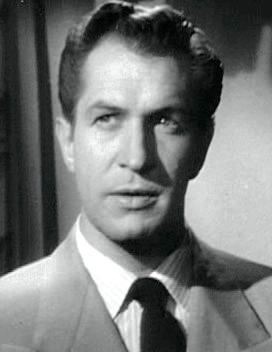
Vincent Price was already one of the most recognizable faces in American horror when House on Haunted Hill was made. His voice was unmistakable. His manner was theatrical and precise. He could deliver a line about murder with the relaxed confidence of a man discussing the weather.
Frederick Loren is not a simple villain. He is charming and generous and clearly intelligent. He is also deeply suspicious of his wife Annabelle, played by Carol Ohmart, whom he believes is plotting against him. His motives for organizing the overnight party are not entirely clear, and Castle and screenwriter Robb White kept them deliberately ambiguous.
The five guests are carefully chosen. They include a pilot, a psychiatrist, a newspaper columnist, the owner of the house himself, and a young woman who desperately needs the money. Each of them has a reason to be there. Each of them has something to lose.
Elisha Cook Jr. plays Watson Pritchard, the nervous owner of the house. His opening monologue, delivered directly to the camera, sets the tone immediately. He is a man who has seen what the house does to people. He does not want to spend the night. He is going to spend the night anyway.
The structure of the film is clever. It is never entirely clear how much of what the guests experience is supernatural and how much is staged. Annabelle is apparently plotting against Frederick. Frederick is apparently plotting against Annabelle. The house may or may not contain actual ghosts. That uncertainty is exactly where the film lives.
William Castle Knew the Theater Was Part of the Show
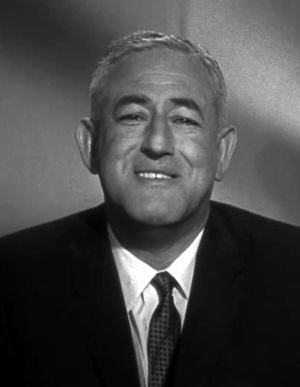
William Castle had a background in live theater before he moved into film. He understood something that most filmmakers of his era did not think much about. The building where the movie played was not neutral space. It was part of the experience.
He had tested this idea with his previous film, Macabre, in 1958. For that release, he arranged for Lloyd’s of London to insure every audience member against death by fright. Theaters displayed the insurance certificates in their lobbies. Nurses in uniform stood in the lobby. The gimmick made headlines.
For House on Haunted Hill, he wanted something physical. Something that would reach off the screen and into the audience.
Castle believed that the more people talked about seeing his films, the more people would pay to see his films. He was correct. Word spread from theater to theater. From town to town. Parents told children. Children told friends. The skeleton became the story as much as the movie itself.
He later described his approach simply. He wanted audiences to feel that they were not watching a horror film. He wanted them to feel that they were inside one.
Emergo Sent a Skeleton Flying Over the Audience
The setup was straightforward in concept and required real preparation from each participating theater.
A black box was positioned beside the theater screen. Inside it sat a glowing plastic skeleton. A system of wires and pulleys ran from the box across the ceiling of the auditorium. At the precise moment in the film when the skeleton rises from the acid vat, a theater employee released the skeleton from the box.
It floated out over the audience. It traveled across the theater on the wire. Meanwhile, on screen, Vincent Price appeared to be operating a device that was controlling the skeleton’s movement. The effect connected the screen and the ceiling into a single continuous experience.
When the scene resolved and the skeleton on screen was pulled back, the skeleton in the theater was pulled back into its box.
Castle called it Emergo. The name came from the idea of something emerging from the screen. The skeleton itself was an illuminated plastic figure. It glowed in the darkened theater. It was visible from every seat in the house.
Not every theater installed the equipment. The pulley system required installation and an operator willing to manage the timing. Smaller theaters sometimes skipped it. But in the theaters that used it, Emergo worked exactly as intended. Audiences screamed. Audiences laughed. Some audiences did both simultaneously.
Kids Eventually Fought Back Against the Skeleton
Castle understood that he had created a problem almost as soon as Emergo became famous.
Word traveled. Children in towns where the film was playing knew the skeleton was coming. They prepared accordingly.
Some brought handfuls of popcorn to throw. Some brought candy. Some came equipped with considerably more serious ammunition. According to accounts from the period, children arrived with slingshots. They loaded them with stones. With ball bearings. With whatever projectiles seemed promising.
When the skeleton appeared from its box and began its journey across the ceiling, the counterattack began.
Many theaters eventually stopped using Emergo because of this. The skeleton was taking damage faster than it could be repaired. Some theaters removed the equipment entirely after local boys made it clear that the skeleton was not going to complete its journey unmolested.
Castle reportedly found this more amusing than troubling. The children who brought slingshots had paid for their tickets. They had told their friends about the skeleton. Their friends had also paid for tickets. The system was working exactly as intended.
What nobody had anticipated was that the audience would fight back. In retrospect, it seems like something that should have been obvious.
The House Was Almost a Character of Its Own
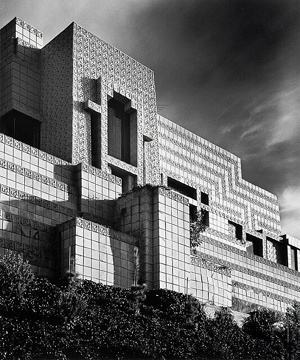
The exterior of the haunted house in the film is one of the most famous buildings in Los Angeles. Most viewers have no idea what they are looking at.
It is the Ennis House, designed by Frank Lloyd Wright and built in 1924 in the Los Feliz neighborhood of Los Angeles. Wright designed four textile block houses in the Los Angeles area. The Ennis House is the last and largest of them. It was constructed from more than twenty-seven thousand patterned concrete blocks, each cast by hand on site. The design draws from Mayan Revival architecture. It sits on a hilltop overlooking the city.
The building looks like something that should contain a haunted house film. Its massive stepped profile and textured stone surfaces suggest age and weight and something slightly outside ordinary experience. Castle used it for the film’s exterior shots because it was already doing the work he needed from it.
The interior scenes were filmed on sound stages rather than inside the actual building. The Ennis House interiors would have been impractical to film in and are architecturally quite different from the gothic spaces the film required.
The house has had an eventful life since 1959. It sustained serious damage in the 1994 Northridge earthquake and again in heavy rains in 2005. It was placed on the National Trust for Historic Preservation’s list of most endangered places. A major restoration costing approximately seventeen million dollars was completed under private ownership. The building was sold in 2019 for eighteen million dollars to its current owners. It remains a private residence. It is not open to the public.
It has appeared in more than eighty films and television productions. Blade Runner is the most famous. House on Haunted Hill got there first.
Why House on Haunted Hill Still Works Without Emergo
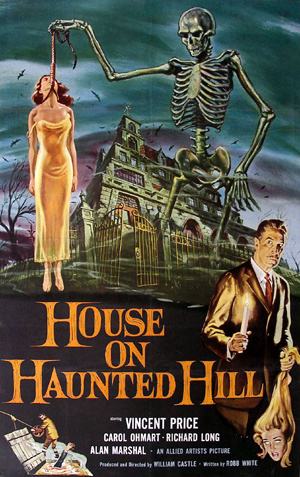
Most people watching House on Haunted Hill today see it without a skeleton sailing over their heads. The Emergo equipment is long gone from American theaters. The film has to work on its own.
It does.
Vincent Price is the primary reason. His Frederick Loren is never quite what he appears to be. He is generous and menacing in alternating scenes. His relationship with Annabelle is openly hostile and darkly funny. The film gives Price room to be theatrical without tipping into parody, and he uses that room well.
The structure of the mystery holds up. Something is genuinely happening in the house. Something is being manufactured by the characters to frighten each other. The film keeps those two categories from becoming entirely clear until the ending, and the ending earns its reveal.
The atmosphere created by the locked doors, the darkness, and the isolated setting still functions. A group of people who cannot leave, who are armed with pistols they did not ask for, who are not sure whether their host is protecting them or threatening them, is a genuinely uncomfortable situation. Castle and White understood how to build that discomfort without releasing it too early.
The black-and-white photography serves the film well. The pools of shadow in the hallways and the sharp contrast of the lit faces create a visual vocabulary that color would have diluted. The film looks like it was designed for exactly the story it is telling.
The Movie Theater Gimmick Became Part of Horror History
Emergo was not Castle’s only theatrical gimmick. It was not even his most technically elaborate one.
For The Tingler, released later in 1959, Castle installed electric buzzers beneath selected seats in participating theaters. At a key moment in the film, the buzzers activated. Audience members received a mild shock. Castle called it Percepto.
For 13 Ghosts, released in 1960, Castle developed Illusion-O, a system in which audience members received ghost viewers and could choose to see the ghosts or filter them out depending on which colored cellophane they looked through.
For Homicidal, in 1961, Castle introduced the Fright Break, a sixty-second timer that appeared on screen near the end of the film. Audience members who found the film too frightening were invited to leave before the climax and receive a full refund, provided they were willing to stand in a designated Coward’s Corner and be escorted out by a uniformed nurse.
Most people stayed.
Emergo connected to a long tradition of theatrical showmanship that predated Castle by decades. Magic shows had planted audience members since the nineteenth century. Vaudeville had used audience participation as a fundamental part of its format. The Spook Shows of the 1930s through the 1960s had been flying glowing objects over movie audiences and sending performers into the aisles in the dark for years before Castle arrived.
What Castle understood was that this tradition could be applied to mainstream commercial cinema at a moment when television was threatening the movie-going habit. He gave people a reason to leave the house. The skeleton was the reason.
Watching House on Haunted Hill Today
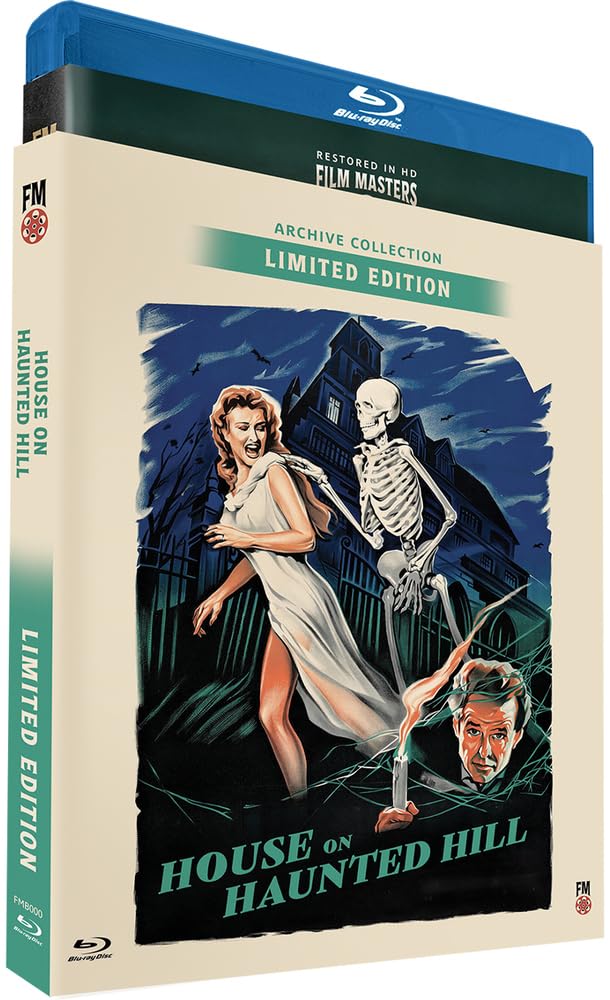
House on Haunted Hill (1959) Blu-ray
Product Description:
If you’ve enjoyed reading about House on Haunted Hill, this beautifully restored Blu-ray lets you experience one of the greatest haunted house films ever made. Starring the incomparable Vincent Price and directed by legendary showman William Castle, this 1959 classic combines mystery, humor, and old-fashioned scares into one of horror’s most entertaining movies. It’s also the film that introduced audiences to Castle’s famous “Emergo” theater gimmick, making it an essential piece of horror history.
Key Features:
• Classic 1959 haunted house film starring Vincent Price
• Directed by legendary horror showman William Castle
• High-definition Blu-ray presentation
• Features one of the most influential haunted house films of the 1950s
• A must-own for classic horror fans and Vincent Price collectors
Why This Works:
After learning the fascinating story behind House on Haunted Hill, there’s nothing better than watching the film itself. From Vincent Price’s unforgettable performance to William Castle’s ingenious theatrical tricks and spooky atmosphere, this horror classic still delivers the fun that made it a box-office sensation over sixty years ago. It’s an essential addition to any classic horror movie collection.
Buy on Amazon
Several repertory cinemas have revived House on Haunted Hill over the years with the Emergo gimmick recreated for the occasion. The Film Forum in New York and the Loew’s Jersey Theatre have both hosted screenings that flew a skeleton over the audience during the appropriate scene. Those screenings reportedly produced responses very similar to the original 1959 engagements. The audience screamed. The audience laughed. Some people threw things.
House on Haunted Hill Turned the Audience Into Part of the Movie
Think about what Emergo actually accomplished.
The skeleton on the screen was fictional. It was a prop in a story. It existed inside the movie’s world and had nothing to do with the theater where people were sitting.
Then a second skeleton appeared. This one was real. It was in the same room as the audience. It was above their heads. It was moving.
For the duration of its journey across the theater ceiling, the boundary between the film and the audience disappeared. The people watching were no longer observers. They were participants. The haunted house had expanded to include their seats.
That is a genuinely unusual thing to accomplish. Most films create the illusion of immersion through sound design and visual storytelling. Castle created actual immersion by putting a glowing skeleton in the room with the audience and making it move toward them.
The children with slingshots understood this instinctively. The skeleton was real enough to fight back against. If it could come for them, they could come for it. The transaction between the film and the audience had become physical.
House on Haunted Hill is sixty-seven years old. Vincent Price has been gone since 1993. William Castle died in 1977. The Emergo equipment is in boxes somewhere, or more likely in pieces, or most likely gone entirely.
But the film still works. The house still locks its doors at midnight. The pistols are still in their little coffins. Frederick Loren is still watching his wife with that particular expression.
And somewhere above the audience, even if only in memory, that skeleton is still making its journey across the ceiling. Still glowing. Still moving toward whoever is watching.
They paid to get in. That was always the point.