🔮 Phantasm 1979 Review: The Bizarre Horror Classic That Still Feels Like a Nightmare
Some horror movies give you rules. Phantasm gives you a funeral home, a towering undertaker, hooded little creatures, a flying silver sphere, disappearing bodies, and strange yellow blood. Then it hands all of it to a teenage boy and lets him try to figure out what any of it means. This Phantasm 1979 review looks at one of the strangest and most original horror films ever made. More than four decades later, it still feels like a nightmare somebody remembered the next morning.
Phantasm 1979 Review: Not a Normal Horror Movie
Phantasm opened in California and Texas on March 28, 1979. It reached New York that June. Avco Embassy Pictures released it after every major studio reportedly passed.
Writer and director Don Coscarelli built the film from a nightmare he had as a teenager. In the dream, he was chased down an endless marble corridor by a flying chrome sphere. That single image grew into one of the most unusual horror movies of its decade.
Phantasm feels less like a conventional horror story than a bad dream stitched together on film. Scenes shift without warning. Logic bends. Questions pile up faster than answers.
That is exactly why fans love it. More than four decades later, its weirdness is still a large part of its appeal. There simply are not many films that look, sound, or feel like Phantasm.
This Phantasm 1979 review keeps the biggest surprises quiet. You will meet the characters, the villain, the sphere, and the famous car. The deepest secrets of the Morningside mausoleum stay locked inside.
Meet Mike, Jody and Reggie
The story centers on Mike Pearson, a 13 year old boy in a small Oregon town. He is played by A. Michael Baldwin. Coscarelli wrote the part specifically for him after Baldwin appeared in his earlier film, Kenny and Company.
Mike lives with his older brother, Jody, played by Bill Thornbury. Their parents are gone, and Jody is all Mike has. Jody is the cool older brother every kid wishes for, with a guitar, a muscle car, and an easy smile.
Mike’s greatest fear is that Jody will leave town without him. That fear of abandonment gives the movie an emotional foundation beneath all the supernatural weirdness. It is a story about brothers as much as it is about monsters.
Then there is Reggie, Jody’s loyal friend. Played by Reggie Bannister, he is the town’s ice cream man and a regular guy with a big heart. He becomes the third member of this unlikely team.
The trouble begins with the funeral of a friend. Mike secretly watches from a distance. He sees the local undertaker do something no ordinary man could do.
He sees something he was never supposed to see. From that moment, Mike cannot stop watching the cemetery.
The Tall Man Doesn’t Need a Mask
Horror villains usually come with a gimmick. There is a hockey mask, a burned face, a chainsaw, or a glove full of blades. The Tall Man needs none of that.
He is tall.
He is severe.
He is unnaturally strong.
He wears a dark, tight suit and stalks the halls of Morningside Mortuary with grim purpose. Angus Scrimm plays him with a scowl that could curdle milk.
And somehow Scrimm can make the simple word “Boy!” sound like a death sentence. Fans have quoted that bark for decades.
Part of what makes him so disturbing is how little the movie explains. Who is he? What does he want? What is he doing with the bodies? The film offers hints but very few clear answers. The mystery makes him more frightening than any detailed backstory could.
He also has some truly odd habits. When Mike slams a door on his hand, the severed fingers keep twitching. They bleed bright yellow. It is a small, strange detail that tells you this is not a normal man.
That Mausoleum Is Pure Nightmare Fuel
The Morningside mausoleum is one of the film’s defining locations. It does not look like a typical horror setting.
There are bright white corridors, long hallways, polished marble walls, and echoing footsteps. Almost nobody is around. Everything is clean, cold, and silent.
It should not be as frightening as a dark, cobwebbed basement. Somehow it is far worse.
Coscarelli turns an ordinary funeral setting into a place that feels disconnected from the real world. The corridors seem to go on forever. Doors open onto rooms that should not exist. You never quite know where you are inside the building.
The exterior of the mortuary was filmed at Dunsmuir House, a grand historic mansion in Oakland, California. The interiors of the mausoleum were built inside a warehouse in the Los Angeles area. On screen, the two blend into one unforgettable place.
That eerie combination of sterile marble and Victorian grandeur makes the mausoleum feel like it belongs in a dream. It is one of the great horror locations of the 1970s.
Then Comes the Silver Sphere
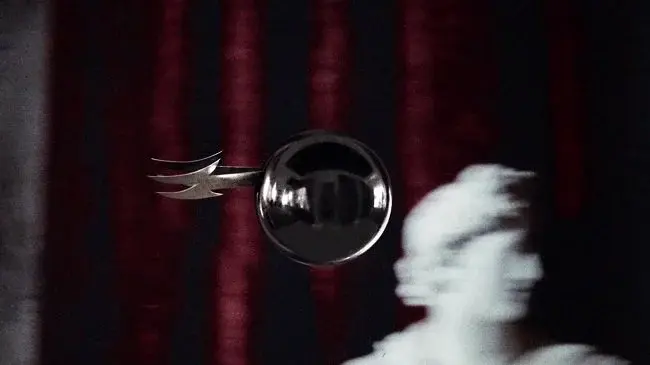
You cannot review Phantasm without talking about the sphere.
The polished silver ball floats silently through the mausoleum halls. It hunts intruders with terrifying speed. When it finds one, it is very bad news.
The sphere became one of the most recognizable objects in cult horror. Its basic idea is simple. It is a flying metal ball that attacks. The details of what it does are nasty, and they are best left for viewers to discover.
The important point is that Coscarelli took something incredibly simple and created a horror weapon nobody had seen before. There was no tradition behind it and no mythology. It came straight out of his nightmares.
The real spheres were made by hand. An elderly metalworker named Will Greene fashioned them for the production. Sadly, he died before the film was released and never saw his creations become horror icons.
Today, the sphere is instantly recognizable to horror fans around the world. Collectors have even bought full scale replicas. It is the kind of iconic image most filmmakers can only dream about.
Where Did Don Coscarelli Get This Stuff?
Don Coscarelli was a young filmmaker in his early twenties when he made Phantasm. He had already directed small independent films, but they had not done well at the box office. He heard horror movies were always successful, so he decided to try one.
He did nearly everything himself. He wrote the script, directed the film, shot it as cinematographer, and edited it. He simply could not afford to hire anyone else for those jobs.
The budget was tiny, estimated at about $300,000. Money came from Coscarelli, his father, and local investors such as doctors and lawyers. His father received the producer credit. His mother helped with special effects, costumes, and makeup, using pseudonyms in the credits.
The cast and crew were mostly friends and aspiring professionals. They filmed mainly on weekends over more than a year, starting in 1977. Some shooting days reportedly ran as long as 20 hours.
Coscarelli drew on several influences. He had hoped to adapt Ray Bradbury’s Something Wicked This Way Comes, but the rights were already sold. The 1953 film Invaders from Mars inspired the idea of a boy whom no adult believes. Dario Argento’s Suspiria showed him that horror did not need to explain everything.
The script changed constantly. Reggie Bannister later said he never saw a finished copy. The cast worked scene by scene, often improvising. Several endings were filmed before Coscarelli chose one.
Rather than explaining every strange element, Coscarelli lets the audience experience Mike’s confusion along with him. That choice became one of the film’s greatest strengths.
Angus Scrimm Became a Horror Icon
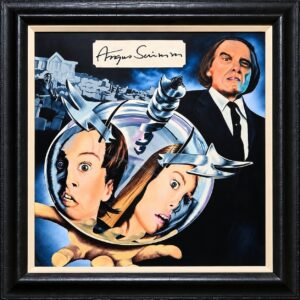
Angus Scrimm deserves a section all his own. Before Phantasm, he was not known as a horror star at all.
Coscarelli met him on the set of an earlier film, Jim the World’s Greatest. Scrimm intimidated the young director, and Coscarelli realized he would make a terrific villain.
Scrimm was already tall, but the production made him look even taller. He wore lifts in his shoes and a suit that was deliberately too small for him. The tight fit made him look longer, thinner, and more unnatural.
His performance is a model of restraint. He barely raises his voice. He does not overact. He simply stares, glares, and moves with slow, terrible purpose. His unusual deep voice adds to the effect.
He does not need much screen time to dominate the movie. Whenever the Tall Man appears, everything feels wrong.
Phantasm turned Scrimm into a cult horror figure. He played the Tall Man in all five films. His final performance came in Phantasm: Ravager, released in 2016, the same year he passed away.
He also became a beloved presence at horror conventions, where fans lined up to meet the man behind the Tall Man. The character has even been cited as an influence on the internet legend Slender Man.
Reggie Bannister Is the Guy You Want Around
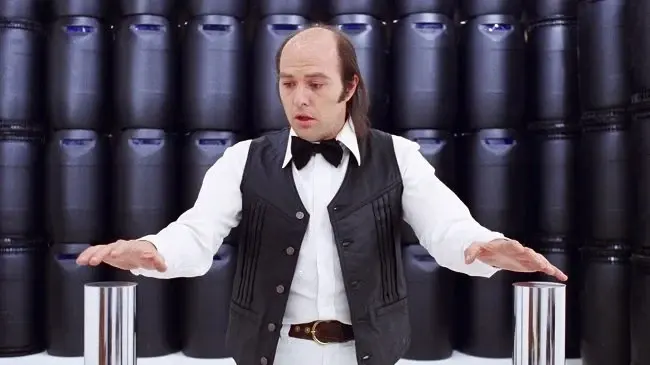
Reggie begins as Jody’s friend and the local ice cream man. He plays guitar, cracks jokes, and seems like the least likely person to battle cosmic evil.
Coscarelli based the character on his real friend Reggie Bannister and wrote the part for him. Reggie was designed as an everyman, a loyal friend, and a bit of comic relief.
That ordinary guy quality is exactly why audiences love him. He is not introduced as an action hero. He is simply Reggie. He is balding, friendly, and loyal to a fault.
Bannister performed most of his own stunts in the film. He later described the production as flying by the seat of their pants.
As the Phantasm series continued, Reggie became more and more important. He grew into the franchise’s unlikely hero, armed with a quadruple barreled shotgun and a never say die attitude. In the original film, though, he is just the guy you want around when things get weird.
Yes, We Need to Talk About the ‘Cuda
The black 1971 Plymouth Barracuda deserves real attention. In Phantasm, it is not just transportation. It is part of the movie’s identity.
The ‘Cuda sits right alongside the Tall Man, the mausoleum, and the silver sphere as one of the film’s signature images. When Jody fires it up, the rumble of the engine feels heroic.
The car has a great backstory. In high school, Coscarelli saw a classmate driving a bright green 1970 Plymouth AAR ‘Cuda. The memory stuck with him. Years later, while writing Phantasm in a mountain cabin, he decided his heroes would drive one.
The car used in the 1979 film was a 1971 ‘Cuda that had originally left the factory painted purple, with a white interior. It carried a 340 cubic inch V8 and a four speed manual transmission. For the movie, it was painted black.
Later sequels upgraded the ride. Phantasm II used a 1971 Hemi ‘Cuda. Phantasm III featured a rare 1970 Hemi ‘Cuda convertible, one of the most prized muscle cars of its era. The original car from the first film later vanished from the record.
For Kilroy readers, this is a perfect example of how cars became genuine characters in late 1970s and 1980s genre movies. Think of the black Trans Am in Smokey and the Bandit or the haunted Plymouth Fury in Christine. In Phantasm, the ‘Cuda is the brothers’ armor, their escape, and their pride.
The Little Hooded Creatures Make Everything Even Weirder
Just when viewers think they understand what kind of movie they are watching, Phantasm introduces the hooded creatures.
They are small figures wrapped in dark brown robes. Their faces stay mostly hidden. They scurry through the cemetery and attack with surprising strength. Their muffled grunts and quick movements make them deeply unsettling.
Their true origin is one of the film’s biggest secrets, and it stays secret here. It is enough to say that they are connected to the Tall Man and to what he is doing with the dead.
Their presence pushes the movie in a new direction. What began as a supernatural mystery about a creepy undertaker starts sliding toward science fiction and surreal horror. The creatures hint that the Tall Man’s plans are much bigger than one small town.
Horror or Science Fiction?
This is one of the things that makes Phantasm so hard to classify.
It contains graveyards, coffins, corpses, and a sinister mortician. Those are classic horror ingredients.
It also contains strange technology, glimpses of other worlds, and concepts that belong just as easily in science fiction. Some scenes feel closer to a space movie than a ghost story.
Coscarelli mixes everything together without worrying much about genre boundaries. He follows his imagination wherever it leads.
That fearless blend is one reason the movie remains so distinctive. It does not fit neatly on any shelf, and that is part of its charm.
Why Phantasm Feels Like a Dream
Characters appear and disappear.
Scenes move unexpectedly.
Reality becomes uncertain.
Questions receive answers that create even more questions.
Phantasm runs on dream logic. Part of that was deliberate. Coscarelli wanted to capture the feeling of a nightmare. Part of it came from the editing room. An early test screening went poorly because the cut was too long, so Coscarelli trimmed heavily. The fractured result made the film feel even more dreamlike.
The music adds to the effect. Fred Myrow and Malcolm Seagrave composed a haunting synthesizer score. Their main theme is eerie, hypnotic, and instantly recognizable. Record collectors will be glad to know Waxwork Records released the score as a three LP vinyl set in January 2025, restored from the original tapes.
This dream logic can frustrate viewers who expect a neatly explained story. They may finish the film wondering what they just watched. For Phantasm fans, though, that confusion is the whole point. Each viewing can reveal something new or suggest a different meaning.
The Low Budget Actually Helps
Phantasm does not look like a polished studio horror movie. That is part of its character.
The practical effects are homemade and inventive. The locations feel real, not built for a soundstage. The editing is strange and sometimes abrupt. The acting is occasionally raw. There are rough edges everywhere.
Yet those rough edges make the movie feel as though someone discovered footage of an actual nightmare. A slicker production might have smoothed away the strangeness.
There are even funny stories from the set. The inexperienced crew did not realize firing blanks could be dangerous. At one point, Coscarelli’s own jacket caught fire from a shotgun blank.
Instead of hiding its independent roots, the movie benefits from them. Coscarelli had the freedom to follow his own vision, including choosing the ending he wanted. No studio executive was there to make it safer.
How Phantasm Became a Cult Horror Classic
The success of John Carpenter’s Halloween in 1978 helped convince Avco Embassy to take a chance on Phantasm. The studio released it region by region in 1979.
Coscarelli and Scrimm traveled across the country to promote it. Scrimm would appear on early morning television shows in full costume and makeup, glaring into the camera.
The gamble paid off. Phantasm earned about $12 million in the United States and around $22 million worldwide. That was a huge return on a budget of roughly $300,000. In Australia, it was retitled The Never Dead.
Critics were mixed. Roger Ebert gave it a largely negative review, though he admired its visual style. The New York Times compared it to a ghost story told by a bright, imaginative child and found it silly but endearing. It did win a Special Jury Award at France’s Avoriaz Fantastic Film Festival.
Its reputation grew through home video, cable television, horror conventions, and repeat viewing. Many fans first saw it as teenagers and never forgot it. The Tall Man and the silver sphere became recognizable far beyond the film’s original audience.
Its influence is easy to spot. Critics have pointed to Phantasm as an influence on A Nightmare on Elm Street and the television series Supernatural. Horror fans keep discovering it decade after decade.
In 2016, the film received a stunning 4K restoration. Director J.J. Abrams, a longtime fan, offered his company Bad Robot to help. The restored version premiered at South by Southwest and returned to theaters that fall.
Phantasm Didn’t End in 1979
Phantasm eventually grew into an entire series. Here are the follow ups:
- Phantasm II (1988)
- Phantasm III: Lord of the Dead (1994)
- Phantasm IV: Oblivion (1998)
- Phantasm: Ravager (2016)
Angus Scrimm and Reggie Bannister appeared in all of them. A. Michael Baldwin was replaced by James Le Gros in Phantasm II, but he returned for the later films. Phantasm IV even reused footage from one of the original film’s unused endings.
Each sequel digs deeper into the mythology of the Tall Man. Each one is a worthy subject for its own review. For now, the original remains the place to start.
Does Phantasm Still Work Today?
Absolutely, although new viewers need to accept the movie on its own terms.
Some effects reveal the limited budget. The acting can be uneven. The storytelling can feel deliberately disjointed, and some viewers will want more answers than the film provides.
But the Tall Man, the mausoleum, the sphere, the music, the atmosphere, and the sheer originality remain difficult to forget. The emotional core also holds up. Underneath the weirdness is a moving story about grief, loss, and two brothers who love each other.
The 4K restoration helps too. The picture looks better than ever, and the film can now be appreciated in sharp detail. There still is not much else quite like Phantasm.
Who Should Watch Phantasm?
This film is ideal for viewers who enjoy 1970s horror and practical effects. It suits fans of independent filmmaking, surreal stories, and cult movies.
It is a must for anyone who likes horror mixed with science fiction. It also rewards viewers who enjoy movies that do not explain everything.
Car buffs will love the ‘Cuda. Record collectors will enjoy the haunting score. Horror history fans will appreciate seeing where the Tall Man began.
Anyone wanting a straightforward slasher may wonder what planet they have landed on.
Which, considering Phantasm, is not entirely inappropriate.
Final Thoughts 4.8/5
Phantasm should not work as well as it does.
It is inexpensive, strange, occasionally confusing, and packed with ideas that sound ridiculous when you try to explain them one at a time. A flying silver ball. A giant undertaker. Hooded little creatures. Yellow blood.
Put them together, however, and Don Coscarelli created something horror movies rarely manage: a world entirely its own.
The Tall Man does not feel borrowed from another monster. The sphere does not resemble another horror weapon. The mausoleum does not feel like another haunted house.
Wrapping up this Phantasm 1979 review, nearly fifty years later, Phantasm is still unmistakably Phantasm.
Watch it late at night, don’t expect every question to be answered, and if you hear someone behind you say “Boy!”, don’t bother looking back.