Spook Show Forgotten Americana
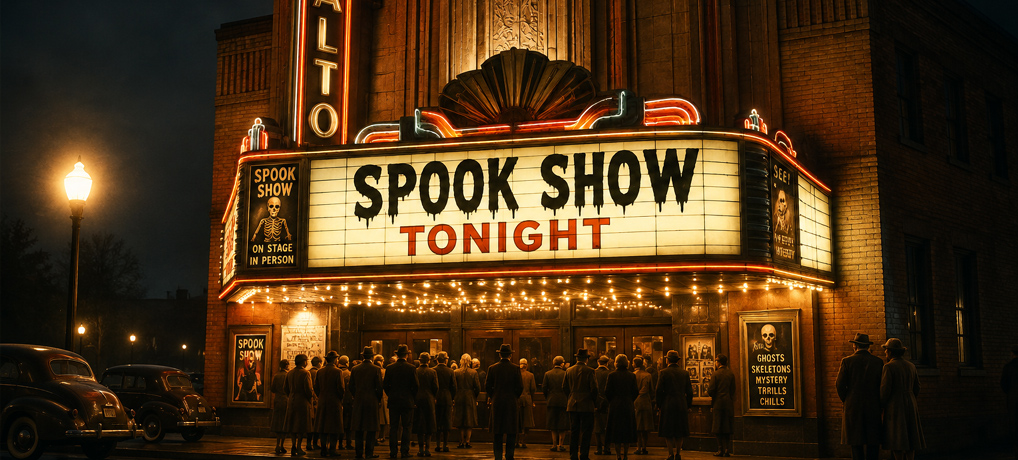
Long before you ever paid admission to walk through a haunted house, long before actors in monster masks jumped out of fog-filled corridors and teenagers screamed their way through elaborate mazes, there was something far stranger, far more personal, and in many ways far more thrilling waiting for you at the local movie theater. It started after midnight. It cost you the price of a single ticket. And if you were lucky enough to have been there, you never quite forgot it.
They were called Spook Shows, and for nearly four decades they were one of the most popular forms of live entertainment in America. Part magic act, part horror comedy, part séance, and part audience prank, the Spook Show was something that has never quite been replicated since. This is the story of where they came from, what went on inside them, the showmen who made them famous, and why the tradition matters more than most people realize.
What Were Spook Shows?
Midnight ghost shows, sometimes called Spook Shows, voodoo shows, or monster shows, were traveling stage productions that originated in the United States during the Great Depression and ran strong through the late 1960s. They were performed almost exclusively in movie theaters, usually after the last regular screening of the evening, and they combined stage magic, horror-themed comedy, fake séances, audience participation, and a grand blackout finale that left grown adults screaming in the dark.
The shows drew from several older traditions at once. Victorian spiritualism had made séances enormously popular throughout the 1800s, and by the early 1900s stage magicians like Howard Thurston and Harry Kellar were already incorporating ghostly illusions into their acts, advertising themselves with posters showing skeletons and spirits. Vaudeville had trained audiences to expect comedy mixed with wonder. And the rise of horror films in the late 1920s and early 1930s, with Dracula, Frankenstein, and The Mummy packing movie houses across the country, had created a public with a serious appetite for being scared in a safe and entertaining way.
The Spook Show pulled all of that together under one roof at midnight and charged a single admission. During the Depression, a theater could do a week’s worth of business in a single Spook Show night. That was reason enough for theater owners across the country to throw open their doors after dark and let the ghostmasters in.
Why They Usually Started at Midnight
The midnight start time was not an accident. It was the single most important piece of showmanship in the entire production, and the ghostmasters knew it.
A movie theater at eleven-thirty at night is a different place than it is at seven in the evening. The families have gone home. The street outside is quieter. The darkness outside the windows feels just a little heavier. When you buy your ticket and take your seat in a nearly empty theater that late, your imagination is already working before the curtain even opens. The ghostmasters understood that the audience’s own mind was the most powerful piece of equipment they had, and everything about the midnight timing was designed to activate it.
The shows were typically structured around the theater’s regular programming. A horror film would play first, warming the crowd up and letting what ghostmaster historian Jim Ridenour once described as the hoodlums get tired and worn out. After the first movie ended, the stage show began immediately, with no break, no chance for the energy in the room to settle. The ghostmaster wanted the audience already primed, already a little jumpy, already in that particular receptive state where a creak from the balcony or a shadow moving at the edge of the stage could send a shiver right through them.
After the stage show reached its shrieking climax in total darkness, the lights would come up and the second horror film would begin. You got two movies, a full live stage performance, comedy, illusions, monsters in the aisles, and the most memorable ten minutes of darkness you had ever sat through, all for one price. No wonder the seats were full.
Inside a Typical Spook Show
Every ghostmaster had his own style, his own persona, and his own set of signature effects. But the general shape of a Spook Show evening followed a pattern that audiences across the country came to know and love, and that structure was part of what made each show feel like both a familiar ritual and a fresh experience.
It opened with comedy. The ghostmaster would stride onto the stage in formal dress, usually a tuxedo or a dramatic cape, and immediately begin warming up the crowd with jokes, banter, and mildly spooky patter. The tone was always a winking blend of genuine menace and good-natured fun. You were being told you were about to be terrified, and the ghostmaster was making sure you knew that being terrified was going to be an absolute pleasure.
The magic demonstrations followed. These were full stage illusions, often with an emphasis on horror themes. Swords through coffins containing assistants. Decapitations that produced more laughs than gasps. Mentalism and mind reading that made members of the audience feel singled out by invisible forces. The magic in a Spook Show was never cold or clinical. It was designed to unsettle you while making you grin.
The fake séance came next, and this was where the Victorian spiritualist tradition made itself fully felt. The ghostmaster would claim contact with the spirit world. Tables would move. Objects would float. Voices of the dead would seem to speak from the darkness around the stage. Many audience members knew perfectly well they were watching illusions, and many others were not so sure, and the ghostmaster played gleefully to both camps at once.
Then came the blackout. Without warning, every light in the theater went out. The darkness was complete and total. In that darkness, all manner of things happened. Luminous ghosts painted with glow-in-the-dark paint swept over the heads of the audience on poles. Glowing skulls appeared and vanished. Performers in skeleton costumes danced and capered on stage, visible only by the luminescent paint on their bones. Something slimy would land on your head. Something cold and damp would drag across your face. All around you, people were screaming. Some of them were screaming because they were genuinely frightened. Some of them were screaming because screaming was the only appropriate response to this much fun.
When the lights came back on, the audience dissolved into laughter and relief. The horror film began. And everyone in the building felt like they had survived something together.
7 Ideas for a Spooky Psychic Halloween Party
Black Art Magic and Ghost Illusions
The technical backbone of the Spook Show was an old theatrical technique known as black art, and it is one of the most elegant deceptions in the history of stage performance.
The principle is straightforward once you understand it, though it takes genuine skill and careful staging to execute well. A stage is dressed entirely in black velvet. Assistants wear black from head to toe, covering even their hands and faces. Against that background, in the right lighting conditions, a person dressed in black becomes functionally invisible to the audience. They can carry objects, manipulate props, move things around the stage, and the audience sees only the objects themselves, appearing to float and move of their own impossible accord.
When the black art stage is combined with ultraviolet lighting and objects painted with luminescent or phosphorescent paint, the effects become genuinely spectacular. Skeletons that glow in the dark appear to dance by themselves. Skulls float through the air. Ghostly forms drift across the stage, rising and falling as if breathing, assembled from nothing more than cheesecloth dipped in luminous paint and carried by invisible assistants.
During the blackout sequence itself, the invisible assistants moved through both the stage and the theater aisles, extending poles with glowing objects into the audience seating area, passing things close over people’s heads, creating the sensation of being surrounded by things that should not exist. When ghostmasters mentioned that spiders or worms were falling from the ceiling, their assistants would simultaneously drop popcorn onto the audience and drag damp mop strings across people’s faces. Your skin told you something was there. Your eyes told you the darkness was empty. And your brain, right at midnight in a theater that had started feeling like a haunted house about two hours ago, was perfectly primed to believe what your skin was saying.
The Monsters Came Alive
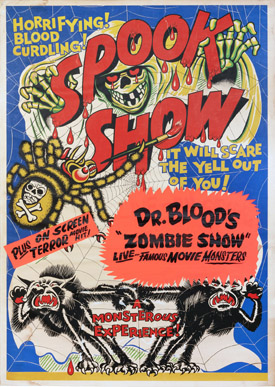
The blackout sequence was the centerpiece of the show, but it was not the only moment when the performance got physical with its audience. Throughout the evening, and especially during the grand finale, performers in full monster costume would pour off the stage and into the seating area, and the screaming would reach a pitch that no horror film had ever quite managed to produce.
Skeletons were a staple. So were devils, vampires, zombies, gorillas, hunchbacks, and whatever creature the ghostmaster’s particular show had chosen as its signature monster. Some shows featured Frankenstein’s monster. Others worked with Dracula. Joe Karston’s productions made use of rubber masks created by Don Post, the legendary Hollywood mask maker, to create creatures that looked genuinely alarming in the chaotic near-dark of the blackout sequence.
Dr. Silkini’s Asylum of Horrors featured Frankenstein’s monster so convincingly, played at one point by Boris Karloff’s own body double from the original Universal picture, that Universal Pictures actually took legal action against Jack Baker to stop him using the character. Baker responded by staging a private performance for studio executives, who were apparently so impressed by what they saw that they allowed him to continue. That detail tells you quite a lot about the quality of what the best ghostmasters were producing.
Bill Neff’s Madhouse of Mystery featured an actress playing Dracula’s daughter, complete with the well-established illusion of locking a woman in a box and thrusting swords through the sides. A gorilla would rush into the audience and snatch up an audience member who was, naturally, a planted accomplice. The genuine audience members around the planted victim had no way of knowing this. Their reactions were entirely real, and the screams of one person in genuine surprise were always enough to set off a chain reaction through the entire house.
Audience Participation Was Half the Fun
The Spook Show was not a passive experience. You did not sit in your seat and watch things happen on a screen. Things happened to you, around you, and occasionally because of you, and that was the whole point.
Planted audience members were essential to the craft. A volunteer from the audience who turned out to be in on the joke could be dragged up on stage and apparently decapitated, their head placed on a table while their body stumbled around the stage in comic confusion. The real audience, watching what appeared to be an actual person’s head sitting there looking around the room, produced a response that no amount of stagecraft alone could have generated. The planted victim always knew exactly when to look terrified and when to look confused, and the ghostmaster played the whole scene like a conductor leading an orchestra of screams.
Some shows featured fake electric chairs. A volunteer, always someone who had been carefully prepared in advance, would be strapped in and apparently subjected to a surge of electricity. Sound effects, lighting, and the volunteer’s own theatrical performance did the rest. The audience saw what they were primed to see, and the resulting panic in the house was entirely genuine.
During the blackout, the ghostmaster was also relying on the audience to do his work for him. He knew perfectly well that the most frightened people in any theater were not the ones being targeted by his assistants. They were the ones sitting next to those people. When your neighbor suddenly screams and grabs your arm in the dark, your nervous system does not stop to ask questions. It simply reacts, and the Spook Show ghostmasters had been studying exactly how audiences reacted in the dark for their entire careers.
Kara Kum, one of the more outrageously gory showmen of the 1950s, was known for staging apparent decapitations and scenes involving what appeared to be cannibalism, pushing the audience’s tolerance so hard that the comedy and the horror became genuinely difficult to separate. His shows were not for the faint of heart, which was exactly why they sold out.
The Great Promoters of Spook Shows
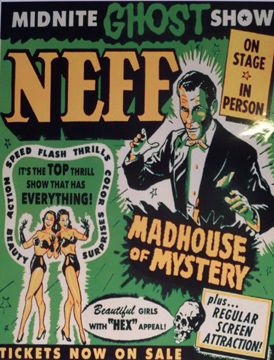
The history of the Spook Show is really the history of a handful of remarkable personalities who turned late-night huckster entertainment into a genuine American art form, and who competed with each other for decades with the cheerful ferocity of rival circus owners.
It started with Elwin Charles Peck, who performed as El-Wyn. In 1929, Peck approached a movie theater and proposed performing a magic show after the last regular screening. Vaudeville was dying by then and magicians needed venues. His Midnite Spook Party combined a horror film, a stage magic act, a fake séance, and the blackout finale that would define every Spook Show that followed. By the early 1930s, El-Wyn was touring the nation and pulling in three thousand dollars a week at a time when that figure was genuinely extraordinary. He retired in the late 1930s but the format he created kept growing without him.
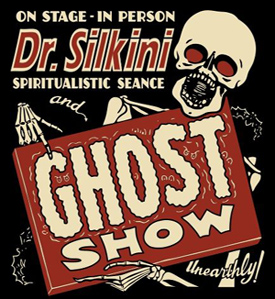
Jack Baker, who performed as Dr. Silkini, became arguably the most successful ghostmaster who ever lived. Baker, who was born John Kessler in Toledo, Ohio, got into magic almost by accident when a magician named The Great Melroy failed to show up for a theater engagement and Baker, who knew a handful of tricks, offered to fill in. He later recalled that he was certain he had been terrific and equally certain he had been terrible. It did not matter. The bug had bitten him. Dr. Silkini’s Asylum of Horrors ran from the late 1930s through the 1960s, playing to sold-out crowds across the United States, Canada, Mexico, and Europe. At his peak, Silkini had seven separate road companies touring simultaneously. A fellow ghostmaster and historian named Jim Ridenour later said that Baker had worked the spookers for forty-two years and made millions of dollars. The show’s sense of humor was as important as its scares. Even though the advertising stressed fright and thrills, the Asylum of Horrors rapidly evolved into something closer to a comedy spoof on spiritualism, and audiences loved it for exactly that reason.
Bill Neff was Silkini’s most serious competitor, and many who saw both shows considered Neff the superior showman. Neff had a connection to Hollywood royalty that no other ghostmaster could match. He and actor James Stewart had grown up together in Indiana, Pennsylvania, where Stewart’s father owned a hardware store. They had a stage act together through high school and continued performing together for a time afterward. When Neff created his touring ghost show, Madhouse of Mystery, during World War II, Stewart gave it a personal endorsement that Neff used to great promotional advantage. Neff ran Madhouse of Mystery from 1945 to 1952, and he closed every show the same way, stepping to the front of the stage after the lights came back up and wishing the audience pleasant nightmares. People remembered that line for the rest of their lives.
Joe Karston operated differently from the solo ghostmasters. He was a booking agent and promoter as much as a performer, and he maintained a stable of magicians who could headline multiple shows simultaneously under various frightening names. Dr. Satan’s Shrieks in the Night, Dr. Macabre’s Frightmare of Movie Monsters, and Dr. Jekyll and His Weird Show were all Karston productions. He also produced a short film called Monsters Crash the Pajama Party in 1965 that included an interval during which costumed actors would appear to exit the film and venture into the actual audience, abducting a planted victim and appearing to drag them back into the movie. It was a Spook Show in miniature built into the film itself.
Philip Morris performed as Dr. Evil and was one of the last ghostmasters to tour in the golden era, working into the 1960s with an emphasis on publicity stunts and radio advertising. He later became one of the few ghostmasters to make the transition to television, hosting Dr. Evil’s Horror Theatre for East Coast TV affiliates.
Kara Kum, whose real name was Wladyslaw Michaluk, occupied the far end of the Spook Show spectrum. His shows were aggressively gory, featuring staged decapitations, apparent cannibalism, and at least one memorable sequence involving what appeared to be the materialization of James Dean. His advertising featured what observers described as overt sensationalism, and his shows drew exactly the crowd that kind of advertising promised.
15 DIY Haunted House Tricks: Simple Ways to Create Frightful Fun
From Traveling Roadshows to Small-Town Theaters
The geography of the Spook Show was as much a part of its character as anything that happened on stage. These were not productions with permanent homes. They were traveling shows in the oldest tradition of American entertainment, loading their equipment into trucks and moving from city to city, often staying for a single night before rolling on to the next engagement.
The economics were straightforward and, for the successful ghostmasters, highly attractive. A movie theater that had already closed for the evening was sitting empty. The ghostmaster offered the theater owner a share of the ticket revenue for the right to use the stage and the house. The theater owner got income from what would otherwise have been dead hours. The ghostmaster got a ready-made venue with seating, a stage, a screen for the horror film component, and a captive local audience who already knew where the theater was.
For the audience in smaller cities and towns, the arrival of a Spook Show was a genuine event. These productions brought a level of theatrical spectacle that small-town residents did not often see. The equipment, the performers, the entire traveling circus of the thing represented a visit from the wider world of entertainment, and people turned out for it accordingly.
By the 1950s, Silkini’s operation had grown to the point where seven separate road companies were touring simultaneously, each presenting the Asylum of Horrors in a different part of the country. This was the ghostmaster business at industrial scale, and it required the logistical sophistication of a small corporation to manage. Equipment had to be maintained across multiple units. Performers had to be hired, trained, and kept in line. Local theaters had to be booked months in advance. The casual impression of huckster showmanship that the audience saw from their seats in the dark was backed by genuine organizational infrastructure.
The Incredible Advertising That Filled the Seats
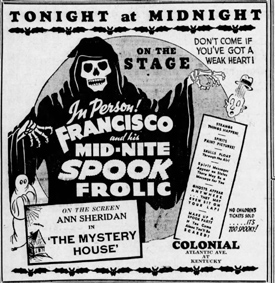
A Spook Show that nobody heard about was a Spook Show playing to empty seats, and the ghostmasters understood advertising with the same creative intensity they brought to every other aspect of their craft. The promotional materials for these shows were among the most exuberant pieces of commercial art that American popular culture ever produced.
The posters were extraordinary. Large cardboard window cards, typically around twenty-two inches wide and twenty-nine inches tall, were placed in theater lobbies and storefronts around town in the days before the show arrived. They were printed in stark, flat colors with maximum visual impact, designed to stop a passerby on the sidewalk and make them feel that missing this event would be a genuine loss. The language on these posters operated at a pitch of hyperbole that would make even the most enthusiastic advertising copywriter of today feel modest by comparison. Ghosts materialize. Real mummies walk. Monsters run loose in the audience. Ghosts and ghouls sit next to you. That last promise was not, technically speaking, entirely false.
Newspaper ads ran in the days leading up to each performance, and they matched the posters for intensity. Handbills were distributed around town. Radio spots on local stations added Philip Morris’s Dr. Evil persona to a new medium in the 1950s, giving potential audiences the voice of the ghostmaster in their living rooms before they ever set foot in the theater. The cumulative effect of all this advertising was to create a sense of event around the show that began days before the curtain went up.
One of the canniest promotional techniques was the invitation to bring a group. Ghostmasters urged audiences to come together and make up a spook party, to gather as many friends as possible and attend as a group. The social reasoning was sound. People who are slightly frightened feel much better in a crowd of friends. People who feel better in a crowd of friends buy more tickets. And a theater full of groups of friends, each egging the others on and screaming together in the dark, generates an atmosphere that no solo audience member could ever create on their own.
Parents Loved Them Almost as Much as Teenagers
The Spook Show has sometimes been described as a teenage entertainment, and in its later years that was largely accurate. By the 1950s, as Mark Walker documented in his book Ghostmasters, the audiences attending these late-night shows had shifted considerably younger. Teenagers on dates, kids from fourteen to seventeen looking for an excuse to hold someone’s hand in the dark, junior and senior high school crowds who had often never seen a live stage show of any kind. For them, the Spook Show was a revelation.
But the earlier era of the Spook Show, through the 1930s and 1940s, drew a much broader audience. The magic demonstrations were sophisticated enough to impress adults who appreciated genuine stage craft. The comedy was broad enough to work across generations. The horror film that accompanied the evening was the same film that audiences of all ages were already buying tickets to see in their ordinary evening screenings.
For many families, the Spook Show became a seasonal tradition, something to be anticipated and attended together the way later generations would anticipate Halloween haunted attractions. A parent who took their children to a Spook Show was giving them something that no other form of entertainment could quite replicate: the experience of being genuinely startled and then laughing about it together, of the fear and the comedy arriving at the same moment, of walking out into the night air afterward and talking about what you had just survived.
El-Wyn’s early promotional materials actually advertised that children would not be admitted because the show was too scary for them, which was a marketing masterstroke. Telling adults that a form of entertainment was too intense for children is one of the most reliable methods ever devised for filling a house with adults who are quietly excited to see what all the fuss is about.
Why Spook Shows Disappeared
The decline of the Spook Show was not caused by any single thing. It was the result of several forces converging on the same moment in American entertainment history, each one individually manageable but together overwhelming.
Television arrived in American living rooms at exactly the wrong moment for the Spook Show. The number of television sets in American homes went from roughly one million in 1949 to over fifty million by 1959. People who had previously gone out for their evening entertainment now had an alternative that required them to go nowhere and spend nothing. The late-night television programming that emerged in the 1950s, including horror hosts like Vampira, who debuted in 1954, Chiller Theatre, and Shock Theatre, was in many cases a direct imitation of the Spook Show format, bringing the macabre comedy and horror film combination into the home. Philip Morris, performing as Dr. Evil, even made the transition directly, hosting his own television horror show.
The movie theater stages themselves were disappearing. The wide-screen formats introduced in the early 1950s, particularly CinemaScope, required theaters to expand and modify their screens. In many houses, this meant removing or reducing the stage area in front of the screen to accommodate the new projection requirements. Without a proper stage, the magic demonstrations and the elaborate blackout sequences became difficult or impossible to mount effectively.
The horror films of the early 1960s were also moving in a direction that made the Spook Show’s pleasantly campy scares feel comparatively tame. As splatter films arrived and drive-in theaters offered a different kind of late-night horror experience, the Spook Show’s combination of comedy illusions and luminescent cheesecloth ghosts began to look like a relic of a gentler era. The ghostmasters who tried to compete by amping up the gore were working against what their format did best. The Spook Show was always at its most powerful when it was playful, and playful was increasingly not what the horror audience of the 1960s was looking for.
The cost of mounting a proper Spook Show had also risen. The equipment required for the blackout sequence, the costumes, the travel expenses for a full company of performers and crew, all of it added up in a way that was increasingly difficult to recoup from a single midnight engagement. By the time the last ghostmasters were working in the late 1960s and early 1970s, the economics that had made the Spook Show so attractive during the Depression had largely inverted.
31 Halloween Superstitions You Didn’t Know About – Fascinating Fears & Hidden Truths
How Spook Shows Inspired Modern Haunted Houses
The commercial haunted attraction industry did not emerge from nowhere. It emerged from a cultural context that the Spook Show had spent four decades creating, and the DNA of the midnight ghost show runs directly through every haunted house that has charged admission since.
The Jaycees, the United States Junior Chamber, began encouraging their members to build haunted houses in abandoned buildings and fields as charity fundraisers in the 1960s, with the first documented official Jaycees haunted house appearing in Cincinnati in 1970. These early attractions drew heavily on the same monster vocabulary that the Spook Shows had established: Frankenstein’s monster, Dracula, the Wolfman. The costumed actors who jumped out of dark corners were doing in three-dimensional space exactly what the ghostmaster’s assistants had been doing in the aisles of movie theaters for decades.
The technical elements are even clearer. Actors emerging from darkness to startle audiences, timed lighting effects that reveal and conceal, sound design built around the same principles of anticipation and shock that the ghostmasters had refined across thousands of performances, monsters engaging directly with audience members rather than simply performing for them from a safe distance: all of this was Spook Show practice transposed into a walk-through format.
When Disneyland opened the Haunted Mansion in 1969, the invisible black-art techniques that had made ghostmaster illusions possible in darkened theaters were translated into a world-class permanent attraction. When Knott’s Berry Farm launched its Scary Farm in 1973, the combination of themed horror environments, costumed performers, and audience interaction had found its modern commercial form. The screaming teenager walking through a fog-filled corridor in a Halloween haunted house today is experiencing, in a different physical arrangement, essentially the same thing that a screaming teenager experienced in a darkened movie theater in 1948 when the lights went out and something cold dragged across their face.
Could You Still See a Spook Show Today?
The golden era is over and will not be returning in its original form. But the Spook Show is not entirely gone.
A small number of dedicated enthusiasts and performers have worked to keep the tradition alive or revive it for new audiences. Doctor Scream and his production company have recreated the classic format, presenting full Spook Show evenings that follow the original structure of magic demonstration, blackout sequence, and horror film, touring theaters and bringing the experience to audiences who never had the chance to see the real thing. Magician Rob Zabrecky revived the format in Los Angeles, presenting what he called a grand guignol magic show combined with a classic horror film, complete with zombies, ghosts, and theatrical trappings that would have felt entirely familiar to a 1940s audience. A documentary project called Alive on Stage has been interviewing surviving ghostmasters and historians to preserve the oral history of the era before it disappears entirely.
The format has also appeared in theatrical contexts outside the traditional Spook Show structure. Play Dead, created by performer Todd Robbins and Teller of Penn and Teller, brought a modern Spook Show to off-Broadway in New York, demonstrating that the essential appeal of the experience, the live performer, the darkness, the comedy, the genuine surprise, remained as potent as it ever was when placed in front of a contemporary audience.
Historic theaters with their original stages intact are the most natural homes for a Spook Show revival, and several have hosted occasional one-off productions over the years. If you ever see one advertised in your area, go. Take somebody with you who scares easily. Sit near the aisle.
Ghostmasters by Mark Walker (Hardcover)
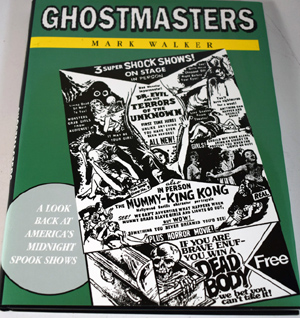
Product Description:
If you enjoyed learning about Spook Shows, this book belongs on your shelf. Ghostmasters by Mark Walker explores the forgotten world of the live midnight ghost shows that thrilled audiences throughout the 1930s and 1940s. Drawing from years of research, rare photographs, vintage advertising, and firsthand accounts, Walker chronicles the magicians, promoters, and performers who transformed ordinary movie theaters into unforgettable nights of ghosts, skeletons, monsters, and theatrical illusion.
Book Highlights:
- Comprehensive history of America’s legendary Spook Shows.
- Covers the famous touring magicians and ghost show promoters of the 1930s and 1940s.
- Filled with rare photographs, newspaper advertisements, posters, and historical research.
- Explains how stage magic, Black Art illusions, comedy, and horror were combined into unforgettable live performances.
- Includes fascinating stories behind the performers who inspired generations of horror entertainers.
Why You’ll Enjoy This Book:
Whether you’re a fan of Halloween history, vintage horror, stage magic, or Forgotten Americana, Ghostmasters is considered one of the definitive books on the subject. It reveals how these spectacular midnight productions laid the groundwork for many of the haunted attractions and live horror experiences that followed. Even Penn & Teller’s Teller has praised the book as essential reading for fans of horror and magic.
Why Spook Shows Still Fascinate Us
There is something about the Spook Show that resists being fully explained by any single theory of entertainment or popular culture, and that resistance is part of what keeps people coming back to the subject long after the shows themselves have vanished.
It was not simply a magic show. The Spook Show was also a comedy, a horror experience, a séance, a participatory theatrical event, and a social occasion, all happening simultaneously in the same building to the same audience over the course of a single evening. No other form of entertainment has ever quite managed to occupy all of those categories at once, and the period from the 1930s to the 1960s was the only moment in American history when the stars were aligned to make it possible. The horror film boom gave the ghostmasters their cultural context. The Depression-era economics gave the theaters their motivation. The vaudeville tradition gave the showmen their craft. The Victorian spiritualist heritage gave the séance its credibility. Glow-in-the-dark paint gave the blackout sequence its magic.
The Spook Show also captured something true about the way human beings experience fear as a social emotion. We do not want to be frightened alone. We want to be frightened together, so that we can grab each other in the dark and laugh about it afterward. The haunted house industry that has grown into a billion-dollar seasonal phenomenon in America today is built on exactly that insight, but the ghostmasters understood it first and built an entire theatrical tradition around it at midnight in movie theaters across the country.
They were more than haunted attractions. They were live theatrical events that relied on imagination as much as any special effect, that trusted their audiences to bring half the experience with them into the building, and that rewarded that trust with an evening unlike anything else available for the price of a single ticket. The showmen who created them were hucksters and artists in equal measure, and the shows they built out of luminous paint, black velvet, planted volunteers, and sheer theatrical nerve deserve to be remembered as one of the genuinely original American entertainments.
Next time you walk through a haunted house and something jumps out of the dark and makes you scream, spare a thought for the ghostmasters. They figured all of that out decades before the fog machines and the animatronics arrived. They did it at midnight. They did it for one admission price. And they wished you pleasant nightmares on your way out the door.
Editor’s Note: Spook Shows evolved over several decades, and performances varied widely from one promoter to another. This article draws on historical newspaper accounts, theater advertisements, books, and archival material to present a representative history of these unique live entertainment events.