🎸 Bob Weir Biography – A Remarkable Career That Changed Rock Music

Bob Weir has spent more than half a century in public view without ever leaning on nostalgia. As the youngest founding member of Grateful Dead, he helped shape a group that treated rock music as a living conversation rather than a fixed script. His presence was steady, curious, and quietly stubborn, qualities that would define both his playing and his career.
Bob Weir was an American guitarist, songwriter, and founding member of the Grateful Dead, one of the most influential bands in rock history. Best known for his role as rhythm guitarist and co-vocalist, he helped define the sound and structure of improvisational rock music. Weir’s career spanned more than six decades, including major post-Dead projects and continued touring. His influence remains deeply embedded in American music culture.
Born in San Francisco in 1947 and raised in the Bay Area, Weir came of age alongside a restless local scene that valued risk over polish. He was still a teenager when he crossed paths with Jerry Garcia, and the connection proved immediate and lasting. From the start, Weir gravitated toward rhythm guitar not as background support but as an active voice that pushed songs forward.
What set Weir apart was his refusal to stay inside the usual lines. His chord choices, clipped phrasing, and off-center accents gave the music tension and movement, even when the songs stretched far past their original forms. That instinct for exploration, present from the beginning, would guide everything that followed.
Bob Weir was never a background player. His unconventional rhythm guitar style quietly controlled the direction of some of the longest and most complex live improvisations in rock history.
👶 Early Life
Summary: Bob Weir’s early life shaped his unconventional musical instincts and long-term creative independence.
Bob Weir was born on October 16, 1947, in San Francisco, California, and adopted as an infant by Frederic and Eleanor Weir. His father was an engineer, his mother a homemaker, and the family moved often during his childhood. That unsettled rhythm left him learning to adapt early, both socially and emotionally.
Weir struggled in school, later attributed to undiagnosed dyslexia, and traditional classrooms never suited him. Music became a refuge rather than an ambition at first, something tactile and forgiving where rules bent instead of closing in. He was drawn to folk and early rock records, absorbing structure and rhythm more than flash or speed.
By his early teens, the guitar became a constant companion. Weir was less interested in virtuoso leads than in how songs were held together, how momentum was built and released. That instinct, formed well before fame entered the picture, would quietly shape his entire approach to music.
Explore the Biographies of Icons in Music
Bob Weir co-wrote “Sugar Magnolia,” one of the Grateful Dead’s most recognizable songs, while still in his early twenties.
🎶 Music Career
Summary: His music career redefined rhythm guitar and helped establish the Grateful Dead as a cultural force.
Bob Weir stepped into professional music almost by accident, but stayed by choice. In the mid-1960s, he became a founding member of Grateful Dead, joining Jerry Garcia, Phil Lesh, Bill Kreutzmann, Ron McKernan, and later Mickey Hart. Weir was the youngest of the group and the least traditionally trained, yet his role became essential. Rather than mirroring Garcia’s leads, he built a shifting rhythmic lattice that gave the band room to stretch.
As the Dead evolved from a jug band-leaning bar act into a touring institution, Weir’s contributions grew more confident and more personal. He emerged as a songwriter and vocalist, penning or co-writing staples such as “Sugar Magnolia,” “Cassidy,” “Estimated Prophet,” and “Playing in the Band.” His songs often carried an unsettled, forward-leaning feel, mirroring his guitar style, which favored unexpected chord voicings and sharp accents over comfort.
Live performance was the band’s true center, and Weir thrived there. Night after night, he treated the rhythm guitar as a conversational instrument, locking in with Lesh’s roaming bass lines and the drummers’ elastic pulse. During long improvisations, his playing steered transitions, cued changes, and kept the music from collapsing under its own freedom. It was a subtle authority, rarely flashy, always present.
Following Garcia’s death in 1995, Weir resisted the idea of closure. He continued performing with various post-Dead configurations, each preserving the music without freezing it. Projects such as RatDog allowed him to mix Grateful Dead material with blues, reggae, and new originals, often alongside keyboardist Jeff Chimenti, a collaborator who would remain central for decades.
Weir later co-founded Furthur with Phil Lesh, revisiting the catalog with a looser, exploratory spirit and a rotating cast of musicians. The emphasis stayed on live reinvention rather than faithful reproduction, reinforcing Weir’s long-held belief that the music only mattered if it stayed in motion.
In 2015, Weir entered one of the most visible chapters of his later career with Dead & Company, joined by John Mayer, Oteil Burbridge, and longtime Dead rhythm partners. The group drew a new generation of listeners while maintaining the improvisational backbone that defined the original band. Weir’s role remained the same: guide, provoke, and keep the music unsettled.
Alongside large-scale touring, Weir also scaled things down with Bob Weir & Wolf Bros, a project that emphasized space, restraint, and reinterpretation. Stripped of excess volume, his songwriting and phrasing stood exposed, revealing how much of his career had been built on structure rather than spectacle.
Across every lineup and era, Weir’s music career has followed a consistent line. He does not chase reinvention for its own sake, nor does he preserve the past behind glass. Instead, he treats songs as living things, meant to change with the people playing them and the rooms they fill.
Unlike most rock guitarists of his era, Weir built his style around chord voicings and syncopation rather than solos.
💀 Skeletons From the Closet – The Best of the Grateful Dead
Released in February 1974, this is the best-selling Grateful Dead greatest hits collection ever issued, drawing together studio favorites that defined the band’s enduring appeal.
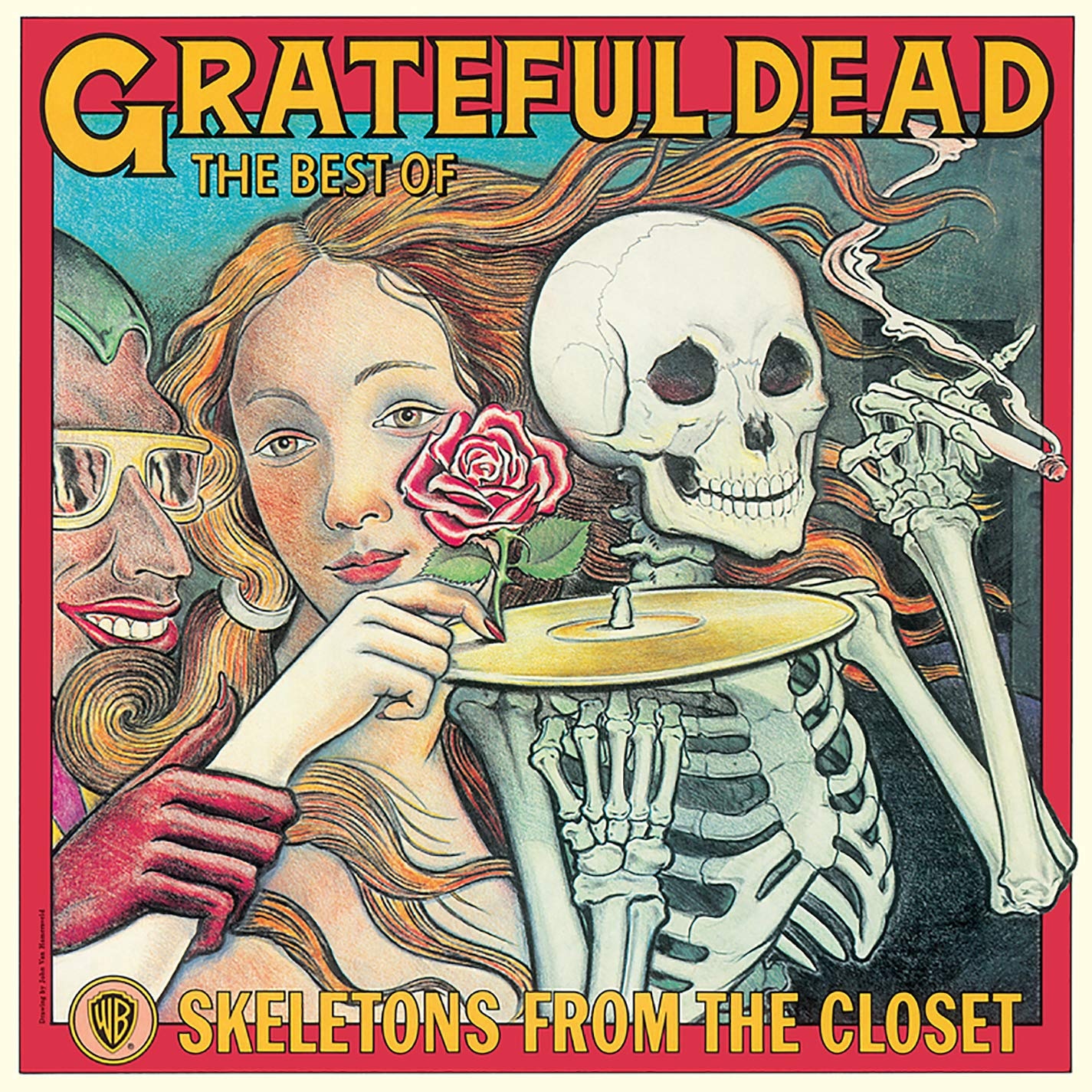
Skeletons From the Closet distills the Grateful Dead’s wide-ranging sound into an accessible, endlessly replayable vinyl experience. Featuring classics like Truckin’, Sugar Magnolia, and Mexicali Blues, this LP became the gateway record for generations of listeners discovering the band for the first time.
- 💿 Format: 1xLP vinyl
- 📅 Original Release: February 1974
- 🎶 Highlights: “Truckin’,” “Sugar Magnolia,” “Mexicali Blues”
- 🌹 Status: Best-selling Grateful Dead compilation
A timeless introduction to the Grateful Dead, equal parts road-worn, melodic, and unmistakably American.
🕊️ Later Years
Summary: In later years, Bob Weir remained active and reflective, continuing to perform until his death.
In his final years, Bob Weir remained engaged with music as a working craft, not a victory lap. He continued to perform, rehearse, and refine his approach, favoring restraint and clarity over volume or spectacle. Age did not soften his commitment, but it sharpened his sense of timing, space, and intention.
Weir became increasingly reflective, often speaking about stewardship rather than legacy. He understood the Grateful Dead’s catalog as something alive, meant to evolve with each generation that touched it. His later performances leaned into that idea, slowing tempos, rethinking familiar passages, and allowing the weight of years to inform the sound rather than fight it.
Bob Weir died on January 10, 2026, at the age of 78. At the time of his death, he was still closely tied to the music that had defined his life, not as a symbol of the past, but as an active participant to the very end.
Bob Weir was the youngest founding member of the Grateful Dead and was initially dismissed from the band before being brought back weeks later.
🏆 Legacy
Summary: Bob Weir’s legacy rests on innovation, longevity, and a refusal to let music stand still.
Bob Weir leaves behind a legacy built on endurance, curiosity, and quiet authority. As a founding member of the Grateful Dead, he helped redefine what a rock band could be, not a fixed act repeating hits, but a living system shaped by risk, trust, and shared intuition. His work proved that rhythm guitar could lead without dominating, guide without announcing itself.
Weir’s influence is felt as much in approach as in sound. He challenged the idea that structure and freedom were opposites, showing instead how they depended on each other. His playing created space for improvisation while holding the music together, a balance that countless musicians studied even if they never named it. In that sense, his style became a language spoken far beyond the Dead’s catalog.
More than anything, Weir modeled longevity without stagnation. He never treated the past as a destination, only as material to be reshaped in the present. That mindset kept the music relevant across decades and generations, ensuring that what he helped build did not end with him, but continues to move, adapt, and invite participation.
🗣️ Why They Still Matter
Bob Weir matters because he proved that longevity in music does not come from repetition, but from adaptation. His approach to rhythm, collaboration, and live performance reshaped how bands think about structure and freedom, leaving a permanent mark on American rock music.
Further Reading & Resources
📖 Read: Bob Weir Biography, Age, Career, Songs, Family
🔍 Explore: Bob Weir | Biography, & Facts | Britannica