🌟 Carole Lombard Biography: A Brilliant Career Cut Tragically Short
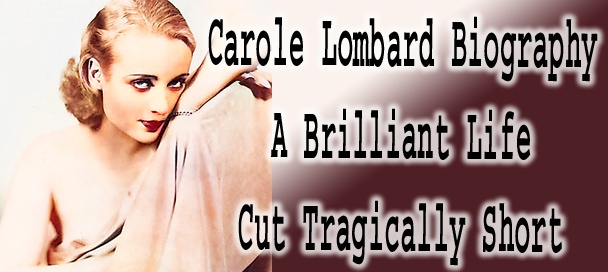
Carole Lombard entered Hollywood during a period when the industry was still defining what a screen star should be. She did not arrive fully formed, nor was her early career marked by immediate success. Instead, her rise reflected a gradual process of trial, miscasting, correction, and eventual control. Lombard worked through the silent era into the early sound period at a time when many actors failed to survive the transition, learning through repetition which performances rang false and which revealed something sharper.
Carole Lombard was one of classic Hollywood’s defining comedy actresses, best known for shaping the screwball comedy style of the 1930s. She rose from silent films to become a top box-office star through sharp timing, fearless performances, and an instinct for rapid-fire dialogue. Her most recognized films include My Man Godfrey, Twentieth Century, and Nothing Sacred. Lombard’s career blended wit, independence, and precision, leaving a lasting imprint on American film comedy.
By the middle of the decade, Lombard had emerged as one of the central figures in the developing screwball comedy style. What distinguished her was not charm or sentiment, but control. She understood how quickly a line should be spoken, when to interrupt another actor, and when to hold a pause just long enough to disrupt expectation. Her performances conveyed intelligence without softness and confidence without stiffness. Audiences responded to that precision, and studios followed.
By the late 1930s, Lombard was among the highest-paid actresses in Hollywood, a position she reached through leverage rather than longevity. Her reputation rested on a concentrated body of work that avoided repetition and resisted decline. Even at the height of her fame, she remained selective, aware that pace and discipline mattered more than volume. The result was a career defined not by myth or nostalgia, but by craft.
Carole Lombard’s story is unique because she never reached a decline phase, her career ended at full speed, freezing her image at absolute command.
👶 Early Life
Summary: Lombard’s early life shaped her resilience and independence long before Hollywood success arrived.
Carole Lombard was born Jane Alice Peters on October 6, 1908, in Fort Wayne, Indiana. Her father, Frederick Peters, worked as a traveling salesman, and her mother, Elizabeth Peters, played a dominant role in shaping her early life. When Lombard was still a child, her parents’ marriage collapsed, and her mother relocated with Jane and her two older brothers to Los Angeles. The move was not motivated by show business ambition at first, but proximity to the growing film industry soon altered the direction of Lombard’s life.
Lombard’s entry into motion pictures was informal and accidental. As a child, she was noticed by director Allan Dwan while playing baseball in the street, an anecdote often repeated because it reflects both chance and personality rather than grooming or privilege. She began appearing as an extra in silent films during the early 1920s, working intermittently while continuing her education. These early roles were uncredited and offered little creative development, but they provided familiarity with studio routines and camera discipline at an unusually young age.
Unlike child stars who were aggressively promoted, Lombard’s early screen exposure was modest and inconsistent. She was not yet identified as a personality or type, and studios showed limited interest in developing her beyond background work. As she entered her teenage years, she began to pursue acting more deliberately, signing contracts that promised opportunity but often delivered routine assignments. During this period, Lombard struggled to stand out in an industry crowded with young actresses trained to deliver restraint rather than speed or individuality.
A pivotal moment occurred in 1926 when Lombard was seriously injured in an automobile accident. The crash left her with facial injuries, including a small scar that would remain visible throughout her life, though frequently concealed through lighting and makeup. The accident forced a temporary halt to her career and raised doubts about her future in an industry that valued flawless appearance. Lombard later acknowledged the experience as a turning point, one that sharpened her resolve and reduced any lingering illusions about security in Hollywood.
After recovering, Carole Lombard returned to film work with a noticeably firmer approach. She became more selective, more disciplined, and less willing to conform passively to expectations. While her early sound-era roles still failed to distinguish her, the foundation had been laid. She had learned how studios functioned, how easily actors were replaced, and how survival depended on adaptability. That understanding would soon prove decisive as she entered the next phase of her career.
Explore the Biographies of Iconic Celebrities
Carole Lombard was known for deliberately ruining glamorous publicity shots with unexpected expressions.
🎬 Movie Career
Summary: Her film career redefined comedy through timing, intelligence, and complete command of dialogue.
Carole Lombard entered the sound era without a clear screen identity, and the first years of her talking-picture career reflected that uncertainty. After early silent work and minor sound roles at Fox, she moved to Paramount in the early 1930s, where she was cast primarily in conventional dramatic and romantic parts. Films such as Man of the World (1931) and Virtue (1932) showed professionalism but did little to separate her from dozens of similar actresses competing for attention. Studios initially viewed Lombard as capable but replaceable.
Her career changed direction with Twentieth Century (1934), directed by Howard Hawks and co-starring John Barrymore. The film’s exaggerated style and rapid-fire dialogue allowed Lombard to abandon restraint in favor of speed and precision. Her performance was widely recognized as a breakthrough and is often cited as one of the earliest fully realized examples of screwball comedy. From this point forward, Lombard was no longer treated as a general-purpose leading lady but as a specialist in high-tempo comedy.
She consolidated that reputation with Hands Across the Table (1935), opposite Fred MacMurray, and then achieved her greatest critical success with My Man Godfrey (1936), directed by Gregory La Cava and co-starring William Powell. The film balanced farce with social satire, and Lombard’s performance earned her an Academy Award nomination for Best Actress. Powell is generally regarded as her most significant screen partner, and the film remains the clearest demonstration of her ability to control chaos without softening its edge.
During the same period, Carole Lombard appeared in Nothing Sacred (1937), directed by William A. Wellman and co-starring Fredric March. Shot in Technicolor, the film allowed Lombard to push satire further, playing a character defined by deception and moral ambiguity. Also in 1937, she starred in True Confession, again opposite Fred MacMurray, a pure screwball comedy built almost entirely around verbal timing and performance rhythm rather than plot logic.
Although comedy defined her public image, Lombard deliberately alternated genres to avoid being confined to a single tone. She appeared in the dramatic romance Made for Each Other (1939), co-starring James Stewart, which emphasized emotional restraint rather than exaggeration. That same year, she starred in In Name Only (1939) with Cary Grant. The film was a domestic drama, not a comedy, and remains their only collaboration. Grant was not a central figure in Lombard’s career, but the pairing demonstrated her ability to adapt her style when required.
Carole Lombard’s final films continued to alternate tone. Vigil in the Night (1940) placed her in a serious medical drama, while They Knew What They Wanted (1940), co-starring Charles Laughton, returned her to romantic comedy with a more grounded emotional register. Her last completed film, To Be or Not to Be (1942), directed by Ernst Lubitsch and co-starring Jack Benny, was released after her death. The film blended farce with political satire and is now considered one of the most daring comedies of the era.
By the early 1940s, Carole Lombard was among Hollywood’s highest-paid actresses, a status she achieved through selective projects rather than volume. Her career, though relatively brief, showed a deliberate progression from miscasting to mastery. She left behind a concentrated body of work that defined a genre and demonstrated how intelligence, timing, and authority could shape American screen comedy.
💍 Personal Life and Marriages
Summary: Lombard’s personal relationships reflected loyalty, humor, and a refusal to conform to studio expectations.
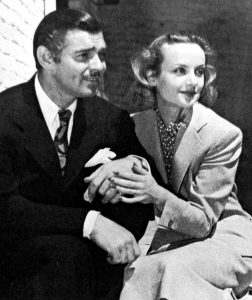
Carole Lombard maintained a personal life that stood in deliberate contrast to Hollywood convention. While studios often promoted actresses through carefully managed public images, Lombard resisted that approach and cultivated a reputation for bluntness, humor, and independence. Colleagues frequently noted that her off-screen personality was less glamorous than practical, marked by plain speech, loyalty to friends, and a lack of patience for pretense. She moved comfortably between studio executives, crew members, and fellow performers without adopting different personas for each setting.
Her first marriage was to William Powell, whom she married in 1931. At the time, Powell was already an established star, and the marriage attracted significant attention. The relationship, however, proved short-lived, and the couple divorced in 1933. Despite the separation, Lombard and Powell maintained a close friendship that lasted for the rest of her life. They spoke openly of mutual respect, and Powell remained one of her strongest professional supporters. Their continued friendship was unusual in an industry where divorces typically severed all public ties.
Lombard’s most significant personal relationship was with Clark Gable. The two met while working on No Man of Her Own (1932), though their relationship developed gradually over several years. They married in 1939 in Kingman, Arizona, deliberately avoiding a studio-arranged spectacle. Lombard was already a major star at the time of the marriage and retained financial independence, refusing to give up professional control or adapt her public identity to fit expectations placed on a leading man’s wife.
The marriage to Gable was widely followed by the press, but those close to the couple described their private life as comparatively quiet. Carole Lombard preferred ranch living, informal gatherings, and a small circle of trusted friends. She rejected Hollywood social rituals, often skipping premieres and publicity events when possible. Her behavior reinforced a public image grounded in authenticity rather than mystique.
Throughout her adult life, Lombard remained outspoken and self-directed. She negotiated her own contracts, participated actively in financial decisions, and resisted studio interference in her personal affairs. Unlike many actresses of her era, she did not allow marriage or public expectation to alter her independence.
🛩️ Final Flight and Aftermath
Summary: Her final flight linked her legacy permanently to wartime sacrifice and national mourning.
Carole Lombard became directly involved in the American war effort following the United States’ entry into World War II. In January 1942, she participated in a war bond tour across the Midwest, using her fame to promote national defense fundraising. The tour proved highly successful, raising more than two million dollars in bond sales, a substantial sum at the time. Lombard approached the effort seriously, viewing it as a civic obligation rather than a publicity exercise.
At the conclusion of the tour, Lombard was eager to return home quickly. Despite suggestions that she travel by train, she chose to fly back to California to minimize time away. On January 16, 1942, she boarded a Transcontinental & Western Air commercial flight departing from Las Vegas after a refueling stop. Shortly after takeoff, the aircraft struck Potosi Mountain in Nevada during a nighttime ascent. All passengers and crew were killed. Lombard was thirty-three years old.
News of the crash spread rapidly and sent shockwaves through Hollywood and the broader public. Film productions paused, and studios issued formal statements expressing disbelief rather than ceremony. Lombard’s death was not framed as the loss of a fading star, but as the sudden removal of an active and highly productive figure at the height of her career.
Her husband, Clark Gable, was devastated by the loss. In the months that followed, he withdrew from studio work and later enlisted in the U.S. Army Air Forces, despite being one of Hollywood’s most valuable male stars. Gable served as an aerial gunner on combat missions over Europe. While patriotic duty played a role, historians widely interpret his enlistment as deeply connected to grief and personal responsibility.
Lombard was posthumously awarded the Medal of Freedom in recognition of her war bond efforts. Unlike many public honors, the award was tied directly to measurable action rather than symbolic support. In death, as in life, her contribution was recorded in practical terms rather than sentiment.
The abruptness of her death ensured that Carole Lombard’s public image would remain fixed in motion. She did not experience professional decline, reinvention, or withdrawal. Instead, her career ended mid-stride, leaving behind a body of work that closed without epilogue, reinforcing the sense of loss felt across the industry and among audiences.
Carole Lombard was so valuable to studios that her insurance policy ranked among the highest for any actress of her era.
🏆 Legacy
Carole Lombard left a legacy built on precision rather than excess. She did not rely on sentiment, image, or longevity to define her place in film history. Instead, she reshaped comedy by proving that speed, intelligence, and emotional control could carry a film as effectively as spectacle.
Her influence is most clearly seen in the rhythm of modern screen comedy. Actresses who followed did not copy her mannerisms so much as her authority. She demonstrated that a woman could drive the pace of a scene, dominate dialogue without apology, and still remain accessible to audiences. That balance became a standard rather than an exception.
Because her career ended abruptly, Carole Lombard was never forced into decline or reinvention. Her body of work remains concentrated, consistent, and free of late-career compromise. What survives is a reputation anchored in craft, nerve, and an absence of pretense, qualities that continue to define her standing long after the industry she worked in has changed.
🗣️ Why They Still Matter
Carole Lombard still matters because modern screen comedy depends on the exact qualities she perfected: pace, authority, and intelligence. Her work remains a benchmark for performers who lead scenes rather than react within them, proving that timing and confidence never age.
Further Reading & Resources
📖 Read: Carole Lombard | Biography, Movies, Marriages, Death, & Facts
🔍 Explore: Lombard, Carole (1908–1942) - Encyclopedia.com