🎭 Charles Laughton: A Singular Presence on Stage and Screen
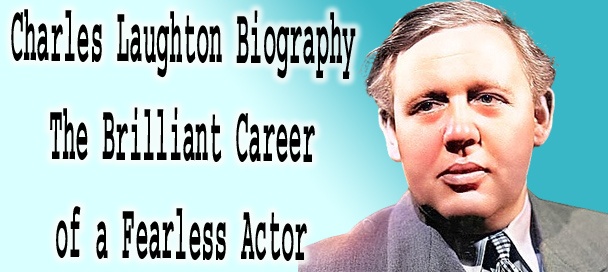
Charles Laughton did not ease his way into a room. He arrived with weight, voice, and a face that refused to be ignored. From his earliest appearances, audiences sensed something uncommon at work, a performer less interested in charm than in command. His physicality, often described as awkward or imposing, became the very instrument that set him apart.
Charles Laughton was one of the most commanding actors of classic cinema, known for intense, transformative performances rather than conventional leading roles. He achieved lasting fame through films such as The Private Life of Henry VIII, Mutiny on the Bounty, The Hunchback of Notre Dame, and The Old Dark House. Trained on the stage and revered for his voice and presence, Laughton built a career defined by intellectual depth, emotional complexity, and lasting influence across film, theater, and spoken performance.
Born in England and trained in the discipline of the stage, Laughton carried with him a deep respect for language and character. He treated dialogue as something to be shaped, not merely spoken, and his performances reflected long study rather than impulse. Even in quiet moments, there was an undercurrent of authority that suggested a man fully aware of his craft.
What distinguished Laughton most was his refusal to fit neatly into expectations. He did not pursue likable roles, nor did he soften his edges for easy approval. Instead, he leaned into complexity, allowing contradictions to remain visible. This choice, deliberate and sometimes risky, defined the foundation of a career built on presence rather than polish.
Charles Laughton spent much of his life hiding essential parts of himself, yet his performances repeatedly exposed the deepest fears, contradictions, and moral tensions of the human condition.
👶 Early Life
Summary: Charles Laughton’s upbringing and physical challenges shaped his observant nature and disciplined approach to performance from an early age.
Charles Laughton was born on July 1, 1899, in Scarborough, a coastal town in Yorkshire shaped by industry and tradition. His father ran a hotel and his mother managed the household, expecting discipline and steady behavior from their children. Nothing in this setting suggested a future in the arts, and least of all a life on stage.
As a child, Laughton was marked by physical fragility and a noticeable stoop, the result of injuries and illness that set him apart from other boys. These differences made him self-conscious but also observant. He learned early how to watch people, how to listen, and how to absorb the rhythms of speech and gesture that later became central to his acting.
His education offered little encouragement toward performance, yet books and language held his attention. Poetry, classical literature, and public speaking exercises revealed a talent that surprised even him. Long before he stepped onto a professional stage, Laughton had begun shaping the inner tools of his craft: memory, voice, and an instinct for character rooted in careful study rather than natural ease.
Explore the Biographies of Iconic Celebrities
Laughton was considered one of the finest public readers of literature in the English language, drawing sold-out audiences for spoken performances alone.
🎬 Film Career
Summary: Laughton’s film work defined the power of character acting, spanning historical epics, gothic horror, and psychological drama.
Charles Laughton entered motion pictures with the instincts of a stage actor and the discipline of a scholar. His early film work in Britain quickly drew attention for its force and precision, and by the early 1930s he was working on both sides of the Atlantic. Unlike many actors who struggled with the transition from stage to screen, Laughton understood how to scale his performances without dulling their impact.
His breakthrough came with The Private Life of Henry VIII, where his portrayal of the aging monarch brought international recognition and an Academy Award. Rather than turning him into a romantic lead, the role established him as something rarer: a character actor who could dominate a film. Hollywood soon placed him opposite major stars and under top directors, including Clark Gable, Marlene Dietrich, and Elsa Lanchester, who would later become his wife and most trusted collaborator.
Throughout the 1930s, Laughton built a reputation for choosing demanding material. He worked with Cecil B. DeMille in The Sign of the Cross, delivering a performance that balanced cruelty and dark humor. In Mutiny on the Bounty, he stood toe to toe with Clark Gable, shaping Captain Bligh into a figure both monstrous and disturbingly human. His Bligh was not a simple villain but a study in authority corrupted by obsession.
Laughton’s range became even more apparent as the decade continued, particularly through roles that brushed directly against horror and gothic cinema. His first Hollywood film, The Old Dark House, directed by James Whale, placed him alongside Boris Karloff in a storm-bound nightmare of menace and dark humor, now regarded as a cornerstone of early horror cinema. Later in the decade, Laughton took on the physically punishing title role in The Hunchback of Notre Dame, transforming himself into Quasimodo with startling conviction. Though not a traditional horror film, its Gothic setting, cruelty, and tragedy firmly tie it to the genre, and Laughton’s performance remains one of the most emotionally powerful portrayals ever committed to a Universal-style spectacle.
Laughton’s range became even more apparent as the decade continued. In Les Misérables, directed by Richard Boleslawski, he portrayed Javert with cold restraint, relying on stillness and voice rather than excess. Jamaica Inn, his only collaboration with Alfred Hitchcock, paired him with Maureen O’Hara and showed his willingness to embrace moral ugliness without apology. Though the film itself divided critics, Laughton’s performance remained a focal point.
The 1940s saw him gravitate toward darker, more psychologically layered roles. In This Land Is Mine, directed by Jean Renoir, he played an unassuming schoolteacher transformed by conscience, acting opposite Maureen O’Hara once again. The performance revealed a quieter side of Laughton, one built on hesitation and inner conflict rather than outward force. Around the same period, he appeared in The Canterville Ghost with Margaret O’Brien, proving he could temper intensity with warmth when the material required it.
As his career progressed, Laughton became increasingly selective. He worked with directors such as David Lean and shared screens with actors including Laurence Olivier, Vivien Leigh, and Charles Boyer, yet he never allowed prestige alone to dictate his choices. Each role was treated as a problem to be solved, a character to be anatomized rather than displayed.
By the early 1950s, his screen appearances grew less frequent, but their impact did not fade. Whether playing tyrants, scholars, or men quietly unraveling under pressure, Laughton left behind a body of film work defined by intelligence and risk. He resisted easy sympathy and rejected vanity, choosing instead to leave audiences unsettled, thoughtful, and aware they had witnessed something deliberate and fully considered.
He remains one of the few actors whose voice recordings are still studied in drama schools for pacing, emphasis, and vocal control.
⚖️ Charles Laughton in Witness for the Prosecution
Witness for the Prosecution is a razor-sharp courtroom drama adapted from an Agatha Christie stage play, anchored by one of Charles Laughton’s most commanding performances. As the brilliant yet ailing barrister Sir Wilfrid Robarts, Laughton balances wit, menace, and moral ambiguity in a film where truth is never as simple as it appears.
🎭 Film Highlights:
- Starring Charles Laughton, Marlene Dietrich, and Tyrone Power
- Directed by Billy Wilder
- Classic black-and-white courtroom suspense
- Famed twist ending and sharply written dialogue
- Widely regarded as one of the greatest legal dramas ever filmed
💍 Marriage and Sexuality
Summary: His long marriage to Elsa Lanchester and his bisexuality reveal the private compromises demanded by Hollywood’s studio era.
Charles Laughton married actress Elsa Lanchester in 1929, forming one of the most discussed partnerships of classic Hollywood. Their marriage endured for nearly four decades, marked by loyalty, mutual respect, and a deep professional bond. They worked together often and spoke openly, at least in private, about the unusual shape their relationship took.
From the outside, their marriage puzzled observers. It did not conform to Hollywood norms, nor did it pretend to. Lanchester later wrote candidly about the emotional distance and private struggles that defined their union, describing it as sincere but unconventional. What sustained it was not romance in the usual sense, but companionship, shared intellect, and an understanding that neither tried to force the other into a role they could not fill.
Charles Laughton’s sexuality was more complex than earlier accounts suggested. He was bisexual, a fact later confirmed through the recollections of Scotty Bowers, who described arranging discreet relationships for actors whose private lives had to remain hidden. Among those named was Tyrone Power, with whom Laughton was said to have shared an intimate connection. In the climate of classic Hollywood, such relationships could not be acknowledged without severe personal and professional risk. The result was a life lived in careful fragments, where desire, affection, and honesty were compartmentalized, leaving behind a legacy shaped as much by restraint as by expression.
Read more about Elsa Lanchester in our exclusive bio.
Despite winning an Academy Award early in his career, Charles Laughton often believed his best work was misunderstood during his lifetime.
🕊️ Later Years
Summary: Laughton found renewed purpose through literary readings and television appearances before his death in 1962.
In his later years, Charles Laughton gradually stepped away from frequent film work and redirected his energy toward the spoken word. He found renewed purpose in one-man readings and stage presentations, where literature, scripture, and classical texts were delivered with the same care he once brought to screen roles. These performances revealed a gentler authority, less concerned with transformation and more with clarity and meaning.
One of his most unexpected public appearances came on September 9, 1956, when Laughton served as a fill-in host for The Ed Sullivan Show. That evening marked Elvis Presley’s first appearance on the program, a moment that would become a dividing line in popular culture. Laughton handled the broadcast with professionalism and restraint, standing at the crossroads between an older theatrical tradition and a rapidly changing entertainment landscape.
Health problems increasingly limited his work as the decade closed. Years of strain, weight fluctuation, and emotional pressure took their toll, yet he remained intellectually active and closely connected to his wife, Elsa Lanchester, until the end. Charles Laughton died on December 15, 1962, at the age of 63. His passing closed the career of an actor who never chased popularity, only truth in performance, and whose presence continues to resonate long after the curtain fell.
🏆 Legacy
Summary: His influence endures through actors and directors who value intellect, restraint, and emotional honesty over surface appeal.
Charles Laughton left behind a body of work that resists easy summary. He was neither a conventional leading man nor a background player, but something more enduring: an actor whose presence altered the temperature of every scene he entered. His performances continue to be studied for their control, vocal precision, and refusal to simplify human behavior.
Actors across generations have cited Laughton as a model for intellectual acting, where preparation and thought matter as much as instinct. His influence can be traced in performers who value character over appearance and substance over ease. Directors and teachers have returned to his films and recordings as examples of how language, posture, and silence can carry meaning without excess.
Beyond technique, Laughton’s legacy rests in his honesty, even when it had to remain indirect. He worked within a system that demanded concealment, yet his art consistently pointed toward complexity and contradiction. That tension, between restraint and expression, remains the defining mark of his career and the reason his work still feels alive rather than preserved.
🗣️ Why They Still Matter
Charles Laughton matters because he proved that cinema does not require beauty, youth, or charm to achieve greatness. His work stands as a reminder that truth, intellect, and courage in performance leave a deeper mark than popularity ever could.
Further Reading & Resources
📖 Read: Charles Laughton - The Movie Database (TMDB)
🔍 Explore: Charles Laughton | Biography, Movies, Plays, & Facts | Britannica