Strange Halloween costume origins tied to seasonal belief
Early Roots in Seasonal Ritual
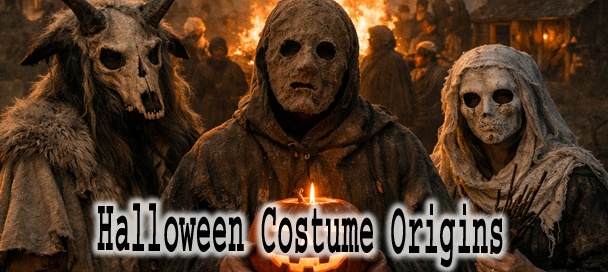
The study of Halloween costume origins begins long before the modern holiday took shape, grounded in seasonal ritual and communal belief. In early agrarian societies, seasonal boundaries carried both practical and symbolic weight. The end of harvest marked a shift not only in labor but in how people understood their relationship to the unseen world. In Celtic regions of Ireland, Scotland, and parts of Britain, this transition was observed through Samhain, a festival marking the close of the agricultural year and the onset of winter.
Halloween costume origins refer to the historical practice of wearing disguises during seasonal observances tied to belief, ritual, and social custom. These disguises served practical roles within community traditions, often connected to ideas about protection, transition, or symbolic representation. The practice developed within agricultural societies that marked the end of the harvest and the onset of winter as a meaningful boundary. Over time, Halloween costume origins persisted as belief systems shifted, while the outward form of disguise remained in use.
Samhain was traditionally understood as a liminal period. Boundaries between the living and the dead were described as thinner, and the presence of spirits, ancestors, or wandering entities was widely reported in folklore. Within this setting, disguises served a functional role. They were not decorative but protective. The earliest Halloween costume origins are tied to this need to navigate a time believed to carry spiritual risk, a pattern repeated throughout later observances.
Explore The History of Halloween
Samhain Costume Traditions and Protective Disguise
Accounts of Samhain costume traditions describe people wearing animal skins, masks, or soot-darkened faces. These disguises were intended to confuse or repel wandering spirits. The logic was straightforward. By appearing non-human or unrecognizable, an individual might avoid notice or harm. Costumes were therefore not expressions of identity but tools of concealment.
This use of disguise fits within a broader pattern seen in ancient Halloween customs. Across cultures, periods of transition were often marked by masking rituals. Such practices allowed participants to step outside ordinary social roles while maintaining a sense of safety. In Samhain, the disguise was temporary, purposeful, and closely tied to communal belief rather than personal expression.
When examining Halloween costume origins, it is important to note that these early disguises were communal acts. Entire villages participated. The goal was collective protection, not individual performance. This emphasis on shared behavior would later influence how the tradition adapted over time.
Christian Adaptation and Continuity
As Christianity expanded across Celtic regions, many seasonal festivals were absorbed into the Christian calendar rather than eliminated. Samhain gradually aligned with All Saints’ Day and All Souls’ Day. This shift reframed older customs within a new theological structure while allowing many practices to continue.
During this period, the history of Halloween costumes reflects a blending of belief systems. Disguises remained part of the observance, but their meaning evolved. Rather than avoiding spirits, participants often represented them. Masks depicting saints, demons, or the dead became more common. The act of dressing as a supernatural figure shifted from protection to ritual acknowledgment.
The costume remained a mediator between the visible and invisible. This continuity is central to understanding Halloween costume origins across religious and cultural shifts The costume remained a mediator between the visible and invisible across religious and cultural shifts.
Explore 31 Halloween Superstitions You Didn’t Know About
Folk Practice and Social Ritual
By the late medieval period, costume use had become embedded in folk customs such as mumming and souling. Groups traveled from house to house performing short plays or songs in exchange for food. Disguise served both practical and symbolic purposes. It allowed participants to move freely between social spaces while temporarily suspending ordinary norms.
The origins of Halloween traditions during this era reflect a gradual shift away from fear-based motivations. Costumes still referenced spirits or the dead, but the tone was often playful or satirical. This change did not eliminate older beliefs. Instead, it softened them, making the practice more socially flexible.
In examining why people wear costumes on Halloween, this period shows how protective disguise evolved into ritualized role-playing. The costume became a way to engage with ideas of death and the unknown without direct confrontation.
Migration and Transformation in North America
Large-scale immigration from Ireland and Scotland in the nineteenth century carried these customs to North America, extending Halloween costume origins into a new social setting. There, the tradition encountered a different social environment.. Rural folk traditions adapted to urban settings. Community rituals became neighborhood events, especially among children.
By the early twentieth century, costumes were increasingly associated with children’s activities. Trick-or-treating formalized the house-to-house tradition, and disguises became expected rather than optional. While the spiritual framework weakened, the structure remained intact.
The evolution of Halloween costumes during this period reflects social priorities. Costumes helped manage public behavior, giving children a sanctioned outlet for mischief within clear boundaries. Though detached from Samhain beliefs, the costume still functioned as a temporary identity shift.
Psychological and Cultural Function
The persistence of Halloween costume origins can be understood through the concept of role suspension Disguise allows individuals to explore alternative identities without long-term consequence. This function aligns closely with earlier uses of masking during liminal periods.
In practice, the costume served as a symbolic buffer. It permits engagement with themes of death, fear, and transformation in a controlled setting. While modern participants may not articulate this purpose, the structure remains consistent with older practices.
The language used to describe disguises and spirits Samhain emphasizes experience rather than belief. In traditional accounts, participants reported feelings of caution, reverence, or excitement. Modern wearers may describe enjoyment or creativity, but both responses arise from stepping outside ordinary identity.
Decline of Belief, Persistence of Form
As secularization increased, the explanatory framework surrounding Halloween costume origins shifted. Costumes were no longer understood as protective or ritual tools. They became cultural artifacts, shaped by commerce and entertainment. Despite this, the basic act of disguise persisted.
The history of Halloween costumes demonstrates that practices often outlast the beliefs that produced them. The costume remains because it fulfills a social and psychological function, even when its original purpose is forgotten.
Understanding Halloween costume origins therefore requires separating form from explanation. The form of disguise remains remarkably stable. The explanation attached to it changes with cultural context.
Read about Safe Halloween Treats
A Tradition Reframed
Today, Halloween costumes are commonly discussed in terms of creativity or celebration. This modern framing obscures their deeper roots. When viewed through a historical lens, the costume appears less as decoration and more as a ritual inheritance.
By tracing Halloween costume origins from Samhain through Christian adaptation and into modern practice, a consistent pattern emerges. Costumes have long appeared during periods of uncertainty and transition. Whether framed as protection, representation, or play, they allow participants to engage safely with ideas that might otherwise feel disruptive.
The tradition continues not because of belief in spirits, but because the structure still works. Disguise creates distance, permission, and temporary transformation. These functions remain relevant, even when the original explanations have faded.
Conclusion
The study of Halloween costume origins reveals a long process of adaptation rather than invention. From Samhain rituals to contemporary observance, costumes have served as tools for managing transition, uncertainty, and social boundaries. While modern usage emphasizes entertainment, the underlying structure reflects much older concerns.
Viewed historically, Halloween costumes are not trivial additions to a holiday. They are remnants of a worldview that treated seasonal change as meaningful and potentially disruptive. Though the language has changed, the practice endures, offering a quiet continuity between past and present.
📼 Horror Classics: 50 Movie Pack Anniversary Edition
For collectors who love Halloween costume origins, this Horror Classics 50 Movie Pack delivers a vault of vintage chills and eerie thrills. With 12 double-sided DVDs, you’re getting an instant horror library featuring legends like Vincent Price, Boris Karloff, Bela Lugosi, and Lon Chaney Sr. all wrapped into one frightfully nostalgic package. This set is a celebration of what made horror golden, with many of these films paving the way for Halloween as we know it today.
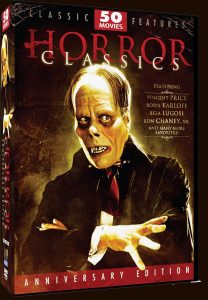
From cult favorites like House on Haunted Hill and Carnival of Souls to silent-era masterpieces like Nosferatu and Phantom of the Opera, this collection captures the essence of spooky storytelling. Whether you’re hosting a Halloween movie marathon or exploring Halloween costume origins through the lens of Hollywood, these films set the perfect tone.
Fans of Halloween will appreciate how these classics influenced everything from trick-or-treat tropes to haunted house aesthetics. Dive into timeless terror with this unforgettable DVD set, featuring everything from mad scientists and vampires to zombies and psychological thrillers.
Further Reading & Resources
📖 The History of Halloween – World History Encyclopedia
📰 The History of Halloween | Definition, Origin, & Facts | Britannica