🎭 DIY Wendy Torrance Costume: Easy Ways to Get It Perfectly Right
She Ran. She Screamed. She Survived. Barely.
There is a version of The Shining conversation that goes on forever about Jack Nicholson, about the axe and the door and the frozen hedge maze and that grin. That conversation is not exactly wrong, but it misses something important. The film belongs just as much to Wendy Torrance, and Shelley Duvall‘s performance is one of the most physically and emotionally committed pieces of acting in the history of American horror cinema. She is in nearly every frame of the second half of that film in a state of absolute deterioration, and Stanley Kubrick, who was not known for his gentleness with actors, pushed her to places that were genuinely difficult to watch. The result is a character who looks like she has been afraid for weeks before the camera even finds her.
The DIY Wendy Torrance Costume draws from one of the most psychologically intense performances in American horror cinema, Shelley Duvall’s portrayal of Wendy Torrance in Stanley Kubrick’s 1980 adaptation of Stephen King’s The Shining. Duvall spent over a year filming under notoriously demanding conditions, and the physical and emotional toll of that process is visible in every frame of her performance, particularly in the film’s climactic sequences where her character’s deteriorating composure becomes the emotional anchor of the entire film. The costume itself is built from practical layered clothing that reflects the character’s functional, unglamorous approach to survival in an isolated and dangerous environment, centered on a corduroy overall dress, flannel shirt, and ribbed sweater combination that became one of the most recognizable wardrobe signatures in horror film history.
The wooden baseball bat carried during the film’s most iconic sequences has become a shorthand symbol for the character’s refusal to stop fighting regardless of circumstance. As a DIY project the costume rewards careful attention to makeup technique, specifically the film and theater methods used to replicate the physical effects of sustained fear and prolonged crying, which are the details that elevate this costume from recognizable to genuinely unsettling.
The DIY Wendy Torrance Costume works because it is built entirely from that deterioration. This is not a glamour costume. It is not a costume that asks you to look beautiful or even particularly put together. It asks you to look like someone who has been trapped in a snowbound hotel with a man losing his mind, who has been running and crying and screaming and surviving on adrenaline and maternal instinct alone. Done well, it is one of the most striking costumes in any room because it carries genuine psychological weight. People who know the film feel it immediately.
The setting matters here. The Overlook Hotel in winter, the isolation, the long empty corridors and the sound of a typewriter going all day. Kubrick shot the film with a cold, institutional clarity that made everything feel slightly wrong even before anything overtly terrible happened. Wendy moves through that space in layers, in practical warm clothing that speaks to someone who packed for a long stay in a cold place and has been wearing the same things for weeks. The costume reflects a woman who started the film trying to hold things together and ended it holding a baseball bat outside a bathroom door.
What makes the DIY Wendy Torrance Costume so satisfying to build is that every piece of it is findable, wearable, and completely ordinary on its own. The genius is in how they combine and in what you do to yourself in the mirror before you walk out the door. The clothing is the easy part. The face is where this costume lives or dies.
It is also worth saying that Wendy Torrance deserves more credit than she typically gets in the Halloween costume conversation. She is not a villain, not a monster, not an icon in the conventional sense. She is a mother who refused to stop fighting even when everything around her had come completely apart. Wearing this costume is in some small way an acknowledgment of that, and the best versions of it carry that recognition in the way they are worn.
👗 Step 1: Create the Base
The foundation of the DIY Wendy Torrance Costume is a layered practical wardrobe that reads as someone dressed for warmth and utility rather than appearance. Wendy wears several distinct outfit combinations throughout the film, but the most recognizable, the one that appears during the film’s most intense sequences, centers on an overall dress worn over a layered top, exactly the kind of thing someone would reach for on a cold morning in an isolated hotel without thinking too much about it.
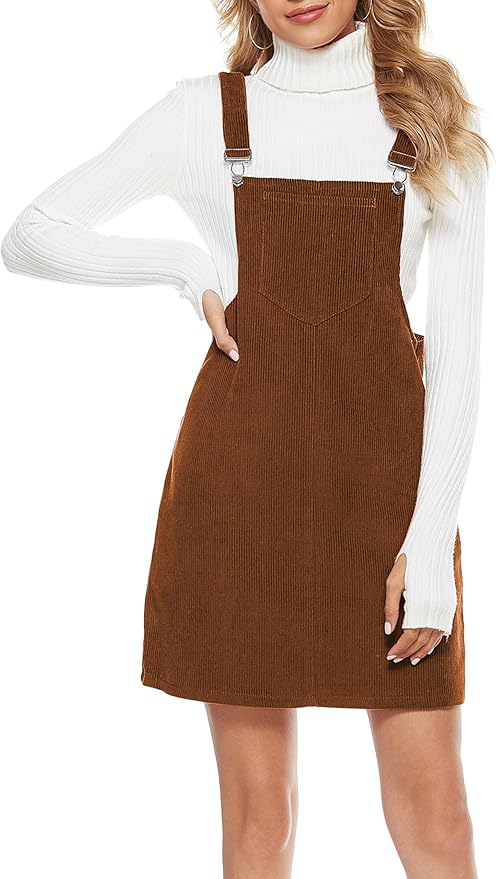
The Brown Corduroy A Line Overall Dress is the anchor piece, and corduroy is exactly right for the period and the character. The fabric has a worn, slightly tired quality that suits Wendy perfectly. A line silhouette keeps the movement practical, something you can actually run in, which matters more than it sounds for a character whose second half of the film is essentially one long desperate sprint. This is not a thrift store find for most people; corduroy overall dresses in the right cut are specific enough that a dedicated costume or online retailer is the more reliable path. When it arrives, resist any urge to press or steam it. Wear it as is. Any natural wrinkling from shipping or storage only helps.
The layering underneath is where the thrift store absolutely earns its place. The White Green Flannel Shirt is the kind of piece that exists in every Goodwill in America in some variation. Look for a slightly oversized fit, something that was clearly bought for comfort rather than style, with a collar that can be worn open and sleeves that can be pushed up or rolled. The color combination of white and green reads as domestic and practical, exactly the register Wendy’s wardrobe occupies throughout the film. Wear it open over the Ivory Neck Ribbed Sweater, which should be simple and close fitting, the kind of base layer someone puts on without thinking about it every single morning.
Brown Knee High Boots complete the base and they should be flat or very low heeled. Practical boots, not fashion boots. The kind of thing you wear because you are in a cold building and your feet need to be warm, not because you are trying to make an impression. Thrift stores turn these up regularly. A little scuffing on the toe and around the heel only improves them for this purpose.
Find other Easy DIY Costume Ideas Here
🧵 Step 2: Add the Details
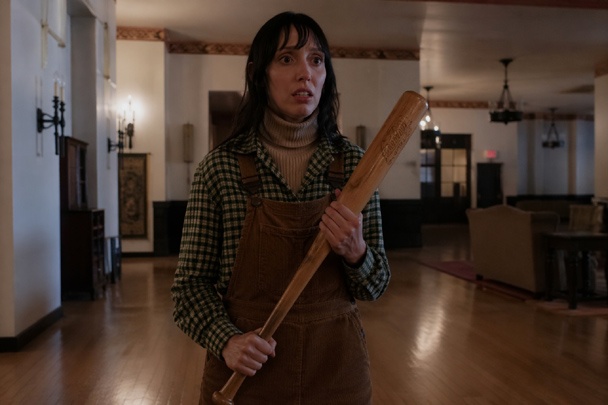
The details that make a DIY Wendy Torrance Costume recognizable rather than just generically seventies are almost entirely about condition and wear rather than specific design elements. Wendy’s clothing looks lived in because it has been. The flannel shirt should have the sleeves slightly pushed up and the collar slightly askew. The overall dress should sit with one strap perhaps slightly twisted at the shoulder. None of this needs to be engineered precisely. Just put it on and move around in it for a few minutes before you leave the house and let it settle into the kind of natural disorder that comes from actually wearing clothes rather than displaying them.
The Wood Baseball Bat is the detail that does the most narrative work in the costume. There is a specific scene, Wendy backing against the bathroom wall with the bat raised, Jack’s face filling the doorway, that is one of the most replicated images in horror film history. Carrying the bat immediately anchors the costume in that moment and in that film. Hold it the way Wendy holds it, two handed, slightly raised, the posture of someone who is terrified but has made the decision to fight anyway. That physical choice communicates the entire character in a single gesture.
In terms of overall condition, the costume should read as day three or four of a crisis, not day one. The clothes are clean enough but they have been slept in. There is a slight compression to the fabric at the elbows and knees. The boots have been walked in on hard floors for hours. These are small things but they accumulate into an impression that feels specific rather than generic.
💄 Step 3: Makeup & Hair
This is where the DIY Wendy Torrance Costume separates itself from every other option in the room, and it requires genuine commitment and a specific set of techniques that go well beyond basic Halloween face paint. Wendy in the second half of The Shining does not look like someone wearing horror movie makeup. She looks like someone who has been crying and screaming and hyperventilating for hours, and those are two completely different things. The film makeup team understood that real fear and real exhaustion change the face in ways that stage fright makeup typically gets wrong.
Start with your normal base, but apply it unevenly, slightly heavier in some areas and sheerer in others, as though it was put on hastily or has been partially worn away by perspiration and tears. The skin should look slightly damp and slightly exhausted. A very light dusting of a grey or taupe powder over the temples and under the cheekbones creates the hollow, drawn quality that comes from sustained adrenaline and poor sleep.
The eyes are the center of everything here and getting them right takes a few steps. First, a red or dark pink eyeliner pencil applied to the waterline of both eyes, upper and lower, creates the raw irritated look of someone who has been crying for a long time. This is more effective and more realistic than eye drops and lasts through an evening. Next, use a small brush to apply a wash of red or pink eyeshadow, blended outward from the inner corner and downward onto the upper cheek, replicating the puffiness and discoloration that comes from sustained crying. The key is to blend it so it looks like inflammation rather than eyeshadow. A touch of the same color on the tip of the nose completes the picture.
The area around the mouth and jaw should carry some tension. A slightly darker contour along the jaw and under the lower lip suggests the kind of muscle tension that comes from clenching your teeth in fear for extended periods. Keep it subtle. The goal is subconscious recognition, the viewer’s brain registering that something is physically wrong with this face without being able to identify exactly what the technique is.
Wendy’s hair in the film’s climactic sequences is genuinely disheveled in a specific way, not randomly messy but centrifugally disordered, as though it started the day in some kind of loose arrangement and has been through significant physical and emotional turbulence since. Sleep on it if you can. Literally go to bed with slightly damp hair and let it do what it wants overnight. In the morning do not brush it.
Separate any sections that have clumped together with your fingers only, shake it out at the roots for a little volume, and leave it alone. If your hair is very straight and resists disorder, a light pass with a curling iron on random sections at varying angles before bed the night before gives it something to work with.
The overall impression should be someone who started the day with their hair pulled back loosely and has long since lost whatever was holding it.
🎀 Step 4: Accessories
The accessories for this costume are minimal by design because Wendy is not a character defined by adornment. She is defined by survival. The Wood Baseball Bat is discussed in the details section but it bears repeating here because it is genuinely the most important accessory this costume has. Craft stores and sporting goods stores both carry wooden bats. A used one from a thrift store or garage sale is better. A little wear on the handle grip and a scuff or two on the barrel only adds to the authenticity.
Beyond the bat, restraint is correct. A simple watch on the wrist, the kind someone puts on every morning without thinking, is period appropriate and adds a grounding detail. No jewelry beyond perhaps a plain wedding band, which is both accurate to the character and easy to source. Wendy is not wearing earrings or a necklace during the sequences this costume represents. She has more pressing concerns.
The boots should be worn with the overall dress sitting just over the top of them, not tucked in. That slight overlap creates the natural, unplanned quality the whole costume depends on.
🕺 Step 5: Movement and Presence
Wendy Torrance moves like someone whose nervous system has been running at maximum capacity for too long. There is a tremor underneath everything she does in the second half of the film, a physical instability that Duvall communicated through micro-expressions and the way she held her body between moments of action. She is not still when she is standing still. Her eyes are always moving. Her breath is always slightly too fast.
To inhabit this costume properly, keep your shoulders slightly raised, just a fraction above where they naturally sit, the physical posture of someone who has not been able to fully exhale in days. Let your eyes move around the room with genuine alertness rather than performed nervousness. There is a difference between someone acting scared and someone who is actually scanning for threats, and an audience reads that difference immediately even if they cannot articulate why.
When you hold the bat, hold it with purpose. Wendy did not brandish it theatrically. She held it the way someone holds the only thing standing between themselves and something terrible. Two hands, slightly raised, weight forward on the front foot. That posture communicates everything about the character in about half a second.
The facial expression to return to between interactions is not a scream and not a blank stare. It is the expression of someone who is holding themselves together through sheer will and is not entirely sure how much longer they can manage it. Slightly parted lips, slightly unfocused eyes, the jaw very slightly set. Duvall wore that expression for most of a year of filming and it is the emotional core of the entire performance.
📸 Step 6: Capture the Moment
The Shining is one of the most visually distinctive films ever made and Kubrick’s cinematography gives you a very clear brief for how to photograph this costume. The Overlook’s interior was shot with cold, even, institutional light that made every space feel slightly wrong. Long corridors, geometric carpet patterns, the sense of too much empty space around a single human figure.
For photographs, a plain wall or a long hallway works better than any decorated space. Position yourself at one end of the corridor and shoot from the other end with the phone camera’s standard lens rather than the wide-angle lens, replicating the slightly compressed, watchful quality of Kubrick’s camera. Cold light, either natural light on an overcast day or indoor light without warm filters, is correct for the aesthetic.
The bat raised in the bathroom doorway pose is the iconic shot and worth attempting. Stand in a doorway with the bat raised to shoulder height, two handed, and look directly into the camera with the expression described in the presence section. Shoot at eye level, not from above or below. The straight on angle is what gives Kubrick’s compositions their unsettling quality and it works here for the same reason.
For editing, pull the warmth out of the image slightly and increase the contrast just a little. The Shining’s palette was deliberately desaturated in the interior sequences and that slight coldness translates directly to a still photograph. Do not add grain or vintage filters. The film’s horror came from clinical clarity, not atmosphere, and the photographs should reflect that.
🏆 Why Go DIY?
The DIY Wendy Torrance Costume matters in a way that goes beyond horror fandom or Halloween novelty. Shelley Duvall gave one of the most genuinely harrowing performances in American cinema and spent decades receiving almost no credit for it while her co-star collected the cultural memory of the film almost entirely. Wearing this costume is a small act of recognition for a performance that deserved far more than it received. The people who understand it will understand it immediately and deeply.
There is also something genuinely satisfying about building a costume that works entirely through accumulation and atmosphere rather than spectacle. You are not wearing a monster suit or a superhero uniform. You are wearing ordinary clothes arranged in a specific way and a face that tells a specific story, and when it lands it lands harder than almost anything else in the room because it asks the viewer to do some of the work. That collaboration between costume and audience is what the best DIY work achieves.
The makeup in particular rewards the effort you put into it. Getting those eyes right, that specific puffy raw look of someone who has been afraid for days, requires real technique and real attention. When someone looks at you across a party and takes half a step back before they recognize what they are seeing, that is the costume doing exactly what it was built to do.
Wendy Torrance survived the Overlook Hotel. She got her son out. She did it with a baseball bat and whatever was left in the tank after weeks of escalating terror. That is worth commemorating. Wear it like you mean it.
🕸️ Related Costumes to Try
DIY Nurse Ratched Costume
DIY Annie Wilkes Costume
DIY Norman Bates Costume
DIY Rosie the Riveter Zombie Costume
Corduroy A Line Overall Dress
Product Description:
A practical and versatile corduroy pinafore dress designed for layering, this A-line overall dress captures the simple, functional look that defines a lived-in, Halloween DIY Wendy Torrance Costume. Its soft corduroy texture and relaxed fit make it ideal for pairing with sweaters or flannel shirts for a complete, season-ready outfit.
Key Features:
• One front bib pocket for a simple, functional touch
• Side hidden zipper closure for easy wear
• Adjustable straps with hook-and-loop fastening
• Medium-weight corduroy fabric with solid color options
• Above-the-knee length with a clean, straightforward design
Why This Works:
The structure and texture of this dress give it a natural, worn-in look that suits layered styling. It pairs easily with long sleeves or lighter tops, making it adaptable for different settings while keeping a grounded, practical feel.
Further Reading & Resources
📖 Read: Wendy Torrance’s Role in THE SHINING Deserves Our Compassion
🔍 More: The Shining: 10 Reasons Wendy Torrance Is Better In The Book