🎬 Joan Crawford Biography: Stunning Rise of a Classic Film Icon
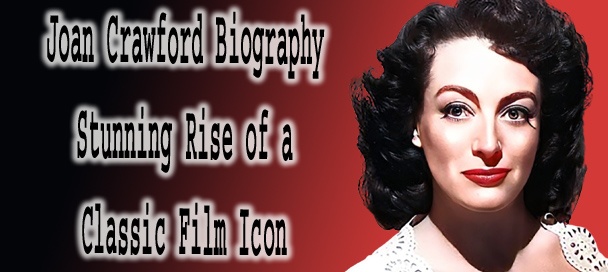
Joan Crawford during Hollywood’s golden studio era.
Few stars embodied the fierce ambition and polished glamour of Hollywood’s studio era more completely than Joan Crawford. Rising to prominence during the transformation of silent pictures into talking films, she became one of the defining screen personalities of twentieth-century American cinema. Her image was carefully sculpted yet unmistakably forceful, blending sophistication, intensity, and emotional authority in a way that audiences instantly recognized.
Joan Crawford was one of the most recognizable stars of Hollywood’s golden age, known for her commanding screen presence, emotional intensity, and remarkable longevity in film. Rising from silent pictures to Academy Award-winning dramas, she built a career that spanned nearly five decades. Crawford became closely associated with classic films such as Mildred Pierce (1945), Grand Hotel (1932), and What Ever Happened to Baby Jane? (1962). Her legacy remains deeply connected to the glamour, ambition, and fierce competitiveness of old Hollywood.
Crawford built a reputation as a commanding presence who could move easily between romance, drama, melodrama, and psychological tension. Throughout decades of changing public taste, she remained a reliable box office attraction and a symbol of perseverance within the film industry. Directors and studios understood that her performances carried a distinct energy, often centered on determined women navigating power, status, love, or personal conflict with relentless resolve.
Beyond the screen, Crawford represented the larger mythology of classic Hollywood itself. Her sharply defined style, disciplined professionalism, and carefully maintained public persona helped shape how movie stardom was understood during the golden age of cinema. Long after her most celebrated films first appeared, her influence continued through popular culture, film scholarship, and the enduring fascination surrounding the stars who defined Hollywood at its peak.
The most fascinating part of Joan Crawford’s story may be how completely she transformed herself. From poverty and instability to becoming one of the most carefully controlled stars in movie history, Crawford spent her entire life fighting to maintain power, image, and survival in Hollywood.
👶 Early Life
Summary: Her difficult upbringing and early dance career shaped the disciplined personality that later became central to her public image.
Joan Crawford was born Lucille Fay LeSueur on March 23, 1904, in San Antonio, Texas. Her parents were Thomas E. LeSueur and Anna Bell Johnson LeSueur, though the marriage collapsed early and her father soon disappeared from the family’s life. Much of Crawford’s childhood was shaped by instability, frequent moves, and financial hardship. Her mother later married Henry J. Cassin, a theater operator whose business exposed young Lucille to vaudeville performers, backstage routines, and the atmosphere of live entertainment long before she ever entered motion pictures.
Despite those surroundings, her early years were difficult rather than glamorous. A severe foot injury during childhood reportedly left her temporarily unable to attend school normally, forcing her into long periods of recovery and isolation. The family’s finances remained uncertain, and Crawford often worked odd jobs while still young. She attended several schools during her teenage years but rarely remained long enough to establish lasting stability. Determined to escape poverty, she developed a disciplined, highly competitive personality that later became central to both her private life and public image.
As a teenager, Crawford became increasingly drawn to dance and performance. She entered dance contests, worked in chorus lines, and spent time performing in traveling productions where energy and endurance mattered more than polish. During the height of the Jazz Age, she embraced the modern image of the energetic young flapper, a style that helped distinguish her from more traditional actresses of the period. Even before achieving recognition, she projected ambition, confidence, and resilience, qualities that would define her identity long before audiences knew the name Joan Crawford.
Explore the Biographies of Iconic Celebrities
Joan Crawford’s famous shoulder pads became so influential during the 1930s that department stores reportedly advertised clothing styles inspired directly by her films.
🎬 Film Career
Summary: Joan Crawford survived major changes in Hollywood by reinventing herself across silent films, dramas, noir classics, and psychological thrillers.
Joan Crawford entered motion pictures during the silent era after signing with Metro-Goldwyn-Mayer in the mid-1920s. Originally appearing in small roles and uncredited parts, she quickly attracted attention for her screen presence and modern image. Early appearances in films such as "Pretty Ladies" (1925) and "The Merry Widow" (1925) placed her alongside major stars including John Gilbert, Mae Murray, and Lon Chaney. MGM soon recognized her popularity with younger audiences, particularly as the Jazz Age transformed American culture.
Her breakthrough arrived with "Our Dancing Daughters" (1928), a defining flapper drama that turned Crawford into one of Hollywood’s brightest young stars. Acting opposite Anita Page and Dorothy Sebastian, she embodied the fast-moving spirit of the Roaring Twenties with sharp fashion, confidence, and emotional intensity. MGM quickly followed with similar productions including "Our Modern Maidens" (1929) and "Our Blushing Brides" (1930), helping establish Crawford as a symbol of modern womanhood during the transition from silent films to talking pictures.
Unlike many silent stars, Crawford adapted successfully to sound films. During the early 1930s, she appeared in major productions including "Grand Hotel" (1932) with Greta Garbo, John Barrymore, Lionel Barrymore, and Wallace Beery. The film became one of MGM’s most celebrated ensemble pictures. She also starred in "Rain" (1932), a dramatic adaptation opposite Walter Huston, proving she could handle emotionally demanding material beyond glamorous society roles.
Throughout the Depression era, Crawford became identified with working women struggling for survival and success. Films such as "Paid" (1930), "Possessed" (1931) with Clark Gable, and "Sadie McKee" (1934) showcased determined female characters navigating difficult circumstances. Her on-screen chemistry with Gable became especially popular, leading to collaborations in "Dance, Fools, Dance" (1931), "Chained" (1934), and "Forsaking All Others" (1934) alongside Robert Montgomery.
By the late 1930s, Crawford faced increasing competition from younger MGM actresses including Norma Shearer, Jean Harlow, Myrna Loy, and Greer Garson. Some trade publications even labeled certain established stars as “box office poison,” a controversial phrase that briefly included Crawford. Despite this setback, she reinvented herself through tougher dramatic performances and eventually left MGM after nearly two decades with the studio.
Her career revival began after signing with Warner Bros.. In "Mildred Pierce" (1945), directed by Michael Curtiz, Crawford delivered one of the defining performances of her career as a determined mother building a restaurant empire while struggling with her manipulative daughter, played by Ann Blyth. The film became both a commercial and critical triumph and earned Crawford the Academy Award for Best Actress. The role restored her standing as a major Hollywood force and remains closely tied to her legacy.
Crawford followed that success with a series of strong dramatic films including "Humoresque" (1946) with John Garfield, "Possessed" (1947) with Van Heflin, and "Daisy Kenyon" (1947) opposite Dana Andrews and Henry Fonda. These performances emphasized emotional complexity and psychological tension rather than the youthful glamour associated with her earlier career.
During the 1950s, Crawford continued adapting to changing audience tastes. She starred with Jack Palance in "Sudden Fear" (1952), a suspense thriller that earned her another Academy Award nomination. She also appeared in "Johnny Guitar" (1954) alongside Sterling Hayden, a highly unusual western directed by Nicholas Ray that later gained cult status for its intense emotional conflict and stylized presentation. Another notable role came in "Queen Bee" (1955) with John Ireland, where Crawford portrayed a destructive Southern socialite with icy authority.
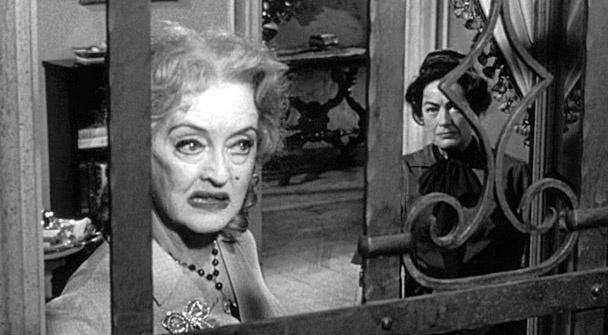
Screenshot from the trailer of the film Whatever Happened to Baby Jane?, starring Bette Davis and Joan Crawford.
One of the most discussed chapters of her career arrived with "What Ever Happened to Baby Jane?" (1962), starring Crawford opposite longtime rival Bette Davis. Directed by Robert Aldrich, the psychological horror film cast Crawford as the wheelchair-bound Blanche Hudson while Davis portrayed the unstable former child star Jane Hudson. The film became a major success and introduced both actresses to a new generation of moviegoers. Stories surrounding the Crawford-Davis rivalry became almost as famous as the production itself and remain part of Hollywood legend.
Crawford continued appearing in thrillers and horror films during the 1960s, including "Straight-Jacket" (1964), "I Saw What You Did" (1965), and "Berserk!" (1967), many produced by director and producer William Castle. These later performances leaned into her powerful screen persona and commanding intensity. Her final film appearance came in "Trog" (1970), after which she gradually withdrew from public life.
Across nearly five decades in motion pictures, Crawford worked with many of the most important names in classic Hollywood, including Clark Gable, Greta Garbo, Bette Davis, Humphrey Bogart, John Garfield, Sterling Hayden, Michael Curtiz, and Nicholas Ray. Her career survived silent films, the rise of sound, the studio era, wartime dramas, film noir, psychological thrillers, and horror cinema. Few actresses reinvented themselves as often or maintained such a commanding presence across so many generations of Hollywood filmmaking.
Flamingo Road Blu-ray
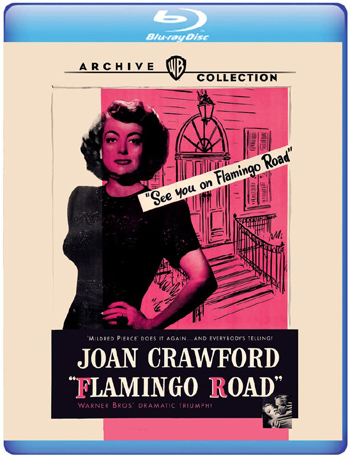
Cover Art for Flamingo Road Blu-ray starring Joan Crawford
Product Description:
Joan Crawford delivers one of her strongest Warner Bros. performances in Flamingo Road (1949), a tense political melodrama directed by Michael Curtiz. Crawford stars as carnival dancer Lane Bellamy, a woman trapped in a corrupt Southern town where power, politics, jealousy, and revenge collide. Featuring standout performances from Zachary Scott, Sydney Greenstreet, David Brian, Gladys George, and Virginia Huston, the film mixes romance, scandal, and noir-style tension into one of Crawford’s most entertaining late-1940s pictures.
Blu-ray Highlights:
• New 1080p HD master created from the best available preservation materials.
• Fully restored picture and audio presentation.
• Includes the featurette Crawford at Warners.
• Bonus cartoon Curtain Razor starring Porky Pig in HD.
• Features the classic blooper reel Breakdowns of 1949.
• Radio adaptation from Screen Director’s Playhouse with Joan Crawford and Michael Curtiz.
• Original theatrical trailer included.
Why Fans Still Love Flamingo Road:
Flamingo Road captures everything audiences admired about Joan Crawford during her Warner Bros. years: determination, toughness, glamour, and emotional intensity. The film balances political corruption with personal drama, while Crawford commands nearly every scene with sharp dialogue and fierce confidence. Sydney Greenstreet gives one of his most memorable villain performances as Titus Semple, creating a powerful clash of personalities that drives the story toward its explosive finale. For classic Hollywood collectors, this Blu-ray finally gives the film the polished presentation it deserved for decades.
Joan Crawford was one of the first major Hollywood stars to openly embrace television interviews and talk show appearances during the 1950s and 1960s.
❤️ Personal Life
Summary: Her marriages, rivalries, and family controversies made her private life nearly as famous as her motion picture career.
Joan Crawford lived much of her private life under intense public attention, carefully balancing Hollywood glamour with a fiercely guarded personal identity. Off screen, she was known for discipline, ambition, and a relentless desire to maintain control over both her image and surroundings. Friends and coworkers often described her as polished and professional, though others found her demanding and emotionally distant. Her reputation for perfection extended into nearly every aspect of her daily routine, from appearance and housekeeping to business decisions and social relationships.
Crawford married several times during her life, each relationship drawing considerable media coverage. Her first marriage was to actor Douglas Fairbanks Jr. in 1929, linking her directly to one of Hollywood’s most famous entertainment families through his father, silent film legend Douglas Fairbanks. Although the marriage attracted enormous publicity, the relationship eventually deteriorated and ended in divorce. Crawford later married actor Franchot Tone in 1935 after the two appeared together in films including "Today We Live" (1933) and "Sadie McKee" (1934). Their marriage became strained by career pressures and conflicting personalities, leading to another divorce.
Her third marriage was to actor Phillip Terry in 1942, though the union lasted only a short time. Crawford’s fourth and final marriage came in 1955 when she wed Alfred Steele, chairman of Pepsi-Cola. The marriage brought her into the corporate world, and she took an active interest in company promotion and public appearances connected to the Pepsi brand. Following Steele’s death in 1959, Crawford remained publicly associated with Pepsi for years afterward, often appearing at company events and maintaining close ties to its executives.
Crawford became a mother through adoption, raising four children: Christina Crawford, Christopher Crawford, and twins Cathy Crawford and Cindy Crawford. Her relationship with her children later became the subject of intense controversy following the publication of "Mommie Dearest" (1978) by Christina Crawford. The memoir portrayed Crawford as emotionally volatile and abusive, creating a lasting public debate about the actress’s private behavior. Some friends and family members defended Crawford and challenged parts of the book, while others believed the allegations reflected the darker side of her demanding personality.
Throughout her life, Crawford maintained close friendships within Hollywood society while also developing a reputation for fierce rivalries and professional competition. Her long-running tension with Bette Davis became one of the entertainment industry’s most famous feuds, fueled by studio politics, competition for roles, and conflicting personalities. Stories surrounding their relationship grew even more dramatic after the production of "What Ever Happened to Baby Jane?" (1962) and later became part of classic Hollywood folklore.
Away from film sets, Crawford valued elegance, structure, and social status. She entertained frequently, followed strict personal routines, and remained deeply conscious of public perception even as the old studio system faded. In later years, she reduced her film appearances but continued making television guest appearances, interviews, and public engagements. Though opinions about her private life often varied sharply, few disputed the intensity with which Joan Crawford approached both fame and personal survival.
Joan Crawford reportedly answered fan mail personally for many years, even while maintaining one of the busiest schedules in Hollywood. She also became heavily involved in Pepsi-Cola promotions after marrying company executive Alfred Steele.
🕊️ Later Years
Summary: Even in later years, Joan Crawford maintained the polished image of a classic movie star while continuing to work in film and public appearances.
During the final stage of her career, Joan Crawford remained determined to preserve the commanding public image she had built across decades in Hollywood. Although major studio roles became less frequent during the late 1960s, she continued accepting film, television, and promotional appearances that kept her visible to audiences who still associated her with classic movie glamour. Crawford understood the value of celebrity long before modern branding became common, and she worked carefully to maintain her status as one of Hollywood’s surviving legends.
Her later film work leaned heavily into suspense and horror pictures, genres that embraced aging stars with powerful screen identities. Productions such as "Straight-Jacket" (1964), "I Saw What You Did" (1965), and "Berserk!" (1967) allowed Crawford to capitalize on her intense screen presence while introducing her to younger moviegoers. Though critics sometimes dismissed these films as sensational entertainment, they developed loyal audiences and later gained cult recognition among classic horror fans. Crawford approached even these lower-budget productions with the same professionalism and seriousness that had defined her earlier studio work.
Outside acting, Crawford devoted significant time to public relations work connected to Pepsi-Cola following the death of her husband Alfred Steele. She frequently appeared at corporate functions, charity events, and business gatherings, presenting herself with the polished confidence expected of a major Hollywood personality. Her ability to move comfortably between the entertainment industry and corporate culture reflected the discipline and social awareness that had shaped her entire public life.
As the 1970s approached, Crawford gradually withdrew from filmmaking and public appearances. Her final motion picture was "Trog" (1970), a British science fiction horror film that marked the end of a screen career spanning nearly half a century. Though the film itself received mixed reactions, Crawford defended her participation, believing that working actresses should continue performing regardless of changing industry trends or critical opinion.
In private, Crawford’s health began to decline during her later years. She became increasingly reclusive and spent much of her time in her New York apartment, limiting outside appearances while remaining intensely protective of her image. Even as Hollywood evolved into a very different industry from the one that had created her, Crawford continued to represent the grandeur and toughness associated with the classic studio era.
Joan Crawford died on May 10, 1977, at the age of 73. Her death marked the passing of one of the final major stars whose career stretched from silent pictures through modern psychological thrillers. News coverage around the world reflected both admiration and fascination, recognizing her as one of the most enduring and complex figures in Hollywood history.
🏆 Legacy
Joan Crawford remains one of the defining figures of classic Hollywood, representing both the glamour and relentless ambition that shaped the studio era. Few actresses reinvented themselves as successfully across so many changing periods of American cinema. From silent films and Jazz Age dramas to film noir, psychological thrillers, and horror pictures, Crawford adapted repeatedly while maintaining a powerful and unmistakable screen identity.
Her performances in films such as "Our Dancing Daughters" (1928), "Grand Hotel" (1932), "Mildred Pierce" (1945), "Sudden Fear" (1952), and "What Ever Happened to Baby Jane?" (1962) continue to attract audiences decades after their original release. Critics and film historians frequently point to her ability to portray emotionally driven, determined women whose strength often existed alongside vulnerability, obsession, or personal conflict. That combination became central to Crawford’s enduring appeal and helped distinguish her from many of her contemporaries.
Crawford’s influence also extended beyond acting. Her carefully controlled image helped define the idea of Hollywood stardom during the twentieth century. The sharply arched eyebrows, dramatic lighting, sculpted fashion, and commanding voice became part of popular culture itself. Generations of performers, filmmakers, photographers, and designers drew inspiration from the larger-than-life persona she projected both on and off screen.
Her complicated public image added another dimension to her legacy. The publication of "Mommie Dearest" (1978) by Christina Crawford transformed public discussion surrounding the actress and introduced a darker interpretation of her private life. The later film adaptation, starring Faye Dunaway as Crawford, became a cultural phenomenon of its own. While the portrayal divided audiences and historians, it also ensured that Crawford remained part of public conversation long after her death.
Film scholars often place Crawford alongside legendary actresses such as Bette Davis, Greta Garbo, Barbara Stanwyck, and Katharine Hepburn as one of the most important female stars of Hollywood’s golden age. Unlike many performers whose fame faded with changing trends, Crawford’s image remained instantly recognizable across multiple generations.
Today, Joan Crawford occupies a rare place in entertainment history where admiration, controversy, myth, and cultural fascination continue to exist side by side. Whether viewed as a brilliant actress, a relentless perfectionist, a survivor of Hollywood’s brutal studio system, or an enduring symbol of old Hollywood glamour, her presence in American film history remains impossible to ignore.
🗣️ Why They Still Matter
Joan Crawford continues to fascinate audiences because she represents both the triumph and pressure of classic Hollywood stardom. Her films remain widely discussed by movie historians, while her personal life still sparks debate generations after her death. Few actresses managed to remain culturally recognizable across silent films, studio dramas, noir classics, and psychological horror. Her image, voice, and determination remain permanently linked to the mythology of old Hollywood.
Further Reading & Resources
📖 Read: Joan Crawford - Movies, Children & Death - Biography
🔍 More: Joan Crawford | Biography, Films, Mommie Dearest
ML Lamp is the owner of Kilroy Was Here. After his 20 years of working in Las Vegas in the entertainment promotions field, Mr. Lamp retired in 2002 from his job to pursue his passion for collectibles. Now as a guest speaker and author he’s living the dream, and sharing his warmth with You.