🤠 DIY Indiana Jones Costume: How to Dress Like Cinema’s Most Beloved Adventure Archaeologist
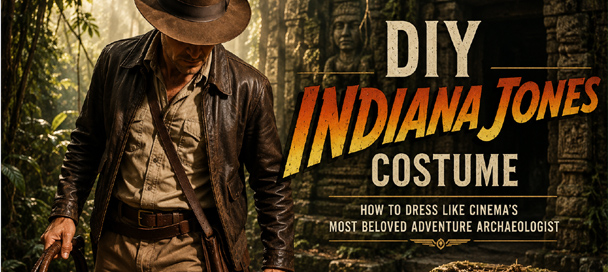
A complete DIY Indiana Jones costume featuring a distressed brown leather jacket, brown fedora, khaki shirt and trousers, brown leather boots, prop whip, leather satchel, and the alert purposeful presence that made Harrison Ford's archaeologist adventurer one of American cinema's most beloved and immediately recognizable characters.
Raiders of the Lost Ark arrived in theaters on June 12, 1981, directed by Steven Spielberg and produced by George Lucas, and within the first fifteen minutes had established one of the most iconic characters in American cinema history. The boulder. The hat rolling under the closing stone door. The silhouette of a man in a leather jacket and a fedora walking into the jungle with a whip at his hip. Harrison Ford played Henry Walton Jones Junior, known to his students as Dr. Jones and to everyone else as Indiana, with a specific combination of competence and barely controlled chaos that made the character immediately and completely beloved. He was not a superhero. He was a man who knew what he was doing and got hurt doing it and kept going anyway, and that quality made every impossible situation he survived feel earned rather than given.
The DIY Indiana Jones costume draws from one of American cinema's most beloved and culturally enduring characters, Henry Walton Jones Junior known as Indiana Jones, portrayed by Harrison Ford across four films beginning with Raiders of the Lost Ark directed by Steven Spielberg and released on June 12, 1981. The Indiana Jones franchise has produced five films from 1981 through 2023 and the character has appeared continuously in theme parks, television, video games, and merchandise across four decades, making the fedora and brown leather jacket combination one of the most recognized costume silhouettes in the history of American popular culture. Harrison Ford's portrayal of Indiana Jones earned the character a place on the American Film Institute's list of greatest film heroes and the franchise was selected as one of the most significant adventure film series in American cinema history.
The Indiana Jones franchise spans four films across twenty-seven years, from Raiders of the Lost Ark in 1981 through Indiana Jones and the Kingdom of the Crystal Skull in 2008, with a fifth installment Indiana Jones and the Dial of Destiny arriving in 2023. The character has appeared in television, theme parks, video games, and merchandise across four decades and shows no meaningful sign of diminishing in cultural recognition. The fedora and the leather jacket are among the most recognized costume silhouettes in the history of American popular culture, which means the DIY Indiana Jones costume faces the same challenge addressed in the Peg Bundy and Dwight Schrute articles. It is everywhere. Most versions of it are a shopping list dressed up as an article. This one is not.
What most Indiana Jones costume articles miss entirely is the character. Indiana Jones was a professor of archaeology at Marshall College who genuinely cared about history and genuinely believed that artifacts belonged in museums, a conviction he expressed with complete sincerity while simultaneously acquiring those artifacts through methods that a museum's board of directors would not have fully endorsed. He was afraid of snakes. He had an ex-student who still had feelings for him that he had handled badly. He had a complicated relationship with his father that the third film addressed with more humor and more genuine emotion than anyone expected from an adventure franchise. He was, in short, a fully realized person wearing an iconic hat, and the hat is more interesting when you understand who is under it.
A DIY Indiana Jones costume is worth building because the visual is immediately recognizable, the sourcing is achievable as a combination of thrift store and specialty finds, and the character behind it rewards the kind of presence work that every article in this series has emphasized. The hat and the jacket establish who you are. What you do with the walk and the expression and the whip does the rest.
One more thing worth noting before the costume instructions begin. This article is the companion piece to the DIY Professor Henry Jones Sr costume guide also on this site, covering the father from Indiana Jones and the Last Crusade as played by Sean Connery. If you are planning a couples or father and son Halloween costume, the two articles together give you everything you need for one of the great pairings in American adventure cinema. Junior got more done. Senior got more dates. Both are worth building.
🤠 Step 1: Create the Base
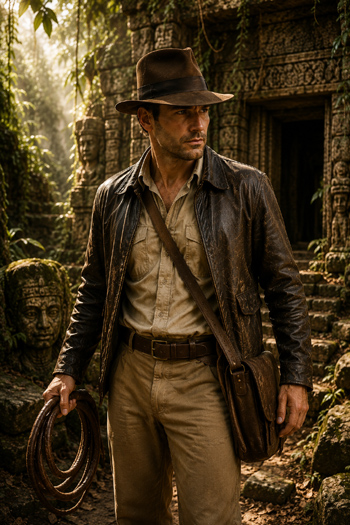
A complete DIY Indiana Jones costume featuring a distressed brown leather jacket, brown fedora, khaki shirt and trousers, brown leather boots, prop whip, and leather satchel inspired by Harrison Ford's iconic portrayal of Indiana Jones beginning with Raiders of the Lost Ark in 1981.
The foundation of a DIY Indiana Jones costume is built from three pieces that together create one of the most recognizable silhouettes in cinema history, and getting each of them right is the whole sourcing job for this costume.
The brown leather jacket is the most important piece and the one worth spending the most time and budget on because it is what the eye finds first from any distance and it is the piece most likely to make or break the overall reading of the costume. Indiana's jacket was a specific style, a distressed brown leather jacket with a particular cut that included a slightly shorter body length than a standard leather jacket, a shirt collar rather than a lapel, and a worn, lived-in quality that communicated a man who had worn this jacket through multiple continents worth of adventure and had never once considered replacing it.
Thrift stores are worth checking first because brown leather jackets turn up in secondhand shops regularly and a genuine leather jacket found at Goodwill at a fraction of retail price will have the kind of natural distressing that a new jacket cannot replicate. Look in the men's outerwear section for a brown leather jacket in a simple style without too much hardware, too many zippers, or any motorcycle styling that would read incorrectly for the character. If the thrift store search comes up short, online retailers and costume shops carry Indiana Jones specific jacket styles at a range of price points. A genuine leather option will always read better than a faux leather version, particularly in photographs where the texture difference is visible.
The khaki trousers are the base layer below the jacket and they should be a warm tan or khaki in a straight-cut style that reads as practical field wear rather than fashion chinos. Thrift stores are the right and honest source here. Look for something with some wear to it already, a pair of khakis that has been washed many times and has arrived at the soft, slightly faded quality that Indiana's clothing always had. The trousers should be worn with a simple brown leather belt.
The khaki shirt goes under the jacket and should be visible at the collar and cuffs when the jacket is worn. A simple button-front shirt in khaki or light tan, worn with the collar open one or two buttons and the sleeves rolled to just below the elbow when the jacket comes off, is the correct configuration. Thrift stores carry khaki button shirts in abundance. The shirt should be slightly lighter in tone than the trousers to give the layers visual separation.
Brown leather boots complete the base at the floor. Lace-up, mid-calf height or ankle height, in a warm brown leather with a low heel and a simple profile. Indiana's boots were working boots worn for serious field work rather than fashion footwear, and the more worn the leather looks the more accurately they read. Thrift stores, surplus stores, and workwear retailers all carry brown leather boots at accessible prices.
🪡 Step 2: The Hat
The fedora deserves its own section because it is the single most important piece in this costume and the one most likely to be gotten wrong. The Indiana Jones fedora is a specific style and getting it approximately right matters more than getting any other single detail right because the hat is what everyone sees first and what they remember longest.
The hat should be a brown fedora with a medium brim that curves down slightly at the front and back and up slightly at the sides. The crown has a specific pinched quality at the front that is characteristic of the style. It should be brown, specifically a warm medium brown that reads as tobacco or chestnut rather than dark chocolate or light tan. The hat should look worn and shaped from use, with the brim slightly irregular and the crown carrying the evidence of having been grabbed, crushed, rolled, and restored many times.
Costume shops carry Indiana Jones specific fedoras at a range of price points and the officially licensed versions are worth the additional cost because the shape has been replicated accurately. Generic brown fedoras from hat retailers are an acceptable alternative if the shape is approximately right and the brim width is in the correct range. Avoid fashion fedoras with very narrow brims, uptilted brims, or any decorative elements that read as contemporary rather than adventure archaeology circa 1936.
When wearing the hat, set it slightly forward on the head rather than pushed back, which is the configuration Indiana wore in most of his running, fighting, and barely escaping sequences. The hat should stay on during active movement because Indiana's hat famously stayed on through situations that should have removed it, which was part of the joke and part of the character's visual identity.
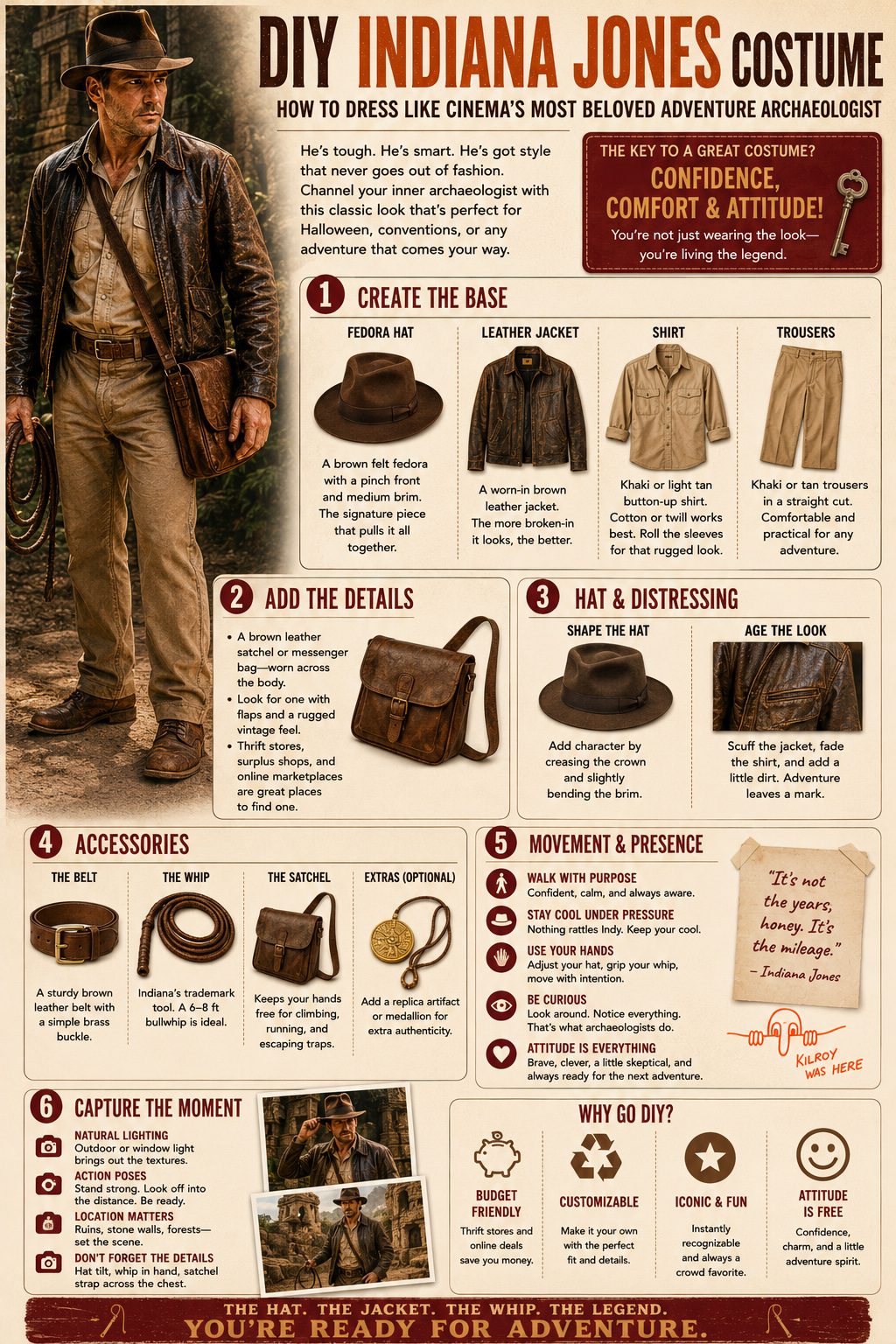
Click Image for full Infographic of the DIY Indiana Jones Costume
🎭 Step 3: Distressing the Costume
The distressing process for this costume is less intensive than the Festus Haggen build but more important than most other articles in this series because Indiana Jones's clothing always looked like it had recently survived something and the clean, pressed version of this costume reads as a theme park character rather than the real thing.
The jacket will develop its own character over time if it is genuine leather and has been worn. If your thrift store find is already distressed, work with what it has. If it is in too good a condition, a light application of brown shoe polish worked into the surface with a cloth and then partially buffed out will add depth and variation to the color. Pay particular attention to the elbows, the shoulders, and the front panels, which are the areas that show wear first on a working jacket.
The trousers and the shirt benefit from the same coffee soak technique described in the Festus Haggen article, particularly if they are in too bright or too stiff a condition. A short soak in cooled strong coffee followed by air drying without ironing will add the faded, slightly aged quality that reads correctly for field clothing worn across multiple expeditions.
The hat is the piece most worth aging carefully because a new-looking hat on an otherwise distressed costume will undermine the whole reading. Work the brim with your hands, bending and reshaping it until it has the irregular, slightly battered quality that Indiana's hat carried throughout the films. A light application of brown shoe polish along the brim edge and the sweat line will add the tonal aging that reads as years of honest adventure rather than recent purchase.
🎀 Step 4: Accessories and Props
The whip is the prop that completes the Indiana Jones identity and it should be treated as a strong recommendation rather than an optional addition because carrying it transforms the costume from a man in a leather jacket and a fedora into Indiana Jones specifically. A prop or costume whip in brown leather or faux leather, coiled and attached to the belt at the right hip, is the correct configuration. Costume shops and online retailers carry Indiana Jones specific whip props at accessible prices. The whip should be carried rather than used, because using a whip at a Halloween party is the kind of decision that ends parties.
A brown leather satchel or messenger bag worn cross-body completes the look as the bag Indiana always carried for transporting artifacts, maps, journals, and whatever else the current adventure required. Thrift stores carry brown leather or faux leather bags regularly. Look for something with a flap closure and a worn, traveled quality. The bag should sit at the hip on the opposite side from the whip.
A coiled rope attached to the belt or the bag adds the secondary prop detail that rewards close observation. Indiana used rope almost as frequently as the whip and carrying both connects the costume to the full inventory of his field equipment.
The five o'clock shadow is the facial detail worth adding if your natural stubble cooperates. Indiana was always slightly unshaven, the stubble of a man who shaves when circumstances allow and has been on a train, a plane, and a camel since the last time circumstances allowed. A few days of growth before the event or a light application of brown eyeshadow stippled across the jaw with a sponge will add the specific quality of someone who has been in the field and is heading back into it shortly.
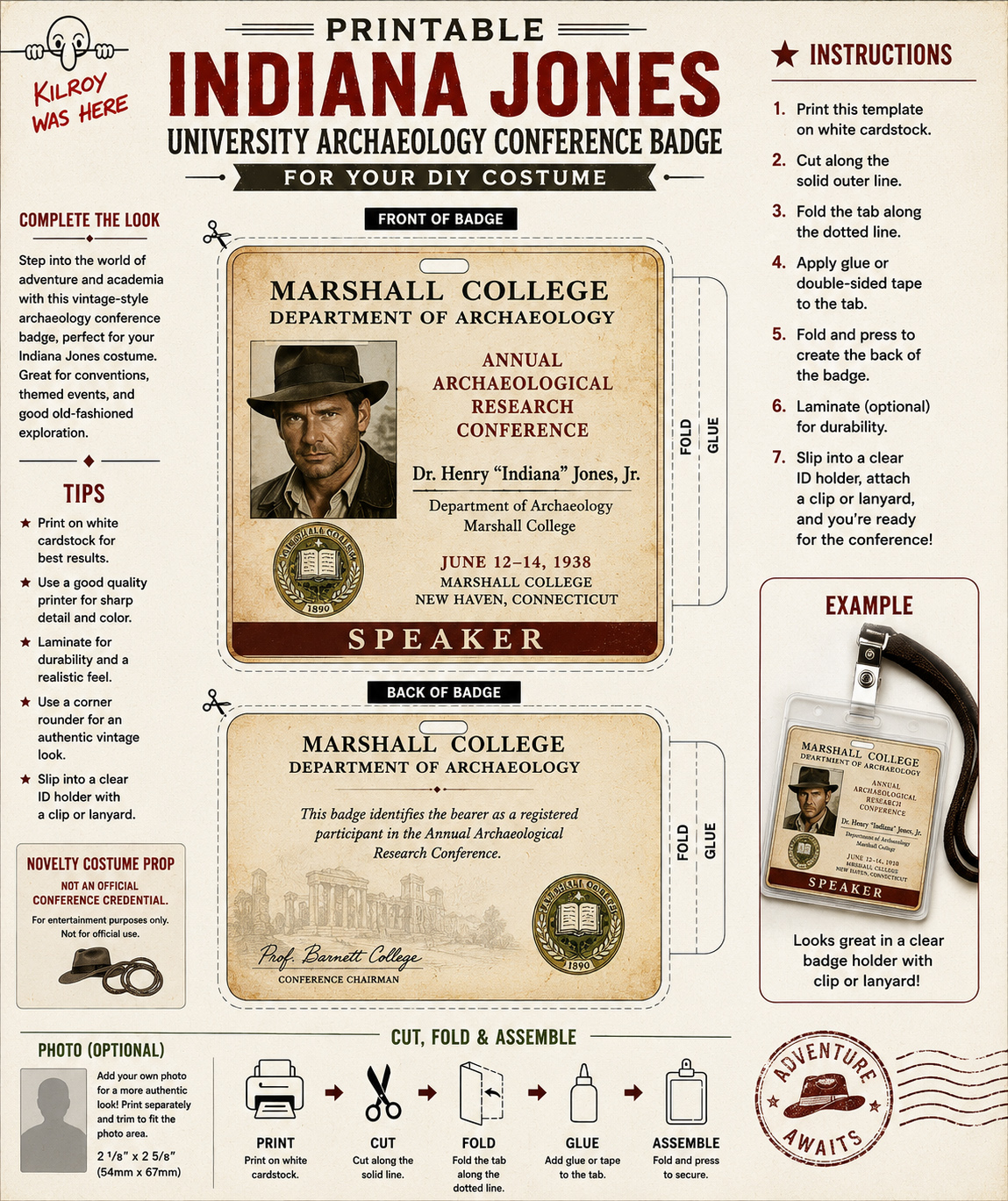
Click the image for your printable Indiana Jones: University conference badge
🕺 Step 5: Movement and Presence
Indiana Jones moved through the world with the specific energy of a man who assessed every situation for threat, opportunity, and exit routes simultaneously and had usually identified all three before anyone else in the room had finished their drink. The posture is alert and slightly forward, the posture of someone who is always ready to move and has the muscle memory of someone who has moved suddenly in bad situations enough times that readiness has become a resting state.
The walk is purposeful without being hurried. Indiana did not run until running was the only remaining option, and even then he looked like someone who had calculated the run rather than panicked into it. Move at a deliberate pace with the weight slightly forward and the eyes scanning the room at regular intervals. Not nervously, not conspicuously, just the habit of a man who has learned that the thing you did not notice is usually the thing that becomes a problem.
The expression is focused and slightly wary with occasional breaks into the dry humor that Harrison Ford brought to the character so consistently that it became inseparable from the role. Indiana was funny in the specific way of someone who found the situations he kept ending up in absurd but had decided that absurdity was not a reason to stop. A slight raised eyebrow at unexpected information, a brief expression of someone who has just confirmed their worst suspicion, and the occasional dry comment delivered without breaking stride are all character-specific physical behaviors worth incorporating.
The whip hand is worth practicing. Indiana held the whip with the casual ease of someone who had been using it since childhood, which the films confirmed he had. The whip should hang at the hip when not in use and be handled with the relaxed confidence of a tool rather than the theatrical flourish of a performer. If you crack it at any point during the evening, and the temptation will be present, do it once and only once and do it well. Indiana never wasted a whip crack.
Snakes. Indiana Jones was afraid of snakes. This is confirmed in Raiders of the Lost Ark when he encounters a pit full of them and delivers the line that became one of the most quoted in the franchise. Why did it have to be snakes. If someone produces a rubber snake at any point during the evening, react with the specific combination of genuine distaste and professional determination that Indiana brought to every snake encounter. He was afraid of them. He went into the pit anyway. That gap between the fear and the action is the whole character.
📸 Step 6: Capture the Moment
For photography the DIY Indiana Jones costume belongs in any setting that suggests adventure, archaeology, or the 1930s. An outdoor setting with natural elements, stone walls, wooden structures, or open landscape reads immediately as the kind of environment Indiana operated in. A library or a university hallway serves the academic side of the character and connects the costume to his day job as a professor.
Warm afternoon light suits this costume well because the leather jacket and the brown hat read best in warm light that picks up the tonal range of the earth tones across the whole costume. Position yourself so the light comes from slightly to one side to add depth to the leather and give the hat the shadow quality that makes it read as dimensional rather than flat.
The silhouette shot is the strongest single image this costume can produce. Stand in profile with the hat on and slightly forward, the jacket collar up, the whip at the hip, looking toward the horizon or a light source slightly above eye level. That profile, the hat brim, the leather jacket shoulder, the whip hanging at the hip, is one of the most recognizable silhouettes in American cinema and it photographs with immediate authority.
A straight-on shot with the hat brim pulled down slightly, the expression set to the focused wary assessment that is Indiana's default, and the whip held loosely in one hand is the second essential image. That combination communicates the character completely and immediately to anyone who has seen any film in the franchise.
🏆 Why Go DIY? Wrap-Up
Building a DIY Indiana Jones costume from a thrift store leather jacket and a correctly sourced fedora means assembling something that connects directly to one of the most beloved characters in American adventure cinema and rewards the specific details with a result that reads immediately and reads completely. The hat does the recognition work. The jacket does the character work. The whip closes the deal.
Indiana Jones mattered because Steven Spielberg and Harrison Ford built a character who was genuinely heroic without being invulnerable, genuinely funny without being comedic, and genuinely smart without being infallible. He got hurt. He made mistakes. He was afraid of snakes and went into the snake pit anyway. That combination of capability and humanity made him one of the most durable characters in American popular culture across four decades and counting.
The franchise has produced some of the most memorable sequences in adventure cinema history and Harrison Ford played every one of them with the specific quality of a man who found the whole situation slightly absurd and was going to save the day anyway because somebody had to and he was already there. Wearing this costume with that energy for an evening is a tribute to forty years of one of cinema's great performances.
It belongs in a museum. So does the effort you put into building this costume correctly. Wear the hat. Carry the whip. Watch out for snakes.
🕸️ Related Costumes to Try
DIY Walter Sobchak Costume
DIY Dwight Schrute Costume
DIY Walter White Heisenberg Costume
DIY Dee Snider Twisted Sister Costume
Adult Brown Fedora Hat
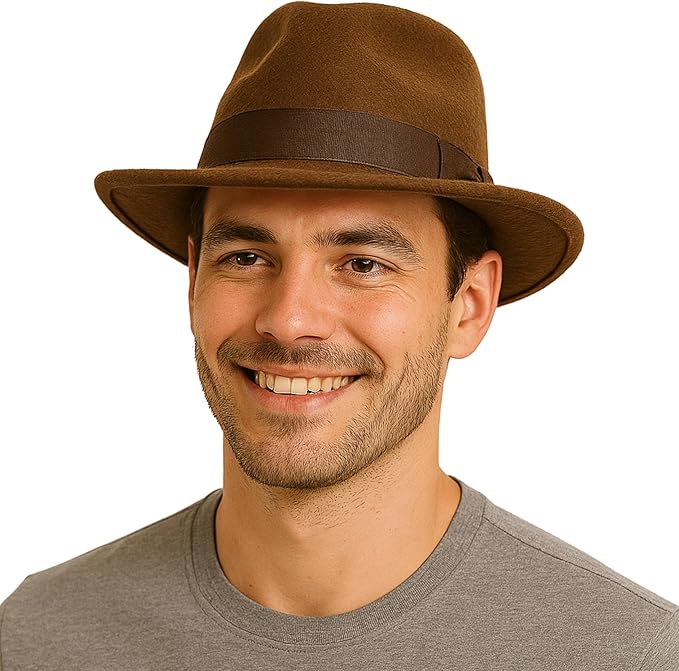
Adult Brown Fedora Hat for a DIY Indiana Jones Costume
Product Description:
No DIY Indiana Jones Costume is complete without the famous brown fedora. More than any other piece of clothing, the hat defines the adventurous archaeologist's look and instantly makes the character recognizable. This classic fedora is perfect for Halloween, cosplay, movie nights, and themed events.
Key Features:
• Classic brown fedora design
• Comfortable lightweight construction
• Traditional pinched crown and medium brim
• Suitable for adults
• Great for Halloween, cosplay, theatrical productions, and movie-themed parties
Why This Works:
Indiana Jones rarely appears without his signature fedora. Pair this hat with a brown leather jacket, tan shirt, khaki pants, leather satchel, and a coiled bullwhip to create a convincing DIY Indiana Jones Costume that adventure movie fans will recognize immediately.
Buy on Amazon
Further Reading & Resources
📺 See: Raiders of the Lost Ark
🔍 More: Raiders of the Lost Ark - Wikipedia
ML Lamp is the owner of Kilroy Was Here. After his 20 years of working in Las Vegas in the entertainment promotions field, Mr. Lamp retired in 2002 from his job to pursue his passion for collectibles. Now as a guest speaker and author he’s living the dream, and sharing his warmth with You.