William Castle Theater Gimmicks and the Man Who Turned Theaters Into Haunted Houses
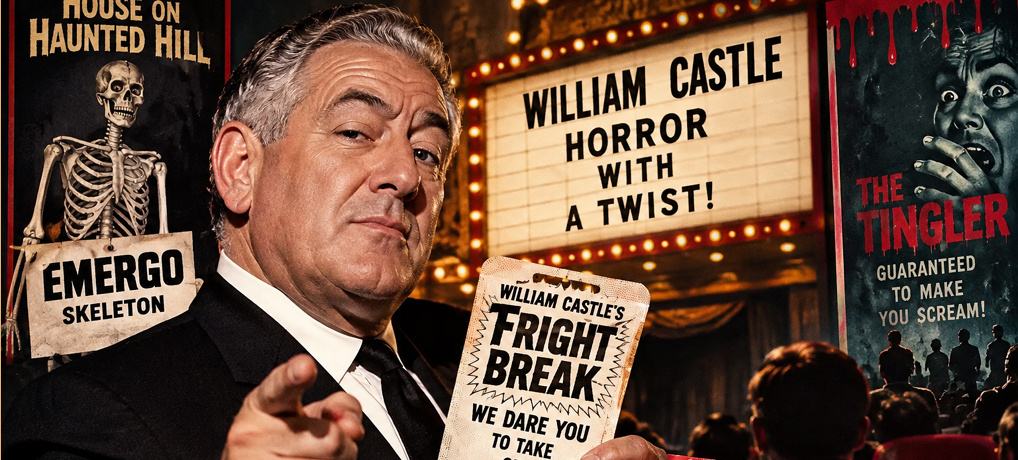
William Castle Theater Gimmicks turned moviegoing into part of the show, from the flying Emergo skeleton to The Tingler, Fright Breaks, and other outrageous promotions.
William Castle was not trying to make great art. He was trying to fill seats.
He did both, in his own particular way, and the results were unlike anything Hollywood had seen before or has quite managed since.
Castle was a producer and director who worked from 1939 through the mid-1970s. He made cheap pictures fast. He understood budgets, schedules, and audiences. He also understood something that most filmmakers of his era did not spend much time thinking about.
The theater itself was part of the show.
From 1958 through the mid-1960s, Castle created a series of theatrical experiences that attached physical stunts, audience props, and outright pranks to his horror films. Audiences came for the gimmick. They stayed for the movie. They left talking about both.
Nobody has done it quite like him since.
William Castle Theater Gimmicks Made Buying a Ticket Part of the Show
Castle was born William Schloss in New York City in 1914. He dropped out of school at fifteen. He worked his way into the theater business by sheer persistence. He eventually landed at Columbia Pictures, where he directed westerns and crime pictures through the 1940s.
He was good at his job. He was not becoming famous doing it.
By the late 1950s, television was eating into movie theater attendance. Families had screens at home. Going out to the movies needed a reason. Castle understood this problem clearly. His solution was characteristically direct.
Give people a reason they could not get at home.
You could not watch a skeleton fly over your head on a television set. You could not feel your seat buzz in your living room. You could not walk out of your house and demand a refund because a movie scared you too badly to continue watching.
Castle turned the act of buying a ticket into an event. The experience began in the lobby. It continued in the seat. It followed people home in the stories they told about what had happened to them.
That was the formula. Simple, effective, and completely his own.
Macabre Insured You Against Dying of Fright
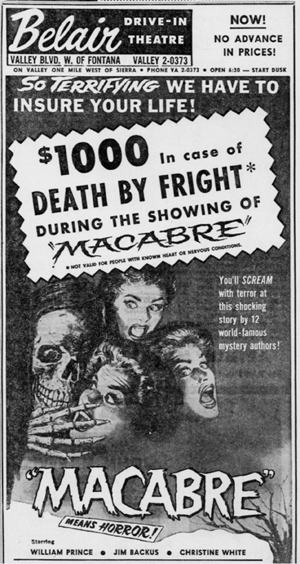
Belair Drive-In theater advertisement for the American horror film Macabre (1958). From the May 1958 San Bernardino Sun.
Castle mortgaged his Beverly Hills home to make Macabre in 1957. He had to. No studio would finance it for him.
The film itself was a decent thriller. It was not going to sell itself.
Castle went to Lloyd's of London. He arranged for the insurance company to issue one-thousand-dollar life insurance policies to every ticket buyer. The policy covered one specific cause of death: fright during the film.
Every customer entering the theater signed a certificate. Nurses in uniform stood in the lobby. Hearses were parked outside on the street. Castle himself arrived at premiere screenings in a coffin.
Before the film began, Castle's voice came over the speakers. He explained that Lloyd's of London sincerely hoped nobody would collect. But just in case, he said, wasn't it comforting to know that your loved ones were protected?
Nobody died of fright during Macabre. Nobody claimed the insurance money. The fine print included a clause voiding the policy for pre-existing conditions, which covered most of the relevant medical situations anyway.
None of that mattered. People lined up to sign the certificate. The film made a profit that allowed Castle to make another movie immediately. The gimmick had worked exactly as intended.
The stunt had a second effect Castle may not have fully anticipated. Word spread. People who had not seen the film told people who had not seen it about the insurance policy. Every person who described the gimmick was also describing the film. Castle had invented a publicity machine that ran entirely on conversation.
House on Haunted Hill Introduced Emergo
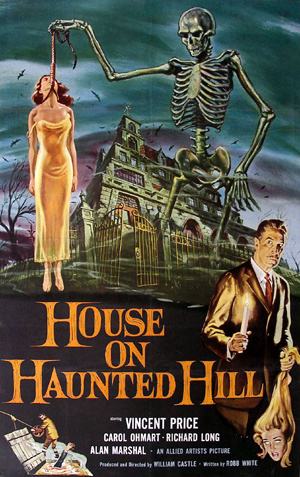
Original theatrical poster for House on Haunted Hill (1959), William Castle’s Vincent Price horror classic famous for its “Emergo” skeleton theater gimmick.
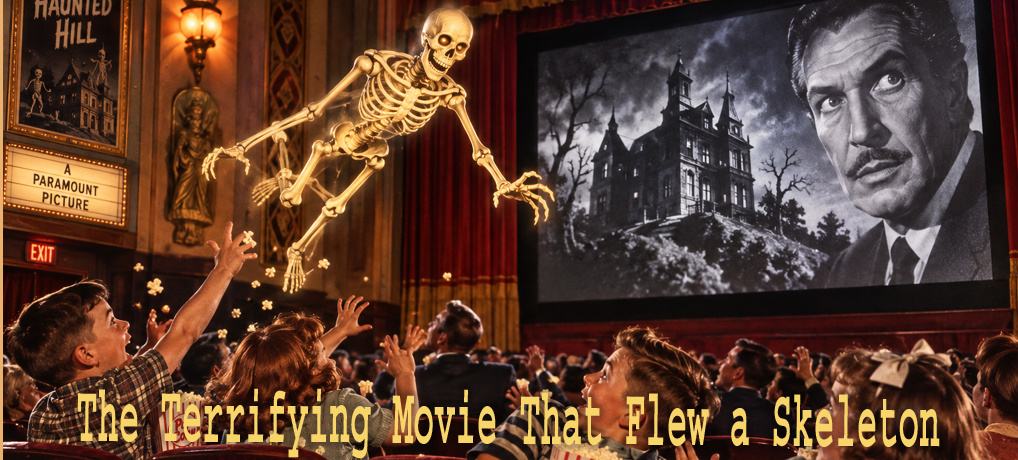
House on Haunted Hill arrived in 1959 with Vincent Price and a skeleton on a wire.
Castle called it Emergo. The name came from the idea of something emerging from the screen. At the moment in the film when a skeleton rises from a vat of acid, a glowing plastic skeleton appeared from a black box beside the screen. It traveled on a wire and pulley system across the ceiling of the theater. It passed over the heads of the audience. It returned to its box as the skeleton on screen was reeled back in.
The effect connected the film and the theater into a single experience. For a few moments, the haunted house was not on the screen. It was in the room.
Not every theater installed Emergo. The pulley system required setup and an operator to manage the timing. Smaller venues sometimes skipped it. In theaters that used it, the results were memorable.
They were also sometimes dangerous. Once word spread that a skeleton was coming, audiences came prepared. Children arrived with slingshots. They loaded them with stones and ball bearings. Many theaters eventually removed the equipment. The skeleton was taking damage faster than it could be repaired.
Castle was not particularly troubled by this. The children with slingshots had paid for their tickets. They had told their friends about the skeleton. Their friends had also paid for tickets. The system continued working.
If you want the full story of House on Haunted Hill and Emergo, including the Frank Lloyd Wright house used for the exterior and what happened when kids actually fought back against the skeleton, we covered it in detail right here on Kilroy Was Here Shop.
House on Haunted Hill: The Terrifying Movie That Flew a Skeleton Over the Audience
The Tingler Put Percepto Under Theater Seats
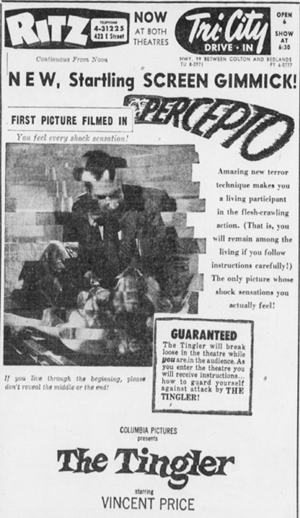
Ritz Theatre and Tri-City Drive-In advertisement for the horror film The Tingler (1959). From the October 1959 San Bernardino Sun.
Also released in 1959, The Tingler starred Vincent Price as a scientist who discovers a creature living in the human spine. The creature feeds on fear. The only way to destroy it is to scream.
Castle needed a gimmick that matched the premise. He found one.
Percepto was built from army surplus equipment. The vibrating motors were aircraft wing defrosters. In the air they shook ice free in cold weather. In Castle's hands they shook theater customers in their seats during horror films.
Castle declared privately that he was going to buzz the backsides of everyone in America. He came reasonably close.
Selected seats in participating theaters were wired to the motors. A projectionist controlled the switch. At the moment in the film when the Tingler escapes into a movie theater, the projectionist activated the buzzers. Audience members in wired seats felt a sudden vibration.
The effect was enhanced by a woman planted in the audience. She screamed and appeared to faint. Theater staff carried her out on a stretcher. From the screen, Price reassured the audience that the Tingler was under control.
The film also had a version designed for drive-in theaters. Price's voice explained that the Tingler was loose in the drive-in. Without seats to wire, the effect relied entirely on suggestion. It reportedly still worked.
One theater screening a different film during daytime hours accidentally left the Percepto system active. The projectionist switched it on during a quiet moment in The Nun's Story. The audience's reaction was apparently significant.
Castle Learned That a Silly Idea Could Sell a Serious Number of Tickets
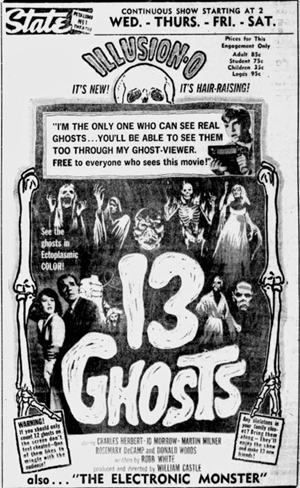
State theater advertisement for the supernatural horror film, 13 Ghosts. July 1960.
After the success of Macabre, House on Haunted Hill, and The Tingler, Castle understood something important. The gimmick did not have to be sophisticated. It had to be memorable.
For 13 Ghosts in 1960, every audience member received a ghost viewer. It was a cardboard frame holding red and blue cellophane strips. Looking through the red strip revealed the ghosts on screen. Looking through the blue strip removed them. Castle called it Illusion-O.
The ghosts were equally visible through either strip to most viewers. That detail was largely beside the point. Audience members had a prop in their hands. They made choices during the film. They participated rather than simply watched.
They also had a souvenir to take home.
For Mr. Sardonicus in 1961, Castle gave each audience member a card with a glow-in-the-dark thumb. At the end of the film, Castle appeared on screen. He explained that the audience would now vote on the villain's fate. Thumbs up meant mercy. Thumbs down meant punishment.
Castle had not filmed a mercy ending. No audience ever needed one. Every crowd voted for punishment. The gimmick created the illusion of choice without the expense of a second conclusion.
For Zotz in 1962, every patron received a gold plastic coin. It did absolutely nothing. Castle said so freely afterward.
The coin worked anyway. People kept it. They showed it to friends. The friends asked where it came from.
Local Theater Owners Helped Complete the Illusion
Castle's gimmicks required participation from the theaters showing his films. That participation was not automatic. It had to be negotiated, encouraged, and occasionally improvised on the spot.
Some theater owners embraced the stunts enthusiastically. They hired nurses for their lobbies, arranged hearses outside their buildings, and installed the Emergo and Percepto equipment as Castle requested. They understood that the gimmick drove attendance and that attendance paid their bills.
Others were more cautious. Smaller venues skipped the physical effects entirely. Some theaters ran the films without any of the promotional apparatus. The films worked without the gimmicks. They worked better with them.
The Fright Break for Homicidal in 1961 required a specific physical setup. Theaters had to designate a Coward's Corner in the lobby. They painted a yellow line on the floor leading to a cardboard booth. Audience members who left during the climax followed the yellow line.
At the booth, they waited. A recording played overhead. It announced that a chicken was in Coward's Corner. It repeated this at intervals. The audience member then signed a certificate confirming they were a bona-fide coward before receiving their refund.
At a preview screening in Youngstown, Ohio, Castle sat in the back of the theater with studio representatives. The gimmick was announced from the screen. The entire audience stood up and walked out.
Castle adjusted the terms. Audience members who wanted refunds had to arrive at the theater fifteen minutes early. They had to sign a form confirming they were too frightened to continue. The lines for early arrival became a publicity story of their own.
Television Was Changing What Movie Theaters Had to Offer
Castle did not invent theatrical gimmicks. He perfected them at the moment they were most needed.
American movie attendance had been declining since 1947. Television arrived in living rooms across the country through the late 1940s and into the 1950s. By the middle of the decade, television sets had become standard household equipment. Families who had gone to the movies regularly now had entertainment available at home without buying tickets or leaving the house.
For major studios with big budgets and major stars, this was a serious problem. They responded with widescreen formats, color films, and expensive spectacles. CinemaScope, VistaVision, and Todd-AO gave audiences images they could not see on a television screen.
For independent producers making low-budget pictures, those solutions were unavailable. A fifty-thousand-dollar horror film could not compete with Ben-Hur on production value. It could not offer what television did not offer at all.
Castle offered something television could not provide. He offered the unpredictable physical experience of being in a room with other people when something unexpected happened. A skeleton flying over your head was not something that could be broadcast into a living room. A buzzing seat was not something that could happen through a television speaker.
He understood that movie theaters had one advantage that television would never have. They were shared spaces. When something surprised one person in a darkened theater, it surprised everyone around them too. The collective reaction was part of the experience. Castle built his gimmicks to exploit exactly that quality.
The Audience Sometimes Became Part of the Gimmick
What Castle discovered, and what makes his gimmicks interesting beyond their novelty, is that audiences were willing collaborators.
The insurance policy for Macabre required people to sign a certificate. They signed willingly. They knew the policy was largely symbolic. They signed anyway because signing made them part of the event.
The ghost viewers for 13 Ghosts required people to choose which strip of cellophane to look through. They made their choices seriously. They consulted each other. They switched between strips and compared what they saw.
The Punishment Poll for Mr. Sardonicus required audiences to vote. They voted with enthusiasm. They chose punishment every time. They cheered the result.
Even the children who brought slingshots to House on Haunted Hill were participating. They had heard about the skeleton. They came back prepared to engage with it on their own terms. They bought tickets specifically to fight a plastic skeleton with projectiles. Castle had created a reason to return.
This is what separates Castle's approach from simple publicity stunts. The gimmicks were not things that happened to audiences. They were things that audiences did. The distinction matters. Passive audiences watch a film and leave. Participating audiences become part of a story they tell afterward.
Homicidal & Mr. Sardonicus Double Feature (Blu-ray)
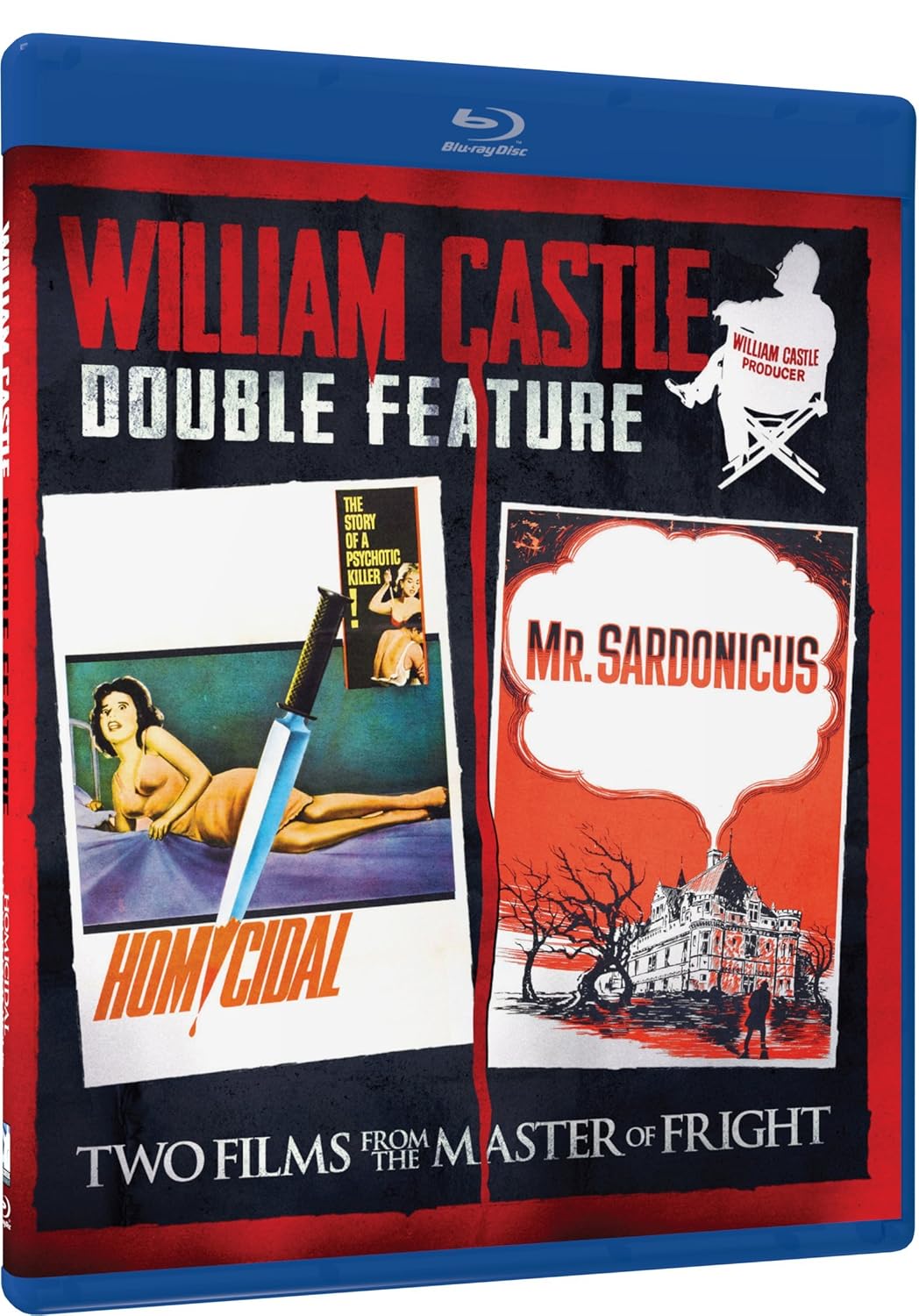
Homicidal & Mr. Sardonicus Double Feature Blu-ray for fans of William Castle theater gimmicks
Product Description:
Fans fascinated by William Castle theater gimmicks won't want to miss this classic double feature. Directed by the legendary "Master of Fright," these two unforgettable thrillers showcase Castle's talent for combining suspense, dark humor, and unforgettable theatrical promotions that turned moviegoing into a one-of-a-kind experience. This Blu-ray pairs two of his most memorable 1961 films in one collector-friendly edition.
Key Features:
• Includes both Homicidal and Mr. Sardonicus on one Blu-ray
• Directed by legendary horror showman William Castle
• Features two of Castle's most famous psychological thrillers
• Excellent addition to any classic horror or William Castle collection
• Perfect companion to articles exploring William Castle's famous theater gimmicks
Why This Works:
If you're interested in William Castle theater gimmicks, these films represent an important chapter in his remarkable career. Homicidal featured the famous "Fright Break," while Mr. Sardonicus introduced the audience participation "Punishment Poll," allowing moviegoers to believe they could determine the villain's fate. Watching these films alongside their original promotional ideas offers a fascinating glimpse into one of Hollywood's greatest showmen.
Buy on Amazon
Why Modern Multiplexes Rarely Feel Like This
Walking into a modern multiplex is a specific kind of experience. The lobby sells popcorn and beverages. The seats recline. The screen is large. The sound is excellent.
Nothing unexpected is likely to happen.
Castle's theaters were different. Something could happen at any moment. The seat might buzz. A skeleton might pass overhead. The film might pause and ask you to make a decision. A nurse might be standing in the lobby when you arrived.
The unpredictability was the point. It made every Castle screening an event rather than a transaction. People bought tickets not just to see a film but to see what Castle had arranged for them this time.
Modern multiplexes have eliminated most of that unpredictability in the name of consistency and efficiency. Every screening of every film at every location offers roughly the same experience. That consistency is commercially sensible. It is also, in its way, the opposite of what Castle understood about why people leave their houses to sit in the dark together.
The 4DX theater format, which adds moving seats, water mist, and scent to selected screenings, is the closest modern equivalent to Castle's approach. It is significantly more expensive and considerably less personal. Castle's gimmicks cost almost nothing to design. They cost something to install and operate. What they created in return was a story that spread by word of mouth faster than any advertisement.
William Castle Sold the Night Out, Not Just the Movie
Here is what gets lost when people talk about William Castle as a gimmick merchant.
He was selling something real.
Going to the movies in 1959 was an event. You dressed up slightly. You left the house. You sat in a darkened room with strangers. You shared an experience you could not have alone. The movies Castle was making were not especially distinguished. The experience of seeing them in his rigged theaters was unlike anything else available in American entertainment.
He understood that what audiences were really buying was not a film. They were buying an evening. They were buying a reason to talk to each other afterward. They were buying a memory.
The skeleton that flew over their heads in 1959 was still a story they told in 1969. The seat that buzzed them during The Tingler was something they described to their children. The insurance certificate they signed before Macabre was something some of them kept.
That is what Forgotten Americana actually means in this case. Not that Castle is forgotten. Film historians know him well. What is forgotten is the specific experience of being in those theaters when those gimmicks ran. The collective gasp when Emergo appeared. The surprise of Percepto activating under a seat. The absurdity of following a yellow line to Coward's Corner while a recording called you a chicken.
Those nights in those theaters cannot be reproduced. The equipment is gone. The films are available on streaming services without any of the physical apparatus. What survives is the record of what happened and the accounts of the people who were there.
William Castle sold the night out. He charged the price of a movie ticket. He delivered something that lasted considerably longer than the film.
Nobody has quite figured out how to do that again.
ML Lamp is the owner of Kilroy Was Here. After his 20 years of working in Las Vegas in the entertainment promotions field, Mr. Lamp retired in 2002 from his job to pursue his passion for collectibles. Now as a guest speaker and author he’s living the dream, and sharing his warmth with You.