Magic 1978 Horror Movie Turns an Old-Fashioned Stage Act into Something Worse
My Rating: ⭐ ⭐ ⭐ ⭐ ☆ 4 / 5
The Magic 1978 horror movie is not like most horror films from its era. Most late-1970s horror knew exactly what it was selling. A masked killer. A supernatural creature. Teenagers making poor decisions in isolated locations. The formula was working and Hollywood knew it.
Magic arrived in November 1978 and sold something different.
There is no masked slasher in Magic. There is no supernatural force stalking innocent victims. The horror in this film begins in a perfectly ordinary place: a struggling performer who cannot find an act that audiences want to see.
His name is Corky Withers. He is a magician. He is talented, nervous, and completely unable to connect with a crowd. His traditional magic act goes nowhere. Then he adds Fats, a foul-mouthed ventriloquist dummy with the personality Corky himself cannot seem to produce onstage.
Suddenly the act works. Audiences respond. People laugh. An agent gets interested. The career Corky wanted his whole life is suddenly within reach.
And that success is where the trouble starts.
Magic takes something meant to entertain people and slowly makes it threatening. The dummy that saved Corky's career begins to feel less like a prop and more like a presence. That transformation is what the film is actually about, and it is considerably more disturbing than anything a masked killer could manage.
Anthony Hopkins as Corky Withers
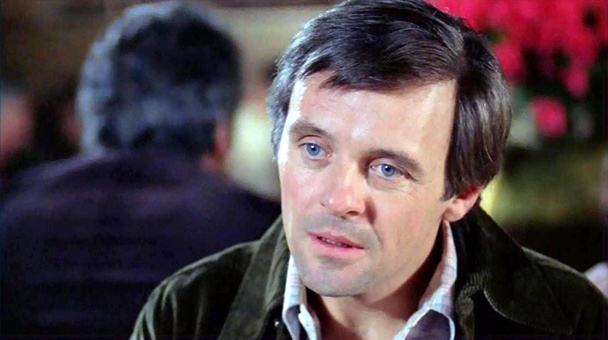
Anthony Hopkins as Corky Withers
Anthony Hopkins was 41 years old when Magic was filmed. He was not yet the household name he would become after The Silence of the Lambs in 1991. He had appeared in The Lion in Winter in 1968 and A Bridge Too Far in 1977. He was a respected actor with a distinctive intensity that had not yet found its defining role.
Magic gave it to him.
The role of Corky went to Hopkins over Gene Wilder, and the casting decision defined the film. Director Richard Attenborough later said he did the picture for Hopkins specifically. He was hoping to cast Hopkins in Gandhi at the time and wanted to work with him on something in the interim.
Hopkins actually learned ventriloquism properly for the role. He did not fake it or rely on editing tricks. He developed skill with the dummy, which meant that the scenes where Corky and Fats interact feel physically real in a way that a less committed performance could not have produced.
The character Corky is someone who cannot quite occupy his own life. Onstage without Fats, he freezes. Offstage with Fats, something changes. The dummy can say things Corky cannot say. Fats can insult people, make jokes, command attention, and get the laughs that Corky has always wanted.
The central question of the performance, and of the film, is whether Fats is giving Corky a voice or whether Corky is slowly disappearing behind Fats. Hopkins has to play both sides of that question simultaneously and make them feel increasingly separate. That is a difficult acting challenge. He makes it look natural, which makes it more unsettling.
Fats Is More Than a Creepy Ventriloquist Dummy
Fats looks unsettling. The fixed grin, the painted eyes, the slightly wrong proportions of the face. A ventriloquist dummy on a shelf in the dark has been earning its keep as a horror image for a very long time, and Fats is well designed for the purpose.
But appearance alone is not what makes him work in this film.
When we first meet Fats, he is part of an act. He performs with Corky for audiences. He gets laughs. He says things that are rude and funny in the way that a dummy can be rude and funny without the ventriloquist taking direct responsibility for the words. That is the basic social function of a ventriloquist dummy. The performer gets to say things through the figure that they could not politely say themselves.
Corky talks to Fats when there is no audience. This is not unusual. Ventriloquists rehearse with their dummies. They develop the relationship between performer and figure through private conversation as much as through public performance. So the early scenes of Corky talking to Fats alone feel normal.
Then those conversations begin to feel like something else.
Fats expresses Corky's anger. He expresses Corky's jealousy. He expresses impulses that Corky himself either cannot or will not acknowledge. The dummy becomes the place where Corky's interior life is stored. The question the film raises, gradually and without providing a clean answer, is whether Corky is still in control of what gets expressed there.
The film is careful not to show Fats moving independently. There is no scene where the dummy gets up and walks across the room. Magic is not that kind of horror film. What it shows instead is Corky behaving in ways that seem increasingly influenced by Fats, and conversations between the two that gradually stop feeling like a performer talking to his act and start feeling like something harder to name.
That ambiguity is exactly what makes Fats effective. A dummy that simply comes to life and attacks people would be frightening in a straightforward way. A dummy that may or may not have an independent existence, whose relationship with his performer is becoming indistinguishable from the performer himself, is frightening in a way that stays with you after the film ends.
Burgess Meredith and the Five-Minute Test
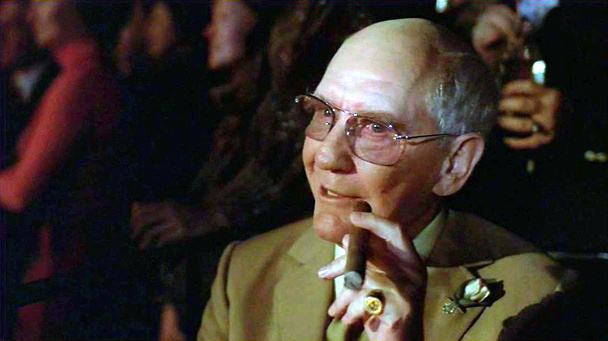
Burgess Meredith as Ben Greene
Burgess Meredith plays Ben Greene, Corky's agent. He is warm, practical, and clearly fond of Corky in the way that a good agent can be fond of a difficult client. He is also, as he tells Corky directly, not a man who scares easily.
Meredith was coming off enormous renewed visibility from Rocky in 1976, where he played Mickey. His presence in Magic carries the weight of that familiarity. When Ben says he is not scared, you believe him, because this is a man who has seen things.
Ben recognizes that something is seriously wrong with Corky. He has his own sense of what that something is. His response is to issue a challenge that is almost absurdly simple.
Go five minutes without making Fats speak.
That is the entire setup. Five minutes. Leave the dummy alone. Do not give him a voice for the length of time it takes to make a cup of coffee.
The scene that follows is one of the most effective pieces of psychological horror in a 1978 film that includes Halloween among its competition. There are no elaborate effects. There is no special makeup or camera trick. There is a man, a dummy, and five minutes, and the suspense that builds from that arrangement is completely out of proportion to how simple it sounds.
Five minutes is nothing. Five minutes is an eternity. The scene makes you feel both of those things simultaneously, and when it resolves, you understand something about Corky that the rest of the film has only suggested.
Ann-Margret Gives Magic Its Human Side
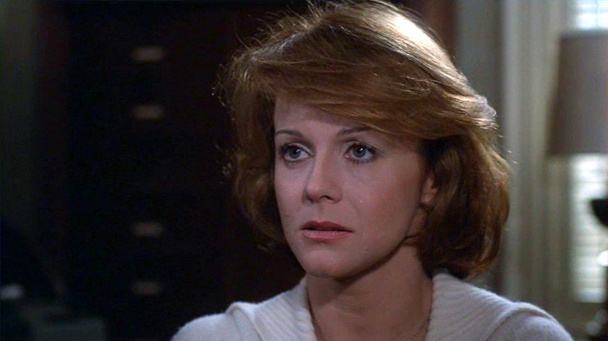
Ann-Margret as Peggy Ann Snow
Ann-Margret plays Peggy Ann Snow, a woman from Corky's past who is now running a lakeside motel in the Catskills. Corky retreats there after his career starts to implode. He is running away from his agent, from a television contract that requires a medical examination he cannot pass, and from everything that his success with Fats has created.
Peggy represents the life Corky might have had. She is warm, grounded, and connected to a version of himself that existed before Fats. Their reunion gives the film something that pure psychological horror rarely provides: areason to care about what happens to Corky beyond simple dread.
Ann-Margret's performance is understated in exactly the way the role requires. Peggy is not naive about what she sees in Corky. She is not a victim waiting to become a plot device. She has her own life, her own complications, and her own reasons for engaging with someone who is clearly not entirely well.
The chemistry between Hopkins and Ann-Margret is real and quietly affecting. That chemistry matters because it creates the film's emotional stakes. Corky's career is in trouble. His mental state is deteriorating. And here is a person who knew him before all of that and seems to want him to be alright.
Whether Fats will allow that is another question entirely.
Richard Attenborough Keeps the Horror Uncomfortably Close
Richard Attenborough was primarily known as an actor before Magic. Young Winston in 1972 was his second directorial effort. Gandhi would follow in 1982 and win him the Academy Award for Best Director. Between those two landmarks sits Magic, which represents Attenborough doing something unusual for his career: making a psychological horror film with deliberate, uncomfortable intimacy.
Attenborough's approach to the material is restrained in ways that a more conventional horror director might not have chosen. He does not reach for shock when discomfort will serve better. He allows rooms and conversations and silences to do the work that most horror films assign to jump scares.
This restraint helps Fats enormously. A ventriloquist dummy sitting perfectly still on a table while two people have a conversation is not frightening in the abstract. Give it enough screen time, enough camera attention, enough silence around it, and something shifts. Attenborough understands that the audience's imagination is a more reliable horror generator than anything he can show them directly.
The film has long takes. It has pauses. It has scenes that run slightly longer than comfort might suggest. All of those choices serve the central relationship. The more time you spend with Corky and Fats together, the less you are able to think of them as entirely separate entities. That is the film's central effect, and Attenborough achieves it through patience rather than spectacle.
William Goldman Adapted Magic from His Own Novel
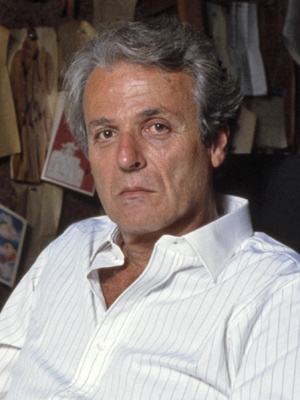
William Goldman adapted the Magic 1978 horror movie screenplay from his own 1976 novel, Magic.
William Goldman published the novel Magic in 1976. Two years later, he wrote the screenplay adaptation himself. This makes Magic one of the relatively rare films where the same writer moved a story from page to screen without the usual complications of a separate adapter's interpretation.
Goldman's other screenwriting credits at this point in his career included Butch Cassidy and the Sundance Kid in 1969, for which he won the Academy Award for Best Original Screenplay, and All the President's Men in 1976, for which he won a second Academy Award. He was one of the most respected screenwriters working in Hollywood. He was not slumming.
The premise Goldman built is almost structured like a cruel show-business bargain. A magician cannot succeed. He adds a dummy. The dummy makes him successful. Then he cannot get away from the dummy. That structure has a fairy-tale quality to it, the kind where the wish is granted and the granting is the problem.
Goldman's tightly wound screenplay gives each character exactly enough room to breathe without allowing the story to wander. The scenes between Corky and Ben have the specific texture of a long professional relationship. The scenes between Corky and Peggy have the specific texture of something unfinished. The scenes between Corky and Fats have something else entirely, and Goldman is careful never to explain it away.
When Ventriloquists and Magicians Ruled Live Entertainment
To understand what Corky wants and why it matters, it helps to understand the world he is trying to enter.
Ventriloquists and magicians were not novelty acts in the context of American popular entertainment. For much of the first half of the twentieth century, they were headliners. Vaudeville theaters across the country featured performers whose entire act consisted of a person and a figure, and audiences paid to see them the same way audiences pay to see anyone they love.
Edgar Bergen and his dummy Charlie McCarthy are the defining example. Bergen moved from vaudeville to radio in 1937, which produced the remarkable and apparently paradoxical situation of a ventriloquist performing on an audio-only medium. It worked. The Edgar Bergen and Charlie McCarthy Show ran on American radio from 1937 to 1957, rating as radio's most popular program from 1937 to 1940 and among the top seven programs through 1952. Charlie McCarthy became a celebrity. He had his own fan mail. He was treated as a person rather than a prop, which tells you something about how completely Bergen had made the illusion work.
Magicians occupied a similar place. Harry Kellar, Howard Thurston, and later performers like Blackstone filled theaters for decades with full-evening stage magic shows that required elaborate sets, large crews, and audiences who came back multiple times to see different illusions. The stage magician was a legitimate theatrical attraction rather than a sideshow novelty.
Jay Marshall was the rare performer who combined both traditions in a single act. Born in 1919 in Massachusetts, Marshall became a magician and ventriloquist whose sixty-year career took him from vaudeville to Las Vegas to The Ed Sullivan Show, where he appeared fourteen times. He opened for Frank Sinatra during one of Sinatra's early Las Vegas engagements and held the prestigious next-to-closing spot on the final vaudeville bill at New York's Palace Theatre in 1957.
His ventriloquist partner was a rabbit named Lefty, created from a white glove with button eyes and cardboard ears. Marshall invented Lefty out of necessity while touring the Pacific with the USO during World War II. His full-sized dummy Henry was impossible to carry in a duffle bag from island to island. A glove fit in his pocket. Lefty is now in the Smithsonian Institution's collection, which is a suitable home for one of the more ingenious solutions to a logistical problem in the history of American entertainment. The Society of American Magicians eventually honored Marshall with the title Dean of American Magicians. He ran Magic Inc., one of the oldest magic shops in America, out of Chicago.Il.
Television variety shows maintained this tradition into the 1950s and 1960s. Paul Winchell and Jerry Mahoney appeared regularly on television. Señor Wences was a staple of The Ed Sullivan Show. The performer-and-figure format had staying power across multiple entertainment formats.
Magic does not choose ventriloquism as its gimmick randomly. Corky is trying to find something that will make audiences remember him. In the tradition of American live entertainment, a ventriloquist with the right dummy could be a complete act. Fats does exactly that for Corky. The tragedy is what the success costs.
Why Ventriloquist Dummies Make Such Effective Horror
The ventriloquist illusion depends on a specific and slightly strange social contract. The audience knows perfectly well that the performer is supplying the dummy's voice. Everyone in the room is aware of this. And yet a skilled ventriloquist encourages everyone to temporarily pretend otherwise. The figure speaks. The performer's lips do not move. The audience plays along.
That willing suspension of the obvious is what makes the dummy work as entertainment. It is also exactly what makes it work as horror.
The dummy's face is fixed. It does not change expression the way a human face does. Its features remain constant while its personality apparently changes through voice and movement. The closer you look at a ventriloquist dummy, the more unsettling that fixed expression becomes. It sits at the edge of the uncanny valley in a permanent and deliberate way.
Horror only has to push the familiar illusion slightly further. What happens when the performer starts believing in the second personality too? What happens when the boundary between the voice the performer gives the figure and the voice the performer uses for himself begins to blur?
The definitive earlier treatment of this idea is the ventriloquist segment of the 1945 British anthology film Dead of Night. Michael Redgrave plays Maxwell Frere, a ventriloquist whose relationship with his dummy Hugo has crossed into territory that a psychiatrist called in to evaluate him finds deeply disturbing. Hugo speaks about leaving Frere to work with another ventriloquist. Frere shoots the rival. He is committed to an asylum. The final image of Frere speaking in Hugo's voice, with the dummy sitting silently beside him, is one of the most haunting images in British horror cinema. Dead of Night established the template that Magic extended and deepened thirty-three years later.
The genius of this particular horror concept is its adaptability. It works as supernatural horror if you want it to. It works as psychological horror if you prefer that. It works as both simultaneously if you are careful enough with the ambiguity. Magic is careful with the ambiguity.
The Strange Genius of Making Success the Threat
Most horror films threaten their protagonists with something external. A killer. A creature. A force that arrives from outside the character's ordinary life and disrupts it.
Magic threatens Corky with something he wanted.
Before Fats, Corky is failing. His magic act goes nowhere. He cannot connect with audiences. His career is stalled. He wants success the way any performer wants it, desperately and constantly and in a way that colors everything else.
Fats gives him that success. The act finally works. An agent gets excited. A television pilot becomes possible. The career Corky wanted his whole life is within reach for the first time.
And the very thing that makes the career possible begins destroying everything else.
Corky cannot submit to a medical examination because someone might figure out what is happening with him and Fats. He cannot maintain a normal relationship because Fats has opinions about it. He cannot separate himself from the act even when the act is threatening the things he cares about most.
The nasty irony at the center of Magic is that Corky finally discovers what audiences want from him. He just discovers it at the price of everything that might make the success worth having. That is a specifically show-business horror, and it lands differently than a supernatural threat would. You can run from a monster. It is considerably harder to run from your own success.
Is Magic Actually Supernatural?
The film invites you to consider this question and declines to answer it definitively. That refusal is one of the smartest decisions the filmmakers made.
Fats never moves independently. He is never shown doing anything that requires a supernatural explanation rather than a psychological one. Every scene in the film can be read as Corky behaving in ways that he attributes to Fats rather than to himself. The dissociation is complete enough that Corky may not recognize where he ends and the dummy begins, but that is a psychological state rather than a supernatural one.
At the same time, the film never definitively closes the door on the possibility that something stranger is happening. The ambiguity is maintained carefully enough that a viewer who wants to believe Fats has some independent existence will find nothing that conclusively disproves it.
A definite supernatural explanation would make Fats frightening in one specific way. A completely psychological explanation makes him frightening in a different specific way. The uncertainty makes him frightening in both ways simultaneously, which is considerably more effective than either option alone.
The dummy is sitting there either way. That is the part that stays with you.
Does Magic Still Hold Up Today?
The Magic 1978 horror movie holds up well, with one honest caveat about expectations.
The performances are the film's greatest strength. Hopkins gives Corky a specific quality of desperate ambition and fragile sanity that makes him sympathetic even as his behavior becomes harder to excuse. Ann-Margret brings warmth to Peggy and chemistry to her scenes with Hopkins. Burgess Meredith makes Ben Greene a fully realized person in limited screen time, which is exactly what the five-minute scene requires of him.
The atmosphere is slow and uncomfortable rather than constantly violent. There is gore in the film, but it is not the primary tool. Discomfort, implication, and the sustained wrongness of the Corky-Fats relationship carry most of the picture's weight.
Jerry Goldsmith's score is worth specific mention. It is melancholy and slightly off-kilter in a way that matches the material without underlining it too heavily. Goldsmith knew when to be present and when to stay out of the way.
The caveat is pacing. Magic is a deliberate 1970s thriller. It takes its time. It trusts its audience to sit with discomfort without requiring a new shock every five minutes. Viewers accustomed to the rhythm of modern horror will need to adjust their expectations. The adjustment is worth making.
Fats is still the image most people are likely to remember afterward. That fixed grin. Those painted eyes. The way he sits perfectly still while somehow seeming to be paying attention to everything in the room.
Magic (1978) 4K Ultra HD
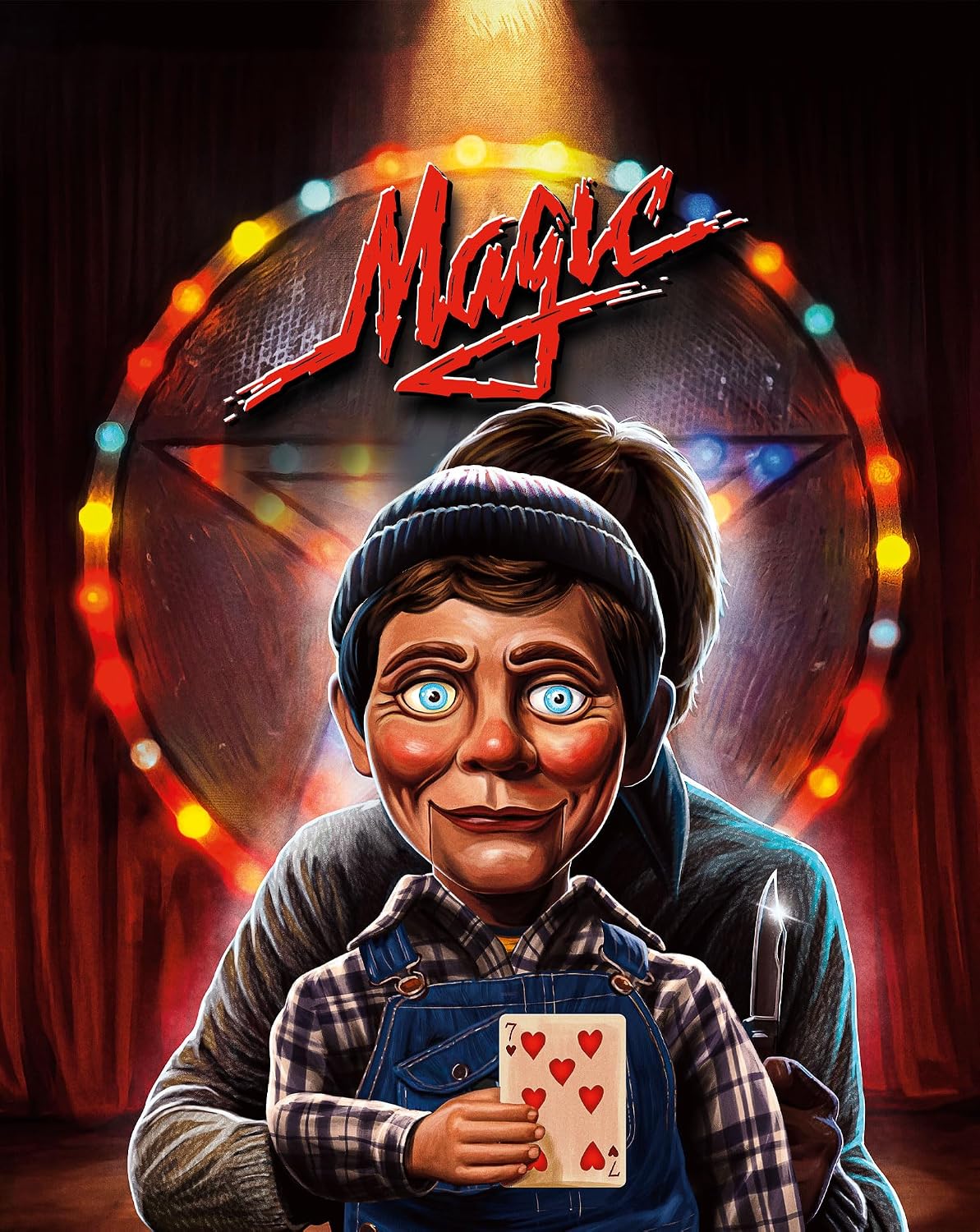
Magic (1978) 4K Ultra HD starring Anthony Hopkins
Product Description:
If our article introduced you to the eerie world of Magic 1978 Horror Movie, this stunning 4K edition is the perfect way to experience it. Anthony Hopkins delivers a chilling performance as Corky, a struggling magician whose ventriloquist dummy, Fats, becomes the center of an increasingly disturbing psychological nightmare. Featuring memorable performances by Ann-Margret and Burgess Meredith, this suspense classic remains one of horror's most unsettling character studies.
Key Features:
• Beautifully restored 4K Ultra HD presentation
• Stars Anthony Hopkins, Ann-Margret, and Burgess Meredith
• Directed by Richard Attenborough
• Screenplay by William Goldman, adapted from his bestselling novel
• Essential viewing for fans of psychological horror, ventriloquist stories, and classic suspense films
Why This Works:
After reading about the history and themes behind the Magic 1978 Horror Movie, watching the film reveals why it has remained a favorite among horror fans for decades. The unforgettable relationship between Corky and Fats, combined with Anthony Hopkins' remarkable performance, creates a suspenseful experience that relies on atmosphere and psychology rather than gore, making it one of the standout horror films of the late 1970s.
Buy on Amazon
Who Should Watch Magic?
Watch Magic if you enjoy 1970s psychological horror that relies on performance and atmosphere rather than shock effects. Watch it if you have any interest in Anthony Hopkins before Hannibal Lecter, because this is Hopkins operating at a high level of commitment in a role that required something unusual from him.
Watch it if ventriloquist-dummy horror is a category that interests you, because Magic and the Dead of Night segment featuring Michael Redgrave are the two films that define what this particular subgenre can do at its best.
Watch it if you enjoy horror films about performers and show business, about people whose relationship with their art has become something they cannot control. Watch it if you appreciate slow-building suspense that arrives at its destination through patience rather than noise.
If you are expecting a conventional slasher with a killer dummy stalking victims through dark hallways, Magic will not give you that. It is doing something more uncomfortable than that. It is suggesting that the person you might need to be afraid of and the person you feel sorry for are the same person, and that the line between performer and performance is thinner than either of them knows.
Final Thoughts on Magic (1978)
Corky Withers wanted an audience. He wanted people to watch him and remember what they saw. He wanted the thing that every performer wants, the knowledge that something he created connected with people in a way they could not forget.
Fats gave him that.
The act worked. The audiences came. The agent got excited. The career that had always been just out of reach was suddenly right there.
That is the setup. The film is what the setup costs.
Magic works as horror because it takes an ordinary human desire and shows you what happens when getting what you want turns out to require more of you than you had available to give. Fats is memorable because he is not introduced as a monster. He is introduced as the solution to Corky's problem.
For a struggling entertainer, getting exactly what you wanted may be the nastiest trick in the show.
ML Lamp is the owner of Kilroy Was Here. After his 20 years of working in Las Vegas in the entertainment promotions field, Mr. Lamp retired in 2002 from his job to pursue his passion for collectibles. Now as a guest speaker and author he’s living the dream, and sharing his warmth with You.