👑 Grace Kelly Biography: The Incredible Story Behind a Timeless Star
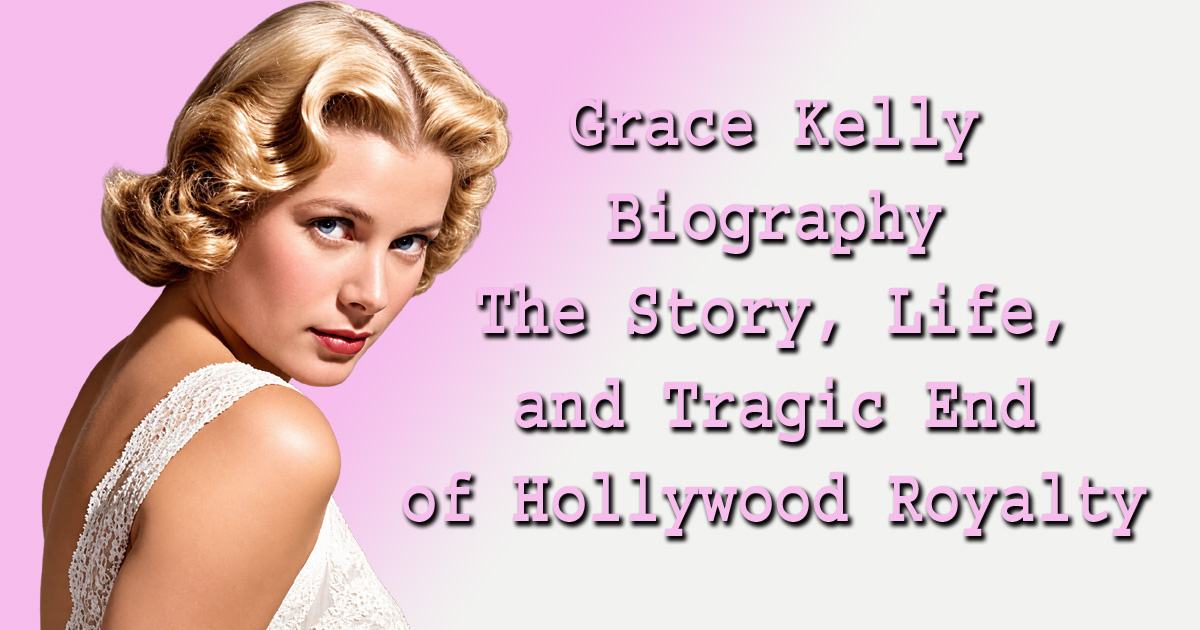
Grace Kelly remains one of the defining figures of Hollywood’s golden age, remembered for an elegance that seemed effortless and a screen presence built as much on restraint as glamour. During a remarkably brief film career, she became an international star whose cool sophistication, intelligence, and striking beauty distinguished her from many of her contemporaries.
Grace Kelly was an Academy Award-winning American actress and one of the defining screen stars of 1950s Hollywood. She is best remembered for Alfred Hitchcock classics including Rear Window, Dial M for Murder, and To Catch a Thief, as well as her Oscar-winning performance in The Country Girl. After an exceptionally brief film career, Kelly married Prince Rainier III and became Princess Grace of Monaco. Her combination of acclaimed acting, Hollywood glamour, fashion influence, and European royal history has kept her an internationally recognized cultural figure.
Kelly worked with some of the most important filmmakers and leading men of the 1950s, earning critical recognition while proving equally effective in romance, drama, suspense, and adventure. Her performances often drew their strength from composure rather than excess, giving her characters an outward calm that could conceal fear, desire, determination, or uncertainty. That quality became particularly powerful in films directed by Alfred Hitchcock, who helped establish the polished yet mysterious screen image most closely associated with her.
Her place in popular culture ultimately extended far beyond the relatively small number of films she made. Kelly became an enduring symbol of mid-century style and Hollywood refinement, while her transformation from celebrated actress to Princess of Monaco gave her life a rare public mythology. Decades later, her films, fashion, photographs, and distinctive persona continue to represent an era when movie stardom carried an almost formal sense of glamour.
Grace Kelly's Hollywood career was so brief that nearly her entire feature-film legacy fits within a five-year period. She nevertheless accumulated an Oscar, worked with several of the era's greatest directors and stars, and created a screen identity recognizable more than seventy years later.
👶 Early Life
Summary: Raised in a prominent Philadelphia family, Kelly pursued acting despite family reservations and trained at the American Academy of Dramatic Arts in New York.
Grace Patricia Kelly was born on November 12, 1929, in Philadelphia, Pennsylvania. She grew up in a prominent Irish Catholic family headed by her father, John B. Kelly Sr., a three-time Olympic gold medalist in rowing who became a successful businessman. Her mother, Margaret Katherine Majer Kelly, had been a competitive swimmer and later taught physical education. Grace was one of four children in a household where achievement, discipline, and competition were taken seriously.
Kelly's childhood differed from the glamorous public image that would later surround her. She was quieter and more reserved than some members of her athletic family and suffered from recurring respiratory problems. She attended Ravenhill Academy and later Stevens School, both in the Philadelphia area. While she did not share her family's enthusiasm for competitive sports, she developed an interest in reading, performance, and the stage.
During her teenage years, Kelly appeared in school productions and became increasingly serious about acting. Her interest also had a family connection through her uncle George Kelly, a successful playwright and recipient of the Pulitzer Prize for Drama. She performed in local theatrical productions and began to see acting as something more substantial than a school activity or hobby.
Kelly's decision to pursue acting professionally was not immediately embraced by her family. Her father, in particular, regarded acting as an uncertain and unsuitable career for his daughter. She also faced an early academic setback when Bennington College rejected her application because of weak mathematics grades. Rather than abandon her plans, she turned her attention toward formal dramatic training.
After finishing school, Kelly applied to the American Academy of Dramatic Arts in New York City. Her audition included a scene from her uncle George Kelly's play The Torch-Bearers. She was accepted and moved to New York, where she studied acting while supporting herself in part through modeling work. The move marked her first sustained attempt to build an independent life around professional performance rather than the expectations of her well-known family.
Explore the Biographies of Iconic Celebrities
Grace Kelly appeared on a United States postage stamp issued in 1993 alongside a separate Monaco stamp honoring her, making her image part of an unusual joint philatelic tribute from the two countries most closely associated with her life.
🎬 Film Career
Summary: In only 11 feature films, Kelly worked with Hollywood legends including Alfred Hitchcock, Gary Cooper, Clark Gable, James Stewart, Cary Grant, Bing Crosby, and Frank Sinatra while winning the Academy Award for Best Actress.
Grace Kelly's professional acting career began on the New York stage and in the rapidly expanding world of television. She appeared in numerous live television dramas before making her Broadway debut in The Father (1949), starring Raymond Massey, who also directed the production. Television gave Kelly valuable experience in productions such as Kraft Television Theatre, Studio One, The Philco Television Playhouse, and Robert Montgomery Presents, placing her before national audiences while Hollywood was beginning to take notice.
Kelly made her feature-film debut in Fourteen Hours (1951), directed by Henry Hathaway and starring Richard Basehart, Paul Douglas, Barbara Bel Geddes, and Agnes Moorehead. Her part was small, but it brought her onto the screen at a time when studios were searching for new leading women who could project both sophistication and dramatic credibility.
Her breakthrough came with High Noon (1952), the landmark Western directed by Fred Zinnemann. Kelly played Amy Fowler Kane, the Quaker bride of Marshal Will Kane, played by Gary Cooper. The film also featured Thomas Mitchell, Lloyd Bridges, Katy Jurado, and Lee Van Cleef. Kelly's restrained performance suited the film's mounting tension and placed her prominently in one of the most celebrated Westerns of its era.
That same period brought Mogambo (1953), directed by John Ford and filmed on location in Africa. Kelly appeared opposite Clark Gable and Ava Gardner as Linda Nordley, a married woman drawn toward Gable's rugged big-game hunter Victor Marswell. The performance demonstrated that Kelly could hold her own beside two established stars and earned her an Academy Award nomination for Best Supporting Actress in 1954 as well as a Golden Globe Award.
Kelly's association with director Alfred Hitchcock began with Dial M for Murder (1954). She played Margot Wendice, whose husband, portrayed by Ray Milland, plots her murder after discovering her relationship with American crime writer Mark Halliday, played by Robert Cummings. Hitchcock used Kelly's controlled manner and polished appearance to create tension between outward respectability and private danger, establishing a screen combination that would become central to her legacy.
She next appeared in The Bridges at Toko-Ri (1954) with William Holden, Fredric March, and Mickey Rooney. Set during the Korean War, the film cast Kelly as Nancy Brubaker, wife of Holden's naval aviator Harry Brubaker. Although the military action drove much of the story, Kelly gave the film an emotional domestic center and further demonstrated her ability to work effectively within large studio productions.
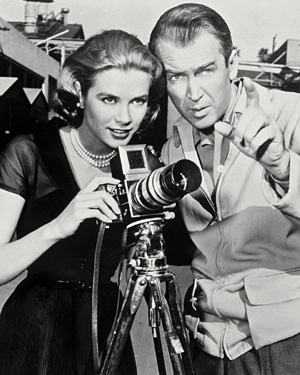
Hitchcock reunited with Kelly for Rear Window (1954), one of the defining films of both of their careers. She played Lisa Carol Fremont opposite James Stewart as photographer L. B. "Jeff" Jefferies. The cast included Thelma Ritter, Wendell Corey, and Raymond Burr. Kelly's Lisa begins as an impeccably dressed Manhattan socialite but gradually becomes an active participant in Jeff's investigation of a suspected murder. Her entrance into the film, wardrobe designed by Edith Head, and chemistry with Stewart helped make the character one of the most recognizable women in Hitchcock's work.
Kelly took a dramatically different role in The Country Girl (1954), directed by George Seaton and based on the play by Clifford Odets. Appearing with Bing Crosby and William Holden, she played Georgie Elgin, the weary wife of alcoholic actor and singer Frank Elgin, portrayed by Crosby. Kelly deliberately abandoned much of the polished glamour associated with her other roles, giving a subdued performance centered on frustration, loyalty, and emotional exhaustion.
The gamble paid off. Kelly won the Academy Award for Best Actress in 1955 for The Country Girl (1954), defeating a field that included Judy Garland, whose performance in A Star Is Born (1954) had been widely acclaimed. Kelly also received a Golden Globe Award for Best Actress in a Motion Picture Drama, establishing that her reputation rested on more than beauty and Hitchcock's carefully constructed image of sophisticated suspense.
Kelly appeared opposite Stewart Granger in Green Fire (1954), an adventure drama set in Colombia and directed by Andrew Marton. She played Catherine Knowland, the owner of a coffee plantation who becomes involved with Granger's emerald prospector Rian Mitchell. The picture was less significant than her major films of the period, but it reflected the remarkable pace at which Hollywood was using Kelly after her emergence as a leading star.
Her third and final collaboration with Hitchcock was To Catch a Thief (1955), filmed on the French Riviera and starring Cary Grant as retired jewel thief John Robie. Kelly played wealthy American Frances Stevens, with Jessie Royce Landis, John Williams, and Charles Vanel in supporting roles. Hitchcock surrounded Kelly with luxury hotels, evening gowns, jewels, convertibles, Mediterranean scenery, and romantic intrigue, producing perhaps the purest expression of her glamorous screen persona.
Kelly followed with The Swan (1956), directed by Charles Vidor, in which she played Princess Alexandra opposite Alec Guinness as Prince Albert and Louis Jourdan as tutor Dr. Nicholas Agi. The cast also included Agnes Moorehead and Jessie Royce Landis. The story of a European princess facing questions of marriage, obligation, and personal desire acquired an unusual resonance because Kelly's own life was already moving toward royalty.
Her final feature film was High Society (1956), a musical adaptation of Philip Barry's play The Philadelphia Story. Kelly starred as Tracy Lord opposite Bing Crosby as C. K. Dexter Haven and Frank Sinatra as reporter Mike Connor. Louis Armstrong appeared with his band, while Celeste Holm, John Lund, and Louis Calhern rounded out the principal cast. The film included songs by Cole Porter, placing Kelly inside one of the most distinguished musical ensembles of the decade.
In High Society (1956), Kelly also sang on screen, most notably performing True Love with Bing Crosby. The recording became commercially successful and revealed another side of a performer whose film work had been dominated by drama, romance, and suspense. Released during the year of her marriage to Prince Rainier III of Monaco, the picture became the closing chapter of a film career that had lasted only a few years.
Kelly retired from acting at the age of twenty-six after completing just eleven feature films. Despite that unusually small filmography, she had worked with directors including Alfred Hitchcock, John Ford, Fred Zinnemann, Henry Hathaway, George Seaton, and Charles Vidor, and shared the screen with Gary Cooper, Clark Gable, Ava Gardner, James Stewart, Cary Grant, Bing Crosby, Frank Sinatra, William Holden, Ray Milland, Alec Guinness, and Louis Armstrong. Her compressed career produced an extraordinary concentration of major films, celebrated collaborators, and performances that remained closely associated with the style and character of 1950s Hollywood.
Grace Kelly was only 25 years old when she won the Academy Award for Best Actress for The Country Girl, placing her among the younger Best Actress winners in Oscar history.
❤️ Personal Life
Summary: Kelly's marriage to Prince Rainier III in 1956 transformed the Hollywood star into Princess Grace of Monaco and began a new life centered on family, royal responsibilities, and public service.
Grace Kelly's private life attracted intense public attention once she became one of Hollywood's leading stars. During her film career she was linked romantically with several prominent men, and the studio-era press often treated her relationships as part of her screen image. Among the men associated with Kelly were actor Gene Lyons, fashion designer Oleg Cassini, and her High Noon (1952) co-star Gary Cooper. Reports also connected her with Ray Milland and William Holden, although accounts of some of these relationships have varied considerably over the years.
One of Kelly's most serious relationships before marriage was with Oleg Cassini, the influential designer who later became closely associated with Jacqueline Kennedy's White House wardrobe. Kelly and Cassini dated during 1954 and 1955, and Cassini later wrote extensively about their relationship. Marriage was discussed, but Kelly's family did not approve of the match, and the relationship ended.
Kelly met Prince Rainier III of Monaco in 1955 while attending the Cannes Film Festival. A meeting and photographic session were arranged at the Prince's Palace in Monaco. Their first encounter did not immediately resemble the fairy-tale romance later created around it, but the two began corresponding after Kelly returned to the United States. Rainier subsequently traveled to America and spent time with Kelly and her family.
Their engagement was announced in January 1956. Rainier presented Kelly with a diamond-and-ruby eternity band representing Monaco's national colors and later gave her a large emerald-cut diamond engagement ring by Cartier. The second ring became particularly famous because Kelly wore it in her final film, High Society (1956).
Kelly traveled to Monaco aboard the SS Constitution in April 1956, accompanied by members of her family and a large entourage. Her arrival became an international press event, with photographers, reporters, and spectators following the American movie star who was about to become European royalty.
Grace Kelly and Prince Rainier III were married in two ceremonies. The civil ceremony took place on April 18, 1956, at the Prince's Palace. The religious ceremony followed on April 19, 1956, at Saint Nicholas Cathedral in Monaco. Millions of television viewers watched coverage of the wedding, turning it into one of the major international media events of the decade.
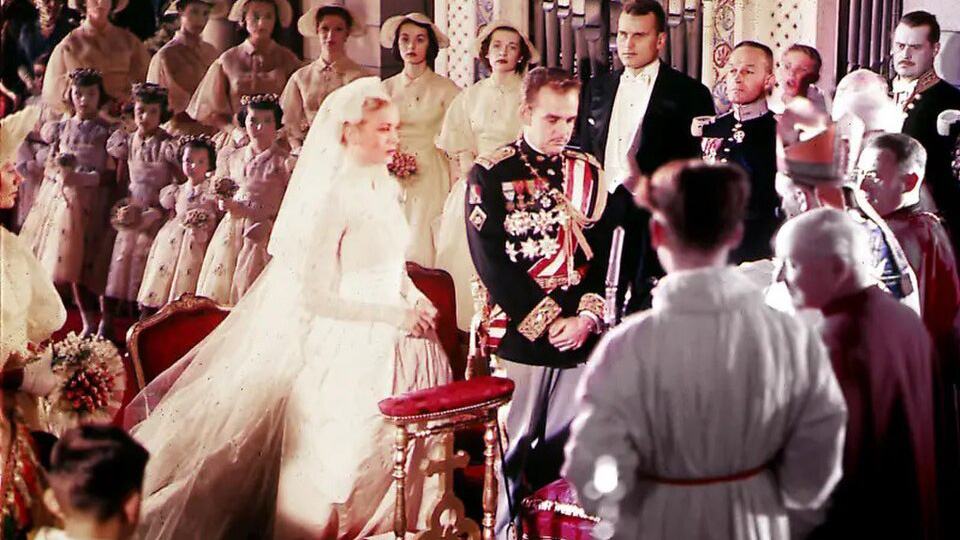
Kelly's wedding gown was designed by Helen Rose, the celebrated MGM costume designer who had also dressed her for films. Made with lace, silk, and thousands of hand-sewn pearls, the gown became one of the most famous wedding dresses of the twentieth century. Kelly formally became Her Serene Highness Princess Grace of Monaco, ending the Hollywood chapter of her public life at the height of her fame.
Grace and Rainier had three children. Princess Caroline was born in 1957, Prince Albert in 1958, and Princess Stéphanie in 1965. As the wife of Monaco's reigning prince, Grace devoted much of her life to raising her family and carrying out the responsibilities expected of a member of a European royal house.
Her marriage also meant giving up professional acting. Although Kelly remained interested in the arts and occasionally considered projects, returning to Hollywood presented political and practical complications for a reigning princess. Alfred Hitchcock hoped to bring her back to the screen for Marnie (1964), but the proposed return generated controversy in Monaco, particularly because the character was a troubled woman involved in theft and sexual trauma. Kelly ultimately withdrew from the project, and the role went to Tippi Hedren.
Princess Grace maintained strong connections with the arts despite leaving motion pictures. She supported theater, dance, poetry, and charitable organizations and became closely involved with cultural life in Monaco. In 1964, she founded the Fondation Princesse Grace, which supported humanitarian and cultural causes in Monaco. She also became president of the Monaco Red Cross and worked extensively with organizations concerned with children and health.
She remained connected to many figures from her Hollywood years. Alfred Hitchcock, Cary Grant, James Stewart, and other former colleagues continued to occupy an important place in her personal history, even though the circumstances of her life had changed dramatically. Hollywood never completely released its fascination with Kelly, and offers or rumors of possible acting returns continued for years.
Grace and Rainier's marriage lasted for more than twenty-six years. Their life together combined family responsibilities, royal duties, international diplomacy, charitable work, and the constant attention that followed one of the world's most recognizable couples. Kelly's transition from American movie star to Princess Grace of Monaco was real rather than symbolic, requiring her to exchange a successful independent career for the responsibilities of a royal household and a small sovereign nation.
🕊️ Later Years
Summary: Princess Grace remained active in cultural and public life until a 1982 automobile accident led to her death at age 52.
By the 1970s, Princess Grace had settled into a public identity that was distinct from the Hollywood career that first made her famous. She represented Monaco at official functions, traveled internationally, and became one of the principality's most recognizable representatives. Her presence helped give the tiny Mediterranean state a cultural visibility far beyond its size, particularly among Americans who had first known her as a movie star.
Grace also developed interests that allowed her to remain creative without returning to conventional acting. She became particularly interested in pressed flowers, creating intricate compositions from dried plants and blossoms. Her work was exhibited publicly, and in 1980 she published My Book of Flowers, combining her knowledge of flowers with photographs, history, folklore, and examples of floral art.
Another unusual project came through poetry. Grace participated in readings and recordings of poetry, sometimes accompanied by music. She worked with actor Richard Kiley on The Children of Theatre Street (1977), a documentary about the Vaganova Choreographic Institute in Leningrad, serving as narrator. The film received an Academy Award nomination for Best Documentary Feature, giving her an indirect connection to the motion-picture world more than two decades after leaving Hollywood.
Grace developed a deep interest in her family's Irish heritage and assembled a personal collection of Irish books and Irish-American sheet music. Following her death, Prince Rainier III established the Princess Grace Irish Library, which was inaugurated on November 20, 1984, as a tribute to his wife's attachment to Ireland. The library incorporated Grace's personal collection and became a permanent center for Irish literature, history, and culture in Monaco.
Grace came unusually close to returning to filmed drama near the end of her life. In 1982, she appeared with Prince Rainier III in a short independent film called Rearranged, directed by Robert Dornhelm. Plans developed to expand the project for wider release, but the completed footage was never commercially released. It became the closest Grace came to a screen comeback after High Society (1956).
On September 13, 1982, Grace was driving her Rover P6 along a steep road near Monaco with her daughter Princess Stéphanie as a passenger when the car left the roadway and plunged down a mountainside. Grace suffered severe injuries in the crash. Stéphanie survived with injuries of her own.
Grace was taken to the Monaco Hospital, later renamed the Princess Grace Hospital Centre. Doctors determined that she had suffered a cerebral hemorrhage and had sustained devastating injuries in the accident. Her condition deteriorated, and her family agreed to remove life support.
Princess Grace of Monaco died on September 14, 1982, at the age of 52. News of her death spread rapidly around the world, bringing together the two identities that had defined her public life: the Academy Award-winning American actress Grace Kelly and the European royal known for more than a quarter century as Princess Grace.
Her funeral was held on September 18, 1982, at Saint Nicholas Cathedral in Monaco, the same cathedral where her religious wedding ceremony had taken place in 1956. Representatives of royal families, governments, and the entertainment world attended. Among the mourners was Cary Grant, one of her closest former Hollywood colleagues.
Grace was buried in the Grimaldi family vault at Saint Nicholas Cathedral. Prince Rainier III never remarried and remained Monaco's sovereign until his death in 2005. He was buried beside Grace, bringing together again the couple whose marriage had linked Hollywood and Monaco for more than a quarter century.
Grace Kelly was considered for the role of Edie Doyle in On the Waterfront before the part went to Eva Marie Saint. The film became one of the defining American pictures of the 1950s and earned Saint an Academy Award.
🏆 Legacy
Grace Kelly left behind one of the most unusual legacies in twentieth-century popular culture. Her film career lasted only a few years, yet she became permanently associated with the elegance and sophistication of 1950s Hollywood. Unlike many stars whose reputations were built across decades of work, Kelly achieved lasting stature with only 11 feature films, leaving a remarkably concentrated body of work.
Three films directed by Alfred Hitchcock remain central to her reputation: Dial M for Murder (1954), Rear Window (1954), and To Catch a Thief (1955). Hitchcock recognized that Kelly's controlled manner could suggest considerably more beneath the surface. That combination of refinement, intelligence, sensuality, and emotional restraint helped create one of the director's most recognizable screen archetypes and influenced how sophisticated women were portrayed in later suspense films.
Her dramatic reputation rests equally on The Country Girl (1954). Winning the Academy Award for Best Actress in 1955 demonstrated that Kelly could move beyond the glamorous image surrounding her. Her earlier Academy Award nomination for Mogambo (1953) further established the critical standing she achieved during an exceptionally short period.
Kelly also became a lasting fashion figure. Her collaborations with costume designer Edith Head helped define the polished American style seen in films such as Rear Window (1954) and To Catch a Thief (1955). Tailored dresses, gloves, scarves, pearls, structured handbags, and understated evening clothes became closely associated with her public image, and photographs of Kelly continue to influence fashion decades later.
One of the most enduring fashion connections carries her name. The Hermès Kelly bag, originally produced under another name, became popularly associated with Grace after she was repeatedly photographed carrying the handbag during the 1950s. Hermès eventually renamed the design in her honor, turning the Kelly into one of the world's most recognizable luxury handbags.
Her influence also survived through photography. Images made by photographers including Philippe Halsman, Howell Conant, and Mark Shaw helped establish a visual record that was more varied than the formal royal portraits usually associated with Princess Grace. Conant in particular photographed her extensively and captured relaxed images that contrasted with the carefully controlled Hollywood publicity photographs of the studio era.
Monaco continues to preserve her name through institutions and cultural programs. The Princess Grace Foundation-USA, established in 1982, provides support to emerging artists in theater, dance, and film. Its Princess Grace Awards have assisted generations of performers, directors, choreographers, and other artists, extending her association with the performing arts well beyond her own lifetime.
Her name is also attached to the Princess Grace Hospital Centre, the Princess Grace Irish Library, and Monaco's Princess Grace Rose Garden. These institutions give her legacy a physical presence within the principality and reflect interests that occupied her life after Hollywood.
Grace Kelly has been repeatedly honored by the film industry. She received a star on the Hollywood Walk of Fame, and her major pictures remain regularly restored, rereleased, studied, and screened. Rear Window (1954) and High Noon (1952) in particular became established American classics, ensuring that new audiences continued to encounter Kelly through films rather than simply through photographs or royal history.
Her influence has also appeared in later popular culture through documentaries, biographies, exhibitions, fashion retrospectives, and dramatizations. Numerous actresses and models have been compared with her, while designers have repeatedly returned to her wardrobe for inspiration. Nicole Kidman portrayed her in the biographical drama Grace of Monaco (2014), evidence of the continuing fascination with the divide between Grace Kelly the actress and Princess Grace the royal figure.
The survival of her reputation is especially striking because Kelly left Hollywood at the height of her success. There was no long decline, series of comeback pictures, or gradual disappearance from leading roles. Her screen image remained largely fixed in the mid-1950s, preserved alongside Cary Grant, James Stewart, Gary Cooper, Clark Gable, Bing Crosby, Frank Sinatra, and the directors who helped define that period.
Grace Kelly ultimately occupies two distinct places in modern history. As an actress, she belongs to the final great years of the Hollywood studio era and remains inseparable from several of its finest films. As Princess Grace of Monaco, she became part of European royal history and transformed Monaco's international image. Few performers have left entertainment so early, lived an entirely different public life, and remained so firmly embedded in the cultural memory of both worlds.
🗣️ Why She Still Matters
Grace Kelly remains culturally important because her reputation survived a career that ended almost as quickly as it began. Rear Window, To Catch a Thief, High Noon, and The Country Girl continue to introduce her to audiences who were born decades after her death, while her clothing and photographs remain reference points for mid-century style. Her second public life as Princess Grace gave her story a dimension almost unmatched among major Hollywood stars. She remains recognizable as an actress, fashion figure, royal, and symbol of an era when Hollywood stardom could still seem larger than ordinary life.