Eva Marie Saint Biography: Unforgettable Life of an Oscar Winner
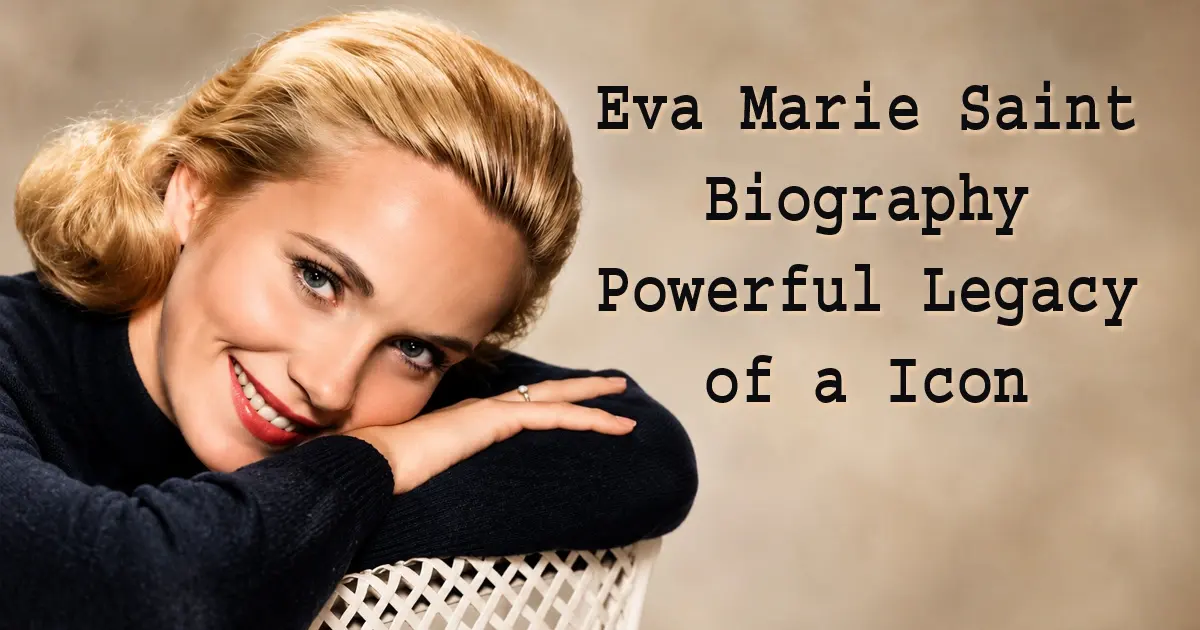
Eva Marie Saint holds a distinctive place in American film history, combining the discipline of live television with the understated power of classic Hollywood screen acting. Her work emerged during a period when American entertainment was changing rapidly, and she became one of the performers who moved naturally between television, theater, and motion pictures without allowing any single medium to define her.
Eva Marie Saint was an Academy Award and Emmy-winning American actress whose career connected the early age of live television with some of Hollywood's most enduring films. She won an Oscar for her film debut opposite Marlon Brando in On the Waterfront and became one of Alfred Hitchcock's most memorable leading women opposite Cary Grant in North by Northwest. Her work extended across film, television, theater, animation, and more than seven decades of American entertainment. Saint died on October 6, 2026, at the age of 102.
Saint became known for performances built on intelligence, restraint, and emotional precision. Rather than relying on theatrical gestures or a manufactured screen persona, she brought a striking naturalism to her roles. That quality made her equally convincing opposite some of the most commanding actors of her era and under directors whose films became permanent parts of American cinema.
Her lasting importance also comes from the unusual breadth and durability of her career. Saint belongs to the generation that helped bridge television's early dramatic age and Hollywood's postwar transformation, while maintaining a recognizable acting style across decades of change. Her work remains a record of an era when quiet authority could command the screen as effectively as spectacle, making her one of the enduring figures of twentieth-century American acting.
Before filming North by Northwest, Alfred Hitchcock personally helped construct Eva Marie Saint's glamorous new screen image. He rejected much of the studio wardrobe and accompanied Saint to Bergdorf Goodman in New York to select clothing for Eve Kendall, helping transform the naturalistic actress of On the Waterfront into one of cinema's most famous Hitchcock blondes.
👶 Early Life
Summary: Born in 1924, Saint entered Bowling Green State University intending to become a teacher before theater and performance redirected the course of her life.
Eva Marie Saint was born on July 4, 1924, in Newark, New Jersey. She was the daughter of Eva Marie Rice and John Merle Saint. Although born in New Jersey, she grew up largely in Delmar, New York, near Albany, in a household far removed from the Hollywood world with which she would eventually become associated.
During her childhood and teenage years, Saint developed interests that extended beyond performing. She attended Bethlehem Central High School in Delmar and was active in school life before continuing her education at Bowling Green State University in Ohio. She initially majored in education, intending to become a teacher like her mother, before changing her major to theater during her junior year.
Her direction changed at Bowling Green when she became involved with the university's theater program and discovered a serious interest in performing. She appeared in campus productions and participated in radio and theater activities at Bowling Green State University, gaining experience before acting became her profession. Unlike many Hollywood biographies built around childhood stardom or years of trying to break into movies, Saint's path developed gradually through education, theater, and practical performance experience, giving her the disciplined foundation that would shape her work.
Explore the Biographies of Iconic Celebrities
One of Saint's lines in the famous North by Northwest dining-car scene was considered too suggestive for the censors. Her original line about never making love on an empty stomach was redubbed for the finished film as the considerably safer line about never discussing love on an empty stomach.
🎬 Film and TV Career
Summary: From On the Waterfront and North by Northwest to decades of television and later films, Saint worked with many of Hollywood's most celebrated actors and directors while building a career that lasted more than 70 years.
Eva Marie Saint entered motion pictures with one of the most remarkable film debuts in Hollywood history. Director Elia Kazan cast her as Edie Doyle opposite Marlon Brando in On the Waterfront (1954). The picture also featured Karl Malden, Lee J. Cobb, Rod Steiger, and Pat Henning. Saint's restrained, emotionally direct performance stood comfortably beside Brando's celebrated work as Terry Malloy, and she won the Academy Award for Best Supporting Actress in 1955 for her first feature film.
Her success did not begin with movies alone. Saint was already an accomplished performer during television's live dramatic era. She appeared with Lillian Gish in the acclaimed television production of The Trip to Bountiful (1953), written by Horton Foote, and later appeared in the same role when the drama moved to Broadway in 1953. She later appeared as Emily Webb in a television production of Our Town (1955) alongside Paul Newman and Frank Sinatra. Her television work established the quiet naturalism that would remain one of her defining qualities.
After On the Waterfront, Saint appeared opposite Bob Hope in That Certain Feeling (1956) before taking on two substantial dramatic pictures in 1957. In director Fred Zinnemann's A Hatful of Rain (1957), she starred with Don Murray and Anthony Franciosa in a serious drama dealing with drug addiction. The performance brought her further critical recognition, including nominations for the Golden Globe and BAFTA.
That same year, Saint joined Elizabeth Taylor and Montgomery Clift in Raintree County (1957), an ambitious Civil War-era production directed by Edward Dmytryk. Working alongside two of the period's most prominent stars placed Saint firmly among Hollywood's leading dramatic actresses, yet she continued to resist becoming a conventional studio-manufactured personality.
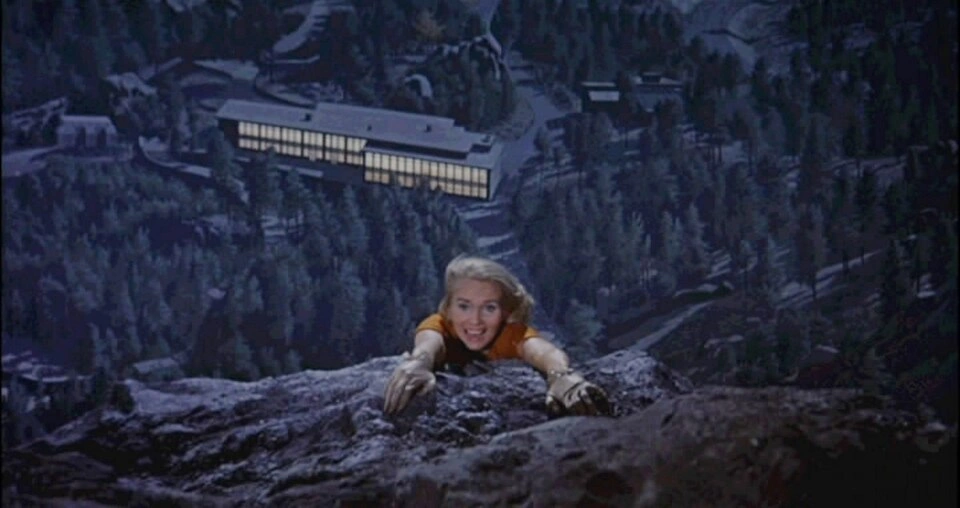
Her most famous screen role after On the Waterfront came when Alfred Hitchcock cast her opposite Cary Grant in North by Northwest (1959). As the mysterious Eve Kendall, Saint displayed a cooler and more sophisticated screen presence than audiences had seen in many of her earlier performances. The film also featured James Mason, Martin Landau, Jessie Royce Landis, and Leo G. Carroll. Hitchcock deliberately reshaped Saint's screen image for the part, and Eve Kendall became one of the defining women in his films. North by Northwest became both a major success and one of the most influential thrillers of its era.
Saint moved into large-scale historical filmmaking with director Otto Preminger's Exodus (1960). She played Kitty Fremont opposite Paul Newman, with a cast that included Ralph Richardson, Sal Mineo, Lee J. Cobb, John Derek, and Peter Lawford. The epic gave Saint another prominent role in one of the period's major international productions, filmed partly in Cyprus and Israel.
Director John Frankenheimer cast her opposite Warren Beatty, Angela Lansbury, Karl Malden, and Brandon deWilde in All Fall Down (1962). She followed it with 36 Hours (1964), starring with James Garner and Rod Taylor, playing Anna Hedler in the World War II suspense story. She also appeared in the television production A Carol for Another Christmas (1964), directed by Joseph L. Mankiewicz and written by Rod Serling.
In The Sandpiper (1965), directed by Vincente Minnelli, Saint worked with Elizabeth Taylor and Richard Burton during the height of their international celebrity. The following year brought two very different films. She appeared in director Norman Jewison's Cold War comedy The Russians Are Coming, the Russians Are Coming (1966), starring Alan Arkin, Carl Reiner, Brian Keith, and Jonathan Winters, and then returned to John Frankenheimer for the racing epic Grand Prix (1966).
Grand Prix placed Saint in another large international ensemble, this time alongside James Garner, Yves Montand, Toshiro Mifune, Brian Bedford, and Jessica Walter. The film's extensive location photography and racing sequences made it one of the major technical spectacles of the decade, while Saint played Louise Frederickson, the estranged wife of a racing driver.
She moved into the Western with The Stalking Moon (1968), directed by Robert Mulligan and starring Gregory Peck and Robert Forster. In Loving (1970), directed by Irvin Kershner, she played opposite George Segal. She then joined Bob Hope again in Cancel My Reservation (1972). By this point Saint was deliberately making fewer feature films, having resisted the pressure to maintain the relentless production schedule traditionally expected of a Hollywood star.
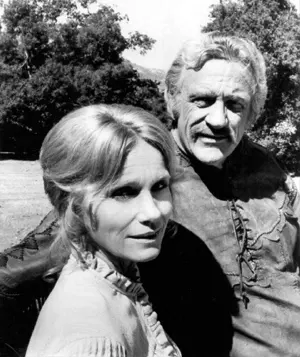
Television consequently became an increasingly important part of her career. Saint played Kate Macahan in The Macahans (1976) and How the West Was Won (1977), appearing with James Arness, Richard Kiley, Fionnula Flanagan, and Bruce Boxleitner. Her work earned an Emmy nomination in 1977 for Outstanding Lead Actress in a Limited Series.
Another Emmy nomination followed in 1978 for the television drama Taxi!!!, in which she appeared opposite Martin Sheen. Saint remained a familiar presence in television movies and miniseries, including A Christmas to Remember (1978), When Hell Was in Session (1979) with Hal Holbrook, The Curse of King Tut's Tomb (1980), and The Best Little Girl in the World (1981).
In Fatal Vision (1984), Saint reunited with her On the Waterfront co-star Karl Malden. The television miniseries dramatized the Jeffrey MacDonald murder case, with Saint playing Mildred Kassab. Her ability to move into mature character roles without losing the emotional control associated with her earlier work allowed television to provide substantial parts at a time when Hollywood offered fewer leading roles to actresses of her generation.
Saint returned to feature films in Nothing in Common (1986), directed by Garry Marshall and starring Tom Hanks and Jackie Gleason. She played Lorraine Basner, the mother of Hanks's character and estranged wife of Gleason's Max Basner. The role introduced Saint to a younger movie audience while placing her alongside two performers associated with a very different generation of American entertainment.
She also appeared with George C. Scott in The Last Days of Patton (1986) and became a recurring presence on Moonlighting (1985–1989) as Virginia Hayes, mother of Cybill Shepherd's Maddie Hayes. The popular series, starring Shepherd and Bruce Willis, gave Saint a place in one of the signature television programs of the decade.
One of her greatest television honors arrived with People Like Us (1990). Playing Lil Altemus in the NBC miniseries based on the novel by Dominick Dunne, Saint won the Primetime Emmy Award for Outstanding Supporting Actress in a Miniseries or Special. It was a significant late-career recognition for an actress who had been receiving Emmy nominations since television's earliest dramatic years.
Her television work continued through projects including Voyage of Terror: The Achille Lauro Affair (1990) with Burt Lancaster, My Antonia (1995) with Jason Robards, the miniseries Titanic (1996), and Time to Say Goodbye? (1997) with Richard Kiley. She also made an appearance on Frasier, extending a television career that had begun during an entirely different technological and cultural age.
Saint returned to feature films again in I Dreamed of Africa (2000) with Kim Basinger. In 2005, she appeared as Miss Franny Block in Because of Winn-Dixie, joining Jeff Daniels, Cicely Tyson, and AnnaSophia Robb. The same year, director Wim Wenders cast her in Don't Come Knocking (2005) with Sam Shepard and Jessica Lange.
A particularly visible late-career role arrived when Saint became Martha Kent in director Bryan Singer's Superman Returns (2006). Appearing with Brandon Routh, Kevin Spacey, Kate Bosworth, James Marsden, and Parker Posey, Saint brought her characteristic warmth and restraint to Superman's adoptive mother. More than half a century after she had stood opposite Marlon Brando in her first movie, she was appearing in one of Hollywood's largest modern franchise productions.
Her final feature-film appearance came in Winter's Tale (2014), directed by Akiva Goldsman and starring Colin Farrell, Jessica Brown Findlay, Russell Crowe, Jennifer Connelly, and William Hurt. By then, Saint's screen career stretched across roughly six decades, from the black-and-white realism of On the Waterfront to twenty-first-century fantasy and superhero filmmaking.
Saint also reached a younger audience through voice acting as the elderly Katara in The Legend of Korra, connecting an actress identified with Hollywood's Golden Age to a major modern animated franchise. Even in her later years she continued performing, including audio drama work, demonstrating the unusual span of a professional life that had begun in the age of live television.
Hitchcock gave Saint three wonderfully specific acting instructions for North by Northwest: lower her voice, stop using her hands so much, and look directly into Cary Grant's eyes during their scenes together.
🕊️ Later Years
Summary: Saint remained connected to Hollywood and her family throughout her later years, celebrated her 100th birthday in 2024, and died on October 6, 2026, at age 102.
As Eva Marie Saint moved into the later decades of her life, she became an increasingly rare living connection to the generation that transformed American film and television in the 1950s. Unlike many stars identified with Hollywood's Golden Age, Saint remained visible long after the period that made her famous, appearing at industry events, accepting honors, and speaking about the actors and directors with whom she had worked.
Family remained central to Saint's life. She had married television director and producer Jeffrey Hayden in 1951, and their marriage lasted 65 years, until his death in 2016. They had two children, Darrell Hayden and Laurette Hayden, and Saint often made clear that maintaining her family life mattered more to her than accepting every role Hollywood offered. That decision helped explain the deliberate pace of her career, particularly after her greatest years as a leading film actress.
Her connection to Bowling Green State University also endured throughout her life. The university named its campus theater the Eva Marie Saint Theatre in her honor, recognizing a former student whose career had eventually reached the highest levels of American entertainment. In 2018, the university honored her with a lifetime achievement award, more than seven decades after her student years there.
Saint also remained part of Hollywood's public life. One of her most memorable later appearances came at the 90th Academy Awards in 2018. At 93, she walked onto the Oscar stage to present the award for Best Costume Design and received a standing ovation. Her appearance carried unusual historical weight. The woman standing before a modern Hollywood audience had won her own Academy Award more than six decades earlier for On the Waterfront (1954).
Saint reached her 100th birthday on July 4, 2024, a milestone that drew renewed attention to the extraordinary span of her life and career. She had entered entertainment during the age of live television and lived to see the industry transformed by more than seven decades of technological and cultural change.
Saint eventually became the oldest living Academy Award winner, an extraordinary distinction for an actress who had received her Oscar in 1955. Even at 100, however, her longevity never overshadowed the performances that had made her famous.
Eva Marie Saint died on October 6, 2026, at the age of 102. She died of natural causes at her home in Los Angeles, surrounded by family and loved ones, according to her representative Jeff Sanderson. She was survived by her two children, four grandchildren, and two great-grandchildren.
Her death closed one of the longest living connections to Hollywood's classic era. Saint's career had stretched from the pioneering years of live television through On the Waterfront, North by Northwest, major films of the 1960s, decades of television work, and appearances in twenty-first-century productions. She left behind an Academy Award, an Emmy Award, and a body of work that placed her alongside several generations of American performers while preserving a screen presence that remained unmistakably her own.
Eva Marie Saint received not one but two stars on the Hollywood Walk of Fame in 1960, recognizing her separately for her contributions to motion pictures and television.
🏆 Legacy
Eva Marie Saint's legacy rests on something rarer than longevity. She created performances that became permanent parts of American film history while resisting the temptation to build her career around a single screen image. The emotional honesty of Edie Doyle in On the Waterfront (1954) and the polished mystery of Eve Kendall in North by Northwest (1959) showed an actress capable of occupying completely different cinematic worlds without losing the quality that defined her work.
Her Academy Award for Best Supporting Actress, won for On the Waterfront at the 27th Academy Awards in 1955, gave Saint one of Hollywood's most extraordinary introductions to motion pictures. Winning an Oscar for a first feature film placed her among a small group of performers whose arrival on the screen immediately became part of Academy history. Yet the award represented only one part of a career that had already been shaped by the demanding world of live television.
Saint's place in television history is equally important. She belonged to the generation of actors who worked during television's early dramatic years, when performances were frequently broadcast live and there was little room for error. Decades later, her Primetime Emmy Award for People Like Us (1990) demonstrated how successfully she had adapted as television changed around her. Few performers remained credible across such a long stretch of the medium's development.
Saint was particularly important as an example of an actress who could be subtle without becoming invisible. Her performances often depended on expression, timing, silence, and careful reaction rather than theatrical display. Opposite powerful personalities such as Brando, Grant, and Newman, she never needed to compete for attention. Her restraint became part of her authority.
The contrast between On the Waterfront and North by Northwest remains perhaps the clearest demonstration of her range. Elia Kazan used her vulnerability and emotional openness, while Alfred Hitchcock transformed her into one of his most elegant and enigmatic leading women. Those two films alone would have secured her place in cinema history, but the decades of work surrounding them made that legacy considerably larger.
Her career also crossed boundaries that separated generations of performers. Saint began professionally when live television drama was still developing, became an Oscar-winning star during the 1950s, worked through Hollywood's changing landscape of the 1960s and 1970s, became a familiar presence in television movies and miniseries, and eventually appeared in productions such as Superman Returns (2006) and The Legend of Korra (2012). Audiences separated by half a century could know Eva Marie Saint from entirely different parts of her career.
The lasting measure of Eva Marie Saint is ultimately found on the screen. More than 70 years after her breakthrough, audiences can still watch Edie Doyle confront Terry Malloy or see Eve Kendall meet Roger Thornhill aboard the Twentieth Century Limited. The performances have not become historical curiosities. They still work. That durability is the strongest legacy an actor can leave.