🎭 History of Krampusnacht: The Dark Alpine Night Before St. Nicholas Day
Every year on the night of December 5, something strange happens in the Alps. Bells clang in the dark. Chains rattle on cobblestones. Horned, hairy creatures stomp through town squares while crowds scream and laugh at the same time.
This is Krampusnacht, which means “Krampus Night” in German. It falls on the eve of St. Nicholas Day, celebrated on December 6. The idea behind it is simple and a little bit wicked.
St. Nicholas arrives with treats for children who behaved well all year. His companion Krampus handles the naughty ones. Good kids get nuts, fruit and sweets. Bad kids get a swat with a bundle of sticks, or worse.
The History of Krampusnacht is a wild ride through medieval plays, Alpine villages, printed postcards and political crackdowns. It ends, for now, with Hollywood movies and parades in American cities. You do not need any background to enjoy it. Grab a mug of something warm and settle in.
We will separate real history from popular legend along the way. The History of Krampusnacht has collected plenty of tall tales over the centuries. Some of them are true, and some are just good stories.
😈 Who Is Krampus?
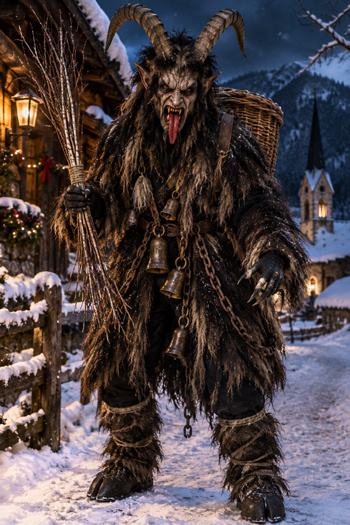
Picture a creature that is part goat, part devil and part nightmare. That is Krampus. He usually has curving horns and a shaggy coat of dark fur. A long, pointed red tongue hangs from his mouth.
Folk art often shows him with one human foot and one cloven hoof. He drags heavy chains and wears bells that announce his arrival. In his claws he carries a bundle of birch switches called Ruten.
Some versions give him a basket or sack strapped to his back. According to the legend, that is where he stuffs the worst children. He hauls them away to punish them later, or so parents warned.
The chains are often explained as a Christian symbol. They show the Devil bound and controlled by the Church. Krampus may look terrifying, but he works under the authority of a saint.
That is the key to his role. Krampus is the dark counterpart to St. Nicholas. One figure rewards, and the other threatens. Together they act like a holiday version of “good cop, bad cop.”
Even his name is a bit of a mystery. One popular theory links it to the Old High German word krampe, meaning “claw” or “hook.” Another links it to a Bavarian dialect word meaning dried out or dead. Scholars at the Library of Congress note that neither theory is fully settled.
🏔️ Origins of the Legend
Krampus belongs to the eastern Alps. His home turf includes Austria, Bavaria in southern Germany, South Tyrol in northern Italy and nearby lands. Many places that were once part of the Habsburg Empire also adopted him.
Here is where the History of Krampusnacht gets tricky. You will often read that Krampus is thousands of years old. Many websites call him a pagan god or the son of a Norse goddess. Those claims deserve caution.
The documented history: Wikipedia’s summary of the scholarship notes that historians generally doubt a pre-Christian origin. The reason is simple. Krampus is not clearly attested in writing until the 16th century.
The documented History of Krampusnacht starts in the church. Medieval religious plays featured devils who burst from hell to drag sinners away. German manuscripts of plays about St. Nicholas survive from the 11th and 12th centuries. Medieval artists drew devils that look remarkably like the later Krampus.
Masked devils causing rowdy trouble are recorded in Germany since at least the 16th century. By the 17th century, Krampus was firmly paired with St. Nicholas in Alpine celebrations.
The theory: Some folklorists and anthropologists believe Krampus has deeper pagan roots. In a 1958 article, writer Maurice Bruce suggested Krampus came from a pagan spirit absorbed into the Christian devil. Many Austrians share that belief today.
The legend: The claim that Krampus is the son of the Norse figure Hel appears in many popular articles. A Library of Congress folklorist called this claim shaky and found no evidence for it. Treat it as modern folklore about folklore.
The fairest answer is a mix. Medieval devils may have borrowed features from older pagan figures. Winter processions with wild masks may echo older customs. But no document proves a straight line from ancient gods to Krampus.
Another influence is the Perchten. These are wild, masked spirits from Alpine folklore who parade around Epiphany in early January. Scholars see them as a major influence on Krampus. The two traditions still blend together in many Alpine towns.
🎅 Krampus and St. Nicholas
To understand Krampus, you need to meet his boss. St. Nicholas was a real bishop of Myra, in what is now Turkey. He lived in the fourth century and became famous for secret generosity.
His feast day is December 6. He became popular in Germany around the eleventh century. Over time, he turned into a gift giver who visited children on the eve of his feast.
That created a problem. A saint is supposed to be kind and holy. It did not seem fitting for him to hand out punishments himself. So, according to tradition, he gained helpers who did the dirty work.
Across Europe, those helpers took many forms. Germany had Knecht Ruprecht. Switzerland had Schmutzli. France had Père Fouettard. In the Alps, the job went to Krampus.
A popular form of folk theater helped cement the pair. The Nikolausspiel, or “Nicholas play,” spread across Alpine regions. These plays showed a battle for human souls, with devils lurking nearby.
Many of these plays ended with Krampus figures charging through the audience. They pretended to attack the spectators for laughs and screams. That rowdy finale looks a lot like a modern Krampus run.
From the 18th and 19th centuries, Nicholas and Krampus also made house calls. They visited homes and schools to check on children’s behavior. In the 19th century, Krampus started showing up at Christmas markets too.
This team is the heart of the History of Krampusnacht. The night before the feast became the moment when both figures came to town. The saint brought the reward, and the devil brought the warning.
🔔 The Krampuslauf: The Krampus Run
If you want to see Krampus in action, go to a Krampuslauf. The word means “Krampus run.” It looks less like a race and more like a loud, chaotic parade.
Groups of costumed Krampus figures march through the streets. They wear huge cowbells that boom with every step. They rattle chains, wave birch switches and lunge at onlookers. Some carry torches or fire effects.
Many Krampus runs are organized by local clubs called Krampuspassen. These groups are common in Carinthia, Salzburg and Tyrol. Most modern runs have security staff, paramedics and barriers between performers and the crowd.
Salzburg hosts one of the biggest. The Gnigler Krampuslauf celebrated its 50th edition in 2025, with roughly 1,300 Krampus figures taking part. The city also holds Krampus runs on the night of December 5.
Bad Goisern in Upper Austria draws more than 800 Krampus figures. Toblach, in South Tyrol, is often called the oldest and largest gathering in that region. Seefeld hosts the largest gathering in north Tyrol.
Munich has one of the best known runs in Germany. Around 300 costumed figures parade near Marienplatz during the Christmas market. The city even offers a special class to help young children feel less afraid.
A fair warning belongs here. Not every run is family friendly. Some have a reputation for alcohol and rough behavior. If you bring kids, look for events with barriers and a strong safety record.
🪵 Carved Masks and Costumes
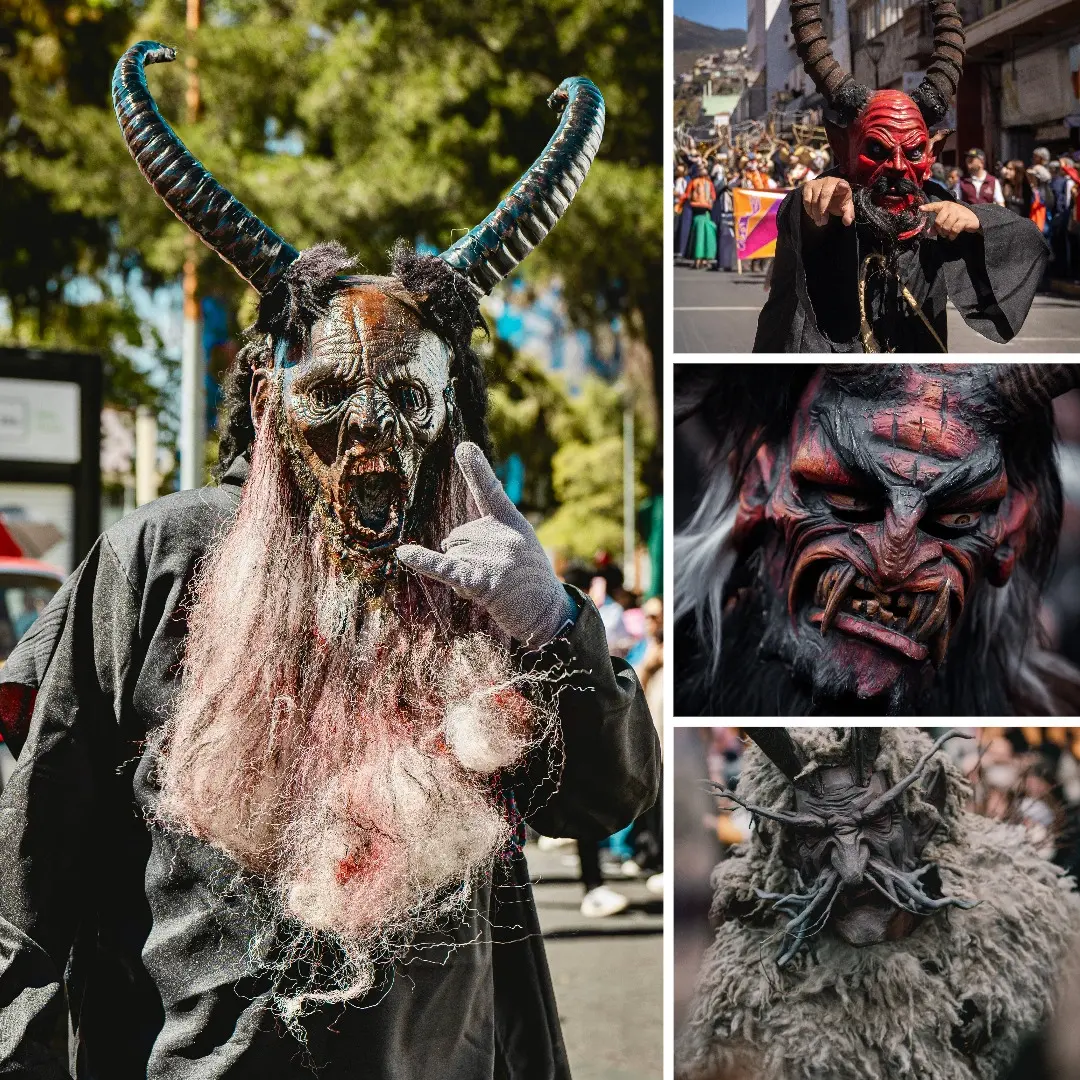
The real stars of any Krampus run are the masks. Traditional Krampus masks are carved by hand from wood. The favorite material in Austria is Swiss stone pine, known locally as Zirbe.
Carvers love this wood for good reasons. It is soft and easy to shape. It is light, which matters when you wear a mask for hours. It also smells wonderful, and some carvers praise its antibacterial quality.
The process starts with a rough block, sometimes shaped with a chainsaw. Then the carver works by hand for many hours. Glass or acrylic eyes go in next. Finally, the mask is painted to give it a unique character.
Horns are the crowning touch. For a time, many carvers used artificial horns. Today, many have returned to real horns from goats, rams or cattle out of respect for tradition. A finished mask can weigh around five kilograms.
The rest of the costume is just as heavy. Performers wear shaggy suits of goat or sheep fur. Massive bells hang from leather belts. It is hot, loud and exhausting work.
The craft is very much alive. One Kitzbühel tourism profile estimates about 4,000 mask carvers in Austria. Some work as hobbyists, while others carve professionally.
Carvers like Bernhard Reiter in Faistenau and Christoph Rieser near Kitzbühel keep the tradition going. Lisa Hirschbichler, known as the “Schoatnhex,” carves in Saalfelden Leogang. She has even dreamed of masks designed for an all women Krampus group.
💌 Vintage Krampus Greeting Cards
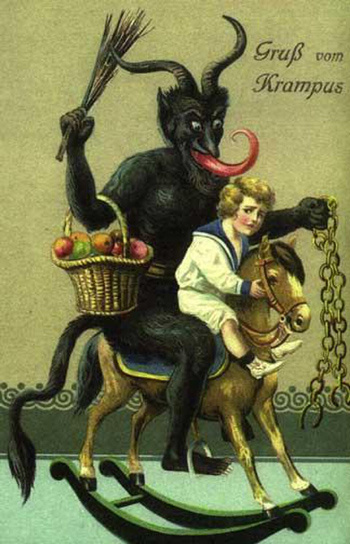
One of the most charming chapters in the History of Krampusnacht is printed on paper. These are the Krampuskarten, or Krampus cards. They were holiday postcards with a devilish twist.
The cards boomed in the late 19th century. Cheap color printing called chromolithography made them affordable. Germany and Austria saw a postcard craze in the 1890s, and Krampus rode that wave.
According to the Library of Congress, hundreds of designs appeared between 1885 and the start of World War I. Many cards carried the greeting “Gruss vom Krampus,” meaning “Greetings from Krampus.”
The images were not exactly cozy. Krampus stuffs crying children into his basket. He chases kids with switches or leads them away in chains. Yet most cards were meant to be funny, not frightening.
Some cards aimed at grown ups. Starting around 1903 or 1904, designs showed Krampus chasing women or playing a romantic suitor. Over the decades, his look softened. Later cards often show a cuter, almost cuddly little devil.
Museums still treasure these cards. The Austrian Museum of Folk Life and Folk Art in Vienna held a special Krampus card exhibition in 2000. Collectors around the world hunt for originals today.
🚫 Bans and Disapproval
Krampus has not always been welcome. Bans are a surprising part of the History of Krampusnacht. His wild and devilish nature has worried authorities more than once.
The Catholic Church long viewed some masked winter customs with suspicion. Wild Perchten processions were treated warily by church leaders. Some civil authorities banned them outright at various times.
The best known crackdown came in the 1930s. Austria was then ruled by the authoritarian government of Engelbert Dollfuss and his Fatherland Front. Many sources report that this regime prohibited or discouraged Krampus customs.
In December 1934, The New York Times ran a headline saying Krampus was disliked in fascist Austria. Mental Floss reports that from 1934 to 1938, Krampus was linked with sin and anti-Christian ideas.
Disapproval continued after World War II. In 1953, the head of Vienna’s kindergarten system published a pamphlet calling Krampus “an evil man.” It warned parents that Krampus could scar children. Mental Floss notes this did not rise to the level of a ban.
Worries about children have never fully gone away. As recently as 2006, an Austrian child psychologist argued that Krampus events were unsuitable for kids. Still, the tradition bounced back strongly in the late 20th century.
🇺🇸 Krampus Comes to America
For most of the 20th century, few Americans had heard of Krampus. American newspapers mentioned him occasionally from about 1905 onward. The Library of Congress found a Krampus Ball held in Washington in 1962.
The big shift began in 2000. Chicago artist Monte Beauchamp published vintage Krampus cards in issue 11 of his comic art magazine Blab! Readers loved them.
In 2004, Beauchamp released a book of Krampus postcards. A gallery in Santa Monica soon hosted an art show inspired by the cards. Then the internet took over, and Krampus fever spread fast.
By the early 2010s, Los Angeles and Philadelphia had founded their own Krampus runs. Today you can find Krampus events in Chicago, Washington, Dallas, New Orleans and many other cities. Some are traditional parades, while others are costume parties or bar crawls.
Books helped too. Gerald Brom published the novel Krampus: The Yule Lord in 2012. Al Ridenour followed in 2016 with The Krampus and the Old, Dark Christmas. It digs deep into the real folklore.
Then Hollywood arrived. Universal Pictures released the horror comedy Krampus on December 4, 2015. Michael Dougherty directed it, with Adam Scott and Toni Collette in the cast.
The release date was moved to land near Krampusnacht. The film opened at number two for its first weekend with about $16 million. It earned roughly $61.5 million worldwide on a $15 million budget.
That success marked a turning point in the History of Krampusnacht in America. Krampus went from an obscure Alpine figure to a holiday horror icon. Many low budget Krampus movies have followed in its wake.
🕯️ How to Celebrate Krampusnacht Today
You do not need to fly to Austria to celebrate the History of Krampusnacht. Here are some easy ways to mark the night of December 5.
Attend a Krampus run. Check your nearest city for a local Krampuslauf or Krampusnacht event. Many American cities now host parades, markets or costume walks in early December. Bring a warm coat and a sense of humor.
Host a Krampus party. Mix dark decor with classic Christmas cheer. Serve German treats like gingerbread, roasted nuts and spiced punch. Invite guests to wear horns, fur or their spookiest holiday sweaters.
Send vintage style cards. Reproductions of classic Krampuskarten are easy to find. Write “Gruss vom Krampus” inside and mail them to friends who love the strange side of the season.
Leave out your shoes. In the Alpine tradition, children set out shoes or boots on December 5. Good kids find treats inside by morning. Naughty ones might find a twig instead.
Watch Krampus films. Start with the 2015 movie Krampus for a fun mix of scares and laughs. Then explore documentaries about real Alpine runs to see the tradition in its homeland.
🔥 Conclusion
The History of Krampusnacht shows that holidays have always had a shadow side. Long before tinsel and shopping malls, Alpine families balanced light with darkness. The saint and the devil arrived together.
Krampus survived church suspicion, political bans and worried educators. He traveled from mountain villages to postcards, then all the way to Hollywood. Along the way, he became something people genuinely love.
Part of his appeal is pure fun. Krampus lets us enjoy a safe scare in the coziest season of the year. He also connects us to a craft tradition that carvers still practice by hand.
The History of Krampusnacht is still being written each December. New runs start, new masks are carved, and new fans discover the horned legend.
Ready to join the fun yourself? Check out our DIY Krampus Costume guide to build your own horned look. For the bigger picture, read our History of Christmas article. Just remember to behave, because Krampus is always watching.