🍬 Candy Corn and the Halloween Candy That Almost Never Happened
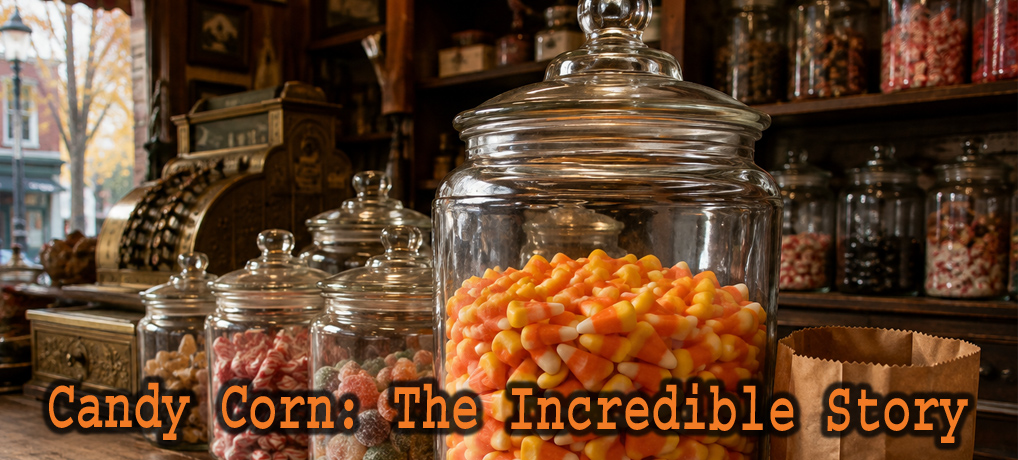
Every October, millions of Americans reach into a bowl of candy corn and do one of two things. They eat it happily. Or they look at it with the kind of suspicion usually reserved for suspicious strangers and questionable leftovers.
Either way, they are participating in a tradition that stretches back more than 140 years. The candy in their hand was invented before the light bulb was common. It was originally sold as chicken feed. It spent decades as an all-seasons penny candy before anyone thought to connect it to Halloween. And the company most associated with it today did not even start making it until forty years after it was invented.
That is a lot of history for something that costs about three cents a piece and tastes like sweetened wax to approximately half the population.
Here is the full story.
Before Candy Corn: America in the 1880s
To understand where candy corn came from, you need to picture America in the 1880s. It was a country that was still mostly agricultural. Farmers made up roughly half the workforce. Children grew up around cornfields, chicken coops, and vegetable gardens. The rhythms of farm life shaped what people ate, what they celebrated, and what they found appealing.
Candy makers of the era understood their market. They were producing sweets shaped like turnips, chestnuts, pumpkins, and other farm products because those shapes meant something to their customers. A candy shaped like a chestnut was not an odd choice. It was a familiar and friendly shape to a child who grew up gathering chestnuts in the fall.
The candy industry was also still relatively young in America. Penny candy, those small individual pieces sold one at a time from glass jars and barrels, was the dominant format. Companies competed by inventing new shapes, new colors, and new novelties that children would find irresistible. Color was the great frontier. A candy that came in three different colors, layered on top of each other, was revolutionary in that era.
That is the world George Renninger walked into when he sat down to invent something new.
Vintage Halloween Collectibles: 31 Creepy Treasures Worth Collecting
Who Actually Invented Candy Corn?
The honest answer is that we are not entirely sure, and anyone who tells you otherwise is being more confident than the historical record allows.
The story most commonly told credits George Renninger, an employee of the Wunderle Candy Company in Philadelphia, with creating the original tri-color candy in the 1880s. The National Confectioners Association accepts this attribution. The History Channel has repeated it. Most candy histories lead with Renninger’s name.
There is one problem. There is no physical documentation of Renninger’s invention. No patent. No dated recipe. No contemporary account from the 1880s confirming that he made it. The attribution comes from oral history, passed down through the industry, and treated as established fact through repetition rather than documentation.
What the record does confirm is this. The Wunderle Candy Company was the first to sell multi-colored candy commercially, sometime around 1888. The Goelitz Candy Company, now known as the Jelly Belly Candy Company, began making it in 1898 and is generally credited with popularizing it. Goelitz has been making candy corn continuously ever since, which makes them the longest-running producer of the candy by a significant margin.
George Renninger may well have been the inventor. He almost certainly never made any money from it. That particular piece of candy history, the inventor who got nothing, is unfortunately a familiar story.
It Was Called Chicken Feed
Here is where the story gets genuinely fun.
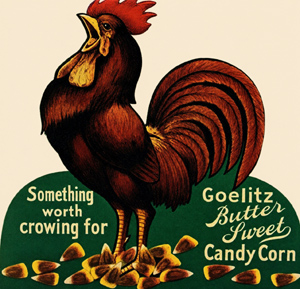
When Goelitz began selling the candy in 1898, they did not call it candy corn. They called it Chicken Feed. The box had a rooster on it. The slogan was something worth crowing for.
That name was not accidental or ironic. Before World War I, corn was primarily grown as animal feed in America. Corn for human consumption was not yet the staple it would become. Chicken feed was a familiar, everyday substance. A candy shaped like corn kernels, sold under the name Chicken Feed, was speaking directly to a rural audience in language they understood immediately.
It was only in the 1920s that the name began shifting to candy corn. Packaging from that period still showed a rooster and used the tagline King of the Candy Corn Fields. The agricultural imagery hung around long after the name had softened into something more obviously appealing to children.
The idea that a candy now associated with Halloween was once marketed as farm animal feed is one of those historical details that sounds made up. It is not. It is sitting right there on the original packaging, rooster and all.
How Candy Corn Was Originally Made
The manufacturing process for early candy corn was genuinely demanding work. It required skill, strength, and a tolerance for carrying very heavy buckets of very hot liquid.
Workers called runners or stringers mixed sugar, corn syrup, water, and other ingredients into a thick slurry, then heated it to precise temperatures in large kettles. The mixture had to be colored separately for each of the three layers: white, orange, and yellow. Then the runners would walk backwards through the factory, carefully pouring the hot mixture from heavy buckets into cornstarch trays imprinted with the kernel shape. Each color had to be poured in a separate pass. The runner had to get the amount and the rate exactly right, or the layers would not sit properly.
Those buckets weighed around forty-five pounds each. The candy was hot. The work was repetitive. And it could only be done during certain months of the year, because the lack of automated machinery made year-round production impossible. Early candy corn was a seasonal product by necessity rather than by marketing strategy.
The essential process has not changed dramatically in over a hundred years. Machines do the work now, pouring all three colors into molds and cooling them efficiently at scale. But the basic approach, three separate layers poured in sequence into a kernel-shaped mold, remains recognizable from the original method. After cooling, the kernels go into large polishing drums where confectioner’s glaze is added to give them their characteristic slight shine.
31 Halloween Superstitions You Didn’t Know About – Fascinating Fears & Hidden Truths
Candy Corn Was Not Originally a Halloween Candy
This is the part of the story that surprises most people.
For the first several decades of its existence, candy corn had nothing specifically to do with Halloween. It was penny candy. Children bought it at general stores and candy shops by the piece, year round, because it was sweet and cheap and available. It showed up at Thanksgiving. It appeared at Easter. It was simply a candy that happened to exist, not a Halloween candy that happened to be available at other times.
This makes complete sense once you remember that trick-or-treating as a national American tradition did not become widespread until the late 1940s and into the 1950s. Halloween in the earlier part of the century was more of a community event centered on parties, pranks, and mischief. The door-to-door candy collection that defines Halloween for most Americans today was not yet the dominant tradition.
Without mass trick-or-treating, there was no particular reason for candy to be seasonalized around October 31. Candy was candy. You bought it when you wanted it. Candy corn was no different from any other penny candy in that regard.
The Smithsonian’s National Museum of American History puts the shift clearly. Starting in the 1950s, more candy companies focused on the commercial opportunity Halloween offered. Packaged candies became increasingly popular for trick-or-treating because they were pre-wrapped and required no preparation. Brach’s was among the companies that packaged candy corn specifically for the trick-or-treat market. A dramatic spike in October advertising of candy corn began in the 1950s, and the seasonal association that feels so natural and permanent today was in fact a deliberate marketing development within living memory.
How Halloween Became a Candy Holiday
The transformation of Halloween from a community event into a candy holiday is one of the more remarkable marketing stories in American commercial history.
Before the 1950s, Halloween treats were mostly homemade. Families handed out baked goods, fruit, and small toys to children who came to the door. The Washington Post reported in November 1943 that Halloween vandals had knocked the nose off a statue at the Capitol, which gives a sense of how much the public and community event side of the holiday dominated at the time.
Several forces converged to change this. Trick-or-treating became more organized and community-focused in the 1940s, partly as a strategy to channel children’s energy away from Halloween mischief and into something more manageable. As the practice grew, the demand for convenient, ready-to-distribute treats grew with it. Pre-packaged candy was the obvious answer. It required no baking. It was individually portioned. It could be purchased in bulk.
Candy companies recognized the opportunity immediately. Mars ran an advertisement in the October 25, 1954 issue of Life magazine featuring a ghost enjoying the haunting flavor of the Milky Way. It was among the first national advertisements specifically promoting candy for trick-or-treating.
Brach’s moved aggressively into the Halloween candy market in the 1960s, producing candy corn and other fall candies in single-serve packets designed specifically for trick-or-treaters. The candy’s harvest color palette of yellow, orange, and white made it a natural fit for the season. And once Brach’s started marketing it as Halloween candy, the association became self-reinforcing. People expected to see it in October. They bought it in October. They gave it out in October. Within a generation, candy corn and Halloween felt like they had always belonged together.
They had not. But they do now.
Enter Brach’s
Emil Julius Brach was a German immigrant who arrived in Chicago in 1881 at the age of twenty-two and went to work for a candy company. He learned the business, saved his money, and in 1904 invested his life savings in a storefront candy kitchen at the corner of North Avenue and Towne Street in Chicago. He named it Brach’s Palace of Sweets.
He started with one kettle and two sons. He sold taffy, caramels, and ice cream, and he priced his candy well below his competitors. Where other candy makers charged fifty cents a pound, Brach charged twenty cents. His fourteen-year-old son Frank secured the company’s first major customer by walking into a department store and asking for the order.
By 1911, the company was producing fifty thousand pounds of candy per week. By 1923, Brach had four factories. He built a new facility, the Kinzie Plant, which became the largest candy manufacturing plant in the country. At its peak, it employed 4,500 workers in more than two million square feet of production space. Emil Brach worked every day until his death in 1947 at the age of eighty-eight.
Brach’s began making candy corn in the 1920s. That is an important detail. The candy had already been on the market for thirty-plus years by the time Brach’s started producing it. Most people assume Brach’s invented candy corn because Brach’s is so completely dominant in the market today. They did not invent it. They simply made it better, cheaper, and more widely available than anyone else.
There was also a tragedy in the company’s history that deserves to be told plainly. In 1948, an electrical spark ignited corn starch in the plant’s third floor. The explosion destroyed much of the factory’s north side, killed eleven employees, and injured eighteen more. The company rebuilt, expanded, and kept going. Emil Brach’s sons Edwin and Frank took over after their father’s death and grew the operation further. By 1986, the last year of family-related ownership, Brach’s accounted for two-thirds of all bagged candy sold in the United States.
3 Safe Halloween Treats – Fun & Allergy-Friendly Options
The Pick-A-Mix Era
If you grew up in America between the 1960s and the 1990s, you probably remember the Brach’s candy display at your local grocery store. A long rack of clear bins, each filled with a different kind of candy. A metal scoop. A paper bag. And a sign that told you the price per pound.
Brach’s introduced the Pick-A-Mix concept in 1958. The idea was adapted from the old candy barrel tradition of general stores, where customers could scoop whatever combination of sweets they wanted and pay by weight. Pick-A-Mix brought that tradition into the modern supermarket and made it a fixture of American grocery shopping for decades.
But Pick-A-Mix was really a more sophisticated version of something older and more personal than a supermarket display. Before chain grocery stores dominated, before plastic bags of pre-packaged candy lined every aisle, there were candy kitchens and corner stores where a child could walk in with a few coins and negotiate for a little of this and a little of that. You had six cents. You wanted some of the caramels and some of the peppermints and maybe a few pieces of candy corn. The person behind the counter knew you by name. They scooped carefully because every piece counted.
Pick-A-Mix mechanized that experience and scaled it to the supermarket era. It was not quite the same as the corner candy kitchen. But it preserved something important from that older tradition. The customer still chose. The customer still scooped. The candy was still by the pound rather than the pre-sealed bag. And for an entire generation of American children, the Brach’s Pick-A-Mix rack was where you went to customize your candy experience in a world that was increasingly moving toward standardized, pre-packaged everything.
The Brach’s factory that produced all of it was eventually closed in 2003 when new owners moved production to Mexico. Part of the abandoned Chicago plant was blown up in 2007 for a special effects scene in The Dark Knight. The rest sat in ruins waiting for demolition. The Pick-A-Mix displays disappeared from most supermarkets around the same time, victims of liability concerns and changing retail practices.
People who grew up with them still talk about those displays. That is not nothing.
How Much Candy Corn Do Americans Actually Eat?
A lot. An almost incomprehensible amount.
The Smithsonian’s National Museum of American History reports that Brach’s produces nine billion pieces of candy corn per year. Nine billion. The National Confectioners Association estimates that more than thirty-five million pounds of candy corn are sold annually in the United States.
Brach’s controls roughly eighty-five percent of the candy corn market during the Halloween season. In 2019 alone, the company sold seventy-three million dollars worth of candy corn. For a candy that half the population claims to dislike, the sales figures suggest that either a great many people are lying about their feelings, or the other half is eating enough for everyone.
The candy is the second most popular Halloween treat in America, behind chocolate as a category. Only gummy candy rounds out the top three. For a product invented in the 1880s that was originally marketed as farm animal feed, that is a remarkable position to hold in the modern candy market.
Why Do People Hate Candy Corn?
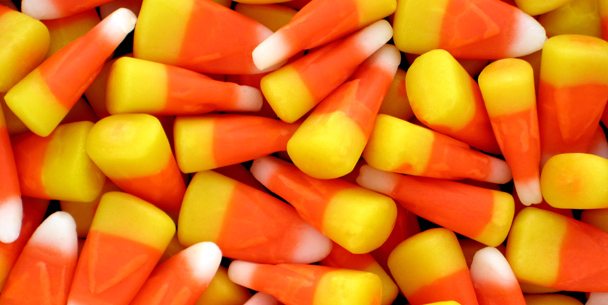
Every October, the internet rediscovers its feelings about candy corn. And those feelings are strong.
The complaints cluster around a few consistent themes. The texture is waxy. The sweetness is overwhelming. There is an artificial quality to the flavor that some people find pleasant and others find genuinely off-putting. One writer at Paste Magazine described the popular urban legend that all the candy corn in the world was made in a single year, stockpiled, and redistributed annually, as a theory that seemed entirely plausible because candy corn is that bad.
The texture complaint has a technical explanation. Candy corn sits between a soft and a hard candy in sugar chemistry terms, cooked to temperatures that produce what food scientists call a firm marshmallow texture. The confectioner’s glaze gives it the waxy exterior. The flavor is technically buttercream, a combination of sugar, butter, honey, and vanilla, which reads as pleasantly sweet to some people and cloyingly artificial to others depending on how their palate processes that particular combination.
Generationally, the data is interesting. A 2020 National Confectioners Association survey found that Gen X was the most likely generation to enjoy candy corn, with 58 percent reporting they liked it. Baby Boomers followed at 56 percent. Millennials and Gen Z were less enthusiastic, with fewer than half of each group reporting enjoyment. The candy skews older, which tracks with the nostalgia factor. If you ate it as a child, you are more likely to find it pleasant as an adult. If your first experience of it was as a teenager who had already been exposed to better candy, you may never have developed the taste.
The annual love-it-or-hate-it debate has become its own Halloween tradition. Brach’s has leaned into the controversy with cheerful pragmatism, at one point releasing a Turkey Dinner flavored candy corn and a candy-corn-themed song, which either proves that they have a sense of humor or that they understand controversy is good for sales. Probably both.
And then there is the question of how you eat it.
According to surveys conducted by the National Confectioners Association, roughly 33 percent of candy corn eaters start with the narrow white end and work their way down. About 16 percent begin with the wider yellow end. The majority, somewhere between 51 and 58 percent depending on which survey you read, just pop the whole piece in their mouth at once.
There is no wrong way, the NCA says diplomatically. That is a reasonable position. It is also the position of an organization with a financial interest in everyone eating more candy corn regardless of technique.
Halloween Costume Origins: A Historical and Cultural Examination
Candy Corn’s Strange Children
Candy corn did not stay in its original form for long. Once the mellowcreme process was established and the market existed, variations were inevitable.
The mellowcreme pumpkin is candy corn’s most successful descendant. Shaped like a small orange pumpkin, made with the same basic formula, it delivers the same flavor in a different form. Brach’s Autumn Mix combines classic candy corn, harvest corn, and mellowcreme pumpkins in a single bag, which allows people who find plain candy corn too much to experience it in rotation with something slightly different.
Harvest corn, also called Indian corn, uses brown, orange, and cream colors to evoke the traditional dried corn of autumn harvest displays. It is the same candy in different clothing, but the different clothing matters to collectors and seasonal decorators who use it in fall tablescapes and crafts.
The caramel apple mellowcreme is a more ambitious variation. It takes the basic mellowcreme format and introduces a genuine flavor departure, apple and caramel rather than vanilla and honey. Whether this works depends significantly on your feelings about artificial apple flavoring, but it exists, and it sells.
Manufacturers have also tried chocolate-dipped candy corn, hot sauce-flavored candy corn, coffee-flavored candy corn, and various holiday-specific color combinations for Valentine’s Day and Easter. Some of these have found audiences. Others have confirmed that there is a reason the original formula has survived for 140 years without significant change. The original works. Everything else is a conversation starter.
Candy Corn Today
George Renninger invented something in a Philadelphia candy kitchen in the 1880s and never made a dollar from it. The candy he made has now been manufactured continuously for more than 140 years. Nine billion pieces of it are produced every year. It is the second most popular Halloween candy in America. Half the country claims to dislike it and buys it anyway.
It started as chicken feed for a nation of farmers. It became penny candy for a nation of children. It became a trick-or-treat staple for a nation of suburban neighborhoods. It became a seasonal icon so deeply embedded in American October that removing it from the holiday would feel like removing the jack-o-lantern.
Brach’s still sells it in bags ranging from 3.5 ounces to 34 ounces. The formula is essentially unchanged from what Goelitz was making in 1898. Sugar. Corn syrup. Honey. Confectioner’s glaze. Three colors poured in sequence and cooled in a kernel-shaped mold. A process that started with runners walking backwards across factory floors carrying forty-five pound buckets of hot candy is now performed by machines, but the result looks the same and tastes the same as it always did.
Brach’s Classic Candy Corn
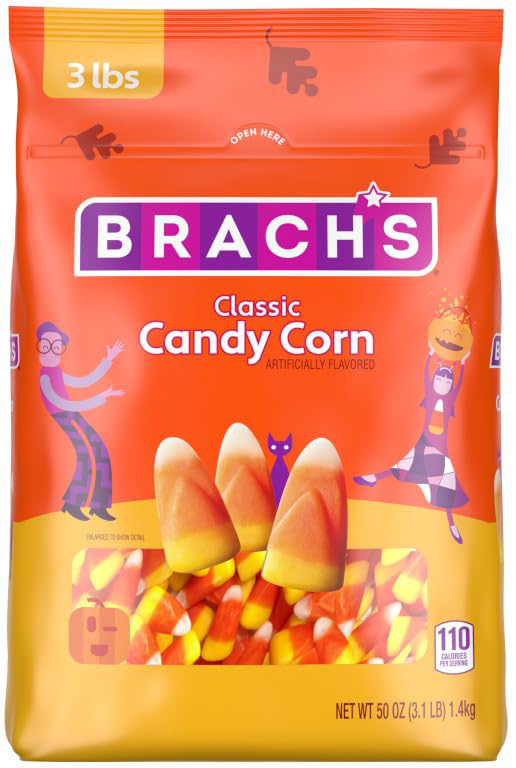
Product Description:
Few treats capture the spirit of autumn like Brach’s Classic Candy Corn. For generations, these colorful kernels have filled candy dishes, Halloween party tables, and trick-or-treat bags across America. Whether you’re decorating for a vintage Halloween display or simply enjoying a seasonal tradition, candy corn remains one of the most recognizable sweets of the fall season.
Key Features:
• The classic tri-colored candy corn recipe loved for generations
• Made with Brach’s signature honey-forward flavor
• Perfect for candy bowls, Halloween parties, and fall decorating
• Great for baking, cookies, cakes, snack mixes, and seasonal recipes
• A Halloween tradition from one of America’s best-known candy makers
Why This Works:
No collection of Vintage Halloween Collectibles feels complete without the candy that has become a symbol of the season. Whether displayed in an old glass candy dish beside vintage blow molds and die-cut decorations or enjoyed during a Halloween movie night, Brach’s Classic Candy Corn brings a nostalgic touch that generations of families instantly recognize.
Buy on Amazon
Some things last because they are extraordinary. Some things last because they become part of how a culture marks time. Candy corn is the second kind. Every October it reappears on the shelves, and every October people argue about it, and every October someone reaches into a bowl and eats a handful anyway.
That rooster on the original box would probably find the whole thing something worth crowing for.