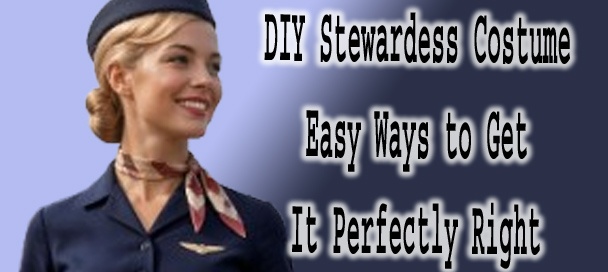
✈️ DIY Stewardess Costume: Easy Ways to Get It Perfectly Right
She Had a Ticket to Everywhere. And She Knew How to Use It.
There is a version of the twentieth century that belongs almost entirely to one specific woman. She is standing in a jetway in a crisp navy dress with a silk scarf tied at her collar and a pair of silver wings pinned above her heart and she is about to board a flight to somewhere you have never been. She is twenty three years old. She speaks two languages. She has been to Paris twice this month. She knows every airport lounge from New York to Hong Kong and she knows which ones have the best bourbon and which ones have the worst lighting and she knows both of those things because she has been paying attention in a way that the world she came from never quite prepared her for. She left that world behind at thirty thousand feet, and she has not looked back since.
The golden age of commercial aviation, roughly 1958 through the late 1970s, produced one of the most enduring and complicated archetypes in American popular culture. The stewardess was simultaneously a symbol of corporate glamour, feminine independence, working class aspiration, and the particular kind of freedom that only comes from a job that puts an ocean between you and everything you used to know. Airlines understood this and marketed it ruthlessly. Pan Am, TWA, Northwest Orient, Braniff. Each one built a visual identity around their cabin crew that was as carefully considered as any fashion house collection, commissioning designers, specifying colors, controlling hemlines and hairstyles and the precise angle of the service smile with an attention to detail that would have been remarkable in any industry.
The cultural fingerprints of this era are everywhere once you start looking. Frank Abagnale, whose extraordinary story became Steven Spielberg's Catch Me If You Can with Leonardo DiCaprio in 2002, spent years impersonating a Pan Am pilot and traveling free across the globe on the strength of a uniform and a confident walk, and the stewardesses he encountered along the way are woven through the story as both witnesses and participants in one of the great cons of the twentieth century. DB Cooper ordered a bourbon and soda from a Northwest Orient stewardess on the afternoon of November 24, 1971 and handed her a note that changed aviation history, and the flight attendants on that plane, Florence Schaffner and Tina Mucklow, conducted themselves with a professional composure under extraordinary pressure that became part of the legend.
Hugh Hefner flew his famous black DC-9, painted with a Playboy bunny on the tail and known simply as Big Bunny, with a crew that embodied every element of the era's particular intersection of glamour, sophistication, and carefully managed transgression. The overlap between that world and the world of commercial aviation in the late 1960s and early 1970s was not accidental. It was the same world wearing different uniforms.
Mad Men understood this. The show's visual and emotional landscape was built partly on the specific energy of that era, the cocktails and the cigarettes and the transatlantic romances and the sense that the postwar American economy had created a class of people who moved through the world with a freedom and a confidence that their parents could not have imagined. The stewardess lived at the center of that energy. She was the person who brought you your drink at thirty thousand feet and smiled like she had a secret, which she did, because the secret was that she had been everywhere and seen everything and she was about to go somewhere else tomorrow and you were going home.
The DIY Stewardess Costume works because that archetype has never lost its power. It shows up in film and television with reliable consistency because it carries so much cultural freight so efficiently. A navy dress, a silk scarf, a pair of wings, and the right quality of composed professional warmth and the whole era arrives fully assembled. This is a costume that rewards commitment and repays attention to detail, with results that stand apart from generic options currently available and that connect naturally to one of the richest periods in twentieth-century American cultural history.
👗 Step 1: Create the Base
The foundation of the DIY Stewardess Costume is a uniform shift dress and this is where the costume separates itself immediately from the cheap, poorly rated options that dominate the Halloween costume market. Those garments are made from fabric that does not hold its shape, in cuts that do not replicate the crisp tailored line of an actual airline uniform, and they communicate costume rather than character from across the room. A purpose built uniform shift dress in navy changes all of that.
The silhouette you are looking for is a straight or very slightly A line dress sitting at or just above the knee with a polo or button placket collar and short sleeves. This is the universal visual language of airline uniform across virtually every carrier from the early 1960s through the 1980s and it reads as stewardess immediately to anyone who has ever seen a photograph from the era. The polo collar is particularly important because it provides the foundation for the scarf, that does so much of the costume's narrative work.
Navy is the correct color choice for maximum readability and period accuracy. It was used by more major carriers across more decades than any other color in commercial aviation uniform history and it photographs with a clean authority that lighter colors and brighter alternatives cannot match. It also provides a strong visual contrast with the silver wings and the scarf, allowing each accessory to register clearly rather than competing with a busy or distracting base color.
The dress should fit cleanly through the shoulders and chest with enough ease through the body to allow natural movement of someone working a cabin rather than standing still for a portrait. Too tight reads as costume. Too loose reads as shapeless. The right fit reads as uniform, which is exactly the register this costume needs to occupy. If the dress runs slightly long, a simple hem brings it to the correct line without any specialized skill. A sharp fold, a few hand stitches, and a press with an iron is twenty minutes of work that transforms the overall silhouette completely.
A fitted navy or dark blazer worn over the dress elevates the look from cabin crew to senior cabin crew and adds a layer of period authenticity that the dress alone cannot provide. Thrift stores carry blazers in navy in reliable abundance. Look for a single breasted style with a straight lapel, nothing too fashion forward or too shapeless, and have it pressed before you wear it. The combination of dress and blazer is the visual shorthand for airline authority across the entire golden age of commercial aviation.
Find other Easy DIY Costume Ideas Here
🧵 Step 2: Add the Details
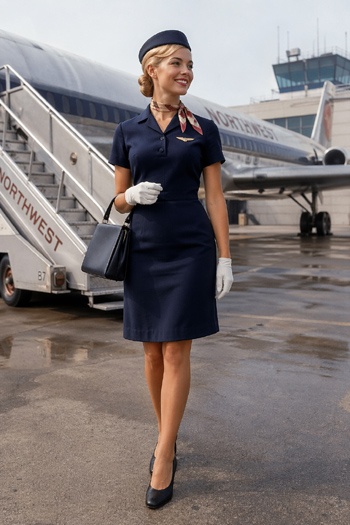
The details that convert a navy dress into a convincing DIY Stewardess Costume are few, specific, and collectively transformative. None of them are expensive. All of them are findable. Together they do the work that no amount of fabric quality or precise tailoring can do alone, which is to locate the costume in a specific time, a specific world, and a specific set of cultural associations that the wearer carries with them throughout the evening.
The silk scarf tied at the collar is the single most important detail in the entire costume and it deserves real attention. Airline uniform scarves of the golden age were typically oblong, in a color that complemented or contrasted with the uniform, tied in a specific neat knot at the base of the throat with the tail tucked into the collar or allowed to fall in a precise line down the front of the dress. A square scarf folded diagonally and tied as an ascot achieves the same effect. Thrift stores are extraordinary sources for silk and silk adjacent scarves in every color and pattern imaginable, and a cream, white, or gold scarf against navy reads as aviation uniform immediately. The knot should be neat and deliberate, tied once in front of a mirror and not adjusted again for the rest of the evening.
The wings are the detail that closes the identification completely. Airline service wings, the small silver or gold pin worn above the left breast, are available through costume suppliers, vintage shops, and online marketplaces at minimal cost and they communicate the costume's identity faster than any other single element. Pin them straight parallel to the collarbone, exactly where a real uniform would position them.
A small navy or black structured handbag or flight bag carried over one shoulder adds both period accuracy and practical function. The golden age stewardess carried herself with a specific organized efficiency and a structured bag contributes to that quality in a way that a casual shoulder bag does not.
💄 Step 3: Makeup & Hair
The makeup for a DIY Stewardess Costume draws from the same mid century professional glamour tradition that shaped every other element of the golden age airline aesthetic. Airlines had specific grooming standards for their cabin crew that were enforced with remarkable precision, covering foundation shade, lip color, eye makeup, and even the specific finish of the nail polish worn on duty. The overall effect was polished, warm, and approachable, the face of someone trained to put people at ease in an environment that made a significant portion of the population genuinely nervous.
Start with a smooth even base in a neutral warm tone, medium coverage rather than heavy, the kind of foundation that looks like very good skin rather than makeup. A warm peachy pink blush applied to the apples of the cheeks and blended upward toward the temple gives the face the healthy glow of someone who spends a lot of time in recycled cabin air and has learned to compensate for it. Lip color should be a classic red or warm coral, semi matte finish, applied cleanly with a lip liner underneath to maintain the precise edge that the grooming standards of the era demanded. Eye makeup should emphasize the lashes with a coat of black mascara and a thin line of black or brown liner along the upper lid, nothing dramatic, nothing that would look out of place in a corporate environment. The goal is the specific quality of someone who looks put together at six in the morning after a transatlantic flight, which requires more technique than it appears to.
The hair is where this costume finds one of its most recognizable signatures and the classic stewardess bun is both period accurate and achievable by almost anyone regardless of hair length or texture. Airlines of the golden age required cabin crew to wear their hair up and off the collar, and the low chignon or French twist became the default style across virtually every carrier because it stayed neat through a ten hour flight, looked professional from every angle, and could be maintained in an aircraft lavatory with minimal equipment.
To achieve the classic stewardess bun, start with clean hair that has been lightly misted with a flexible hold spray while still slightly damp and allowed to dry completely. Brush everything smooth and gather it into a low ponytail at the nape of the neck, positioned at the center rather than to either side. Twist the ponytail clockwise until it begins to coil naturally against the head, then wind that coil into a flat round bun sitting directly against the nape and secure it with bobby pins pushed inward toward the center of the bun rather than across it, which holds the shape more securely through an active evening. A light mist of finishing spray over the completed style and a careful smoothing of any flyaways with a fine tooth comb gives the bun the lacquered, intentional quality that distinguished a professionally styled airline chignon from a hastily assembled one.
The French twist is an equally valid alternative and slightly more forgiving for hair that resists the smooth round bun shape. Gather all hair to one side at the back of the head, twist it upward toward the crown, fold the twisted length back on itself against the head, and secure with bobby pins along the fold. Tuck the ends under at the top and pin. The result should be a smooth vertical roll sitting at the center back of the head, elegant and structured and immediately readable as the golden age professional silhouette.
A simple center or side part at the front, hair smoothed cleanly back from the face with no volume at the crown, completes the look. The face should be fully visible and unframed by loose hair, which was both a grooming requirement and a practical necessity for people working in close quarters with passengers for hours at a time.
🎀 Step 4: Accessories
The accessories for the DIY Stewardess Costume are straightforward and each one earns its place in the overall picture. The wings and scarf are covered in the details section and remain the primary identifying elements of the costume, but several additional pieces contribute to the period accuracy and the specific quality of composed professional elegance that the archetype demands.
Court shoes in navy or black with a low to medium block heel are the correct footwear and they matter more than people expect. The golden age stewardess worked on her feet for hours in a moving aircraft and the footwear reflected that practical reality, a heel high enough to maintain the professional silhouette but low and stable enough to walk a galley aisle with a beverage cart at altitude. Thrift stores carry court shoes in reliable abundance. Look for a closed toe, a plain upper with no decorative detail, and a heel between one and two and a half inches. Polish them before you wear them.
Nude or sheer hosiery is period accurate and completes the leg line between the hem of the dress and the top of the shoe in the way that bare legs do not, which matters in photographs even if it seems like a minor detail in person. A word on the cap, because some carriers made it as central to the uniform identity as the wings themselves.
Pan Am's navy service cap with its gold braid and emblem was so recognizable it became shorthand for the entire golden age airline aesthetic, and Southwest Airlines in its early years built a uniform look that leaned heavily on the cap as a unifying visual element across the whole ensemble. Whether the requirement came from food service regulations, brand standardization, or simply the era's preference for a completely controlled appearance from crown to heel depends on the carrier and the decade, but the effect was the same.
A simple navy or black service cap worn straight and level on the head, positioned just above the hairline, adds an authority to the overall silhouette that reads as senior crew immediately. Costume suppliers carry them reliably and vintage shops turn up original examples with some regularity. If you choose to include it, wear it with commitment. A cap worn tentatively looks like an afterthought. Worn correctly it completes the picture entirely.
A small service tray carried in one hand, with a single glass of something amber and elegant sitting on it, is the prop that adds both humor and historical accuracy to the costume simultaneously. It is a direct reference to the bourbon and soda that DB Cooper ordered and paid for on Flight 305, to the cocktail culture that Mad Men documented so precisely, and to the specific professional ritual of the cabin service that defined the golden age passenger experience. It also gives your hands something to do, which is useful for both photographs and conversations throughout the evening.
A slim structured clutch or small envelope bag in navy or black completes the accessory picture without overloading it. The golden age stewardess traveled light and carried herself with an organized efficiency that extended to every element of her appearance. Restraint is correct here as everywhere else in this costume.
🕺 Step 5: Movement and Presence
The physical vocabulary of the golden age stewardess is one of the most specific and most imitable in the entire costume catalog and it is worth understanding before you walk into a room wearing this costume. She moved with a particular quality of composed professional warmth that was partly trained and partly the result of spending years navigating difficult situations in confined spaces with hundreds of strangers at a time. She was unhurried without being slow. She was warm without being familiar. She was in complete command of her environment without ever making the people around her feel managed.
Stand with your weight evenly distributed, shoulders back and relaxed, chin level. The posture of the golden age cabin crew was deliberately upright, a grooming standard requirement that also communicated authority and competence in a way that a more casual bearing did not. When you move, move with purpose and economy, the way someone moves in a space they know completely and have navigated a thousand times before.
The service gesture is worth practicing. The slight forward incline from the waist when offering something to a seated person, the tray held level with both hands, and a professional smile that reaches the eyes without becoming familiar. It is a specific physical vocabulary that reads instantly as the archetype and it is available to you throughout the evening as both a conversational gambit and a photographic pose.
If you are wearing this costume alongside a DIY DB Cooper Costume, the physical dynamic between the two is the entire story of Flight 305 told in body language. She is composed and professional under conditions that would unravel most people. He is calm in a way that is slightly wrong. The tension between those two registers, her trained warmth and his strange ease, is immediately readable and endlessly interesting to anyone who knows the reference.
📸 Step 6: Capture the Moment
The visual reference points for photographing the DIY Stewardess Costume span six decades of commercial aviation imagery and all of them share certain qualities that are directly achievable with a phone camera and some attention to environment. Golden age airline photography was bright, clean, and deliberately aspirational, the kind of images that made people want to fly somewhere they had never been and look exactly that put together while doing it.
Natural light from a large window is the ideal source for the primary costume photograph. Position yourself facing the light with your profile to the camera, the tray held level in both hands and the wings visible on the chest. The combination of the upright posture, the navy dress, the scarf, and the service gesture reads as the archetype immediately and the window light gives the image the bright clean quality of golden age airline promotional photography.
An airport is the obvious location shoot and most commercial airports have areas accessible without a boarding pass where the combination of the environment and the costume produces immediately cinematic results. The departure board, the gate seating, the long corridor of a terminal, all of these provide compositional context that the costume alone cannot supply and that connects the image directly to the world the costume is drawing from.
For the couples photograph with DB Cooper, the aircraft interior approximation discussed in the DB Cooper article applies here as well. Two seats, overhead lighting, the tray extended toward a seated figure in a dark suit and sunglasses with a briefcase beside him. That image is a complete story in a single frame and it is the photograph that both costumes were built to take together.
Edit with a slight increase in brightness and a modest boost in saturation. Golden age airline photography was deliberately vivid and warm, the colors of a world that wanted you to believe travel was glamorous and mostly succeeded. A touch of warmth in the edit reflects that quality without pushing into vintage filter territory.
🏆 Why Go DIY?
The DIY Stewardess Costume endures because the archetype it draws from has never stopped being fascinating. The golden age stewardess was a genuine cultural phenomenon, a figure who embodied a specific intersection of freedom, professionalism, glamour, and independence at a moment when those things were newly and not yet universally available to women in American life. She traveled the world and got paid for it at a time when that was an extraordinary thing. She navigated Frank Abagnale and DB Cooper and a thousand ordinary passengers with equal measures of warmth and steel and she looked extraordinary doing all of it. That is a compelling thing to walk into a room carrying.
Building this costume yourself, finding the dress and sourcing the scarf and pinning the wings and learning the bun, means that every element of it reflects a decision you made rather than a compromise you accepted. The cheap costume alternatives available elsewhere are compromises from the first moment you put them on, in the fabric and the fit and the way they communicate costume rather than character. This version communicates character because it was built with understanding rather than assembled from a bag.
The couples dynamic with DB Cooper adds a layer of historical specificity that elevates both costumes simultaneously. Together they tell a complete story, one of the stranger and more compelling afternoons in American aviation history, and they do it through clothing and presence and a bourbon and soda on a tray. That is efficient storytelling by any standard.
The golden age of commercial aviation is gone and what replaced it is fluorescent lighting and middle seats and the particular indignity of the security line. But the archetype survives because it represented something real about a specific moment when the world felt genuinely large and genuinely navigable and the person handing you your drink at thirty thousand feet had been everywhere you wanted to go and was leaving again tomorrow. Wear the wings. Tie the scarf. Carry the tray. Let people remember what flying used to feel like.
🕸️ Related Costumes to Try
DIY Alex Owens Flashdance Costume
DIY Jane Eyre Costume
DIY Hitchcock Blonde Look
DIY Black Dahlia Costume
Uniform Shift Dress
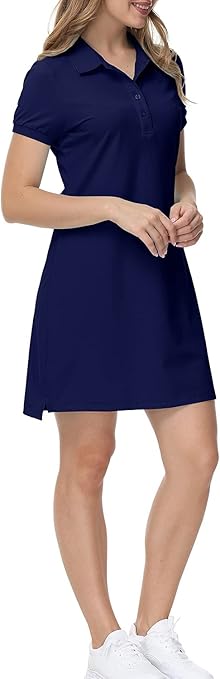
Product Description:
This uniform shift dress provides the clean, structured foundation needed to bring a DIY Stewardess Costume to life with the right balance of polish and practicality. Designed for all-day wear, it reflects the crisp, tailored look associated with classic airline uniforms.
About this item:
• 55% Cotton + 40% Nylon + 5% Elastane.
• The polo dress for women with medium length, solid color.
• US size from XS-2XL. Hand wash or machine wash in cold water, do not bleach, hang to dry.
• Designed for comfort, movement, and a clean silhouette that works especially well for a DIY Stewardess Costume.
Why This Works:
The structured shape, breathable fabric, and classic polo collar make this dress a strong match for a DIY Stewardess Costume, giving you the right base to build the full look with scarf, wings, and accessories while maintaining a natural, uniform appearance.
Further Reading & Resources
📖 Read: Pan Am flight attendant training videos are so very fun
🔍 More: How to Become a Flight Attendant After 50 - AARP