🐣 Easter Albums: A Survey of Seasonal Recordings

Easter albums provide seasonal listening for families and individuals observing the Easter season at home.
Easter albums represent a specialized category within religious music, distinct from the broader holiday music market. Unlike Christmas recordings, which flood retail channels annually, Easter records serve a more focused audience. These recordings document how musicians across genres have approached themes of resurrection, redemption, and spiritual renewal through full-length albums specifically designed for Easter season listening.
Easter albums are full-length recordings produced specifically for listening during the Easter season, featuring hymns, sacred compositions, and original material centered on resurrection themes. These recordings emerged as a distinct format during the LP era, serving churches, families, and individual listeners observing Lent and Easter. Unlike Christmas albums, which achieved broad commercial reach, Easter albums developed primarily within religious music markets through gospel labels, contemporary Christian publishers, and classical music catalogues. The format spans traditional hymnody, orchestral liturgical works, contemporary worship, and gospel quartet performances. Easter albums remain a specialized but enduring category documenting how multiple generations have expressed seasonal faith through recorded music.
Easter albums occupy a smaller market than Christmas recordings but maintain consistent demand within religious communities where seasonal observance includes musical tradition. The format spans classical Bach passions recorded by period instrument ensembles, southern gospel quartet performances, contemporary worship releases, and country gospel collections, each serving distinct denominational practices and listening preferences while sharing common resurrection themes.
The Development of Easter Recordings
Easter recordings emerged as a distinct category during the LP era when the album format made thematic collections practical. The market for Easter recordings has always been smaller than Christmas releases, but certain artists and labels built substantial catalogs in this area. Religious music labels like Word Records, Sparrow, and Spring Hill maintained steady output throughout the latter half of the twentieth century, while major labels occasionally issued Easter-themed collections from established artists.
The format allowed artists to present complete musical statements around Easter themes rather than isolated singles. Gospel quartets, church choirs, and solo vocalists used the album format to explore resurrection narratives, passion hymns, and seasonal liturgical music across ten to twelve tracks. These early Easter LP's typically drew from established hymnody, presenting familiar material in period-appropriate arrangements.
Discover more Easter Movie And Records Reviews Here
Contemporary Christian Easter Albums
Andrew Peterson created one of the most ambitious Easter album projects with his Resurrection Letters series. He released Resurrection Letters, Vol. II in 2008, followed a decade later by Resurrection Letters: Vol. I in 2018 and Resurrection Letters: Prologue the same year. The three-disc anthology presents a complete musical meditation on Christ's death, burial, and resurrection. Peterson structured the project so Vol. II addresses implications of resurrection in contemporary life, Vol. I explores the resurrection event itself with songs like "Is He Worthy" and "His Heart Beats," and Prologue focuses on the crucifixion. The anthology boxed set combines all three volumes into a unified Easter narrative spanning approximately ten years of compositional work.
Michael W. Smith, Amy Grant, and other contemporary Christian artists released Easter recordings throughout the 1980s and 1990s. These recordings blended original compositions with updated hymn arrangements, reflecting worship music trends of their respective periods. Smith's approach tended toward piano-driven arrangements, while Grant incorporated pop production elements into traditional material.
The Bill Gaither Vocal Band and related Gaither projects produced multiple Easter-themed recordings. The Wondrous Cross: A Celebration of Easter Hymns specifically addresses Easter content through traditional hymn arrangements. The Gaither Homecoming video series included Easter concerts that were later released as audio recordings, featuring multiple generations of gospel artists performing resurrection-themed material. These collaborative recordings documented live performances and preserved southern gospel traditions for home listening.
Gospel and Traditional Albums
George Beverly Shea recorded extensively for RCA Victor and later Word Records during a career spanning six decades. His baritone voice became synonymous with evangelical music through his work with Billy Graham crusades. Shea's recordings include Inspirational Songs (1951), How Great Thou Art, and The Love of God. While not exclusively Easter albums, these collections featured hymns central to Easter worship including "The Old Rugged Cross" and "Christ Arose." His 1965 album Southland Favorites won a Grammy Award and demonstrated the commercial viability of traditional gospel Easter albums.
Country artists contributed significantly to Easter albums through gospel recordings. Alan Jackson released Precious Memories in 2006, a platinum-certified collection featuring "In The Garden," a hymn directly reflecting on Easter morning. Jackson's follow-up gospel recordings maintained similar traditional approaches. Carrie Underwood included "Nothing But The Blood Of Jesus" and other resurrection-themed material on her gospel recordings. Reba McEntire released Sing It Now: Songs Of Faith & Hope in 2017 and My Chains Are Gone in 2022, both containing traditional hymns and newly-penned Easter songs.
The Statler Brothers recorded gospel content throughout their career, with albums like The Holy Bible – New Testament (1975) and Radio Gospel Favorites (1986) featuring "There Is Power In The Blood" and other hymns appropriate for Easter listening. Loretta Lynn released Hymns in 1966, which included "How Great Thou Art." These country gospel recordings bridged denominational traditions and reached audiences beyond traditional religious music markets.
George Beverly Shea's 1965 album Southland Favorites won a Grammy Award, proving that traditional gospel Easter albums could achieve mainstream recognition during an era dominated by rock and pop music.
Classical Albums
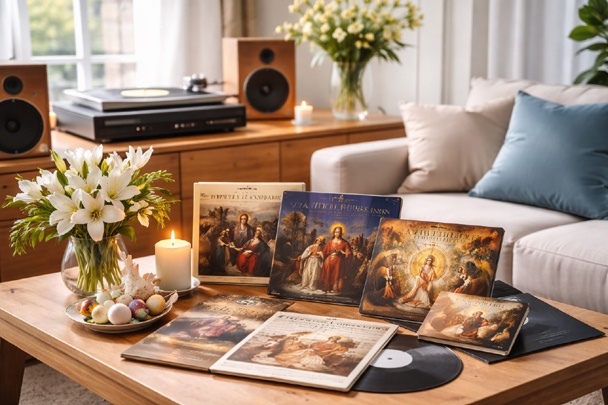
Classical Easter recordings arranged for quiet listening in a contemporary home environment
Classical Easter albums center on liturgical works and oratorios from the baroque and romantic periods. Johann Sebastian Bach's Easter Oratorio, BWV 249 remains central to this repertoire. Originally performed in 1725 as an Easter cantata titled Kommt, gehet und eilet, Bach revised it circa 1738 under the oratorio designation. Multiple recordings exist, including versions from the Retrospect Ensemble conducted by Matthew Halls with soloists Carolyn Sampson, Iestyn Davies, James Gilchrist, and Peter Harvey. These recordings typically pair the Easter Oratorio with Bach's Ascension Oratorioto to create complete seasonal recordings.
Bach's passion settings also constitute essential recordings in classical repertoire. St. John Passion, BWV 245 (1724) and St. Matthew Passion, BWV 244 (c. 1727) receive regular recording and have been released by conductors including John Eliot Gardiner, Ton Koopman, Masaaki Suzuki with Bach Collegium Japan, and John Butt with the Dunedin Consort. These works typically run two to three hours and document the events from Jesus' arrest through crucifixion. Recorded performances serve both as reference recordings for musicians and as devotional listening for Easter observance.
George Frideric Handel's Messiah, HWV 56 represents perhaps the most frequently recorded work associated with Easter, though it spans Advent through resurrection. The 1988 recording by Trevor Pinnock conducting the English Concert with soloists Arleen Augér, Anne Sofie von Otter, Michael Chance, Howard Crook, and John Tomlinson exemplifies period instrument approaches. Handel's La Resurrezione, HWV 47 (1708) addresses resurrection themes more directly and has received multiple modern recordings. These classical Easter albums serve audiences seeking historically-informed performances and high production values.
Choral and Liturgical Easter Albums
Cathedral choirs and professional ensembles have produced Easter albums focusing on Anglican and Catholic liturgical traditions. The Gloriæ Dei Cantores recorded Gregorian Chants for Easter, which presents traditional plainchant for the Easter season. Paraclete Press released multiple seasonal recordings featuring both the Monks of Solesmes and American choirs performing Gregorian repertoire appropriate to Holy Week and Easter.
These liturgical Easter albums include Introits, Graduals, Alleluias, Sequences, Offertories, and Communions specific to Easter Mass and the octave of Easter. Collections like Music for Lent and Easter compile plainchant alongside polyphonic settings by Giovanni Pierluigi da Palestrina and Leo Sowerby. The Kammerchor Stuttgart under Frieder Bernius and the Clare College Choir, Cambridge under Graham Ross have released recordings featuring both baroque and contemporary sacred works.
These recordings serve practical liturgical functions while also reaching listeners seeking contemplative Easter music. The repertoire differs substantially from contemporary worship albums, drawing from centuries of Western liturgical tradition rather than modern composition.
Bach's Easter Oratorio BWV 249 began as a secular birthday cantata before being transformed into sacred Easter music, demonstrating how composers adapted existing musical material for liturgical purposes.
Instrumental and Specialized Albums
Instrumental Easter albums provide background music without vocal performance. Piano collections featuring hymn arrangements, orchestral recordings of Easter classics, and solo guitar albums have all found niche markets. These recordings typically include recognizable Easter hymn melodies presented in instrumental arrangements suitable for private devotion or as accompaniment to other Easter activities.
Hymn accompaniment collections serve church musicians preparing for Easter services. Companies like Church Hymnal Publishers released multi-disc sets containing organ accompaniments for Easter hymns from various hymnals. These practical Easter albums support congregational singing rather than serving as listening experiences.
Children's Easter records represent another specialized category. These recordings simplify resurrection narratives and present them through age-appropriate songs and stories. Sunday school publishers and Christian education labels produced these recordings for home and classroom use, often coordinating with curriculum materials.
Production and Market Characteristics
Easter albums follow distinct release patterns. Labels typically position them for February through early April availability, coordinating with Lent and the moveable Easter date. Because Easter shifts annually according to lunar calculations, timing requires strategic planning. Peak sales occur in the weeks immediately before Easter Sunday.
Distribution historically centered on Christian bookstores, church supply retailers, and specialty mail-order catalogs. Mass-market retailers stocked fewer of these records than Christmas titles, reflecting the more limited audience. Contemporary Christian music retailers maintained deeper Easter catalog selections than general music stores.
Digital distribution altered access considerably. Streaming platforms and download services made back catalog Easter albums available year-round. Listeners could locate specific recordings without depending on physical retail timing. Niche recordings that disappeared from store shelves remained accessible digitally, expanding available repertoire.
Musical and Thematic Elements
Easter albums share common musical characteristics. Texts address sacrifice, redemption, resurrection, and renewal. Many recordings follow narrative arcs from somber reflection through triumphant celebration, mirroring Good Friday to Easter Sunday progression. Arrangements often begin with sparse instrumentation and restrained dynamics before building to fuller, more jubilant conclusions.
Traditional albums draw heavily from established hymnody: "Christ the Lord Is Risen Today," "Up from the Grave He Arose," "He Lives," "The Old Rugged Cross," "Were You There," "O Sacred Head Now Wounded," and "Crown Him with Many Crowns." Contemporary recordings incorporate these standards alongside newly-composed material maintaining thematic consistency.
Musical styles range from a cappella gospel quartets through full orchestral productions. Southern gospel Easter albums emphasize vocal group harmony. Contemporary worship Easter albums feature modern instrumentation and production techniques. Classical Easter albums maintain period-specific performance practices. This stylistic diversity allows Easter albums to serve multiple denominational traditions and personal preferences.
Contemporary Production
Current Easter album production continues primarily within Christian music industry circles. Major labels release fewer Easter-specific projects than previous decades, but independent artists and ministry-focused labels maintain output. Worship leaders and contemporary Christian artists occasionally release Easter EPs or full albums timed to the season.
Streaming changed listening patterns significantly. Rather than purchasing complete albums, many listeners build custom playlists mixing tracks from multiple sources. This fragmentation challenges the album format but increases access to individual recordings. Artists and labels adapted by releasing singles and shorter collections alongside traditional album-length projects.
The Gaither Homecoming series continues producing Easter concert recordings and video releases. Artists like Hillsong Worship, Chris Tomlin, Matt Redman, and Shane & Shane release Easter-themed projects or include Easter material in broader worship albums. These contemporary Easter albums reflect current worship music trends while maintaining connections to traditional Easter hymnody.
Andrew Peterson's Resurrection Letters trilogy was released out of chronological order, with Vol. II appearing in 2008 while Vol. I and Prologue both emerged in 2018, creating a decade-long meditation on Easter themes across three distinct albums.
Audience and Function
Easter albums serve active religious practitioners more than casual observers. Churches purchase them for seasonal programs and services. Individuals buy them for personal listening during Lent and Easter. Choir directors and worship leaders reference them when planning seasonal music. This audience typically demonstrates greater theological engagement than the broader Christmas album market.
Demographic patterns show Easter albums appealing primarily to older listeners and those active in traditional church settings. Younger audiences engage less consistently with the album format, though contemporary worship recordings with Easter themes reach some younger demographics through different marketing approaches. Gospel and country gospel recordings maintain consistent audiences within those genres.
Easter albums function devotionally for many purchasers. The recordings support private reflection, family worship, and seasonal observance. Unlike Christmas albums, which often serve as background music for secular holiday activities, Easter albums typically connect more directly to religious practice and belief.
Format Evolution
Easter albums transitioned through multiple physical formats. Vinyl dominated early releases, followed by cassettes in the 1980s, then compact discs through the 1990s and 2000s. Each format shift required catalog re-releases and affected distribution strategies. Digital formats now dominate new releases, though physical copies continue selling to collectors and those preferring tangible media.
CD releases remain available for classical recordings and traditional gospel recordings. Vinyl has seen modest revival among collectors, with some labels re-releasing classic titles on LP. However, digital formats streaming and downloads represent the primary access point for most contemporary listeners.
Conclusion
Easter albums occupy a distinct but enduring position within religious music. These recordings document how multiple generations and musical traditions have approached Easter themes through full-length album statements. The catalog spans classical masterworks, traditional gospel quartets, contemporary worship, and country gospel. While never achieving the commercial prominence of Christmas albums, Easter recordings maintain their place serving communities observing the season. Production continues across genres, reflecting ongoing demand for music addressing resurrection, redemption, and renewal themes central to Easter observance.
🗣️ Why It Still Matters
Easter albums document how religious music adapted to recording technology and consumer markets across eight decades. The format preserved traditional hymnody while accommodating contemporary worship trends, creating an archive of seasonal observance practices. Classical recordings of Bach passions and Handel oratorios remain reference standards for musicians and scholars. Gospel and contemporary Christian Easter albums continue serving churches and individual listeners despite declining physical media sales. Digital platforms extended access to back catalog recordings that disappeared from retail, ensuring specialized repertoire remains available. The category demonstrates how niche markets sustain formats serving cultural and religious functions beyond commercial popularity.

ML Lamp is the owner of Kilroy Was Here. After his 20 years of working in Las Vegas in the entertainment promotions field, Mr. Lamp retired in 2002 from his job to pursue his passion for collectibles. Now as a guest speaker and author he’s living the dream, and sharing his warmth with You.