From Beyond the Grave Review: A Sinister Antique Shop Nightmare
My Rating: ⭐ ⭐ ⭐ ⭐ ⭐ 4.6/5
Every collector knows the thrill of walking into a dusty old shop and spotting something special. This From Beyond the Grave review is about a shop where that thrill turns deadly. Amicus Productions released this wicked anthology in 1974, and it may be the most collector friendly horror film ever made. The rules are simple. Pay a fair price, and you might be fine. Cheat the kindly old man behind the counter, and you will pay in ways you never imagined.
From Beyond the Grave Review
From Beyond the Grave opened in Britain on February 22, 1974. American audiences had to wait longer. The film did not open in Los Angeles until March 1976, two years after its British debut.
It was the seventh and final horror anthology from Amicus, the British studio run by producers Milton Subotsky and Max Rosenberg. The film was distributed by Warner Bros. During production it carried the working title Tales from Beyond the Grave, and it later turned up in some markets as The Creatures from Beyond the Grave.
The director was Kevin Connor, a veteran film editor making his first feature. He would go on to direct The Land That Time Forgot, At the Earth’s Core, and the cult favorite Motel Hell. His confident work here shows why Amicus trusted him with bigger projects.
At the center of it all is Temptations Ltd., a small London antique shop. Its proprietor is a gentle, pipe smoking old man played by Peter Cushing. He seems harmless. He is polite, patient, and always happy to make a deal. That is exactly what makes him so frightening.
This From Beyond the Grave review will keep the endings secret. The fun of an anthology is watching each sting in the tail land, and this film has some beauties.
Welcome to Temptations Ltd.
The shop sign promises offers you cannot resist. Inside, the place is crammed with treasures. Strange masks hang from the walls. Puppets, clocks, and old furniture crowd every corner. Dust floats in the light from the front window.
Sharp eyed horror fans will spot something fun. Many of the props in the shop came from earlier Amicus productions. The studio was famous for stretching a budget, and the antique shop became a kind of attic for its past films.
The shop works as a perfect framing device. Customers come in one at a time, browse, and leave with something. The camera then follows them home to see what they bought. Each visit becomes a new story.
Between stories, we return to the shop and its patient owner. He tends his stock, puffs his pipe, and waits for the next customer. A small bell rings each time the door opens. By the second story, that little bell starts to sound like a warning.
The framing story also has a final twist of its own, involving a visitor with very bad intentions. It ties the whole film together nicely and gives Cushing one last chance to shine.
Every Antique Comes With a Price
The structure is beautifully simple. Four customers enter Temptations Ltd. Most of them try to cheat the proprietor in some way. One lies about the value of an item. Another steals. Another swaps price tags. The old man never complains, but he always seems to know.
The stories come from R. Chetwynd-Hayes, a British author who wrote more than 200 short stories over three decades. Raymond Christodoulou and Robin Clarke adapted four of them for the screen. Chetwynd-Hayes had a gift for ghost stories with a dark sense of humor, and that tone runs through the whole film.
The first tale, The Gatecrasher, stars David Warner as a man who buys an ornate antique mirror. He talks the price down by insisting it is only a reproduction. Soon after he hangs it at home, something inside the glass begins asking for blood.
The second, An Act of Kindness, follows Ian Bannen as a downtrodden office worker stuck in an unhappy marriage. He wants respect, and he thinks a military medal might help him earn it. That decision leads him to a strange old matchseller and his even stranger daughter.
The third, The Elemental, stars Ian Carmichael as a man who cheats the shop out of a fine snuff box. On the train home, an eccentric clairvoyant tells him he has picked up an invisible passenger. The fourth, The Door, features Ian Ogilvy as a young man who buys an ornate antique door for his home.
Each story is a small morality play. The punishment always fits the crime, though it is usually far worse than anyone deserves. That cruel sense of justice is the heart of the Amicus style.
Peter Cushing’s Quietly Sinister Shopkeeper
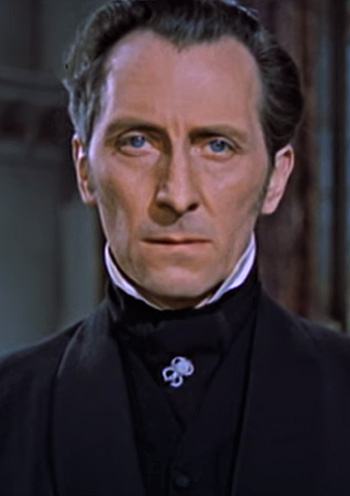
Peter Cushing was the face of British horror for two decades. By 1974 he had played Baron Frankenstein, Van Helsing, and Sherlock Holmes. This was his tenth appearance in an Amicus production, and he was a favorite of the studio.
Here he does very little, and he does it brilliantly. The proprietor has no name. He never raises his voice or makes a threat. He simply smiles, quotes a price, and accepts whatever the customer offers.
Cushing gives him a gentle, shuffling manner and a soft, friendly voice. He seems like a lonely old shopkeeper grateful for a little business. Yet his eyes tell another story. When a customer lies to him, you catch a tiny flicker of knowing amusement.
The power of the role lies in what he does not do. He never punishes anyone directly. He simply lets the antiques do their work. That restraint makes him far more unsettling than a cackling villain could ever be.
Cushing appears only briefly in each section, yet he dominates the film. His screen time adds up to a modest total, but every scene with him is memorable. It is a masterclass in doing more with less.
A Mirror, Medal, Snuff Box and Door
The best idea in the film is how ordinary its cursed objects are. None of them look evil. You could find any of them at an estate sale on a Saturday morning.
The mirror is the most classic. Haunted mirrors are a horror tradition, and this segment owes a clear debt to the famous haunted mirror story in Dead of Night from 1945. That British anthology inspired Amicus to start making portmanteau films in the first place.
The medal is a Distinguished Service Order, a real British military decoration for gallantry. It should be an honor. In the hands of a man who never earned it, it becomes a doorway to something much darker. Donald Pleasence and his real daughter, Angela Pleasence, play the odd father and daughter who enter his life. Diana Dors plays his sharp tongued wife.
The snuff box is the most playful. It brings along an invisible elemental spirit, and the cure arrives in the form of Madame Orloff. She is played with glorious, scene stealing eccentricity by Margaret Leighton, a Tony winning stage star and Oscar nominee. Her exorcism scene is a riot.
The door is the most atmospheric. It is a heavy, carved antique that seems to open somewhere other than where it should. Lesley-Anne Down co stars as Ogilvy’s young wife. This final story has the strongest gothic flavor of the four.
Together, these four objects make the case for the whole film. Horror does not need a castle or a monster. It just needs something old that someone wanted a little too badly.
Horror Made for Collectors
Anyone who has spent time in antique shops, flea markets, or estate sales will feel right at home here. That is part of what makes this film so special for collectors.
We all know the questions that come with old objects. Who owned this before me? Where has it been? Why was it sold? Most of the time the answers are simple. A family moved, a collection was split up, or someone needed the money.
From Beyond the Grave plays on the possibility. What if an object carries something along with it? What if a mirror remembers, or a door opens onto a place it should not? The movie turns a common collector’s daydream into a nightmare.
It also plays on a collector’s guilt. Every dealer has met the customer who swaps a price tag, lowballs an honest seller, or pockets something small. Every collector has felt the temptation to drive a hard bargain. The film asks what happens when the seller knows more than you do.
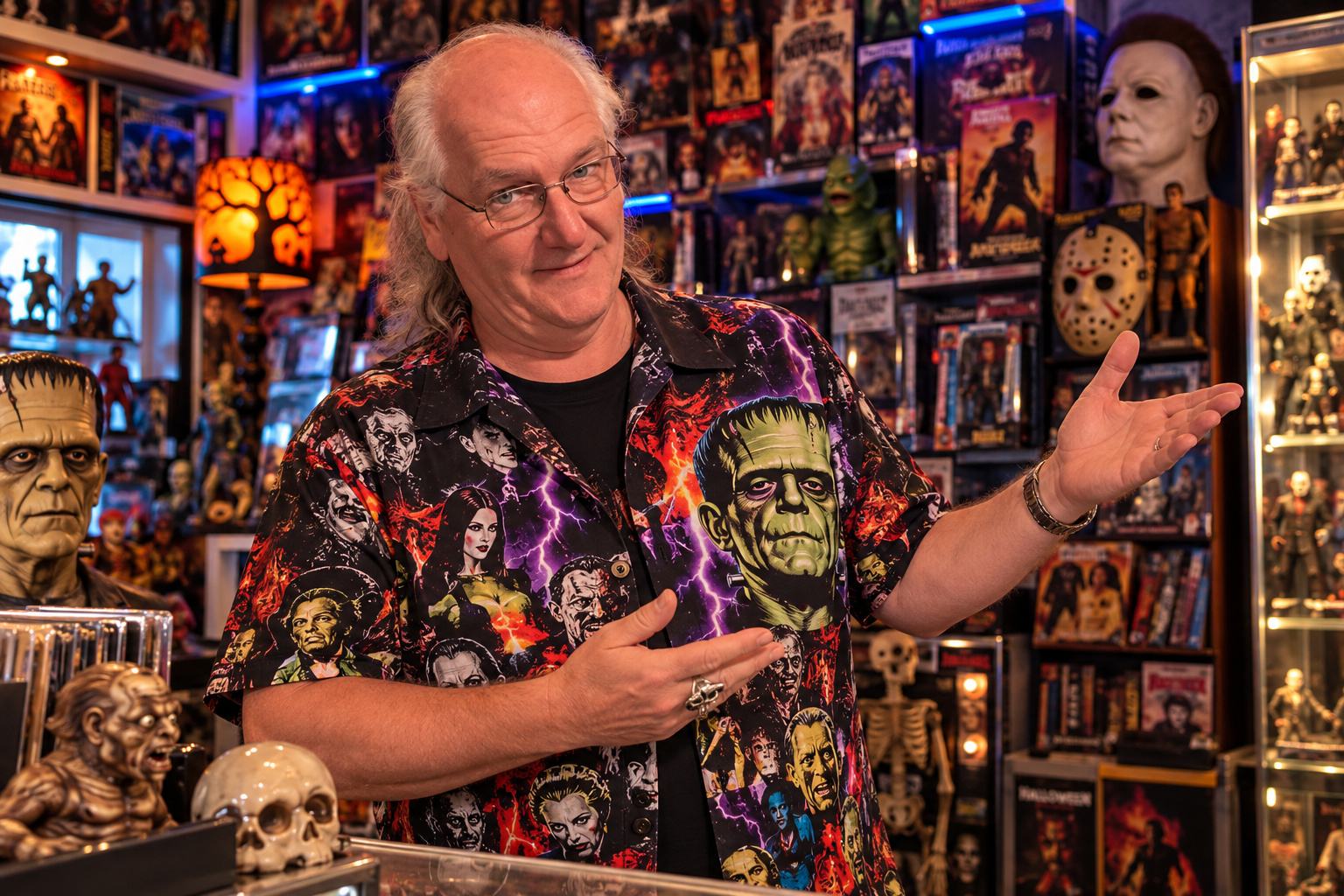
As a shop owner, I find the moral of this film very satisfying. Treat the dealer fairly, pay what the piece is worth, and you will probably go home happy. Cheat the old man behind the counter, and you may be taking home far more than you bargained for.
The Amicus Anthology Formula at Full Strength
Amicus built its reputation on anthology horror. Starting with Dr. Terror’s House of Horrors in 1965, the studio turned out a string of portmanteau films. Torture Garden, The House That Dripped Blood, Tales from the Crypt, Asylum, and The Vault of Horror all followed before this one.
By 1974, the formula was polished to a shine. Each film used short stories by a respected horror writer. Each drew big name actors for a few days of shooting apiece. Each closed its tales with a supernatural payoff that felt like poetic justice.
From Beyond the Grave follows that recipe exactly. The cast is packed with familiar faces, including David Warner, Donald Pleasence, Ian Bannen, Diana Dors, Margaret Leighton, Ian Carmichael, Nyree Dawn Porter, Ian Ogilvy, and Lesley-Anne Down. Few films of its size could afford a lineup like that.
Kevin Connor directs with energy and color. His years as an editor show in the tight pacing. Cinematographer Alan Hume gives each story its own look, from the cramped London flats of the medal tale to the shadowy gothic room behind the door.
The film also has a little more bite than some earlier entries. The mirror segment in particular gets surprisingly bloody for an Amicus picture. Even so, it still carried a PG rating in the United States.
Critics have long debated where this film ranks among the Amicus anthologies. Some call it a solid, unspectacular finale. Many fans call it one of the very best. Either way, it was a fitting way for the studio to close the book on its signature format.
Why Watch From Beyond the Grave Today?
The simplest reason is that it is great fun. Four short stories, a charming villain, and a terrific cast make for an easy, entertaining evening. Nothing outstays its welcome, and each tale has a different flavor.
The film also captures a universal temptation. Everyone has wandered into an old shop and found something strange. Everyone has wondered about a bargain that seemed too good to be true. That shared experience gives the movie a lasting hook.
The British setting adds charm. Instead of creaky castles, you get 1970s London flats, suburban homes, crowded trains, and corner pubs. The ordinary backdrop makes the supernatural payoffs land harder.
Then there is the acting. Margaret Leighton steals every scene she is in. Donald Pleasence and his daughter are deeply creepy together. David Warner is intense and unnerving. Cushing ties it all together with quiet authority.
Any honest From Beyond the Grave review should admit that not every segment is equally strong. Still, even the weaker stories have something to enjoy. For an October movie night, it is hard to beat.
One last bit of trivia adds to the fun. Chetwynd-Hayes later wrote a book called The Monster Club, featuring a filmmaker named Vinke Rocnnor. That name is an anagram of Kevin Connor, a playful tip of the hat to the director of this film.
From Beyond the Grave on Blu-ray
For years, collectors made do with DVD. Warner Bros. included the film in its Twisted Terror Collection, a budget friendly set of horror titles. It looked fine for the time, but it never did justice to the film’s rich colors.
That changed on October 8, 2019. Warner Archive released From Beyond the Grave on Blu-ray with a fresh remaster. It was the last of the Amicus anthologies to reach Blu-ray, and fans had been waiting a long time.
The picture is a big step up. It is presented in its original 1.85:1 widescreen ratio, with crisp detail and strong color. The original mono soundtrack comes in a DTS-HD Master Audio 2.0 track that sounds clean and clear.
The one weakness is the lack of extras. There are no commentaries or featurettes like those found on some other Amicus discs. Collectors who want background on the production will need to look elsewhere.
The good news is that the Warner Archive disc is region free. It will play on most players around the world. That makes it a smart pick for collectors anywhere.
For a complete Amicus shelf, this disc belongs right beside Tales from the Crypt, Asylum, and The House That Dripped Blood. Watch for it at shops and shows, especially as Halloween approaches and demand rises.
Final Thoughts 4.6/5
This one earns a 4.6 out of 5 from Kilroy. Closing out this From Beyond the Grave review, the film is a stylish, wicked, and deeply satisfying farewell to the Amicus anthology era.
My favorite segment is An Act of Kindness. It is sad, strange, and nasty in the best way. Ian Bannen is pitiful as a man desperate for respect, and Donald and Angela Pleasence are unforgettable as the father and daughter who change his life. The ending lands like a slammed door.
The film loses a few tenths because the segments are uneven, and the Blu-ray lacks extras. Everything else works. Cushing is superb, the cast is loaded, and the antique shop idea is pure gold for anyone who loves old things.
Next time you find a bargain in a dusty shop, think about Temptations Ltd. Pay the fair price. Then look over your shoulder on the way out.