🎭 James Cagney Biography: Powerful Discipline Behind a Film Icon
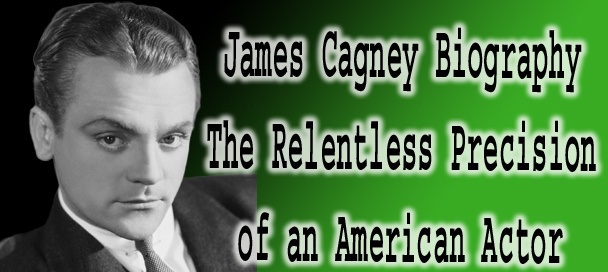
Studio publicity portrait of James Cagney
James Cagney occupies a distinctive place in American film history. He rose to prominence in the early sound era and became one of the most recognizable screen presences of the 1930s and 1940s. His work bridged stage and film at a moment when Hollywood was still defining how actors should move, speak, and behave on camera. Cagney’s performances were marked by precision and control rather than spectacle.
James Cagney was a defining figure of classic American cinema, known for his precision, intensity, and disciplined screen presence. Rising to prominence in the early sound era, he became famous for both hard-edged crime films and technically refined musical performances. His career spanned five decades, including an Academy Award-winning portrayal of George M. Cohan. Cagney’s work reshaped screen acting by emphasizing control, timing, and realism over theatrical excess.
He is often associated with fast-talking gangsters, yet that reputation only captures part of his range. Cagney brought a compact physicality and sharp timing to his roles, shaped by years of theatrical training. His movements were economical, his diction clipped, and his emotional shifts deliberate. These qualities made him stand out in an industry that frequently favored broader gestures and exaggerated delivery.
Unlike many stars of his era, Cagney maintained a strong sense of professional independence. He was known for challenging studio authority when he believed contracts or roles were unfair. This stance, unusual at the time, influenced how later actors viewed their relationship with the studio system. It also reinforced his public image as a performer who valued craft and fairness over compliance.
Cagney’s greatest strength was not aggression or speed, but control. His ability to compress emotion into small, deliberate gestures permanently altered how intensity was portrayed on screen.
👶 Early Life
Summary: His early life in New York fostered a practical outlook and work ethic that shaped his approach to performance.
James Cagney was born on July 17, 1899, on the Lower East Side of Manhattan, an area defined by dense housing, working-class families, and constant economic pressure. His parents were of Irish descent, and the household was disciplined but supportive. Money was tight, and stability was never assumed. This environment shaped his sense of responsibility early and left him with little patience for pretense later in life.
Cagney showed an aptitude for performance while still young, though practicality guided most early decisions. He attended local schools and briefly studied at Columbia University, where he was drawn to athletics as much as academics. Financial strain forced him to leave school before completing a degree, pushing him into a series of short-term jobs. These experiences reinforced a workmanlike view of labor, including acting, which he never romanticized.
His path toward the stage began almost by accident. A chance involvement in amateur performance led to formal dance training, an uncommon foundation for a future film star. Vaudeville and Broadway work followed, providing steady employment and rigorous discipline. By the time he reached Hollywood, his technique had already been tested by live audiences and unforgiving schedules.
Explore the Biographies of Iconic Celebrities
James Cagney was an accomplished painter in retirement and exhibited his artwork privately for friends and family.
🎬 Film Career
Summary: Cagney’s film career balanced iconic gangster roles with unexpected musical and dramatic range.
James Cagney entered Hollywood at the beginning of the sound era, signing with Warner Bros. in 1930 after a successful stage run. His first notable film appearance came in The Public Enemy (1931), directed by William A. Wellman, which established his screen persona almost overnight. As Tom Powers, Cagney brought a sharp, unsettling realism to the gangster role. The performance rejected melodrama in favor of speed, restraint, and sudden violence, setting a template that would influence crime films for decades.
Throughout the early 1930s, Cagney became closely associated with urban crime pictures. Films such as Smart Money (1931), co-starring Edward G. Robinson, Taxi! (1932) with Loretta Young, and Picture Snatcher (1933) reinforced his image as a volatile, street-hardened figure. These roles relied less on physical size than on rhythm and presence. Cagney’s delivery was fast and exact, his movements tightly controlled. He often appeared dangerous without raising his voice.
Despite the gangster label, Cagney repeatedly pushed for variety. He surprised audiences with musical performances in Footlight Parade (1933), directed by Lloyd Bacon and choreographed by Busby Berkeley, and later in Yankee Doodle Dandy (1942). His background in dance allowed him to move with clarity rather than flourish. In Yankee Doodle Dandy (1942), portraying George M. Cohan, Cagney combined physical discipline with understated emotion. The role earned him the Academy Award for Best Actor and remains one of the defining performances of his career.
Cagney’s relationship with Warner Bros. was often strained. He clashed with studio executives over contracts, compensation, and role assignments, leading to suspensions and temporary departures during the mid-1930s. During one such break, he formed his own production company and appeared in Boy Meets Girl (1938) at Goldwyn Studios, a lighter comedy that demonstrated his adaptability. Although independent ventures were short-lived, they underscored his insistence on professional autonomy.
Returning to Warner Bros., Cagney entered a mature phase of his career in the 1940s. He delivered darker, more reflective performances in films such as White Heat (1949), directed by Raoul Walsh, where his portrayal of Cody Jarrett blended criminal brutality with psychological instability. The role is often cited as one of the last great gangster performances of the classic studio era. Other notable works from this period include The Strawberry Blonde (1941) with Rita Hayworth, Love Me or Leave Me (1955) opposite Doris Day, and Mister Roberts (1955) alongside Henry Fonda and Jack Lemmon.
By the 1950s, Cagney gradually reduced his film output, choosing projects selectively. His final film appearance came in Ragtime (1981), directed by Miloš Forman, where he played Commissioner Rheinlander Waldo. The role was brief but deliberate, reflecting a career that favored control over visibility. Across five decades, Cagney remained consistent in his approach: disciplined preparation, precise execution, and a refusal to rely on reputation alone.
James Cagney refused to live in Hollywood full-time for much of his career, preferring rural life in New York over studio culture.
James Cagney in Yankee Doodle Dandy (Blu-ray)
Legendary actor James Cagney stars in the role that earned him the Academy Award for Best Actor, portraying singer, dancer, and songwriter George M. Cohan. This energetic musical chronicles the life of the entertainer whose patriotic songs helped lift national morale during wartime America.
From Cohan’s early vaudeville roots to his rise as a Broadway powerhouse, the film celebrates the career of the first entertainer awarded the United States Congressional Medal of Honor for contributions to morale. Directed with confidence by Michael Curtiz, the film also earned Academy Awards for Best Musical Score and Best Sound Recording, with five additional nominations.
Recognized as a cornerstone of American cinema, Yankee Doodle Dandy was added to the National Film Registry by the Library of Congress in 1993 for its enduring cultural significance.
🎬 Special Features
- Leonard Maltin hosts Warner Night at the Movies (1942)
- Casablanca theatrical trailer and 1942 newsreel
- Warner Bros. short: Beyond the Call of Duty
- Vintage cartoons: Bugs Bunny Gets the Boid and Yankee Doodle Daffy
- Wartime short: You, John Jones
- Let Freedom Sing!: The Story of Yankee Doodle Dandy documentary
- Audio commentary by historian Rudy Behlmer
- John Travolta Remembers James Cagney featurette
- Radio show recordings and rehearsal outtakes
Note: Animated cartoons presented in 1080p HD.
🕊️ Later Years
Summary: In later years, he withdrew from public life, choosing privacy and selective work over continued visibility.
In the years following his reduced screen activity in the 1950s, James Cagney shifted his focus away from Hollywood and toward a quieter, more private life. He spent long periods at his farm in Dutchess County, New York, where he devoted himself to painting, reading, and maintaining distance from the industry that had defined much of his adulthood. Public appearances became infrequent, and interviews were rare. When he did speak, his comments were measured and unsentimental.
James Cagney formally retired from acting after Ragtime (1981), directed by Miloš Forman, which marked his first film role in more than two decades. The decision to return was deliberate and limited. He declined further offers, expressing no interest in extending his career for its own sake. His final performance reflected restraint rather than nostalgia, consistent with his long-standing approach to work.
Health issues gradually emerged during the 1980s, including cognitive decline following a series of strokes. Even as his condition worsened, Cagney remained largely out of the public eye, cared for by his wife Frances Willard Cagney, whom he had married in 1935. He died on March 30, 1986, at the age of 86, leaving behind a body of work defined not by volume alone, but by discipline, clarity, and lasting influence.
James Cagney was so exacting about movement that he could repeat complex dance routines years later with minimal rehearsal, relying on muscle memory developed on the stage.
🏆 Legacy
Summary: His legacy endures through influence on acting technique, genre realism, and professional independence.
James Cagney left a legacy grounded in technique rather than image. His influence rests on how he worked, not on how he was promoted. He demonstrated that intensity could be conveyed through precision and timing instead of volume or size. Later generations of actors studying film from the classical era often cite his economy of movement and disciplined delivery as benchmarks of screen craft.
His gangster roles reshaped a genre that had previously leaned toward theatrical excess. By tightening speech patterns and physical gestures, Cagney introduced a sharper realism that altered audience expectations. Performances such as his work in early crime films and later psychological roles showed that menace could be internal rather than decorative. This approach carried forward into postwar American cinema, where restraint increasingly replaced exaggeration.
Beyond performance, James Cagney’s career is remembered for his stance within the studio system. His willingness to challenge contracts and resist typecasting helped shift conversations about actor autonomy. While he never positioned himself as a reformer, his actions set precedents. Today, his reputation endures not as a symbol of a single genre, but as a model of professional rigor and lasting artistic discipline.
🗣️ Why They Still Matter
James Cagney remains relevant because his work demonstrates that power on screen does not require exaggeration. His influence can be seen in later generations of actors who value economy, timing, and internalized intensity. Long after the studio system faded, his performances continue to serve as technical reference points for serious film study.
Further Reading & Resources
📖 Read: James Cagney Biography
🔍 Explore: James Cagney Biography - Britannica
ML Lamp is the owner of Kilroy Was Here. After his 20 years of working in Las Vegas in the entertainment promotions field, Mr. Lamp retired in 2002 from his job to pursue his passion for collectibles. Now as a guest speaker and author he’s living the dream, and sharing his warmth with You.