🌟 Joan Fontaine Biography: A Powerful Portrait of Classic Cinema
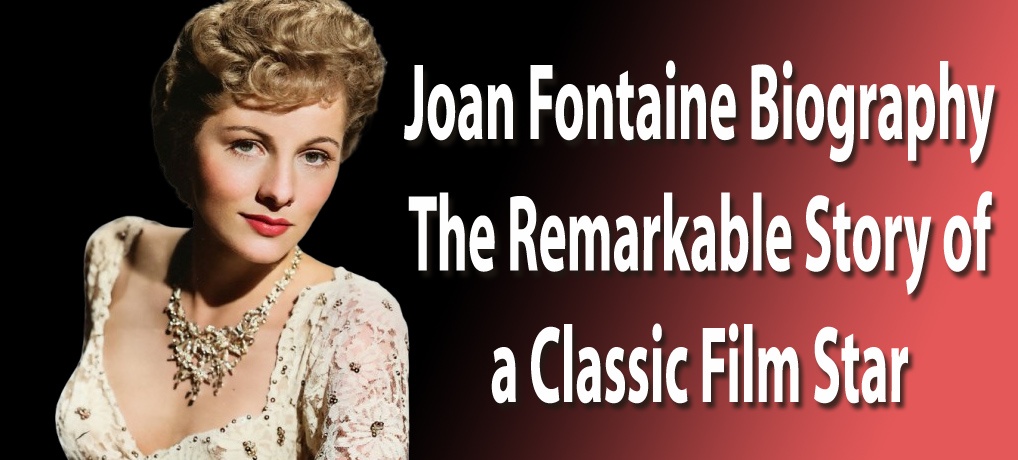
Joan Fontaine during the height of her Hollywood film career.
Joan Fontaine was an American film actress whose career belongs squarely to the classical Hollywood period. She emerged within a studio system that emphasized control, continuity, and carefully managed screen identities. Her work fit that structure while remaining notably personal in tone.
Joan Fontaine was a leading American film actress of the classic Hollywood era, best known for psychologically complex roles in prestige dramas. She starred in landmark films such as Rebecca (1940), Suspicion (1941), and Jane Eyre (1943), working with directors including Alfred Hitchcock and Max Ophüls. Her career was defined by restrained performances centered on inner conflict rather than spectacle. Fontaine remains one of the most enduring dramatic actresses of the studio system period.
On screen, Fontaine was associated with characters marked by uncertainty, emotional restraint, and psychological pressure. Rather than projecting dominance or glamour, she conveyed tension through stillness and controlled expression. This approach distinguished her from many of her contemporaries and became a defining feature of her reputation.
Across her career, Fontaine maintained a consistent presence in serious dramatic roles. Her performances favored internal conflict over outward display, aligning her work with films that relied on mood and character rather than spectacle. This focus shaped how audiences and critics understood her place in American film history.
📌 If You Only Read One Thing...
Fontaine’s most celebrated roles were built almost entirely on suggestion and restraint, proving that fear and doubt could be more compelling than action or spectacle.
👶 Early Life
Summary: Joan Fontaine’s early life reflected a transnational upbringing that shaped her reserved screen persona.
Joan Fontaine was born Joan de Beauvoir de Havilland on October 22, 1917, in Tokyo, Japan, to British parents. Her father worked as a patent attorney, and her mother had stage training, an influence that would later surface in both daughters’ lives. The family’s circumstances required frequent relocation during Fontaine’s early years.
Her childhood was divided between Japan, England, and the United States. These moves disrupted formal schooling and limited stable social ties. Fontaine was a quiet and physically fragile child, often separated from peers and encouraged toward solitary pursuits.
She eventually settled in California as a teenager, where she completed her education. By this time, she showed interest in acting, initially through stage work rather than film. These early experiences occurred well before any professional career took shape.
📌 Fun Fact
Joan Fontaine legally changed her surname to distinguish herself professionally from her sister.
🎬 Film Career
Joan Fontaine Interview
Summary: Her film career peaked during the 1940s with critically acclaimed performances in psychological dramas.
Joan Fontaine entered motion pictures in the late 1930s after securing a series of studio contracts and loan-out roles. Her earliest credited roles included No More Ladies (1938) and The Women (1939), where she appeared in minor parts that offered limited scope. These films placed her within the studio system but did little to define her early screen identity.
A turning point came when David O. Selznick cast her opposite Laurence Olivier in Rebecca (1940), directed by Alfred Hitchcock. Fontaine portrayed the unnamed second Mrs. de Winter, a role built on insecurity, fear, and psychological pressure. The performance brought her first Academy Award nomination and established her association with restrained, inward characters. The film’s success sharply elevated her professional standing.
Fontaine continued working with Hitchcock in Suspicion (1941), again opposite Laurence Olivier. Her portrayal of Lina McLaidlaw, a woman increasingly convinced her husband intends to murder her, earned her the Academy Award for Best Actress. This remains the only acting Oscar ever awarded for a Hitchcock-directed performance.
Throughout the early 1940s, Fontaine appeared in a series of dramas that reinforced her screen image. These included Frenchman’s Creek (1944) with Arturo de Córdova, Jane Eyre (1943) opposite Orson Welles, and The Constant Nymph (1943), which brought her a second Oscar nomination. The roles emphasized emotional vulnerability and moral tension rather than glamour.
As the decade progressed, Fontaine worked across studios, including 20th Century Fox and Paramount Pictures, often selecting material that sustained her dramatic reputation. Films such as Letter from an Unknown Woman (1948), directed by Max Ophüls and co-starring Louis Jourdan, later gained critical reassessment for their emotional precision and visual control.
In the 1950s, her film output slowed as Hollywood production patterns changed. She appeared in darker, more psychologically oriented works such as Born to Be Bad (1950) and September Affair (1950) with Joseph Cotten. These roles reflected both aging studio contracts and shifting audience tastes.
By the end of the decade, Joan Fontaine moved increasingly toward television and stage work. Her film career, concentrated largely between 1938 and 1955, left a body of work defined by consistency of tone rather than volume. She remained closely identified with the serious psychological dramas that marked her peak years.
📌 Fun Fact
She published two autobiographies, both offering sharply different accounts of her Hollywood years.
🕊️ Later Years
Summary: In later years, Fontaine shifted away from film while remaining active through writing and public appearances.
In the late 1950s, Joan Fontaine gradually reduced her film work as leading roles for women of her generation became less frequent. She shifted attention to television, appearing in anthology dramas and guest roles that allowed for shorter commitments. These appearances kept her professionally active without the demands of studio-era production schedules.
Fontaine also returned periodically to the stage, where she had greater control over material and performance. She toured in theatrical productions during the 1960s and 1970s, often in dramatic roles consistent with her established screen persona. Stage work provided a steadier outlet as film opportunities declined.
In her later decades, Fontaine lived largely outside Hollywood, dividing her time between California and other residences. She wrote two autobiographies, No Bed of Roses (1978) and Something to Live For (1989), which addressed both her career and personal life. She died on December 15, 2013, at the age of ninety-six.
📎 Did You Know?
Joan Fontaine remains the only actor ever to win an Academy Award for a performance in a film directed by Alfred Hitchcock.
🏆 Legacy
Joan Fontaine’s legacy rests on a narrow but influential body of work that helped define the psychological drama of the early 1940s. Her performances demonstrated that tension and vulnerability could be conveyed through restraint rather than display. This approach influenced how female characters were written and perceived during the studio era.
Her Academy Award–winning role in Suspicion remains a reference point in discussions of performance under minimalism, particularly within suspense films. Fontaine’s work showed how ambiguity and interior conflict could sustain a narrative without overt action. That contribution continues to be noted in critical reassessments of classic Hollywood acting styles.
Although her film output was limited in later years, Fontaine’s reputation has endured through repeated revivals of her key films. She is remembered less for volume or versatility than for consistency and precision. Within American film history, she occupies a distinct place defined by control, understatement, and psychological clarity.
🗣️ Why They Still Matter
Joan Fontaine’s work continues to resonate because it represents a turning point in screen acting, where emotional realism replaced theatrical display. Her performances remain reference points for understated dramatic technique and psychological storytelling in film history.
ML Lamp is the owner of Kilroy Was Here. After his 20 years of working in Las Vegas in the entertainment promotions field, Mr. Lamp retired in 2002 from his job to pursue his passion for collectibles. Now as a guest speaker and author he’s living the dream, and sharing his warmth with You.