🍀 Essential Irish-American Actors of Early Cinema

The Golden Age Begins: Irish-American Actors Take the Screen
Irish-American actors arrived in Hollywood during its formative years and left marks that outlasted the silent era. The early film industry drew heavily from stage traditions, particularly vaudeville and theater circuits where Irish performers had already built reputations. When studios began consolidating power in the 1920s and 1930s, these actors brought with them a working-class authenticity that resonated with Depression-era audiences.
Irish-American actors were performers of Irish descent who worked in Hollywood primarily during the 1920s through 1950s, a period when the studio system controlled production and talent. They specialized in working-class roles gangsters, priests, laborers, authority figures that aligned with immigrant narratives and Depression-era realism. Their stage training, particularly from vaudeville circuits, prepared them for the transition to sound films in 1927.
The transition from silent films to talkies in 1927 created an immediate demand for performers who could handle dialogue. Irish-American actors, many with years of stage experience, adapted quickly. Their voices carried well on early sound equipment, and their delivery felt natural compared to the stilted performances of some silent film veterans who struggled with the new medium.
Studios recognized the commercial value of casting actors who could embody everyman characters cops, priests, soldiers, laborers. The Irish immigrant experience aligned closely with broader American narratives of struggle and upward mobility. This made Irish performers particularly effective in roles that required both toughness and vulnerability, a combination that became central to Hollywood's evolving vision of what American masculinity looked like on screen.
Explore the St. Patrick’s Day Movies – 15 Best Irish Films to Watch
📌 If You Only Read One Thing...
Irish-American actors succeeded in early Hollywood not because of ethnic novelty but because their working-class backgrounds and stage experience made them credible in roles that required authenticity. They could play both toughness and vulnerability without appearing to perform class identity, which mattered during the Depression when audiences wanted characters who reflected their own economic struggles.
🍀 James F. Cagney Jr: From Vaudeville to Warner Brothers Stardom
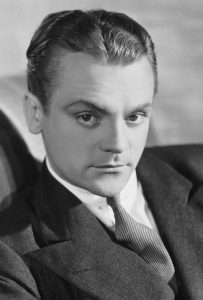
James Cagney started in vaudeville, where he learned timing, physicality, and how to hold an audience's attention without relying on elaborate sets or costumes. When he signed with Warner Brothers in 1930, the studio was building its reputation on gritty urban dramas that contrasted sharply with the glossier output of MGM or Paramount.
His breakout role came in "The Public Enemy" in 1931. Cagney played Tom Powers, a small-time hoodlum whose violent rise and fall captured the moral ambiguity of Prohibition-era crime. The famous grapefruit scene where he shoves half a grapefruit into Mae Clarke's face became iconic not because it was shocking, but because Cagney sold the sudden shift from charm to menace in a single gesture.
What set James Cagney apart was his refusal to glamorize criminality. His gangsters were not romantic outlaws but street rats driven by desperation and ego. He moved with a distinctive energy, quick and compact, that suggested coiled tension. This physicality became his signature and influenced how action would be staged in American films for decades.
Warner Brothers cast him repeatedly in similar roles, but Cagney fought for range. He won an Oscar for "Yankee Doodle Dandy" in 1942, playing George M. Cohan in a musical that showcased his dance skills and proved he could carry a film without firing a single shot. The performance reminded audiences that James Cagney's talent extended far beyond the tough-guy roles that made him famous.
📌 Fun Fact
Many Irish-American actors started in vaudeville, where they learned timing and physicality that translated directly to early sound films. The grapefruit scene in "The Public Enemy" was improvised by James Cagney during rehearsal and kept in the final cut.
🍀 Maureen O’Hara: Technicolor’s Fiery Leading Lady
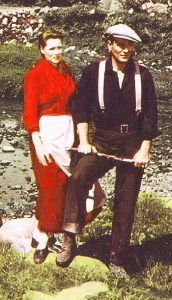
Maureen O'Hara arrived in Hollywood in 1939 after being discovered by Charles Laughton, who cast her in "Jamaica Inn" and brought her to America for "The Hunchback of Notre Dame." Irish-American actors had mostly been men up to that point, but O'Hara carved out a distinct place as one of the few women who could hold her own in adventure films and Westerns without being relegated to decorative roles.
Her red hair and sharp features made her a natural fit for Technicolor, which was still relatively new and expensive in the early 1940s. Studios used the format selectively, often for prestige pictures or genre films that benefited from vivid color. Maureen O'Hara appeared in several high-profile Technicolor productions, including "The Black Swan" in 1942 and "Buffalo Bill" in 1944, where her physical presence registered as forcefully as any male lead.
What set O'Hara apart was her refusal to play fragile. In "The Quiet Man" in 1952, directed by John Ford, she played Mary Kate Danaher opposite John Wayne. The film romanticized rural Ireland, but O'Hara's performance had an edge that prevented it from becoming pure sentiment. She matched Wayne in physicality and temper, and their on-screen fights felt genuine rather than staged for charm.
Ford cast her repeatedly, valuing her professionalism and her ability to handle both drama and action without special accommodation. She did her own stunts when possible and approached physical scenes the way male actors did as part of the job rather than a novelty. This made her valuable in an era when most actresses were expected to stay within narrow performance boundaries, giving Irish-American actors a broader canvas to work with regardless of gender.
O'Hara's partnership with Wayne extended beyond "The Quiet Man." They appeared together in five films, including "Rio Grande" in 1950 and "The Wings of Eagles" in 1957. Their chemistry worked because neither actor softened for the other. O'Hara brought the same intensity to romantic scenes that she brought to confrontations, which gave their collaborations a balance that many screen pairings lacked.
Her career longevity was unusual for actresses of her generation. She worked steadily from the late 1930s through the early 1970s, appearing in over fifty films. Unlike many female stars whose opportunities dried up as they aged, Maureen O'Hara continued to find substantive roles, partly because she had established herself in genres where physical capability mattered more than youth.
📌 If You Only Read One Thing...
Maureen O'Hara was a trained opera singer and could project her voice so powerfully that directors sometimes asked her to hold back on set.
🍀 Spencer B. Tracy: The Conscience of Hollywood
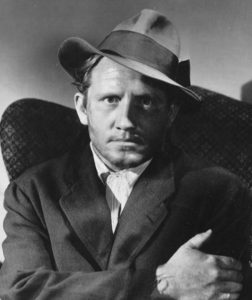
Spencer Tracy arrived in Hollywood in 1930 after a successful run on Broadway. Unlike Cagney, who leaned into ethnic typecasting early in his career, Tracy's Irish background rarely factored into his screen persona. Directors cast him for his ability to project moral authority without grandiosity.
His early work at Fox was uneven, but when he moved to MGM in 1935, the studio gave him better material. "Fury" in 1936 saw Tracy play a man nearly lynched by a mob, and his restrained performance turned what could have been melodrama into something closer to tragedy. He never overplayed victimhood or rage. Instead, he let the camera catch smaller moments a twitch of the jaw, a flicker of doubt that suggested a man processing trauma in real time.
Spencer Tracy's partnership with Katharine Hepburn produced nine films, starting with "Woman of the Year" in 1942. Their dynamic worked because Tracy never competed with Hepburn's intensity. He played opposite her with a calm that balanced her sharper edges, creating chemistry based on mutual respect rather than romantic idealization.
He won back-to-back Oscars for "Captains Courageous" in 1937 and "Boys Town" in 1938. The latter cast him as Father Flanagan, a priest who builds a home for troubled boys. The role could have been sanctimonious, but Spencer Tracy played it with enough weariness and pragmatism to make the character feel lived-in rather than saintly.
📌 Fun Fact
Spencer Tracy won back-to-back Academy Awards in 1937 and 1938, becoming one of only nine actors to achieve consecutive wins in the Best Actor category.
🍀 Pat O’Brien and the Rise of the Character Actor
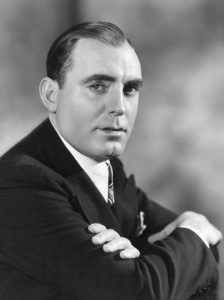
Pat O'Brien never achieved the star power of Cagney or Tracy, but his career illustrated how Irish-American actors filled essential supporting roles that gave Hollywood films their texture. He specialized in authority figures coaches, priests, military officers and appeared in over one hundred films between 1931 and the early 1950s.
His most famous role came in "Knute Rockne, All American" in 1940, where he played the legendary Notre Dame football coach. The film's climactic locker room speech, urging his players to "win one for the Gipper," became part of American cultural vocabulary. O'Brien delivered the line with conviction but avoided sentimentality, which made the moment land without feeling manipulative.
He worked frequently with Cagney, often playing his friend or foil. In "Angels with Dirty Faces" in 1938, O'Brien's Father Connelly serves as the moral counterpoint to Cagney's gangster Rocky Sullivan. The film explores whether Rocky will die bravely or pretend to be a coward to discourage the neighborhood kids from idolizing him. Pat O'Brien's performance anchors the film's ethical questions without turning the priest into a mouthpiece for simple moralism.
Character actors like Pat O'Brien provided continuity across studios and genres. Audiences recognized them even if they didn't know their names, and their presence signaled reliability. They were the professionals who showed up, hit their marks, and made everyone else's work easier.
📌 Fun Fact
Pat O'Brien appeared in over one hundred films between 1931 and the early 1950s, often playing authority figures who provided moral grounding in Warner Brothers crime dramas.
🍀 J. Pat Malley Character & Voice Actor
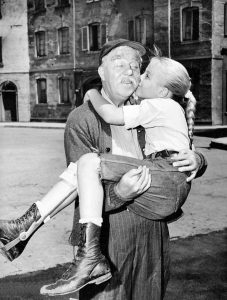
J. Pat O'Malley was one of the most prolific Irish-American character actors in television history. Born James Patrick O'Malley in 1904 to Irish parents, he emigrated to the United States in the 1930s and became a naturalized American citizen, proudly representing the Irish-American community in Hollywood for decades. His distinctive voice and versatile acting ability made him a familiar face on virtually every major television Western and drama of the 1950s and 1960s. O'Malley's legendary work ethic resulted in over 500 credits across film, television, and radio, making him one of the hardest-working Irish-American performers of his era.
O'Malley's television work showcased his remarkable range as an Irish-American performer. He appeared multiple times on "Have Gun Will Travel" playing various characters, and brought his talents to several episodes of "Perry Mason," often playing witnesses or suspects crucial to the courtroom drama. His other notable appearances included "The Virginian," "Rawhide," "Gunsmoke," "The Twilight Zone," and "Wagon Train." What set O'Malley apart as an Irish-American actor was his ability to play both comedic and dramatic roles with equal skill, never becoming typecast despite his accent.
Perhaps O'Malley's most enduring legacy comes from his extensive voice work for Walt Disney Studios. He provided multiple character voices for "Alice in Wonderland" (1951), including Tweedledee, Tweedledum, the Walrus, and the Carpenter. His Irish-American charm brought warmth to Colonel Hathi the elephant in "The Jungle Book" (1967), one of his most beloved performances. He also voiced characters in "101 Dalmatians" and "Mary Poppins," helping establish a tradition of Irish-American voice talent in animation.
His legacy as an Irish-American actor encompasses the dignity and skill he brought to every performance, whether playing frontier characters on Westerns, suspicious figures on crime dramas, or bringing animated characters to life, standing as testament to the significant impact Irish-American actors had on shaping American popular culture.
🍀 How Irish-American Actors Redefined Masculinity on Screen
Early Hollywood often depicted masculinity through aristocratic or cowboy archetypes distant, stoic figures who solved problems through wealth or violence. Irish-American actors introduced a different model: working-class men who were tough but emotionally accessible, capable of both brutality and tenderness.
Cagney's gangsters were small and scrappy, not towering physical specimens. Tracy's everyman characters struggled with doubt. O'Brien's authority figures earned respect through competence rather than dominance. These variations complicated the narrow definitions of manhood that had dominated silent films.
The Irish experience in America marked by discrimination, labor struggles, and gradual assimilation gave these actors a framework for playing characters caught between worlds. They could embody ambition without losing their connection to the streets. They could play upward mobility as both triumph and compromise.
This resonated during the Depression, when audiences saw their own economic precarity reflected on screen. Films starring Irish-American actors often centered on characters trying to survive systems that were rigged against them. The actors brought authenticity to these roles because many had grown up in similar circumstances. They weren't performing poverty or struggle from a distance; they were drawing on lived experience.
The physicality they brought to their roles also shifted how action was staged. Cagney's compact, explosive movements contrasted with the slower, more theatrical gestures of earlier film actors. Tracy's stillness became a form of tension. These choices influenced how masculinity would be performed in American cinema going forward, paving the way for actors like Marlon Brando and James Dean in the 1950s.
Explore Irish Gangsters in Old Hollywood Crime Films Forgotten Roles
🍀 The Studio System and Irish Talent
The studio system of the 1930s and 1940s relied on contract players who could be cycled through multiple films per year. Irish performers fit this model well. They were versatile, professional, and rarely caused the kind of off-screen scandals that complicated production schedules.
Warner Brothers in particular built its brand around working-class narratives, and Irish actors became central to that identity. The studio's crime dramas, social problem films, and biopics required performers who could handle tough dialogue and physical scenes without appearing out of place in urban settings.
MGM, by contrast, favored a more polished aesthetic, but even there, actors like Tracy found steady work. His ability to project decency without blandness made him valuable in prestige pictures that required moral weight.
Studios also appreciated that Irish actors could move between genres. Cagney could do musicals, crime films, and war pictures. Tracy could handle comedy, drama, and adventure. This flexibility made them cost-effective and reduced the risk that a star would be pigeonholed into a single type of role.
The system was exploitative in many ways long hours, restrictive contracts, limited creative control but it also provided stability. Actors who proved reliable could count on steady employment, and the best of them eventually gained enough leverage to negotiate better terms or move into independent production.
🍀 Irish-American Actors and the Pre-Code Era
Before the strict enforcement of the Motion Picture Production Code in 1934, Hollywood films explored themes that would later be censored. Irish-American actors appeared frequently in these pre-Code films, often playing morally ambiguous characters in stories that didn't resolve neatly into good versus evil.
Cagney's early gangster roles depicted crime with a frankness that later films had to soften. "The Public Enemy" showed violence as sudden and unglamorous. The protagonist dies face-down in the gutter, not in a blaze of redemptive glory. These films didn't moralize as explicitly as post-Code pictures would be required to do.
Tracy's pre-Code work also benefited from looser narrative constraints. Films could end ambiguously or allow flawed characters to escape punishment. This gave actors more room to explore complexity rather than fitting into simplified moral categories.
When the Code began to be enforced more rigorously, Irish-American actors adapted. They shifted toward roles that aligned with the new guidelines priests, coaches, law enforcement but retained the underlying toughness and authenticity that had made them effective in pre-Code films. The restraint imposed by censorship sometimes worked in their favor, forcing subtlety where earlier films might have been more explicit.
🍀 Legacy: From Silent Films to the Talkies
The Irish presence in early Hollywood wasn't limited to actors. Directors like John Ford shaped the visual and narrative language of American cinema, and many writers, producers, and technical workers came from similar backgrounds. But the actors remained the most visible part of this contribution.
Their influence extended beyond the roles they played. They helped establish templates for character types that would recur throughout Hollywood history: the street-smart cop, the tough-but-fair coach, the morally conflicted everyman. These archetypes became so embedded in American film that their origins were often forgotten.
The transition from silent films to talkies created a brief moment when the industry had to rebuild itself around sound. Irish-American actors were positioned to take advantage of that shift because their stage training had prepared them for dialogue-driven performance. They didn't just survive the transition they thrived in it, and in doing so, they helped define what Hollywood would become during its most culturally dominant period.
Why It Still Matters
Irish-American actors established performance templates that remained influential long after the studio system collapsed. The everyman archetypes they embodied street-smart cops, working-class heroes, morally conflicted authority figures became permanent fixtures in American cinema. Their approach to masculinity, which balanced physical toughness with emotional accessibility, paved the way for Method actors of the 1950s and influenced how vulnerability would be depicted on screen. Directors continued to cast in their mold even as the industry shifted away from studio contracts, and their films remain reference points for understanding how Hollywood constructed American identity during its most culturally dominant period.