🤠 Slim Pickens Biography: Hollywood’s Most Authentic and Beloved Cowboy
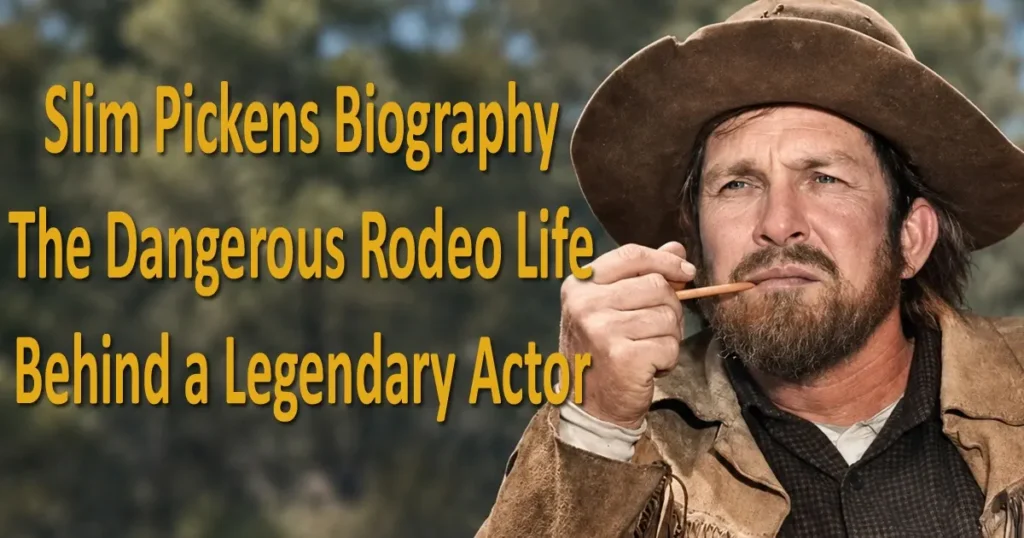
Slim Pickens was one of the most authentic Western figures ever to work in American entertainment, a genuine cowboy who moved from the dusty arenas of the rodeo circuit to the soundstages of Hollywood. His screen career ran from the late 1940s to the early 1980s, and over those decades he appeared in well over a hundred films and television productions, becoming one of the most recognizable character actors of his era.
Slim Pickens (June 29, 1919, to December 8, 1983) was an American actor and rodeo performer who spent nearly two decades as a bronc rider and celebrated rodeo clown before becoming one of Hollywood’s most recognizable Western character actors. Born Louis Burton Lindley Jr. in Kingsburg, California, he appeared in well over a hundred films and television productions, often as cowboys, lawmen, villains, and comic sidekicks. He is best remembered as Major T. J. “King” Kong, the B-52 pilot who rides a hydrogen bomb in Stanley Kubrick’s Dr. Strangelove, and as Taggart in Mel Brooks’s Blazing Saddles.
As a performer, Pickens was defined by his realness. He did not have to learn how to ride, rope, or drive a team of horses, because he had done those things for a living long before he ever stepped in front of a camera. His slow, gravelly drawl, his rugged face, and his easygoing humor made him equally believable as a menacing villain, a loyal sidekick, a grizzled lawman, or a figure of broad comedy.
To the public, Pickens embodied the plainspoken spirit of the American West. Audiences came to see him as the real thing in a business full of imitators, a man whose warmth and humor came through in every part. He endured because he brought honesty and good humor to everything he did, and because one unforgettable performance gave him a permanent place in the history of American film.
One of Major Kong’s wisecracks in Dr. Strangelove joked that the crew’s survival kit held enough to have a good weekend in Dallas. Then, in November 1963, President John F. Kennedy was assassinated in Dallas. The film’s scheduled screening was canceled, and Slim Pickens’s line was quietly re-dubbed, so that the movie’s most famous cowboy no longer named the city where the nation had just lost its president.
👶 Early Life
Summary: Born Louis Burton Lindley Jr. to a dairy farming family in Kingsburg, California, he defied his father to ride rodeo and took the name Slim Pickens as a teenager.
🏡 Birth and Family
Slim Pickens was born Louis Burton Lindley Jr. on June 29, 1919, in Kingsburg, California, in the farm country of the San Joaquin Valley. His father, Louis Bert Lindley Sr., was a Texas-born dairy farmer, and his mother was Sally Mosher Lindley (née Turk). To his family and friends, he was known simply as Burt.
🐴 A Boy on Horseback
Burt grew up surrounded by livestock and was riding horses from early childhood, quickly becoming an accomplished rider. His father hoped he would follow him into dairy farming, but the boy found the work dull and was drawn instead to the excitement of riding broncos and roping steers. By his early teens he had begun competing in local rodeos, much to his father’s displeasure.
🎓 Schooling
Pickens attended Hanford High School in Hanford, California, where he was a member of the Future Farmers of America. His heart, however, was already in the rodeo arena, and the pull of the circuit soon took over his life.
Explore the Biographies of Iconic Celebrities
🏷️ Becoming Slim Pickens
When his father forbade him from competing in rodeos, the determined teenager simply entered under another name so his father would not find out. According to the story he told for the rest of his life, a skeptical rodeo hand warned him that there would be nothing but slim pickings for him in prize money. He took the phrase as his rodeo name, entered as Slim Pickens, and won four hundred dollars that very afternoon. The name stayed with him for the rest of his life and career.
Stanley Kubrick later offered Slim Pickens the role of Dick Hallorann in The Shining (1980), but Pickens turned it down because he had no desire to endure Kubrick’s endless retakes again. The part went to Scatman Crothers.
🤠 The Rodeo Years
Summary: For nearly twenty years Pickens rode broncs and worked as a daring rodeo clown and bullfighter before retiring from the arena in 1962.
🐂 Bronc Rider and Bullfighter
Pickens spent nearly twenty years working in rodeo, competing as a bareback bronc rider and a saddle bronc rider. The work was punishing, and over the years he broke many bones, including his back twice. He was confident in his abilities and willing to sacrifice almost anything to keep competing, and he became a well-known figure on the Western rodeo circuit.
🤡 A Celebrated Rodeo Clown
Pickens became best known in the arena as a rodeo clown and bullfighter, one of the most dangerous jobs in live entertainment. His task was to entertain the crowd while also protecting fallen riders by distracting enraged bulls. He was famous for his colorful bullfighting performances, which included a trademark toreador outfit complete with cape. Over time he became one of the most highly paid and respected rodeo clowns in the country. He remained a rodeo regular into the early 1960s, finally retiring from the arena in 1962.
🎖️ World War II Service
Summary: Pickens enlisted in the Army Air Forces during World War II and, after his profession was recorded as radio instead of rodeo, served at a Midwest radio station.
📻 Rodeo or Radio
During World War II, Pickens enlisted in the United States Army Air Forces. According to the well-known story, when the recruiter asked his profession, he answered rodeo, but it was recorded as radio. As a result, instead of being placed with horses or in combat, he spent his entire enlistment working at a radio station in the Midwest. After the war, he returned to the rodeo circuit.
🎬 Film and TV Career
Summary: From Rocky Mountain to The Howling, Pickens built a long career in Westerns, Peckinpah films, comedies, and television series including B.J. and the Bear and Hee Haw.
🎞️ From the Arena to Hollywood
Pickens made his first screen appearance as an uncredited rodeo cowboy in Smoky (1946). His real break came in 1950, when director William Keighley saw him perform at a rodeo and offered him a screen test. Keighley cast him as Plank in Rocky Mountain (1950), a Civil War Western starring Errol Flynn, and Pickens’s film career was launched.
🌵 B Westerns and Sidekick Roles
Through the 1950s, Pickens worked steadily in Westerns, often playing villains or comic sidekicks. He became known as the comic partner of singing cowboy Rex Allen in a string of B Westerns, including Old Oklahoma Plains (1952) and Down Laredo Way (1953). He also appeared in The Outcast (1954), the MGM Western The Sheepman (1958) with Glenn Ford, and Disney’s Tonka (1958), the story of a Sioux warrior and the horse that survived the Battle of the Little Bighorn.
Because of his rodeo background, Pickens rode his own horses on screen, including Appaloosas, and drove six-horse stagecoach teams himself without a stand-in. Directors valued him for this authenticity, and he did much of his own stunt work throughout his career.
🃏 One-Eyed Jacks
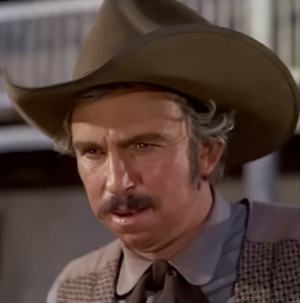
Pickens showed his darker side in One-Eyed Jacks (1961), the only film Marlon Brando ever directed. Brando starred as Rio, an outlaw seeking revenge on his former partner, played by Karl Malden, who has become a respected sheriff. Pickens played Deputy Lon Dedrick, a sadistic and cowardly lawman who torments Rio. It was a menacing performance that proved he could be far more than comic relief.
📺 Television in the 1960s
Pickens became a familiar face on television. He played Johnson in a recurring role on the NBC Civil War series The Americans (1961) and appeared in three episodes of The Wide Country (1962), a rodeo drama starring Earl Holliman and Andrew Prine. He had recurring roles on Bonanza and on the Western series Custer (1967), and he made guest appearances on shows including Gunsmoke, Maverick, Wagon Train, Cheyenne, The Virginian, The Man from U.N.C.L.E., and Daniel Boone.
🐎 Sam Peckinpah’s Westerns
Pickens became a favorite of director Sam Peckinpah. In Major Dundee (1965), starring Charlton Heston as a Union cavalry officer leading a ragtag force into Mexico, he played the mule packer Wiley. He later appeared in Peckinpah’s The Ballad of Cable Hogue (1970) starring Jason Robards, and played a cowboy in Peckinpah’s crime thriller The Getaway (1972) with Steve McQueen and Ali MacGraw.
His most moving work for Peckinpah came in Pat Garrett and Billy the Kid (1973), starring James Coburn as Garrett and Kris Kristofferson as Billy. Pickens played Sheriff Baker, an aging lawman who is fatally wounded in a gunfight. His death scene, in which Baker sits dying beside a river at sunset while his wife, played by Katy Jurado, watches over him, set to Bob Dylan‘s “Knockin’ on Heaven’s Door,” became one of the most celebrated moments in any Western of the period.
🚂 Westerns of the Late 1960s
In the 1966 remake of Stagecoach (1966), directed by Gordon Douglas and starring Ann-Margret, Alex Cord, and Bing Crosby, Pickens took the role of Buck, the stagecoach driver, the part Andy Devine had made famous in John Ford‘s 1939 original. He also appeared in An Eye for an Eye (1966), Rough Night in Jericho (1967), and Tom Gries‘s Will Penny (1968), another film with Charlton Heston, as well as the Disney comedy Never a Dull Moment (1968) with Dick Van Dyke.
🌄 The 1970s
In Mark Rydell’s The Cowboys (1972), Pickens played Anse, an old friend of John Wayne‘s rancher, who must hire a group of schoolboys to drive his cattle when his regular hands abandon him for a gold rush. In Ginger in the Morning (1974) he played a sheriff, and in Rancho Deluxe (1975), a contemporary comic Western set in Montana and starring Jeff Bridges and Sam Waterston, he played Henry Beige, a veteran stock detective. He also played Sheriff Orville in the Southern thriller Poor Pretty Eddie (1975) and appeared in the trucker drama White Line Fever (1975).
For Disney, he played the outlaw Frank Stillwell in The Apple Dumpling Gang (1975), a family Western comedy starring Bill Bixby, Don Knotts, and Tim Conway. In J. Lee Thompson’s The White Buffalo (1977), starring Charles Bronson as Wild Bill Hickok, he played Abel Pickney. He appeared as Jud Hawkins in Irwin Allen‘s disaster film The Swarm (1978) and as Dewey “Tex” Hopkins in Allen’s Beyond the Poseidon Adventure (1979) with Michael Caine and Karl Malden.
🔥 Blazing Saddles
Pickens had one of his most famous comic roles in Mel Brooks‘s Western satire Blazing Saddles (1974). Brooks directed and co-wrote the film, which follows Cleavon Little as Bart, a Black railroad worker who is made sheriff of the all-white frontier town of Rock Ridge as part of a scheme to drive the townspeople out. Gene Wilder co-starred as the Waco Kid, a washed-up gunslinger who becomes Bart’s closest ally, and Madeline Kahn played the saloon singer Lili Von Shtupp.
Pickens played Taggart, the dim but loyal chief henchman of Harvey Korman‘s scheming attorney general, Hedley Lamarr. Taggart bosses the railroad crew, leads Lamarr’s gang of thugs against Rock Ridge, and takes part in the film’s famous campfire scene with his cowboys. Pickens played him with the same deadpan sincerity he had brought to Major Kong, and his scenes with Korman became some of the funniest in the picture. Blazing Saddles was a major box office hit and is still regarded as one of the greatest comedies ever made, a film that skewered both the racism of the Old West and the clichés of the Hollywood Western.
✈️ 1941
In Steven Spielberg‘s wartime comedy 1941 (1979), set in the days after Pearl Harbor when Southern California braced for a Japanese invasion, Pickens played Hollis P. Wood, a cantankerous civilian captured aboard a Japanese submarine whose crew is searching for Hollywood. His scenes opposite Toshiro Mifune and Christopher Lee made gentle fun of his own cowboy image.
🎸 Tom Horn and Honeysuckle Rose
Pickens reunited with Steve McQueen in Tom Horn (1980), playing Sheriff Sam Creedmore in the story of the real-life frontier scout and range detective who was hanged for murder in 1903. That same year he played Garland Ramsey in Jerry Schatzberg‘s Honeysuckle Rose (1980), starring Willie Nelson as a touring country singer, with Dyan Cannon and Amy Irving.
🐺 The Howling
In Joe Dante‘s horror film The Howling (1981), Pickens played Sheriff Sam Newfield, a small-town lawman in the remote California coastal community where Dee Wallace‘s television news anchor is sent to recover from a traumatic attack. The colony turns out to be home to a community of werewolves, and the film became one of the most influential horror pictures of its decade, celebrated for its groundbreaking transformation effects.
📺 B.J. and the Bear and Hee Haw
On television in the late 1970s and early 1980s, Pickens played Sergeant Beauregard Wiley, a bumbling Southern lawman, on the NBC trucking adventure series B.J. and the Bear, starring Greg Evigan. He had a recurring role on the comedy Filthy Rich, played Wild Jack Monroe on The Mary Tyler Moore Show, and appeared as Grandpa Luke Scofield in a two-part episode of The Love Boat (1980). In 1981 he hosted the NBC country music series The Nashville Palace, and that same year he joined the syndicated country comedy show Hee Haw as a semiregular, a role he kept until his death.
🎵 Music and Narration
Pickens also worked as a singer and narrator. He narrated the first part of Bobby Bridger’s A Ballad of the West in 1975, released a self-titled country album, Slim Pickens, on Blue Canyon Records in 1977, and recorded the single “Christmas in November” in 1980.
🎬 Final Film
His last film was the comedy Pink Motel (1982), in which he played Roy opposite Phyllis Diller.
Slim Pickens bought his beloved blue roan Appaloosa, Dear John, in Montana in 1954 for just $150, then trained him to sit like a dog and buck on cue.
☢️ Dr. Strangelove and the Ride of a Lifetime
Summary: As Major T. J. “King” Kong in Dr. Strangelove, Pickens created one of cinema’s most famous images by riding a hydrogen bomb like a rodeo bronc.
🎥 Kubrick’s Call
Pickens’s most famous role came in Stanley Kubrick’s Cold War satire Dr. Strangelove or: How I Learned to Stop Worrying and Love the Bomb (1964). The film follows the chaos that erupts after a deranged general, played by Sterling Hayden, orders a nuclear strike on the Soviet Union, while the president, played by Peter Sellers, and his advisers, including George C. Scott‘s bellicose General Buck Turgidson, try desperately to stop it. Sellers had originally been slated to play the B-52 pilot as well, in addition to his three other roles, but after Sellers was injured and could not do it, Kubrick turned to Pickens.
✈️ Major T. J. “King” Kong
Pickens played Major T. J. “King” Kong, the gung-ho Texan commander of a B-52 bomber whose crew cannot be recalled from its mission. His accent, his natural comic timing, and his complete sincerity made him perfect for the role. Kubrick famously did not tell him that the movie was a black comedy and instead had him play the part completely straight. The result was a performance of absolute conviction, which made Kong’s patriotic speeches to his crew both hilarious and disturbing.
💣 Riding the Bomb
The film’s climax became one of the most famous images in movie history. When the bomb bay doors jam, Kong climbs down to repair the wiring himself, and when the doors suddenly open, he rides the falling hydrogen bomb toward its target like a rodeo bronc, whooping and waving his cowboy hat in the air. The scene captured the absurdity of the nuclear age in a single unforgettable picture, and it drew directly on the rodeo skills Pickens had spent his life perfecting.
📈 A Career Transformed
Pickens always credited Dr. Strangelove as the turning point of his career. After the film’s release, his roles, his dressing rooms, and his paychecks all started getting bigger, and the cowboy from the rodeo circuit found himself treated as a star character actor for the rest of his career.
The man who rode a nuclear bomb into the Soviet Union on screen had never set foot outside the United States. When Stanley Kubrick urgently summoned him to London for Dr. Strangelove, Slim Pickens rushed off without a passport, and his arrival was held up while he scrambled to get one.
❤️ Personal Life
Summary: Pickens married Maggi Harmon in 1950, raised three children, and lived a quiet outdoor life in Columbia, California, far from Hollywood.
💍 Marriage to Margaret Harmon
Pickens met Margaret “Maggi” Harmon at the Madera County Fair, and the two married on March 22, 1950, the same year his Hollywood career began. Their marriage lasted for the rest of his life. Maggi survived him by many years and died in 2011.
👨👩👧👦 Children and Family
Pickens raised Maggi’s daughter from a previous marriage, Daryle Ann, as his own child. The couple also had two children of their own, a son, Thomas Michael, and a daughter, Margaret Louise. The family kept a low public profile, preferring ranch life to the Hollywood social scene.
👬 Easy Pickens
His younger brother, Samuel Lindley, also became an actor, working under the name Easy Pickens. Samuel was born in 1921 and died in 2001.
🏞️ Life Outside Hollywood
Pickens never lost his love of the outdoors. He made his home in Columbia, California, in the Sierra Nevada foothills, far from Hollywood. He was an enthusiastic outdoorsman and a longtime supporter of the National Rifle Association, and he appeared in several episodes of the ABC outdoors series The American Sportsman. He remained devoted to his horses throughout his life.
🩺 Health
In 1983, Pickens was diagnosed with a brain tumor. He underwent surgery but never fully recovered.
🕊️ Later Years and Death
Summary: Honored by Western and rodeo halls of fame, Pickens died at 64 in Modesto, California, on December 8, 1983, following surgery for a brain tumor.
🏅 Honors and Recognition
In 1982, Pickens was inducted into the Hall of Great Western Performers at the National Cowboy and Western Heritage Museum in Oklahoma City, recognizing his contributions to Western film and television.
His rodeo career was honored many times after his death. He was inducted into the Rodeo Hall of Fame of the Rodeo Historical Society in 1986, the ProRodeo Hall of Fame in 2005, the Pendleton Round-Up and Happy Canyon Hall of Fame in 2006, and the Ellensburg Rodeo Hall of Fame in 2020, a rare collection of honors for a man best known to the public as an actor.
🎭 Final Work
In his final years, Pickens remained active on television, particularly through his semiregular appearances on Hee Haw, which allowed him to return to his country roots and enjoy the warm reception of a loyal audience.
🕯️ Death
Slim Pickens died on December 8, 1983, at the age of 64, at a hospital in Modesto, California, following surgery for a brain tumor. His funeral was held at the Presbyterian Church of the Forty Niners in Columbia, California, near his home. In keeping with his love of the outdoors, his ashes were scattered over his favorite riding trails.
He was survived by his wife, Maggi; his children, Daryle Ann, Thomas Michael, and Margaret Louise; and his brother, Samuel. His death marked the passing of one of the last true working cowboys to become a Hollywood star.
🏆 Legacy
🤠 The Real Thing
In an industry built on illusion, Pickens was authentic. Audiences sensed that he was not playing at being a cowboy, and that authenticity gave his performances a credibility that no amount of training could create. He stood as a living connection between the real working West and its portrayal on screen.
😄 Comedy Without Winking
Pickens’s greatest comic performances worked because he never played them for laughs. His sincerity, whether as Major Kong or in his many other comic roles, created humor out of complete commitment. That approach has influenced generations of character actors who learned that the funniest performances often come from playing the absurd with total seriousness.
🎞️ An Image for the Ages
The picture of a cowboy riding a nuclear bomb, whooping and waving his hat, has become one of the defining images of the twentieth century. It has been referenced, parodied, and analyzed countless times, and it remains a shorthand for the madness of the nuclear arms race. Few character actors have ever created a single moment so deeply embedded in popular culture.
🏆 Slim Pickens’s Place in American Entertainment
Their legacy is ultimately one of authenticity, humor, and the enduring spirit of the American West. Slim Pickens rode broncs, fought bulls, and clowned in rodeo arenas before ever stepping in front of a camera, and he brought that hard-won realness to every role he played. From B Westerns to Peckinpah epics, from Mel Brooks to Stanley Kubrick, he remained exactly who he was, a cowboy first, last, and always. He leaves behind a body of work that captures both the grit and the good humor of the West, and one unforgettable ride that will never be forgotten.
🗣️ Why He Still Matters
Slim Pickens still matters because he was the real West on screen, not a performance of it. He rode broncs and fought bulls before he ever said a line of dialogue, and that authenticity gives his Westerns a truth that still lands with modern viewers. His image of Major Kong riding the bomb remains one of the most powerful pictures of nuclear-age anxiety, as sharp a warning today as it was in 1964. With Dr. Strangelove, Blazing Saddles, and Pat Garrett and Billy the Kid still finding new audiences, Pickens reminds us that the biggest laughs and the deepest truths often come from someone playing it completely straight.