🎭 Yul Brynner Biography: A Bold Portrait of Hollywood Authority
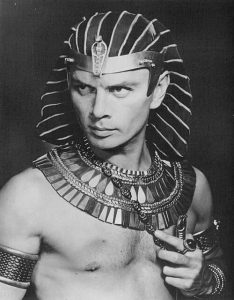
Yul Brynner in his iconic role as the King of Siam
Yul Brynner did not look or sound like anyone else who rose to Hollywood stardom in the mid-twentieth century. With his shaved head, steady gaze, and clipped delivery, he projected a calm authority that felt both modern and ancient at the same time. Audiences sensed it immediately. This was not a man shaped by the studio system, but one who arrived fully formed.
Yul Brynner was a commanding film and stage actor whose unmistakable presence reshaped the idea of the Hollywood leading man. Best known for The King and I, The Ten Commandments, and The Magnificent Seven, his career spanned epic cinema, Westerns, and science fiction. With a disciplined style built on restraint and authority, he became one of the most recognizable performers of the twentieth century.
He carried an air of mystery that the screen never quite explained. His accent defied easy placement, his background seemed deliberately opaque, and his presence suggested experience rather than youth. Even standing still, he commanded attention. Hollywood had leading men. Brynner was something else entirely.
Before the fame and the iconic image, there was a restless figure drawn to performance in its rawest form. He was not chasing celebrity or polish. He was chasing expression, discipline, and control. That pursuit, quiet and deliberate, set the foundation for everything that followed.
📌 If You Only Read One Thing...
Yul Brynner’s power came not from volume or emotion, but from silence and control, a rare approach that made him unforgettable.
👶 Early Life
Summary: Yul Brynner’s childhood across cultures and borders shaped his independence and distinctive sense of self.
Yul Brynner was born on July 11, 1920, under the name Yuliy Borisovich Briner. His early life was shaped by constant movement and cultural overlap rather than any single national identity. From the beginning, stability was scarce, and adaptability was essential.
His family background was layered and, at times, deliberately obscured later in life. What is clear is that he was raised in an environment where reinvention was normal and self-definition mattered more than origin. This early uncertainty fostered independence and a strong inner discipline.
As a child, Brynner gravitated toward observation rather than conformity. He learned by watching people closely, noting how confidence, restraint, and silence could command space. These instincts formed long before any formal training and would later become central to his public persona.
By adolescence, his sense of separation from those around him was already apparent. It was not arrogance or affectation. It was the result of growing up between worlds, learning early how to stand alone without needing to explain himself.
📌 Fun Fact
He played the same role in The King and I more than 4,600 times across stage and screen performances.
🎬 Film and TV Career
Yul Brynner: The Man Who Was King
Summary: Yul Brynner performances defined authority on screen, earning acclaim across film, stage, and genre cinema.
Yul Brynner entered film at full strength rather than through a slow apprenticeship. His breakout screen year was 1956, when he appeared in The King and I (1956), directed by Walter Lang, opposite Deborah Kerr, Rita Moreno, and Martin Benson. His performance defined his screen identity overnight and earned him the Academy Award for Best Actor, a rare achievement for a role rooted so strongly in theatrical discipline.
under director Cecil B. DeMille, portraying Rameses opposite Charlton Heston, with Anne Baxter, Edward G. Robinson, and Yvonne DeCarlo in prominent roles. The contrast between the regal ruler and Heston’s Moses cemented Brynner as a commanding screen presence capable of matching Hollywood’s biggest stars.
Brynner continued building momentum with Anastasia (1956) alongside Ingrid Bergman and Helen Hayes, followed by The Buccaneer (1958) with Claire Bloom and Charles Boyer. Rather than settle into one genre, he moved easily between historical epics, romantic drama, and character-driven roles.
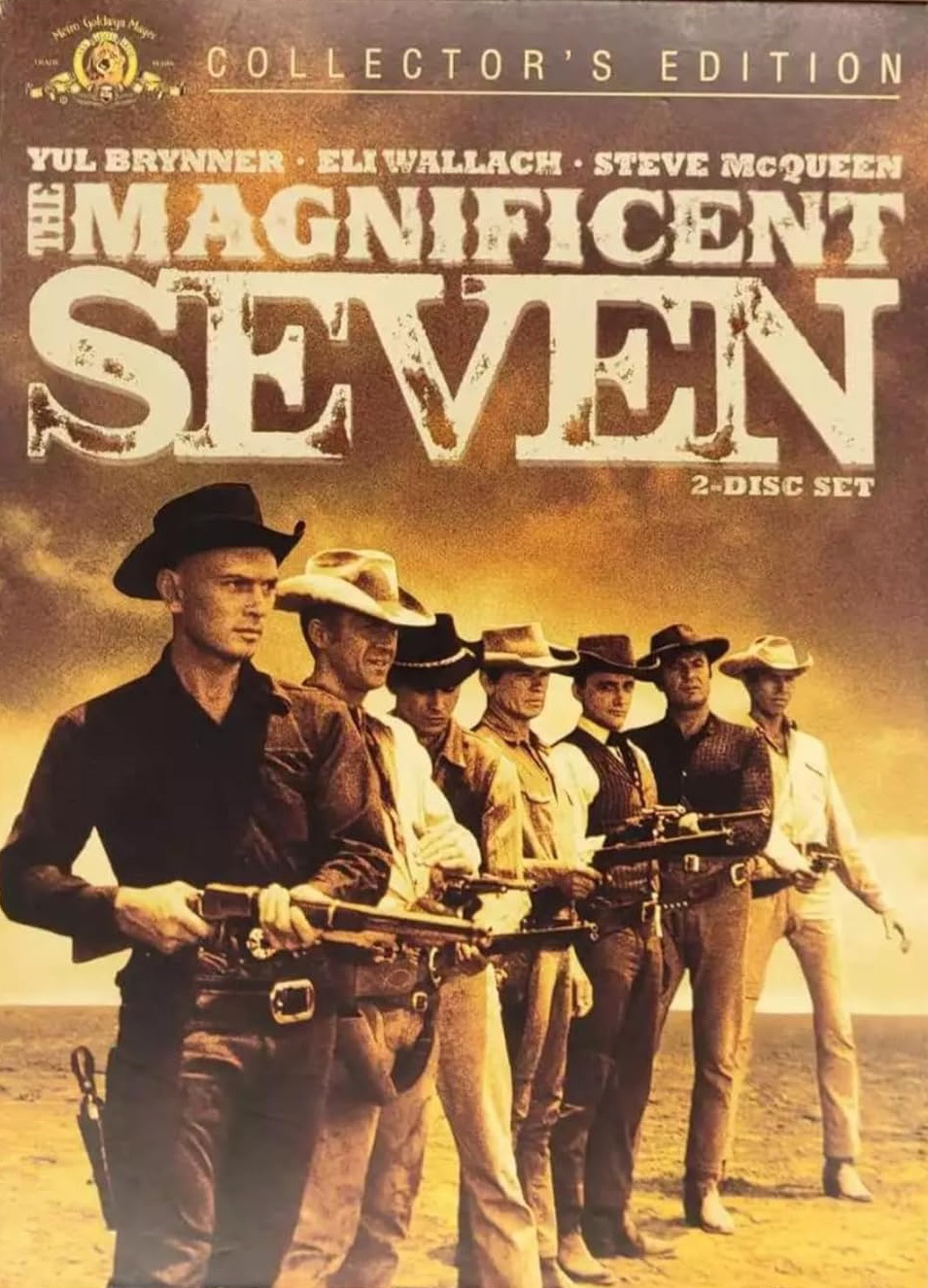
In 1960, he became indelibly associated with the Western through The Magnificent Seven (1960), sharing the screen with Steve McQueen, James Coburn, Charles Bronson, Robert Vaughn, and Horst Buchholz. His quiet authority anchored the ensemble and influenced the tone of the entire film. He later reprised variations of the role in sequels released in 1966 and 1969, reinforcing his association with disciplined, controlled leadership.
Throughout the 1960s, Brynner appeared in a wide range of productions, including Taras Bulba (1962) with Tony Curtis, Kings of the Sun (1963) with George Chakiris, Invitation to a Gunfighter (1964) opposite George Segal, and The Double Man (1967) with Clive Revill. His choices favored intensity and control over sentimentality, even when box office returns varied.
In the 1970s, Brynner introduced a new generation to his presence through science fiction. Westworld (1973) cast him as a relentless gunslinger opposite Richard Benjamin and James Brolin, under director Michael Crichton. The role emphasized stillness, physical economy, and menace, extending his screen legacy beyond classical Hollywood into modern genre filmmaking.
While film remained his primary medium, Brynner also appeared on television in specials, interviews, and limited dramatic projects rather than long-running series. His television work favored prestige over volume, aligning with his preference for carefully controlled performances rather than episodic repetition.
Across four decades, Brynner worked with an unusually wide range of actors, directors, and genres without diluting his identity. Whether opposite established legends or rising stars, his performances remained precise, restrained, and unmistakable. His film and television career stands as a study in authority built through discipline rather than excess.
📌 Fun Fact
Yul Brynner was also an accomplished photographer whose work was exhibited internationally.
🤠 The Magnificent Seven (Two-Disc Collector’s Edition) DVD – A Western Legend
The Magnificent Seven
Spectacular gun battles, epic-sized heroes, and an all-star cast make The Magnificent Seven one of the most enduring Westerns ever filmed.
Starring Yul Brynner and James Coburn, alongside Steve McQueen, Eli Wallach, and Charles Bronson,
this classic remake of The Seven Samurai remains a benchmark of the genre.
Yul Brynner leads the seven gunfighters as Chris Adams in this definitive Western classic.
When the ruthless bandit Calvera and his outlaws terrorize a defenseless Mexican village,
the desperate townspeople hire professional gunfighter Chris Adams and six others to stand against them.
As the next raid approaches, the seven must train the villagers to defend themselves, knowing survival is far from guaranteed.
Featuring Elmer Bernstein’s Oscar-nominated score and praised as
“a hard-pounding adventure” and “enduringly popular,” this film spawned three sequels and a successful television series, securing its place in cinema history.
Collector’s Edition Features:
📀 Two-Disc Collector’s Edition DVD
🎬 Classic Western restored for modern viewing
🎵 Elmer Bernstein’s iconic musical score
⭐ Legendary ensemble cast performances
A defining Western where courage, sacrifice, and honor are measured at the barrel of a gun.
Summary: His private life remained guarded, while his later illness reshaped his public message.
Yul Brynner guarded his private life carefully, revealing only what he chose and often reshaping details on his own terms. He was married four times, first to Virginia Gilmore in 1944, then to Doris Kleiner in 1960, followed by Jacqueline Thion de la Chaume in 1971, and finally Kathy Lee in 1983. Each marriage reflected a different period of his life, marked by travel, work, and long separations rather than domestic routine.
He was the father of five children, including Rock Brynner, who later became an author and academic. As a parent, Brynner was present but unconventional, maintaining a lifestyle shaped by performance schedules and international movement. Family life existed alongside, not in place of, his professional discipline.
Health became a defining issue later in his life, largely tied to his long-term habit of heavy smoking. Brynner was a chain smoker for decades, a practice common in his era and rarely questioned during the height of his career. In 1983, he was diagnosed with lung cancer, a diagnosis he chose not to hide from the public.
Rather than retreat, he used his illness with characteristic control and clarity. Shortly before his death, Brynner recorded a public service message warning against smoking, urging viewers not to repeat his mistake. The message was direct, unsentimental, and effective, becoming one of the most widely remembered anti-smoking statements by a public figure.
📎 Did You Know?
Yul Brynner carefully maintained his shaved head years before it became famous, turning what began as a stage necessity into a lifelong trademark.
🕊️ Later Years
Summary:Yul Brynner continued working with discipline and purpose until the end of his life.
In his final years, Yul Brynner remained professionally active, refusing to withdraw quietly from public life. He continued performing on stage, most notably returning to The King and I, the role that had defined him decades earlier. Even as his health declined, his performances retained the same restraint and authority that had marked his prime.
Away from the stage, his focus narrowed. Travel slowed, appearances became selective, and personal time took precedence over ambition. Those close to him noted a calmer rhythm, shaped less by reinvention and more by reflection. He spoke plainly about mortality and showed little interest in sentimentality or legacy-building.
His illness progressed steadily, and the physical toll became impossible to conceal. Still, he resisted dramatization. There were no farewell tours framed as spectacle, only continued work for as long as discipline allowed. When he stepped away, it was without announcement.
Brynner died on October 10, 1985, at the age of 65. His death marked the end of a career built on control rather than excess, presence rather than volume. He left behind an image so distinct that it never required explanation, only recognition.
🏆 Legacy
Summary: His influence endures through an image and performance style that never followed trends.
Yul Brynner left behind one of the most unmistakable screen identities in film history. His shaved head, measured speech, and stillness were not gimmicks but tools, carefully chosen and rigorously maintained. He proved that authority on screen could come from restraint rather than volume, from posture rather than motion.
His performances reshaped expectations for leading men, especially those who did not fit traditional Hollywood molds. Without relying on charm or sentiment, he conveyed power through control and intelligence. That approach influenced later actors who favored presence over excess and discipline over display.
Beyond acting, his public anti-smoking message became a lasting part of his legacy, extending his impact beyond entertainment. It was blunt, unsparing, and effective, mirroring the qualities that defined his career. Decades after his death, Brynner remains instantly recognizable, a rare figure whose image never faded because it never followed trends to begin with.
🗣️ Why They Still Matter:
Yul Brynner remains a symbol of disciplined performance and visual authority. In an era of excess, his restraint feels timeless, influencing actors who value presence over spectacle and proving that true power on screen often comes from stillness.
ML Lamp is the owner of Kilroy Was Here. After his 20 years of working in Las Vegas in the entertainment promotions field, Mr. Lamp retired in 2002 from his job to pursue his passion for collectibles. Now as a guest speaker and author he’s living the dream, and sharing his warmth with You.