🎬 Origins of the Motion Picture Production Code

Studio script evaluation conducted under the Motion Picture Production Code
The Motion Picture Production Code emerged during a period of growing public concern over the influence of movies. In the early 1930s, Hollywood faced pressure from religious groups, civic organizations, and politicians who argued that films promoted immorality. The industry responded by drafting the code in 1930 as a set of moral guidelines intended to regulate content before outside authorities imposed federal censorship.
The Motion Picture Production Code was a set of industry guidelines adopted by major Hollywood studios to regulate film content. It defined standards for the portrayal of crime, sexuality, religion, and social conduct in motion pictures. Enforced beginning in 1934, it required studio approval before films could be distributed nationally. The system operated for more than three decades and shaped the tone, structure, and themes of American cinema during the studio era.
The code was largely shaped by Martin Quigley, a Catholic publisher, and Father Daniel Lord, a Jesuit priest. Their document outlined standards for acceptable portrayals of crime, sexuality, religion, and social behavior. Although studios formally adopted the code, enforcement was initially weak. Filmmakers often ignored its provisions, especially during the so-called Pre-Code era between 1930 and mid-1934.
That period produced films that openly depicted adultery, prostitution, drug use, and political corruption. Gangster pictures and sexually assertive female characters flourished. Studios calculated that controversy drew audiences. Without meaningful oversight, the Motion Picture Production Code functioned more as a public relations statement than a binding rulebook. Only after threats of organized boycotts and local censorship boards did the industry move toward stricter control.
Pre-Code Hollywood and Rising Pressure
Before mid-1934, Hollywood operated with relative freedom. Studios released films that reflected urban realities and social tensions of the Depression era. Dialogue could be suggestive. Costumes were revealing. Criminal characters sometimes escaped punishment. Female leads, played by actors such as Barbara Stanwyck and Jean Harlow, often pursued personal ambition without moral restraint.
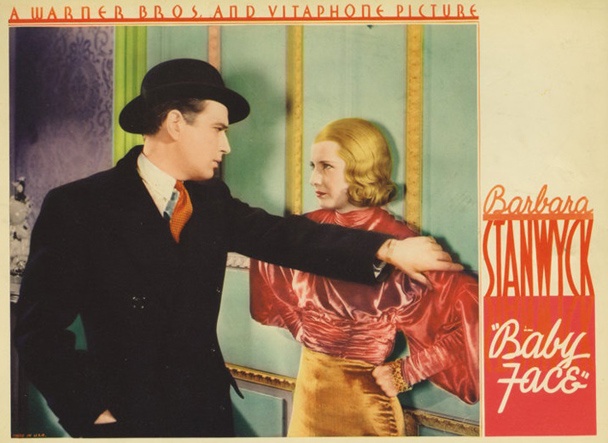 Original 1933 lobby card for Baby Face starring Barbara Stanwyck. The film was released just before strict enforcement of the Motion Picture Production Code in mid-1934. Its storyline followed a young woman who deliberately uses sexual relationships to advance socially and financially, a theme that alarmed religious groups and censorship boards. In its original version, the character’s rise carried minimal moral consequence and included dialogue and scenes that implied transactional relationships and personal autonomy without punishment.
After pressure from the Production Code Administration, significant edits were required for reissue. Scenes were shortened or removed, the ending was altered to suggest repentance, and the moral framing was strengthened so that ambition rooted in seduction appeared condemned rather than rewarded. The controversy surrounding Baby Face became one of the clearest examples cited by reform groups when arguing that Hollywood required stricter oversight.
Religious leaders, particularly within the Catholic Church, mobilized against what they saw as moral decline in cinema. The formation of the Legion of Decency in 1933 intensified the pressure. The group rated films and encouraged boycotts of those deemed offensive. Civic organizations joined the campaign. Politicians warned that federal intervention might follow if Hollywood did not police itself.
Studios feared economic consequences more than moral criticism. Regional censorship boards already demanded cuts in certain cities. A national boycott threatened box office revenue at a time when the industry was still recovering from the transition to sound. Under this combined pressure, studio heads agreed to give the code real authority.
Discover more Movie And TV Information Here
Enforcement Under the Motion Picture Production Code
In July 1934, enforcement shifted decisively when the Production Code Administration was established under Joseph Breen. From that point forward, no film could receive distribution from major studios without approval. The Motion Picture Production Code now carried financial consequences. Scripts were reviewed in advance. Completed films required a seal of approval.
The revised enforcement system changed daily production practices. Studios submitted outlines and screenplays to the Breen Office for comment. Objectionable elements were flagged early. Scenes involving sexual relationships outside marriage were softened or removed. Criminal acts had to be portrayed in ways that avoided sympathy for wrongdoing. Under the code, even the wording of dialogue was scrutinized to eliminate double meanings and suggestive language.
Costume departments adjusted wardrobe designs. Camera angles were reconsidered to avoid emphasizing the human body. References to abortion, interracial relationships, and explicit violence were prohibited. The Motion Picture Production Code required that clergy be treated with respect and that religion not be ridiculed. The cumulative effect was a system in which moral clarity replaced ambiguity.
Studios, Stars, and Script Rewrites

Joan Blondell banned photo under the Motion Picture Production Code.
Strict oversight affected both narrative structure and star personas. Writers revised scripts to ensure that criminals faced punishment and that moral order was restored by the final reel. Romantic plots were reshaped to emphasize marriage and domestic stability. Dialogue that once hinted at sexual autonomy became indirect or symbolic.
Some performers adjusted their screen images. Actors who had built reputations on provocative roles faced new limitations. Studios often rebranded them in more restrained parts. Directors learned to imply what could no longer be shown. Suggestion replaced display. Visual symbolism, shadows, and coded dialogue became tools for working within constraints.
Certain films were altered significantly. Early versions of crime dramas were recut to emphasize law enforcement triumphs. Scenes in which female characters leveraged sexuality for advancement were shortened or rewritten. Even publicity materials, including posters and still photographs, were reviewed to ensure compliance with moral standards.
Controversies Surrounding the Motion Picture Production Code
The Motion Picture Production Code generated criticism from multiple directions. Some filmmakers argued that it restricted artistic expression and oversimplified human experience. Complex characters were reduced to moral types. Ambiguous endings were discouraged. The code insisted that wrongdoing be punished, often at the expense of narrative realism.
International markets also posed challenges. Foreign films frequently addressed subjects barred in American productions. Distributors sometimes released imported pictures with minimal cuts, creating tension between domestic and overseas standards. Within the United States, independent producers attempted to test the limits of the Motion Picture Production Code by submitting borderline material, forcing the Breen Office to clarify its interpretations.
Critics later noted that enforcement was not always consistent. Well-connected studios occasionally negotiated exceptions. Some films passed with themes that others could not. Over time, observers questioned whether the code reflected broad public sentiment or the influence of specific religious and political groups. Debate over its fairness continued throughout its existence.
The Breen Office and Industry Compliance
Joseph Breen became the central figure in code enforcement. His office maintained detailed correspondence with producers, offering guidance on revisions. Studio executives learned that cooperation avoided costly delays. Scripts were often modified before cameras rolled to ensure smooth approval.
The relationship between the Breen Office and studios evolved into a structured negotiation. Filmmakers proposed scenes; administrators responded with required changes. While the office rarely banned entire projects, it demanded substantial revisions when necessary. This process became embedded in studio operations.
Over time, creative professionals developed strategies to work within limits. Writers used implication and metaphor. Directors relied on lighting and framing to convey tension without explicit depiction. Although some resented oversight, others viewed it as a discipline that encouraged narrative economy and subtlety.
In Frankenstein (1931), Boris Karloff appears as the Creature while Colin Clive’s Dr. Frankenstein famously exclaims, “Now I know what it feels like to be God!” a line permitted before strict enforcement of the Motion Picture Production Code. By the time Bride of Frankenstein was released in 1935, that kind of overt God complex was no longer allowed under Code supervision.
The Decline of the Motion Picture Production Code
By the 1950s and 1960s, cultural attitudes began to shift. Court decisions strengthened free speech protections for films. Television introduced new competition, and studios sought edgier material to attract audiences. The Motion Picture Production Code appeared increasingly out of step with social change.
Filmmakers gradually pushed boundaries. Themes involving drug use, sexual relationships, and moral ambiguity returned to mainstream cinema. Foreign films with adult content gained American audiences. The authority weakened as enforcement became less rigid and exceptions more common.
In 1968, the system was formally replaced by a rating structure administered by the Motion Picture Association of America. Rather than prescribing content, the new approach categorized films by suitability for age groups. The transition marked the end of an era in which moral standards were centrally defined for the entire industry.
Lasting Legacy in Modern Film Ratings
Although the code ended in the late 1960s, its influence persisted. For more than three decades, it shaped narrative conventions in American cinema. Audiences grew accustomed to stories in which justice prevailed and transgression carried consequences. That pattern left a lasting imprint on genre expectations.
The later ratings system inherited some assumptions about audience protection and social responsibility. Filmmakers today operate under fewer formal restrictions, yet debates over representation, violence, and sexuality continue. Discussions about content often echo earlier arguments about public influence and moral standards.
Historians view the era as a defining chapter in studio history. The structure of oversight created predictable production practices and reinforced the power of major studios. It also demonstrated how economic pressure and organized activism could alter creative industries. The period remains a case study in the balance between artistic freedom and social regulation.
Why It Still Matters
The Motion Picture Production Code remains a defining example of organized industry self-regulation. It shaped narrative conventions, studio authority, and public debate about media responsibility. Its replacement with a rating system marked a structural shift in how American films were classified and distributed.
Further Reading & Resources
ML Lamp is the owner of Kilroy Was Here. After his 20 years of working in Las Vegas in the entertainment promotions field, Mr. Lamp retired in 2002 from his job to pursue his passion for collectibles. Now as a guest speaker and author he’s living the dream, and sharing his warmth with You.