🍀 Irish Folklore in Early Horror Films Strange Origins

Irish folklore in early horror films is a subject that deserves far more attention than it typically receives. The connection is not incidental. Long before studio horror developed its familiar conventions, filmmakers were drawing on a body of legend that had been refined over centuries in the cottages, crossroads, and churchyards of Ireland. The result shaped the genre in ways that are still visible today, even when audiences and critics have forgotten where the roots lead.
Irish folklore in early horror films refers to the incorporation of traditional Irish legends, supernatural figures, and rural myth traditions into the formative decades of horror cinema. These stories often supplied narrative structures, character archetypes, and atmospheric settings for silent and early sound productions. Filmmakers drew from established folklore to provide audiences with recognizable motifs such as banshees, curses, haunted ruins, and ancestral guilt. This practice connected emerging film technology with older oral traditions, embedding regional mythology within the broader development of twentieth-century horror.
Ireland is unusual among European nations in the sheer density and consistency of its supernatural tradition. The beliefs were not decorative. They were functional, embedded in daily life, tied to real places and real family lines. When early cinema began reaching for material that could genuinely unsettle an audience, this was not folklore that had to be dressed up or exaggerated. It arrived already fully formed, already frightening.
🍀 A Tradition Built for the Screen
Irish folklore in early horror films found fertile ground partly because the folklore itself was already dramatic. The stories were not abstract or allegorical in the way that some classical mythology can feel. They were immediate. The banshee did not appear to humanity in general. She appeared to specific families, on specific roads, outside specific windows. That particularity translated directly into the kind of storytelling early cinema required.
Silent film, in particular, depended on physical performance and visual atmosphere. Ireland's supernatural tradition supplied both. The keening woman, the spectral light over a bog, the sudden silence before something terrible, all of these had visual equivalents that early directors could render without dialogue. The folklore was, in a practical sense, already cinematic.
It is worth noting that the filmmakers drawing on these traditions were not always Irish, and were not always conscious of the specific sources they were using. Cultural material moves through intermediary channels. A London or New York screenwriter might encounter Irish legend through Anglo-Irish literature, through emigrant communities, through the Gothic novels that had been absorbing Celtic material for a generation. The influence was diffuse, which is partly why it has been underappreciated.
The evidence shows up early in the record. A number of early silent productions drew on the keening woman tradition and brought Irish folklore in early horror films to mainstream American audiences, though many of these works have not survived with complete production records intact. Kathleen Mavourneen (1919) worked themes of fate and obligation into its Irish-set melodrama in ways that carried echoes of the fatalistic tradition embedded in Celtic folklore.
Lon Chaney, who dominated the horror adjacent cinema of that era, appeared in material that repeatedly echoed the shapeshifting and disguise traditions so central to Irish supernatural belief. These titles are not exhaustive, and some of the most direct engagements with the tradition appeared in short films and regional productions that have not survived. But they establish clearly that Irish folklore in early horror films was not a theoretical influence. It was a working one, present on actual sets, in actual scripts, reaching actual paying audiences throughout the silent era and into the early sound period.
Films like The Wicker Man (1973) and Darby O'Gill and the Little People (1959) demonstrated early on that Irish and Celtic folklore carried genuine cinematic weight without requiring heavy adaptation. The folklore arrived at the screenplay stage already structured for drama. The Wicker Man in particular showed how ancient ritual belief, transplanted to a Scottish island community, could generate sustained dread without a single conventional monster. Darby O'Gill, lighter in tone but rooted in authentic Connacht legend, proved that the material could reach broad audiences while retaining its folkloric integrity. Irish folklore in early horror films and fantasy cinema found in these productions a proof of concept that later filmmakers would return to repeatedly.
Discover more Irish Articles Here
Several early horror screenplays borrowed directly from nineteenth-century Irish ghost story collections that had been widely reprinted in Britain and the United States.
🍀 The Banshee and the Logic of Foretold Death
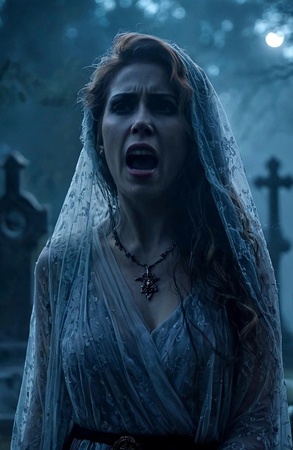
No figure from the Celtic tradition has had a more direct impact on horror cinema than the banshee, and Irish folklore in early horror films returns to her again and again. The bean sidhe, in her original form, was not a monster in the conventional sense. She did not simply announce death and withdraw. In several regional traditions, particularly across Munster, her role was more layered. She was understood at times as a psychopomp figure, one who guided the dying as much as she heralded their passing. Early horror filmmakers grasped only part of this complexity, but even the simplified version carried enormous power.
For audiences in the early decades of the twentieth century, many of whom had experienced genuine mass bereavement through the First World War and the influenza pandemic, this kind of horror carried particular resonance. The idea that death sends a warning, that it observes some formal procedure before arriving, was both terrible and, in a strange way, almost consoling. Irish folklore in early horror films offered fear with a kind of structure to it, and that structure gave audiences something to hold onto even as it frightened them.
The banshee tradition found direct screen expression in productions that treated her not as spectacle but as a figure of mourning. Cry of the Banshee (1970), starring Vincent Price and directed by Gordon Hessler, used the keening woman as the driving force of a revenge narrative built on the certainty of death rather than surprise. Darby O'Gill and the Little People (1959), featuring Albert Sharpe and a young Sean Connery, presented the banshee’s wail as confirmation of fate already sealed.
These films recognized that the banshee’s power lies less in action than in foreknowledge. Irish folklore in early horror films found in her a figure whose terror required no elaborate effects, only performance, atmosphere, and sound.
🍀 Changelings and the Corruption of the Familiar
The changeling tradition gave early horror cinema something equally powerful, and considerably more domestic. According to belief widespread across Ireland, certain supernatural beings associated with the older layers of Irish tradition would sometimes substitute one of their own for a human infant. Here it is worth being precise. The Tuatha De Danann and the broader category of beings described as the people of the mounds are related but not interchangeable.
They represent different layers of belief that were collapsed together over centuries of storytelling, and treating them as simple synonyms flattens a tradition that was always more varied than outsiders recognized. What the changeling stories share across these different strands is the central, disturbing premise: the replaced child looked the same, behaved almost the same, but was not the same.
Irish folklore in early horror films exploited this premise with considerable sophistication. The changeling story is not fundamentally about the supernatural creature. It is about the impossibility of certainty regarding the people closest to you. It raises questions that have no comfortable answers. How do you know the person you love is who they appear to be. What evidence would be sufficient. What would you do if you became convinced they were not. These questions map directly onto the psychological concerns that horror cinema has always circled around. Early cinema found in this tradition a way to generate sustained unease from entirely ordinary-looking situations and people, which was both economically practical and dramatically effective.
The changeling premise, that the familiar may conceal something fundamentally alien, shaped several significant productions across these decades. The Changeling (1980), directed by Peter Medak and starring George C. Scott and Trish Van Devere, follows the emotional and structural logic of the tradition without explicitly citing Irish sources. Village of the Damned (1960), featuring George Sanders and Barbara Shelley, carries a similar idea into science fiction while retaining its folkloric core.
The corrupted child, the unsafe household, and affection turning into dread are all changeling story elements recast for modern audiences. Irish folklore in early horror films seeded this branch of horror so deeply that later filmmakers repeated its narrative logic, often without direct awareness of its origins.
🍀 Geasa, Curses, and Narrative Structure
Irish mythology contains a formal concept, the geis, that functioned as a kind of sacred prohibition. A person under a geis was bound by obligation, and the violation of that obligation set catastrophe in motion. The geis gave ancient Irish narrative a particular shape: the audience knew from the moment the prohibition was established that it would eventually be broken, and that the consequences would be proportionate to the violation.
Irish folklore in early horror films absorbed this structure wholesale, often without acknowledging the source. The haunted house that must not be entered. The object that must not be opened. The name that must not be spoken. These conventions, which became so standard in horror that they feel like genre furniture, trace back to a logic developed over centuries in Celtic storytelling.
This is one of the more underappreciated contributions of Irish folklore in early horror films, because it operates at the level of structure rather than imagery. It is not just that Irish legend supplied monsters. It supplied a way of organizing horror stories that has proven extraordinarily durable.
The curse narrative built on the geis tradition found clear cinematic expression in films where a single broken prohibition drives the story toward unavoidable disaster. The Awakening (1980), starring Charlton Heston and Susannah York, centers on the violation of an ancient site and the catastrophic consequences that follow, echoing the structure of a geis even in an Egyptian setting. The Omen (1976), with Gregory Peck and Lee Remick, follows the same logic: a boundary exists, whether known or ignored, and events unfold with grim inevitability.
Pumpkinhead (1988), featuring Lance Henriksen, makes the curse mechanics explicit by depicting a bargain whose terms proceed without mercy or revision. Irish folklore in early horror films helped establish this tight cause-and-effect architecture, and these later productions show how deeply that narrative pattern became embedded in mainstream horror storytelling.
Early American horror studios frequently adapted European literary sources that themselves had already absorbed Irish supernatural motifs, effectively layering folklore through multiple cultural transmissions.
🍀 Landscape and the Geography of Dread
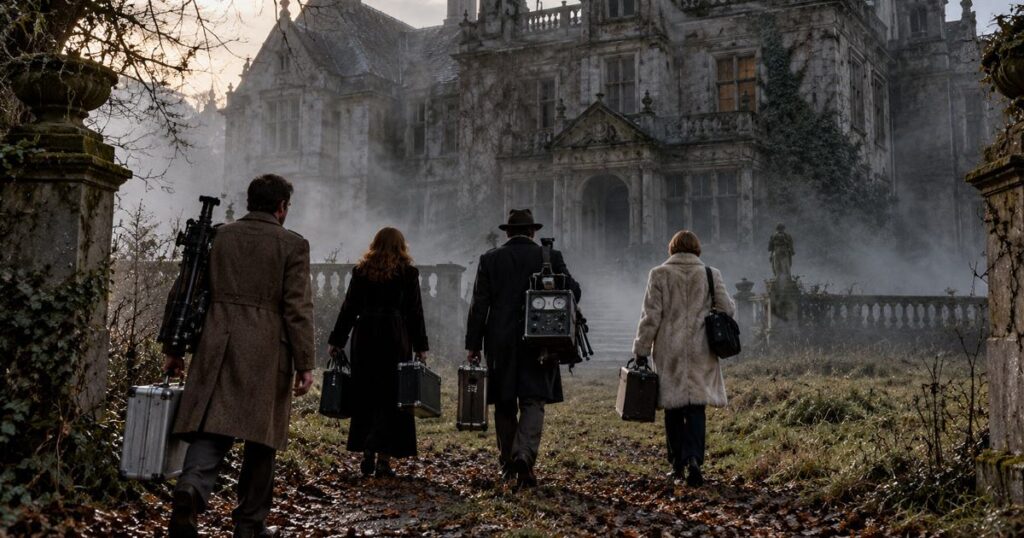
The physical landscape of Ireland carried supernatural meaning in the folklore tradition, and early horror cinema was quick to appropriate that meaning. Bogs were understood as liminal spaces, places that existed between the world of the living and something else. They preserved the dead unnaturally. They obscured boundaries. They swallowed things and returned them changed, or did not return them at all. Irish folklore in early horror films used landscape not merely as background but as a participant in the horror itself. The fog over a marsh, the silhouette of a ruined stone structure on a hillside, the narrow road leading toward a dark tree line, these were not neutral settings.
The fairy mound deserves particular mention. These ancient earthworks, scattered across the Irish countryside, were understood in folklore as dwelling places for beings who were dangerous to disturb. The motif of the accidentally violated sacred place, which recurs constantly in horror cinema, has a direct antecedent in the belief that digging into a hillside without proper regard could provoke consequences no human authority could contain.
The landscape as an active participant in horror found strong expression in films that treated place as more than backdrop. The Wicker Man (1973), starring Edward Woodward and Christopher Lee, made its remote island a deliberate trap, a geography with its own will. An American Werewolf in London (1981), with David Naughton and Griffin Dunne, opened on the Yorkshire moors yet echoed the Celtic idea of liminal wilderness, where ordinary rules fail. The Fog (1980), featuring Adrienne Barbeau and Janet Leigh, used coastal isolation and rolling mist to suggest a boundary between the living and something older.
Ireland itself became explicit terrain in Rawhead Rex (1986), directed by George Pavlou and based on Clive Barker’s story, with David Dukes and Niall Tóibín among its cast. The Irish countryside is presented not as scenery but as a repository of buried, pre-Christian force. Irish folklore in early horror films helped establish this grammar of dread geography, and these later productions show how firmly that language remained embedded in the genre.
Stone ruins and coastal cliffs associated with Irish legend became recurring visual backdrops in studio-built sets during the silent era, even when filming took place far from Ireland.
🍀 The Dullahan and the Pursuer Without Mercy
The Dullahan, a headless rider who carries his severed head and calls out the name of the next to die, stands among the most striking figures in Celtic tradition. Irish folklore in early horror films, filtered through Gothic fiction and literary adaptation, helped shape one of horror’s enduring archetypes: the relentless supernatural pursuer who cannot be reasoned with or escaped by ordinary means. The Dullahan does not chase from anger or hunger, but from duty, and that fixed purpose makes him more unsettling than creatures driven by human emotion.
The archetype of the supernatural pursuer without negotiable motive, which the Dullahan tradition fed into horror cinema, produced some of the genre's most effective and enduring figures. Halloween (1978) with Jamie Lee Curtis gave audiences Michael Myers, a pursuer so stripped of recognizable human motive that he functioned almost as a force of nature, closer in spirit to the Dullahan's purposeful inevitability than to any conventional killer.
The Terminator (1984) carried the same logic into science fiction. Christine (1983) with Keith Gordon, Robert Prosky, and Harry Dean Stanton transferred the relentless pursuer quality onto an object. What these films share is the Dullahan's core terror: the thing coming for you is not angry, not hungry, not negotiating. It is simply coming. Irish folklore in early horror films planted this archetype so deeply in the genre's roots that it grew into some of the most commercially successful horror cinema ever made.
🍀 What Survived and What It Means
The relationship between Irish folklore in early horror films and the horror genre as a whole is not a closed chapter. The conventions and archetypes established in those early decades continue to operate in contemporary cinema, often several steps removed from their origins but still recognizably shaped by them. The death-harbinger, the infiltrated domestic space, the inescapable obligation, the dangerous landscape, the relentless pursuer without motive, all of these remain central to horror as it is practiced today.
What makes the Celtic contribution distinctive is its particular emotional register. Irish folklore is not simply frightening. It is mournful. The banshee grieves. The changeling story is also a story about loss. Even the landscape of dread is a landscape that was once, and perhaps still is, deeply loved. Irish folklore in early horror films carried that ambivalence into a genre that was otherwise inclined toward simpler emotional states, and the genre was the richer for it.
The storytellers who developed these traditions over centuries in Ireland could not have anticipated their eventual audience. They were addressing specific fears, specific landscapes, specific communities. But the fears they named turned out to be broadly human, and the medium that picked them up turned out to have an almost unlimited reach. That is how the keening woman, the stolen child, and the rider in the dark became, eventually, part of the vocabulary of world cinema.
Why It Still Matters
Irish folklore in early horror films demonstrates how regional myth traditions were transformed into cinematic language during the formative decades of the medium. These adaptations shaped visual conventions and narrative patterns that continued to influence horror filmmaking long after the silent era ended.
Further Reading & Resources
🔍 Explore: The National Folklore Collection (Dúchas.ie)