🎃 Summer Halloween Movies Strange Seasonal Horror Picks

Summer settings often feel far removed from autumn, yet summer Halloween movies manage to carry that same uneasy tone into bright daylight. A close look at summer Halloween movies shows how filmmakers use heat, isolation, and stillness to mirror October’s quiet tension. Films such as Friday the 13th from 1980 with Betsy Palmer and Adrienne King, and Midsommar from 2019 starring Florence Pugh and Jack Reynor, demonstrate how different eras arrive at the same unsettling effect through entirely different visual language.
Summer Halloween movies refer to horror and suspense films set during warm weather that maintain themes commonly associated with autumn. These films often use bright environments, open spaces, and seasonal activities as a contrast to underlying tension. They were produced across several decades, particularly in slasher, supernatural, and thriller genres. Their continued presence reflects how horror storytelling adapts to setting while preserving core narrative structures.
🌞 Why Watch Summer Halloween Movies
Many viewers return to summer Halloween movies because they offer familiar horror moods in an unexpected seasonal setting. The contrast between bright skies and dark themes creates a subtle tension that feels grounded rather than exaggerated. In warm-weather settings, danger appears without warning and without the visual cues often associated with October, which can make the experience feel more immediate. The absence of falling leaves and dim light does not weaken the atmosphere. Instead, it replaces those elements with still air, long afternoons, and the sense that something is slightly out of place.
In daylight settings, the absence of darkness removes many familiar visual cues, which shifts attention toward quieter elements. Sound design becomes more noticeable, whether it is distant movement, water against shorelines, or the simple absence of noise. Pacing also changes, as scenes tend to linger longer, allowing small details to carry weight. Characters are often placed in open environments where there is nowhere obvious to hide, which creates a different kind of unease that builds gradually rather than through sudden shocks.
Discover more Celebrity Articles Here
🔪 Classic Summer Slashers
Early summer Halloween movies in the slasher category established a pattern of danger tied to youth and isolation. These summer Halloween movies rely on simple setups that allow tension to build steadily without distraction. Friday the 13th from 1980, featuring Betsy Palmer and Kevin Bacon, centers on a remote camp reopening after tragedy, where silence and distance shape the threat.
The Texas Chain Saw Massacre from 1974, with Marilyn Burns and Gunnar Hansen, places its characters in rural heat, where exhaustion and confusion amplify fear. Sleepaway Camp from 1983, starring Felissa Rose, uses familiar camp routines to mask its darker turns. I Know What You Did Last Summer from 1997, with Jennifer Love Hewitt and Sarah Michelle Gellar, shifts the setting to a coastal town, yet still carries the same sense of consequence tied to past actions. These films rely less on seasonal decoration and more on human behavior under pressure.
🌊 Beach & Coastal Horror
Some summer Halloween movies shift the fear to open water and coastal towns, where the horizon itself feels uncertain. Jaws from 1975, directed by Steven Spielberg and starring Roy Scheider and Richard Dreyfuss, uses the ordinary setting of a beach community to explore unseen danger beneath calm surfaces. The Fog from 1980, featuring Adrienne Barbeau, Janet Leigh, and Jamie Lee Curtis, introduces a creeping presence that arrives with the tide, tying history to place.
Piranha from 1978, with Bradford Dillman, approaches the same setting with a more direct threat, emphasizing chaos over mystery. The Shallows from 2016, starring Blake Lively, isolates its character in open water, where distance becomes a barrier rather than freedom. In each case, the setting remains bright and familiar, yet the tone shifts toward unease through suggestion and pacing.
🏕️ Summer Camp Horror Favorites
The appeal of summer Halloween movies in camp settings comes from the uneasy contrast between recreation and threat. The Burning from 1981, featuring Brian Matthews and a young Jason Alexander, presents a story shaped by past actions returning to disrupt a structured environment.
Madman from 1981, starring Paul Ehlers, relies on storytelling traditions within the camp itself, where warnings are dismissed until they take form. Camp Cold Brook from 2018, with Danielle Harris, introduces a more modern perspective, blending investigation with familiar isolation. These films use the same basic setting but approach it from different angles, each emphasizing the vulnerability that comes with distance from everyday life.
The physical layout of camps plays a significant role in shaping tension. Cabins are spread out, pathways wind through wooded areas, and natural boundaries such as lakes or tree lines limit movement. These spaces feel familiar at first, yet they can quickly become confusing when viewed under stress. The distance between structures means that help is rarely immediate, and simple tasks such as walking from one location to another can carry an unexpected sense of risk.
👻 Supernatural Summer Scares
A quieter group of summer halloween movies leans into supernatural themes while keeping the seasonal backdrop intact. Poltergeist from 1982, directed by Tobe Hooper and starring JoBeth Williams and Craig T. Nelson, presents a suburban environment disrupted by unseen forces, where ordinary life becomes unstable.
The Others from 2001, with Nicole Kidman, uses a different climate but maintains a sense of isolation and controlled space that mirrors summer stillness. The Wicker Man from 1973, starring Edward Woodward and Christopher Lee, sets its story during a community’s seasonal rituals, where daylight does not lessen the sense of unease. These films move away from physical threats and instead focus on presence, memory, and belief.
When supernatural elements enter otherwise calm environments, the contrast becomes more pronounced. A quiet neighborhood or an isolated property in warm weather suggests stability and routine, which makes any disruption feel sharper. Subtle changes in behavior, unexplained sounds, or shifts in atmosphere stand out more clearly because the setting itself offers no natural explanation. This approach allows the unusual to emerge slowly, without relying on spectacle.
🧛 Fun & Light Summer Spooky Movies
Not all summer Halloween movies aim for dread, as some balance humor and nostalgia with gentle suspense. The Lost Boys from 1987, starring Jason Patric and Kiefer Sutherland, places its story in a coastal town where youthful rebellion and supernatural elements intersect. Beetlejuice from 1988, with Michael Keaton and Geena Davis, offers a stylized approach, where the unusual becomes part of everyday life.
Scooby-Doo on Zombie Island from 1998, featuring the familiar voice cast including Frank Welker, presents mystery within a warmer setting, allowing tension to exist without overwhelming the tone. These films demonstrate that atmosphere can be adjusted without losing the connection to familiar themes.
Monster Summer (2024, PG-13, 1h 37m)
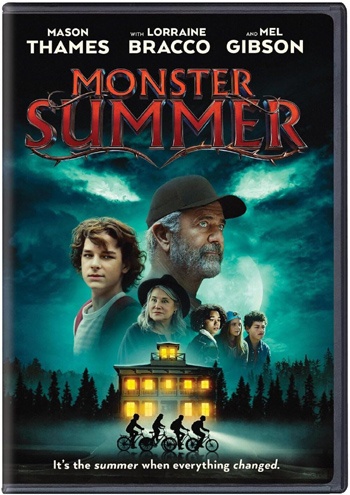
Director: David Henrie
Writers: Cornelius Uliano & Bryan Schulz
Stars: Mel Gibson, Mason Thames, Julian Lerner, Lorraine Bracco
Product Description:
When a mysterious force begins to disrupt their big summer fun, Noah and his friends team up with a retired police detective to investigate strange events spreading across their island. What starts as curiosity quickly turns into a tense race to uncover what is hiding beneath the surface before it changes everything around them.
Highlights:
• Blends coming-of-age adventure with light suspense and mystery elements
• Features a coastal island setting that shifts from relaxed to uneasy
• Strong ensemble cast led by Mason Thames and Mel Gibson
• Focuses on friendship, curiosity, and facing the unknown
• PG-13 tone makes it accessible while still carrying tension
Why It Stands Out:
The film uses familiar summer Halloween movies imagery such as beaches, bikes, and long daylight hours, then gradually introduces disruption into that routine. The result is a steady shift in tone rather than a sudden shock, which allows the story to build in a grounded way. Its balance of youthful perspective and investigative elements gives it a distinct place among modern seasonal suspense films.
🌙 Modern Summer Horror Picks
Recent summer Halloween movies show that the approach still works when adapted to modern storytelling. These newer summer Halloween movies often focus on atmosphere over shock, drawing from older traditions. Midsommar from 2019, with Florence Pugh, uses constant daylight to create a sense of disorientation rather than comfort. Us from 2019, directed by Jordan Peele and starring Lupita Nyong’o, places its story within a family setting that slowly reveals deeper layers of tension. It Follows from 2014, with Maika Monroe, avoids a fixed seasonal identity but maintains a warm-weather tone that supports its quiet pacing. These films rely on restraint, allowing the viewer to notice small details that build over time.
Recent films often rely on restraint rather than constant action, allowing tension to develop over time. Dialogue is used sparingly, and long stretches of silence encourage attention to visual detail. Scenes may unfold at a measured pace, giving space for the viewer to notice patterns and inconsistencies. This method reflects a shift toward atmosphere-driven storytelling, where the overall tone carries as much importance as the events themselves.
🎬 What Makes a Summer Movie Feel Like Halloween
At their core, these summer Halloween movies succeed by translating the emotional rhythm of October into a different time of year. The absence of traditional imagery does not reduce their effect. Instead, it shifts attention to sound, pacing, and character behavior. Long stretches of quiet, minimal movement, and a focus on environment create a similar sense of anticipation. Whether set in a camp, a coastal town, or a suburban home, the key lies in how tension is introduced and sustained. The result is a body of work that feels consistent in tone despite its varied settings, offering a different path to the same emotional outcome.