Best Legal Movies Ranked: Top Courtroom Drama Films
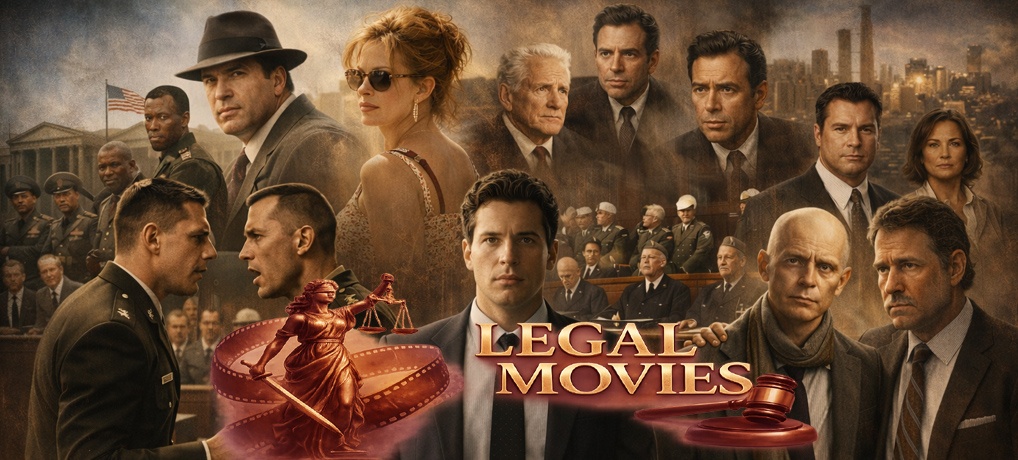
Legal movies have a way of pulling you into the room and making you feel every argument, every objection, and every moment of doubt. Some are based on real cases, others are pure fiction, but the best ones all share one thing: they make the outcome feel personal. From quiet black-and-white classics to modern courtroom battles, these films show how much can rest on a single decision. Legal movies have built one of the most dependable genres in American cinema, and the best of them hold up decade after decade.
Legal movies are narrative films built around courtroom procedure, trial law, and the legal system as a dramatic framework. They emerged as a distinct genre in American cinema during the studio era, drawing from high-profile criminal and civil cases that generated public interest in how law operated. The genre functions by placing characters under the pressure of formal judgment, using cross-examination, testimony, and jury deliberation as the primary vehicles for conflict. Legal films have appeared across comedy, thriller, and social drama, reflecting changing public attitudes toward justice, institutional authority, and individual rights. From the Nuremberg trials to wrongful termination cases, the subject matter has consistently drawn from real legal history while adapting it to the conventions of popular entertainment.
The Verdict, released in 1982, is the film that best illustrates what separates a courtroom drama from a legal procedural. Paul Newman’s Frank Galvin is not a hero in any conventional sense. He is a lawyer who has failed more than he has won, and the case at the center of the film is one he nearly walks away from. What makes the film work is that the courtroom is only the final destination. Most of the story happens in the spaces around it, in the decisions a person makes when the system offers every reason to quit.
⚖️ True Stories and Real Cases
Among all legal movies, the ones rooted in real events carry a particular kind of gravity. The audience already knows something terrible happened. The question is whether the system will answer for it.
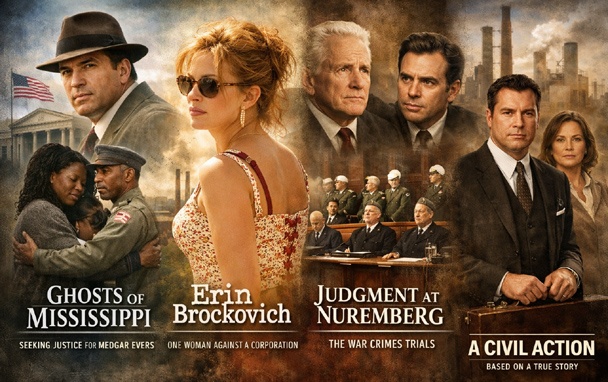
Ghosts of Mississippi follows the decades-long effort to prosecute Byron De La Beckwith for the 1963 murder of civil rights leader Medgar Evers. Alec Baldwin plays Bobby DeLaughter, the district attorney who reopens a case most people assumed was permanently buried. Whoopi Goldberg plays Myrlie Evers, whose persistence over thirty years made the prosecution possible. James Woods earned an Oscar nomination for his portrayal of Beckwith, a man who had bragged about the killing for years. The film does not sensationalize. It sits with the weight of delayed justice and asks whether arriving late is the same as arriving at all.
Erin Brockovich puts Julia Roberts in the role of a single mother with no legal training who helps build a massive environmental case against Pacific Gas and Electric. Albert Finney plays Ed Masry, her reluctant boss, and the dynamic between them is one of the more believable partnerships in courtroom film history. The film earned Roberts an Academy Award and introduced the story of Hinkley, California to a generation that had never heard of it. Steven Soderbergh directed with enough restraint to keep the procedural elements from overwhelming the human story at the center.
Discover more Movie and TV Reviews Here
Judgment at Nuremberg remains one of the most demanding entries in the genre. Stanley Kramer directed a film that runs nearly three hours and does not apologize for it. Spencer Tracy plays an American judge presiding over the trials of German judiciary officials. Maximilian Schell won an Oscar for Best Actor as the defense attorney. Marlene Dietrich, Burt Lancaster, Montgomery Clift, and Judy Garland all appear in supporting roles of varying scope. The film asks whether following orders is a defense, and it does not answer the question cheaply.
A Civil Action places John Travolta as Jan Schlichtmann, a personal injury lawyer who takes on a contaminated water case in Woburn, Massachusetts, and nearly destroys his firm in the process. Robert Duvall plays the lead defense attorney with characteristic economy. The film captures how civil litigation can grind down even the most committed plaintiff, and how corporations can outlast individuals simply through resources and time.
🎬 Classic Courtroom Dramas
The foundation of legal movies as a genre was built on a handful of films that prioritized dialogue, performance, and moral tension over action or spectacle.
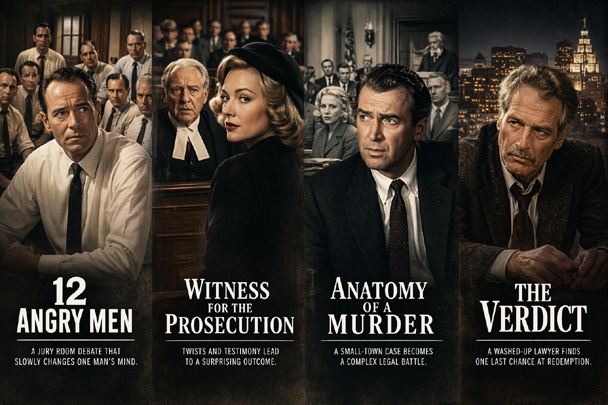
12 Angry Men, directed by Sidney Lumet, never leaves the jury room. Henry Fonda plays the lone holdout who refuses to vote guilty without discussion. Lee J. Cobb, Ed Begley, Jack Warden, and Martin Balsam round out an ensemble that makes the deliberation feel like a pressure cooker rather than a civic exercise. The film was adapted from a television play and found its permanent place through decades of critical reassessment, despite a modest theatrical run.
Witness for the Prosecution gives Charles Laughton one of his finest roles as a barrister defending Tyrone Power against a murder charge. Marlene Dietrich plays the defendant’s wife, and the film’s final turn is as cleanly constructed a surprise as the genre has produced. Billy Wilder directed with confidence, and the film rewards close attention to everything said in the early scenes.
Anatomy of a Murder features James Stewart as a small-town Michigan attorney defending Ben Gazzara on a murder charge. Lee Remick plays the defendant’s wife, and the film unfolds with an unusual frankness about legal strategy and the way courtroom narrative is constructed rather than discovered. George C. Scott appears as the prosecutor. Duke Ellington composed the score.
The Verdict gives Paul Newman his most celebrated performance. He plays Frank Galvin, a Boston attorney who has been coasting on alcohol and low-stakes cases until a medical malpractice suit forces him to make real decisions. Charlotte Rampling, Jack Warden, and James Mason co-star. Sidney Lumet directed again, and the film moves slowly enough that the climax earns its emotion.
The 1957 production of the legal movie of 12 Angry Men was filmed almost entirely within a single room and completed in under three weeks, making it one of the most efficiently shot courtroom films in Hollywood history. Sidney Lumet deliberately raised the camera angles as the deliberation grew more intense, a technique designed to increase psychological pressure without changing the set.
🔍 Legal Thrillers
Some legal movies are less interested in courtroom procedure than in the thriller architecture surrounding it. These films use legal settings as a container for suspense and misdirection.
Primal Fear casts Richard Gere as a high-profile defense attorney who takes on a case involving a young altar boy accused of murder. Edward Norton appears as the defendant in his film debut, and his performance shifts the entire weight of the movie before the credits roll. Frances McDormand and Laura Linney appear in supporting roles. The film moves like a conventional thriller until it does not.
The Client adapts John Grisham‘s novel with Tommy Lee Jones as a federal prosecutor and Susan Sarandon as a legal aid attorney protecting a young boy who overheard something he was not supposed to hear. Jones plays the role with the comfortable authority he brings to most of what he does. The film is efficient and entertaining without requiring more than it delivers.
Runaway Jury puts John Cusack and Rachel Weisz against Gene Hackman and Dustin Hoffman in a story about jury manipulation in a firearms liability case. The pairing of Hackman and Hoffman on opposing sides was treated as a notable event in itself, given that the two actors had not shared the screen before. The film is built around process and information rather than confession or combat.
Suspect pairs Cher as a public defender with Dennis Quaid as a juror who starts feeding her information from inside the jury room. The premise is legally absurd, but the film commits to it with enough conviction to stay engaging.
Gene Hackman and Dustin Hoffman, who appear on opposing sides in Runaway Jury, had been close friends since the early 1960s when both were struggling actors sharing a New York apartment building with Robert Duvall.
😂 Lawyer Comedies
Legal movies have occasionally made room for comedy, and a few of those films belong alongside the dramas.
My Cousin Vinny remains the most respected entry in the subgenre. Joe Pesci plays Vincent Gambini, a New York personal injury lawyer with no trial experience who shows up in rural Alabama to defend his cousin, played by Ralph Macchio. Marisa Tomei won the Academy Award for Best Supporting Actress as his fiancée, whose knowledge of automotive mechanics turns out to matter. The film works because it respects the courtroom even while finding humor in the mismatch between its protagonist and his surroundings.
From the Hip gives Judd Nelson room to play a young attorney who grandstands his way through cases until the methods catch up with him. John Hurt plays his client in the more serious second half of the film. It is a less celebrated film, but Nelson holds the screen throughout.
Liar Liar builds its premise entirely around Jim Carrey as a lawyer who cannot lie for twenty-four hours. The film is broad and fast, but Carrey’s physical commitment to the concept makes even the most improbable moments land. Maura Tierney and Justin Cooper co-star.
Marisa Tomei’s Academy Award win for My Cousin Vinny in 1993 was widely doubted at the time, with persistent rumors that presenter Jack Palance had misread the envelope. No evidence has ever supported this claim, and the Academy confirmed the result was accurate.
🧢 Underdog and Redemption Stories
Some of the most enduring legal movies are shaped around the idea of a person or a cause that has no realistic chance of winning.
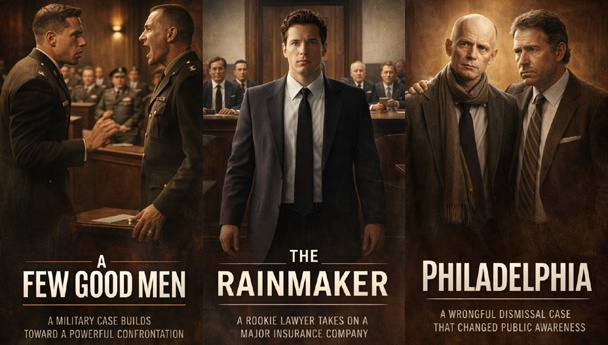
A Few Good Men is driven by Tom Cruise as a Navy lawyer who would rather negotiate than litigate until the case demands he actually show up. Jack Nicholson‘s cross-examination scene has been quoted and referenced more than almost anything in legal cinema. Kevin Bacon, Demi Moore, and Kevin Pollak round out a cast that gives the film more texture than the courtroom confrontation alone would provide.
The Rainmaker puts Matt Damon as a fresh law school graduate facing down Jon Voight and a large insurance company on behalf of a dying young man. Francis Ford Coppola directed from the John Grisham novel, and the film benefits from Danny DeVito in a supporting role as a paralegal with no credentials and considerable practical knowledge.
Philadelphia places Tom Hanks in the role of Andrew Beckett, an attorney fired after his employer discovers he has AIDS. Denzel Washington plays the personal injury lawyer who takes the case despite his own discomfort. Jonathan Demme directed the film with a directness that gave mainstream audiences access to a story they might otherwise have avoided. The film changed the public conversation about AIDS in a way that few legal movies have managed to affect broader culture.
⚖️ Closing Thoughts
The best legal movies are not just about winning or losing. They are about truth, pressure, and the choices people make when everything is on the line. Across six decades and a wide range of tones and styles, these films have returned again and again to the same fundamental drama: one person, one room, and the question of what really happened. Whether the approach is classical or contemporary, comic or solemn, the genre holds because the stakes it describes are ones that anyone can understand.
Why It Still Matters
The courtroom film endures because it requires no special knowledge to follow and no suspension of disbelief to accept. The room is familiar, the stakes are human, and the outcome is never entirely certain until it arrives. Legal movies have served as a reliable mirror for whatever the public most fears or hopes from its institutions, whether that was postwar accountability in Judgment at Nuremberg, corporate power in Erin Brockovich, or systemic bias in Philadelphia. The genre does not require spectacle to function. It requires only a confined space, a question without an obvious answer, and enough pressure to make the characters show what they are made of.
Further Reading & Resources
📖 Read: 65+ Great Legal Movies, Ranked By Fans
🔍 20 Best Legal Movies of All Time, Ranked