🎬 Robert Duvall: The Quiet Force of American Film

Robert Duvall never needed fireworks to command a screen. He built his reputation on restraint, on the slow burn rather than the explosion. While other actors reached for grand gestures, Duvall leaned into stillness. That quiet intensity became his signature, turning supporting roles into centerpieces and centerpieces into master classes.
Robert Duvall was one of the most respected actors of modern American cinema, known for his powerful restraint and unforgettable performances in The Godfather (1972), Apocalypse Now (1979), and Tender Mercies (1983). Over a career spanning more than six decades, he became a defining presence in both supporting and leading roles. His Academy Award-winning work and multiple nominations cemented his reputation as a master of disciplined, realistic acting. Duvall’s influence continues to shape generations of performers and filmmakers.
He emerged during a period when American film was shifting toward realism. Directors wanted truth, not polish. Duvall delivered it with unsettling ease. Whether standing in the background or carrying the weight of a story, he gave every character a lived-in gravity that felt earned rather than performed.
Across decades of work, he moved from stage to film to television without losing that grounded presence. Audiences remember him not for spectacle, but for conviction. He made complicated men understandable, and in doing so, became one of the most respected actors of his generation.
Robert Duvall won his Academy Award for Tender Mercies by playing a broken country singer with almost no theatrics, proving that stillness can be more powerful than spectacle.
👶 Early Life
Summary: Raised in a disciplined military family, Duvall developed his craft through theater training and early stage experience.
Robert Duvall was born January 5, 1931 in San Diego, California, into a military family. His father was a career naval officer, and that background shaped the steady, disciplined atmosphere of his childhood. The family moved frequently, eventually settling for a time in Virginia. Order, duty, and structure were part of daily life, yet Duvall quietly gravitated toward something less predictable.
He developed an interest in acting while still young, though it was hardly the obvious path for a Navy admiral’s son. After college and a brief period of service in the United States Army during the Korean War era, he made a deliberate choice to pursue the stage. It was not a glamorous beginning. He trained seriously, studying acting in New York alongside classmates who would later become legends in their own right.
In the late 1950s, Duvall was part of a tight circle of aspiring performers that included Dustin Hoffman and Gene Hackman. They shared apartments, struggled through auditions, and sharpened their craft in small theater productions. The early years were marked by patience and persistence rather than quick success. That foundation in disciplined stage work would become the backbone of a film career defined by authenticity.
Explore the Biographies of Iconic Celebrities
Robert Duvall and Dustin Hoffman once shared a modest New York apartment while studying acting before either became famous.
🎬 Movie Career
Summary: From The Godfather to The Judge, Duvall built a career defined by authenticity, versatility, and critical acclaim.
Robert Duvall’s film career began with a performance that contained almost no dialogue, yet it announced him immediately. In To Kill a Mockingbird (1962), directed by Robert Mulligan and starring Gregory Peck, Duvall appeared as Boo Radley. His screen time was brief, but the quiet gravity he brought to the role left a lasting impression. It was an early sign that he did not need volume to be powerful.
The 1970s transformed him from respected actor to essential presence. In The Godfather (1972), directed by Francis Ford Coppola, he portrayed Tom Hagen alongside Marlon Brando, Al Pacino, James Caan, and Diane Keaton. The performance earned him a nomination at the 45th Academy Awards: Best Actor in a Supporting Role, nomination, The Godfather (1972). He returned in The Godfather Part II (1974), further deepening the character’s quiet authority within the Corleone family.
That decade continued with bold choices. In Apocalypse Now (1979), again under Francis Ford Coppola, Duvall delivered one of the most quoted performances of the era as Lt. Col. Bill Kilgore opposite Martin Sheen, Marlon Brando, and Laurence Fishburne. His role earned recognition at the 52nd Academy Awards: Best Actor in a Supporting Role, nomination, Apocalypse Now (1979). The now-famous line about loving the smell of napalm cemented his place in cinematic history.
Between those milestones, he explored wide-ranging characters. In Network (1976), directed by Sidney Lumet, he appeared with Peter Finch, Faye Dunaway, and William Holden, embodying corporate ambition with unsettling calm. In The Eagle Has Landed (1976), he acted alongside Michael Caine and Donald Sutherland, proving equally effective in large-scale war drama.
Duvall moved seamlessly into leading roles. In The Great Santini (1981), he portrayed a demanding Marine father opposite Blythe Danner, earning a nomination at the 53rd Academy Awards: Best Actor in a Leading Role, nomination, The Great Santini (1981). The performance was layered and personal, revealing vulnerability beneath rigid authority.
His defining triumph arrived with Tender Mercies (1983). Playing country singer Mac Sledge, Duvall delivered a restrained and deeply human portrayal that resonated far beyond its modest budget. The role earned him the 56th Academy Awards: Best Actor in a Leading Role, win, Tender Mercies (1983). It remains one of the most respected performances of the 1980s, praised for its authenticity and emotional restraint.
In the 1990s, he maintained that momentum. In The Apostle (1997), a project he also wrote and directed, Duvall played a troubled preacher seeking redemption. The performance earned recognition at the 70th Academy Awards: Best Actor in a Leading Role, nomination, The Apostle (1997). A year later, he appeared in A Civil Action (1998) opposite John Travolta, receiving acknowledgment at the 71st Academy Awards: Best Actor in a Supporting Role, nomination, A Civil Action (1998).
His later career showed no signs of slowing. In Open Range (2003), which he directed and starred in alongside Kevin Costner and Annette Bening, Duvall returned to the Western genre with quiet authority. More than a decade later, he appeared in The Judge (2014) with Robert Downey Jr., earning recognition at the 87th Academy Awards: Best Actor in a Supporting Role, nomination, The Judge (2014).
Across decades, Robert Duvall worked with directors such as Francis Ford Coppola, Sidney Lumet, and Robert Altman, and alongside performers including Al Pacino, Marlon Brando, John Travolta, Kevin Costner, and Robert Downey Jr. His career was not built on flash, but on truth. From supporting roles to Oscar-winning leads, he remained steady, disciplined, and unmistakably authentic.
He was a trained ballet dancer in his youth, which he credited for improving his physical control and posture on screen.
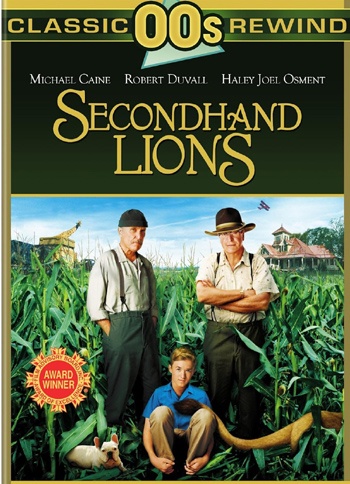
Secondhand Lions (WS/FS) (Line Look/DVD)
Product Description:
Over one unforgettable Central Texas summer in the early 1960s, everything changes for fourteen-year-old Walter (Haley Joel Osment). Sent to spend the season with his eccentric great-uncles, Hub and Garth McCann (Robert Duvall and Michael Caine), Walter expects boredom and isolation. Instead, he finds himself drawn into larger-than-life stories of adventure, romance, and daring exploits from a mysterious past.
Rumored to have been bank robbers, hit men, or war criminals in their youth, the uncles slowly reveal tales of distant deserts, charging stallions, sword fights, princesses, and treacherous sheiks. As the dusty Texas nights unfold, Walter’s imagination transforms those stories into sweeping legends of bravery and honor.
Film Highlights:
• Starring Robert Duvall, Michael Caine, and Haley Joel Osment.
• A heartfelt coming-of-age story set against the wide-open Texas landscape.
• Blends family drama with fantasy adventure sequences.
• Directed by Tim McCanlies.
• A modern classic about courage, storytelling, and finding your place in the world.
Why You’ll Enjoy This Film:
Secondhand Lions balances humor and heart with old-fashioned adventure. Duvall and Caine deliver performances filled with grit, warmth, and quiet dignity. The film celebrates imagination, loyalty, and the bond between generations, making it a favorite for family viewing while still resonating deeply with adults.
Buy on Amazon
🏠 Personal Life • Political Views • Philanthropy & Activism
Summary: Duvall lived privately in Virginia, balancing artistic independence with personal convictions and cultural interests.
Robert Duvall’s personal life was far removed from Hollywood spectacle. He married four times, including to actress Barbara Benjamin, and later to Argentine filmmaker Luciana Pedraza, who became both his partner and collaborator. Unlike many of his contemporaries, Duvall preferred rural life over industry social circles. He spent much of his time in Virginia, raising horses and living quietly away from the spotlight.
His connection to Argentina, through Pedraza, deepened over the years. The two shared an interest in traditional horsemanship and culture, often supporting equestrian and cultural preservation events. Duvall’s appreciation for craftsmanship extended beyond film into land stewardship and heritage traditions.
Politically, Robert Duvall did not fit neatly into Hollywood’s common narrative. He identified with conservative viewpoints and supported Republican candidates at various times, including expressing admiration for leaders such as Ronald Reagan and later George W. Bush. However, he remained largely private about party politics, preferring to speak about independence, responsibility, and personal discipline rather than campaign rhetoric.
Philanthropically, Duvall focused on causes tied to the arts and cultural preservation. He supported theater initiatives and projects aimed at maintaining traditional music and storytelling. Through his independent film efforts, particularly with The Apostle, he demonstrated a commitment to creative control and artistic integrity rather than large studio backing.
While many actors sought constant visibility, Duvall built a reputation for discretion. His activism was quiet, rooted more in personal belief and local engagement than public campaigning. In both life and career, he favored substance over spectacle, a reflection of the same grounded character that defined his work on screen.
🕊️ Later Years
Summary: Even into his nineties, he continued working selectively, maintaining creative control and artistic integrity.
In his later decades, Robert Duvall showed no interest in slowing down. While many actors gradually withdrew from demanding roles, he continued choosing projects that challenged him rather than simply honoring his reputation. He moved easily between independent films and major studio releases, maintaining the same steady presence that defined his earlier work.
In Secondhand Lions (2003), opposite Michael Caine and Haley Joel Osment, he brought warmth and dry humor to the role of an aging uncle guarding family secrets. The performance introduced him to a younger audience without softening his authority. That same year, he directed and starred in Open Range (2003) alongside Kevin Costner and Annette Bening, reaffirming his respect for traditional Western storytelling.
The 2010s proved that age did not diminish his command. In Get Low (2009), he played a reclusive man planning his own funeral, earning critical praise for a performance that blended mystery with vulnerability. In The Judge (2014), acting opposite Robert Downey Jr., he delivered a deeply human portrayal of a stern father confronting mortality. The role earned him his seventh Academy Award nomination, demonstrating that his craft had only grown more refined.
Even in his nineties, Duvall remained selective rather than nostalgic. He preferred character-driven stories and maintained creative independence whenever possible. Interviews from this period reveal a man still committed to discipline, preparation, and honesty in performance. There was no farewell tour, no grand announcement of retirement. He worked because he still believed in the work.
In his final years, Duvall lived quietly in Virginia with his wife, Luciana Pedraza, staying close to the rural traditions and disciplined life that had shaped him from childhood. Robert Duvall died on February 15, 2026, at the age of ninety-five. His passing marked the close of a career that spanned more than six decades, leaving behind performances that continue to define American cinema.
Robert Duvall personally funded much of The Apostle (1997) when studios declined to back it, insisting on creative control and authenticity.
🏆 Legacy
Summary: Robert Duvall remains a benchmark for disciplined, realistic screen acting in American film history.
Robert Duvall’s legacy rests on discipline, restraint, and an unwavering commitment to truth in performance. He was never dependent on spectacle or celebrity culture. Instead, he built his reputation on precision, preparation, and emotional control. Whether portraying Tom Hagen in The Godfather (1972) or Mac Sledge in Tender Mercies (1983), he demonstrated that stillness could be more powerful than theatrics.
He helped redefine the modern character actor. In an era when film was shifting toward realism, Duvall stood at the center of that movement. His work alongside Marlon Brando, Al Pacino, Martin Sheen, and Robert Downey Jr. placed him within several of the most influential films of the late twentieth century. Yet he never overshadowed a story. He strengthened it from within.
His Academy Award win and multiple nominations reflect industry recognition, but his deeper influence lies in craft. Younger actors frequently cited him as a model of professionalism. Directors trusted him to elevate material without drawing attention to the mechanics of acting itself.
More than anything, Robert Duvall represented longevity without compromise. Across decades of changing trends, he remained steady. His performances endure not because they were loud, but because they were honest. That quiet integrity is what secures his place in American film history.
🗣️ Why They Still Matter:
Robert Duvall’s career demonstrated that disciplined realism could anchor some of the most influential films of the twentieth century. His performances remain reference points for actors seeking authenticity rather than showmanship.
Further Reading & Resources
📖 Read: Robert Duvall | Biography, Movies, & Facts | Britannica
🔍 Explore: Robert Duvall The Movie Database (TMDB)