Henry Fonda Biography: Remarkable Career of a Timeless Star
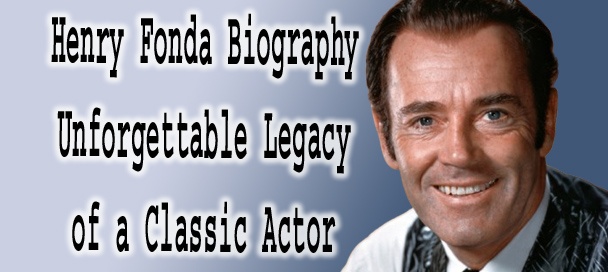
Henry Fonda in a promotional headshot for Warlock (1959)
Henry Fonda stood as one of the defining figures of American screen acting, a performer whose quiet authority reshaped the idea of the leading man. At a time when Hollywood often favored flamboyance, he brought restraint, moral gravity, and a steady presence that audiences trusted without question. His work carried a sense of honesty that felt less like performance and more like lived experience.
Henry Fonda was one of the most respected American actors of the twentieth century, known for his calm authority and moral presence on screen. He delivered landmark performances in films such as The Grapes of Wrath (1940), 12 Angry Men (1957), and Once Upon a Time in the West (1968). His career spanned decades, blending stage and film work with a reputation for quiet strength. Fonda’s influence helped define a generation of character-driven storytelling rooted in realism and integrity.
Across decades of film and stage, Fonda became closely associated with characters rooted in principle, often portraying men caught between personal conviction and larger social forces. His roles reflected the tensions of his era, particularly during periods when the nation itself was wrestling with questions of justice, identity, and responsibility. He did not dominate scenes through force, but through a calm intensity that lingered long after the moment passed.
What set Fonda apart was his ability to suggest depth without excess, allowing silence and stillness to carry meaning. He represented a tradition of American acting that valued clarity and truth over display, influencing generations who followed. In an industry built on image, he remained something rarer, a figure whose credibility gave weight to every story he entered.
Despite portraying some of the most morally grounded characters in film history, Henry Fonda’s personal life was often marked by distance and complexity, revealing a contrast that still fascinates audiences today.
👶 Early Life
Summary: Raised with strong Midwestern values, Henry Fonda’s early years shaped the quiet discipline seen throughout his career.
Henry Fonda was born on May 16, 1905, in Grand Island, Nebraska, into a family shaped by Midwestern values and quiet discipline. His father, William Brace Fonda, worked in the printing business, while his mother, Elma Herberta Jaynes, encouraged an appreciation for literature and the arts. The household was orderly and reserved, a setting that would later echo in Fonda’s own composed public presence.
His childhood unfolded within a community that prized hard work and modesty, and he absorbed those expectations without question. As a boy, he was observant rather than outspoken, more inclined to watch than to lead, developing an inward focus that set him apart from more extroverted peers. During his teenage years, he attended local schools and later enrolled at the University of Minnesota, though his path there showed little sign of a clear artistic direction.
Fonda’s first encounter with acting came almost by accident when he joined a local theater group at the encouragement of family friends. What began as a casual diversion soon revealed a natural ease on stage, though it did not come without difficulty. He struggled with confidence and presence, often working through nerves that contrasted sharply with the calm authority he would later project. These early efforts, shaped by uncertainty and persistence, laid the foundation for a style that would favor restraint over showmanship.
Explore the Biographies of Iconic Celebrities
Henry Fonda served in the U.S. Navy during World War II and earned a Bronze Star for his service.
🎬 Film Career
Summary: His film work spanned decades, with iconic roles that influenced American cinema and storytelling.
Henry Fonda entered motion pictures in the mid-1930s, bringing with him a stage-honed sense of discipline that translated cleanly to the screen. His early appearances in films such as The Farmer Takes a Wife (1935) and Way Down East (1935) established a presence that was understated yet dependable. While others leaned into theatricality, Fonda’s approach was already defined by simplicity and control, qualities that began to draw attention in an industry still adjusting to sound film.
His stature rose steadily with performances in Jezebel (1938) opposite Bette Davis and Young Mr. Lincoln (1939) under the direction of John Ford. That same year, he appeared in Drums Along the Mohawk (1939), further cementing a collaboration with Ford that would become one of the most respected actor-director partnerships of the era. Fonda’s ability to portray integrity without excess gave these roles a lasting weight, setting him apart from many of his contemporaries.
The defining moment of his early career arrived with The Grapes of Wrath (1940), with Jane Darwell and John Carradine. Here his portrayal of Tom Joad became a cultural landmark. Directed again by John Ford, the film captured the hardship of the Great Depression with a realism that resonated deeply, and Fonda’s performance earned him an Academy Award nomination. He followed this with The Lady Eve (1941), directed by Preston Sturges, showing a lighter, comedic side opposite Barbara Stanwyck, proving his range extended beyond solemn roles.
During the early 1940s, Fonda continued to balance drama and character-driven storytelling with films like The Ox-Bow Incident (1943), a stark examination of mob justice that highlighted his skill in conveying moral conflict. His film work paused when he entered military service during World War II, a decision that reflected the same sense of duty often seen in his screen roles. Upon returning, he resumed acting with renewed focus, choosing projects that aligned with his measured style.
In the postwar years, Fonda appeared in My Darling Clementine (1946), with Linda Darnell, Victor Mature, Walter Brennan and Ward Bond, once again under John Ford, portraying Wyatt Earp with quiet authority. He later took on one of his most complex roles in Fort Apache (1948), sharing the screen with John Wayne, and Shirley Temple where his portrayal added tension to the evolving Western genre. These performances reinforced his reputation as an actor who could anchor a film without overshadowing its ensemble.
The 1950s brought one of his most celebrated performances in 12 Angry Men (1957), along side of Lee J. Cobb, E.G. Marshall, Jack Warden, and Jack Klugman. This film he also helped produce. As Juror #8, Fonda guided the narrative through reason and patience, creating a character defined by calm persistence rather than force. The film became a benchmark for ensemble drama and remains closely tied to his legacy. He continued working through the decade with films such as War and Peace (1956), with Audrey Hepburn, expanding his reach into large-scale productions.
Fonda’s later career included a shift toward more varied and sometimes darker roles. In Once Upon a Time in the West (1968), with Charles Bronson, Jason Robards, and Jack Elam, directed by Sergio Leone, he surprised audiences by playing against type as a cold, calculating villain, a stark contrast to his earlier image. This performance revealed a depth that had long been present but rarely explored so directly on screen.
He continued appearing in films such as The Cheyenne Social Club (1970) alongside James Stewart, and Shirley Jones, blending humor with reflection. His final major role came in On Golden Pond (1981), where he starred with Katharine Hepburn and his daughter Jane Fonda. The performance earned him the Academy Award for Best Actor, a fitting recognition for a career defined not by spectacle, but by consistency, restraint, and enduring influence.
Midway (1976) Blu-ray
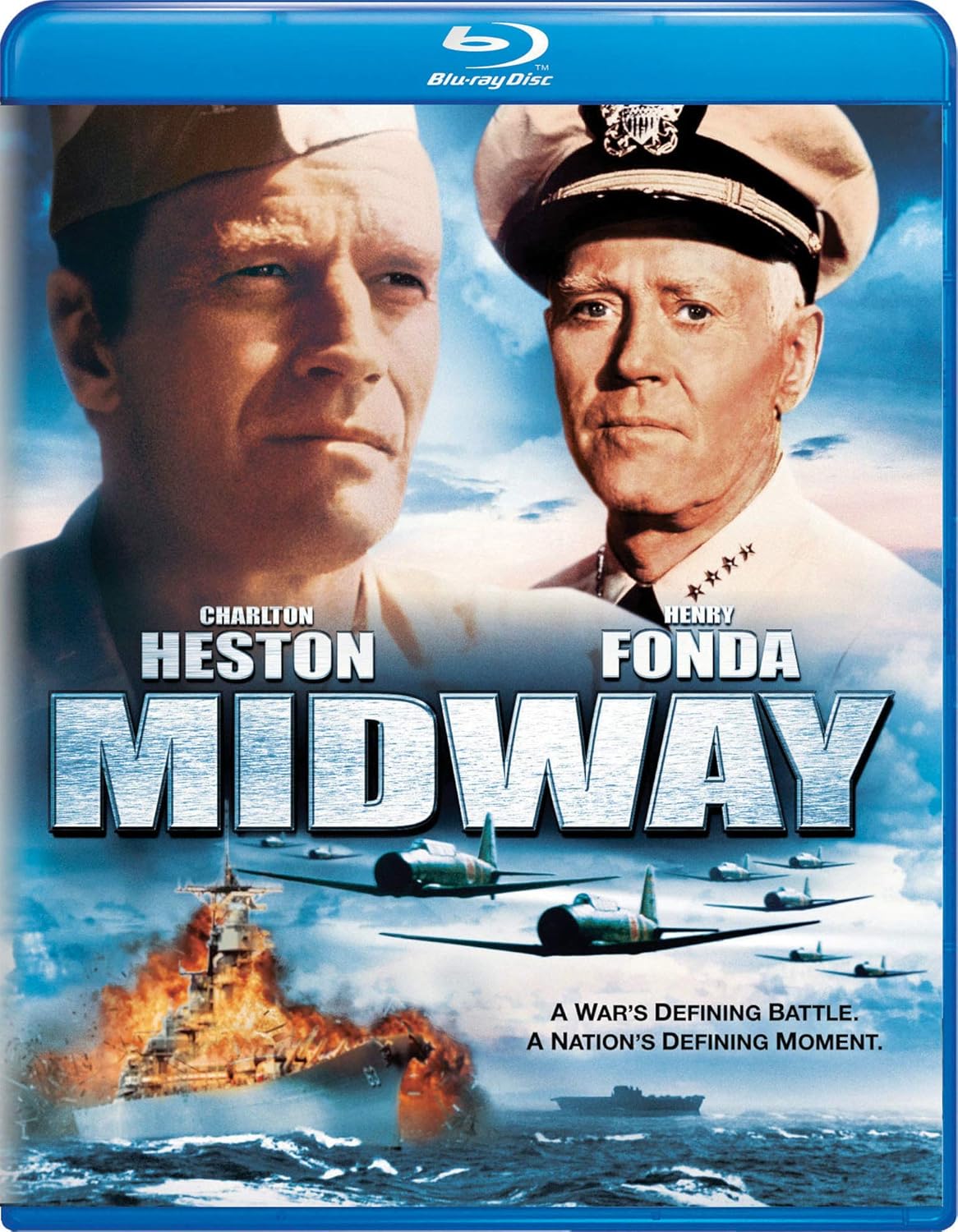
Cover Art for Midway (1976) Blu-ray
Product Description:
Charlton Heston and Henry Fonda lead an all-star cast in Midway, interweaving the dramatic personal stories of the men who fought one of the most important battles of World War II. Just six months after the attack on Pearl Harbor, the battle of Midway sounded its furious thunder in June 1942, becoming the turning point of the Pacific for the United States. Featuring breakthrough war footage, Midway conveys the powerful reality and epic sweep of a nation's defining battle.
Bonus Content:
• The Making of Midway
• The Score of Midway
• Sensurround: The Sounds of Midway
• Scenes Shot for the TV Version
• They Were There, Hosted by Charlton Heston
• Photograph Montage
• Theatrical Trailer
• My Scenes
Why You’ll Enjoy This Film:
Midway blends large-scale combat with personal storytelling, giving viewers both the strategy and the human side of war. The cast delivers steady, grounded performances, while the battle sequences capture the tension and scale of one of history’s most decisive naval conflicts. It stands as a classic war film that balances spectacle with respect for the events it portrays.
Henry Fonda refused to watch his own films, preferring to focus only on the work ahead rather than revisit past performances.
💼 Personal Life and Political Views
Summary: A complex personal life contrasted with his reserved public stance and measured political views.
Henry Fonda lived a personal life that drew as much attention as his work, marked by a series of marriages and a family that would become deeply rooted in American film history. He was married five times, including to Margaret Sullavan, Frances Ford Seymour, Susan Blanchard, Afdera Franchetti, and Shirlee Mae Adams. His relationships often reflected the pressures of a demanding career, with long stretches of absence and emotional distance shaping much of his domestic life.
His most lasting legacy within his family came through his children, particularly Jane Fonda and Peter Fonda, both of whom became major figures in their own right. Jane rose to international prominence as an Academy Award-winning actress and later as a vocal political activist, while Peter carved out a distinct identity during the counterculture era, most notably with Easy Rider (1969). The next generation continued the family’s presence in film, with Bridget Fonda, Peter’s daughter, emerging as a successful actress in the late twentieth century.
Despite portraying characters often associated with strong moral conviction, Fonda’s personal political views were more reserved and less publicly defined. He held a generally liberal outlook but avoided the spotlight when it came to activism, especially in contrast to his daughter Jane, whose outspoken positions during the Vietnam era created a well-known divide in public perception. Fonda himself was a supporter of the Democratic Party and appeared in a campaign commercial for presidential candidate John F. Kennedy.
Henry Fonda once turned down roles that conflicted with his personal values, even at the height of his fame. He believed strongly in maintaining a consistent moral image on and off screen.
🕊️ Later Years
Summary: Henry Fonda final performances reflected maturity and earned long-overdue recognition at the height of his legacy.
Henry Fonda entered his later years with a reputation already secured, yet he continued to work with the same steady discipline that had defined his career from the beginning. As the industry shifted around him, he remained selective, choosing roles that suited his age and presence without attempting to recapture earlier personas. His performances carried a reflective quality, shaped by time and experience rather than ambition.
His final major appearance in On Golden Pond (1981) brought together both personal and professional threads, as he shared the screen with Katharine Hepburn and his daughter Jane Fonda. The role allowed him to portray an aging man confronting memory, family, and mortality, themes that resonated beyond the script. The performance earned him the Academy Award for Best Actor, a long-awaited recognition that acknowledged a lifetime of consistent work rather than a single defining moment.
In his final years, Fonda’s health declined, and he withdrew from public life with little ceremony. Henry Fonda passed away on August 12, 1982, at the age of 77, leaving behind a body of work marked by clarity, restraint, and enduring relevance. His influence remained evident in the generations that followed, not through imitation, but through the lasting example of an actor who understood the strength of simplicity.
🏆 Legacy
Henry Fonda left behind a legacy defined by discipline, integrity, and a style of acting that resisted excess. In an era that often rewarded larger-than-life personalities, he proved that restraint could carry equal, if not greater, power. His performances set a standard for authenticity, influencing generations of actors who recognized the strength in quiet conviction rather than overt display.
His impact extended beyond individual roles, shaping the broader language of American cinema. Films such as The Grapes of Wrath (1940) and 12 Angry Men (1957) remain enduring examples of character-driven storytelling, where moral clarity and human conflict take center stage. Directors and performers alike have pointed to Fonda’s work as a model of consistency, noting how he maintained the same grounded presence across decades of changing styles and expectations.
The Fonda name itself became a lasting part of Hollywood history, carried forward by Jane Fonda, Peter Fonda, and Bridget Fonda, each contributing in distinct ways to film and popular culture. Yet Henry Fonda’s place within that lineage remains singular, defined not by legacy alone, but by a body of work that continues to resonate with audiences who value honesty, clarity, and enduring craft.
🗣️ Why They Still Matter:
Henry Fonda’s work continues to resonate because it reflects a style of acting built on truth rather than spectacle. His performances remain a standard for authenticity, reminding modern audiences that quiet strength and moral clarity can leave the deepest impression.
Further Reading & Resources
📖 Read: Henry Fonda | Biography, 12 Angry Men, Westerns, Movies
🔍 Explore: Henry Fonda Biography - New World Encyclopedia
ML Lamp is the owner of Kilroy Was Here. After his 20 years of working in Las Vegas in the entertainment promotions field, Mr. Lamp retired in 2002 from his job to pursue his passion for collectibles. Now as a guest speaker and author he’s living the dream, and sharing his warmth with You.