👑 Marlene Dietrich Biography: Bold Icon Who Changed Hollywood Forever
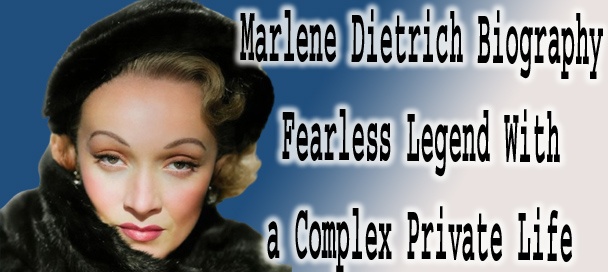
Marlene Dietrich emerged as one of the most striking and unconventional figures in twentieth-century entertainment, shaping the image of the modern screen icon with a cool, self-possessed presence. Her work carried an unmistakable blend of elegance and defiance, allowing her to move between European sophistication and American studio polish without losing her identity. At a time when film was still defining its language, she brought a controlled intensity that felt both distant and magnetic.
Marlene Dietrich stands as one of the most influential figures in classic Hollywood, known for her roles in The Blue Angel (1930), Morocco (1930), and Shanghai Express (1932). A German-American actress and singer, she reshaped screen presence with a controlled, magnetic style that influenced generations. Beyond film, her music career and wartime contributions during World War II strengthened her global impact. Her legacy continues to define elegance, independence, and artistic discipline in entertainment history.
Her influence extended beyond performance into fashion and personal expression, where she challenged expectations with a deliberate and often androgynous style. Tailored suits, measured gestures, and a steady gaze became part of her public image, setting her apart from her contemporaries. This careful construction of persona gave her a lasting cultural weight, making her not simply a performer but a symbol of independence and self-definition.
Across decades of work in film and on stage, Dietrich maintained a rare consistency in tone and presence, even as the industry around her changed. She represented a bridge between old-world artistry and modern celebrity, holding to a sense of mystery that resisted easy interpretation. Her legacy rests in that balance, a figure who commanded attention without excess, and whose influence continues to shape ideas of style, performance, and star power.
Behind the composed image, Marlene Dietrich lived with a level of control that extended into every detail of her private life, shaping both her legend and her isolation.
👶 Early Life
Summary: Her early life reflected discipline and transition, shaping her path toward performance.
Marlene Dietrich was born on December 27, 1901, in Berlin, Germany, into a disciplined, middle-class household shaped by military order and social expectation. Her father, Louis Erich Otto Dietrich, served as a police lieutenant, while her mother, Wilhelmina Elisabeth Josephine Felsing, came from a well-established family with connections to the jewelry trade. The early loss of her father altered the structure of the home, leaving her mother to remarry a cavalry officer, a change that reinforced an atmosphere of formality and control during her formative years.
As a child, Dietrich displayed a reserved temperament paired with a strong sense of observation, traits that would later define her public presence. She was educated in private schools where discipline and refinement were emphasized, and she developed an early interest in music, particularly the violin. This pursuit was taken seriously, and for a time it appeared she might follow a formal musical path, though her ambitions remained quietly broader than her surroundings suggested.
During her teenage years, her focus shifted as she became drawn to the stage, exploring performance in small but meaningful ways. An injury to her hand curtailed her plans as a concert violinist, forcing a difficult transition that brought uncertainty and frustration. She began to study acting with determination, taking on minor roles while navigating the rigid expectations placed on young women of her background. These early struggles were marked not by dramatic setbacks, but by a steady resistance to limitation, as she moved toward a life defined on her own terms.
Explore the Biographies of Iconic Celebrities
🎬 Film Career
Summary: Her film career established a lasting visual and emotional style that influenced generations of cinema.
Marlene Dietrich entered the international spotlight with “The Blue Angel” (1930), directed by Josef von Sternberg, a film that transformed her into a global sensation and established a creative partnership that would define her early screen identity. Her portrayal of the cabaret singer Lola Lola opposite Emil Jannings introduced audiences to a performer whose allure rested as much in restraint as in spectacle. Sternberg brought her to Hollywood, where their collaboration continued with “Morocco” (1930), co-starring Gary Cooper, earning her an Academy Award nomination and cementing her reputation for controlled, enigmatic performances.
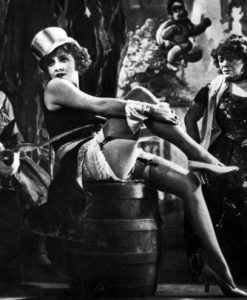
The Sternberg collaborations became a series of carefully crafted productions that emphasized lighting, costume, and atmosphere, including “Dishonored” (1931) with Victor McLaglen, “Shanghai Express” (1932) alongside Clive Brook and Anna May Wong, and “Blonde Venus” (1932) with Cary Grant. Each film reinforced her image as a figure of elegance and quiet authority, while also pushing visual boundaries through stylized direction and bold character choices. Their final major pairing, “The Scarlet Empress” (1934), and later “The Devil Is a Woman” (1935), marked the end of this distinctive chapter, leaving behind a body of work that remains visually influential.
As studio tastes shifted, Dietrich adapted by working with a wider range of directors and co-stars, demonstrating a flexibility that preserved her relevance. She appeared in “Desire” (1936) with Gary Cooper and John Halliday, followed by “Destry Rides Again” (1939) opposite James Stewart, where she revealed a sharper comedic edge and broadened her appeal. This period showed her willingness to step beyond the carefully controlled Sternberg aesthetic, embracing roles that allowed for greater variation in tone and character.
Throughout the 1940s, she continued to collaborate with prominent figures, including “The Flame of New Orleans” (1941) directed by René Clair and co-starring Bruce Cabot, as well as “Manpower” (1941) with Edward G. Robinson and George Raft. Her performance in “The Spoilers” (1942) alongside John Wayne added to her standing as a versatile screen presence. During this era, her work reflected a balance between glamour and strength, aligning her image with a more grounded, mature sensibility.
In the later years of her film career, Dietrich took on selective roles that emphasized character depth over star persona. She appeared in “A Foreign Affair” (1948), directed by Billy Wilder, sharing the screen with Jean Arthur and John Lund, offering a performance that blended irony with subtle emotional weight. Her role in “Witness for the Prosecution” (1957), again under Wilder’s direction and alongside Charles Laughton and Tyrone Power, demonstrated her ability to command attention within tightly constructed narratives. These later films confirmed her enduring presence, not as a relic of an earlier era, but as a performer capable of adapting to changing cinematic styles while retaining her distinct identity.
🎶 Music Career
Summary: Her music career relied on tone and interpretation, creating a distinct and enduring vocal identity.
Marlene Dietrich built a parallel reputation as a recording artist and live performer, cultivating a musical identity that matched the poise of her screen work. Her voice, low and measured, favored phrasing over range, giving her songs a conversational intimacy that set her apart from traditional vocalists. She drew from cabaret traditions and wartime standards, shaping a repertoire that felt both personal and deliberate, anchored by her signature delivery rather than vocal power.
Her most enduring songs included “Falling in Love Again (Can’t Help It)” (1930), introduced in “The Blue Angel” (1930), which became inseparable from her public image, along with “Lili Marlene” (1944), a wartime ballad that resonated across national boundaries. Other notable recordings such as “Ich hab’ noch einen Koffer in Berlin” (1954) and “Where Have All the Flowers Gone” (1962) reflected her ability to move between languages and audiences without losing emotional clarity. These performances emphasized mood and interpretation, allowing her to convey longing, irony, or quiet strength within a single line.
Her albums further defined this phase of her career, including “Marlene Dietrich Overseas” (1953), drawn from her performances for troops, and later recordings such as “Dietrich in London” (1964) and “Marlene Dietrich at the Café de Paris” (1954), which captured her live stage presence. These releases preserved the atmosphere of her concerts, where minimal staging and controlled lighting placed full attention on her voice and phrasing. She approached each performance with precision, treating songs as extensions of character rather than separate material.
By the later years, her music career stood as a testament to endurance and refinement, with carefully chosen songs that suited her evolving voice. Rather than chasing trends, she maintained a consistent tone rooted in cabaret and classic standards, reinforcing the image she had shaped decades earlier. Her recordings remain closely tied to her persona, offering a direct connection to the qualities that defined her work across both stage and screen.
Explore the Biographies of Iconic Music Stars
Marlene Dietrich’s German-language recordings were knowingly used in secret OSS psychological warfare broadcasts, and later analysis ranked their impact on enemy morale alongside bombing campaigns.
🎖️ World War II Contributions
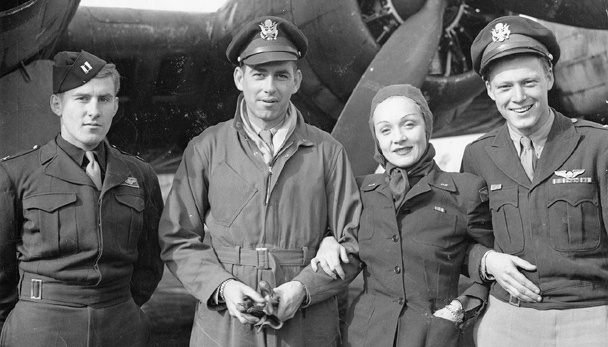
Summary: Marlene Dietrich’s wartime contributions showed direct involvement and commitment beyond performance.
Marlene Dietrich took a firm and public stand during World War II, rejecting the German regime and committing herself to the Allied cause at a time when such a choice carried personal risk. She became a naturalized American citizen in 1939, and from that point forward aligned her efforts with the United States, using her visibility to support morale and resistance against fascism. Her decision was not symbolic; it shaped the course of her public life and defined her role beyond entertainment.
She spent years performing for Allied troops through the United Service Organizations (USO), traveling to demanding and often dangerous locations across North Africa, Italy, and Western Europe. Appearing in makeshift venues close to the front lines, she endured harsh conditions, including extreme weather and long transport routes, to bring a sense of familiarity and encouragement to soldiers in active service. Her performances were direct and personal, often delivered without elaborate staging, relying on presence and voice to connect with audiences far from home.
Dietrich also contributed through recorded broadcasts and propaganda efforts, participating in programs such as “Voice of America” to reach German listeners with carefully delivered messages. She recorded anti-Nazi songs and messages intended to weaken morale within Germany while strengthening resolve among Allied forces. These efforts required careful balance, as her identity as a German-born figure gave her words added weight, but also placed her under scrutiny from both sides.
Her wartime service earned formal recognition, including the Medal of Freedom from the United States in 1947, as well as honors from France such as the Légion d’honneur. These awards reflected not only her visibility, but the sustained commitment she demonstrated throughout the war years. In this period, Dietrich moved beyond the role of performer into that of active participant, using her voice and presence as tools in a global conflict that demanded more than symbolic support.
The FBI secretly investigated Marlene Dietrich for two years as a suspected Nazi spy, even while she was actively supporting Allied troops.
💍 Personal Life
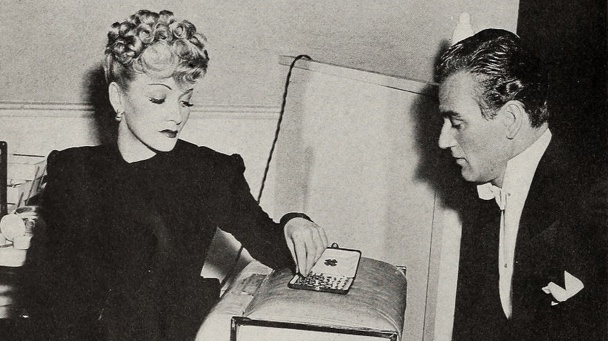
Summary: Her personal life reflected independence, unconventional relationships, and lasting family ties.
Marlene Dietrich maintained a private life that stood in quiet contrast to her carefully controlled public image, marked by a long-standing marriage and a series of widely discussed relationships. She married Rudolf Sieber in 1923, and although they remained legally married for life, they lived largely separate lives, allowing each other personal freedom without public scandal. This arrangement became one of the more unusual yet enduring partnerships of its time, reflecting a practical approach rather than a conventional domestic structure.
Her personal relationships became the subject of lasting fascination, as she was linked to many prominent figures across film, literature, and politics. Among the men associated with her were Gary Cooper, James Stewart, John Wayne, Yul Brynner, Frank Sinatra, Ernest Hemingway, Jean Gabin, and Erich Maria Remarque, each connection adding to her reputation for independence and selectivity. At the same time, she was known to have relationships with women, including Mercedes de Acosta, a writer closely tied to Hollywood circles, and Edith Piaf, the celebrated French singer. These relationships, often conducted with discretion, reinforced her image as someone who moved beyond traditional boundaries without seeking attention for it.
Dietrich’s daughter, Maria Riva, remained a central figure in her life, offering a more stable and personal connection amid a shifting social world. Riva later became an actress and writer, providing insight into her mother’s life with a perspective shaped by both admiration and distance. Through marriage, motherhood, and a wide circle of influential companions, Dietrich’s personal life reflected the same sense of control and independence that defined her public persona, never conforming fully to expectation yet rarely losing its composure.
According to her daughter, Dietrich once called a lover’s impotence “wonderful” because it allowed her to avoid physical intimacy and focus on companionship instead.
🕊️ Later Years
Summary: Marlene Dietrich’s years were marked by privacy, control, and a deliberate withdrawal from public life.
Marlene Dietrich gradually withdrew from public life after decades of carefully managed appearances, choosing privacy over continued visibility. Following her final stage performances in the mid-1970s, she retreated to her apartment in Paris, limiting contact with the outside world and communicating primarily through letters and occasional phone calls. This period reflected a deliberate shift, as she maintained control over her image by stepping away rather than allowing it to fade in public view.
Though largely unseen, her presence remained influential, and interest in her life never diminished. A notable moment came with the release of “Marlene” (1984), a documentary by Maximilian Schell, in which she participated through recorded interviews while refusing to appear on camera. The film preserved her voice and perspective, offering insight without compromising the sense of mystery she had guarded for years. Even in absence, she shaped how her story would be told, reinforcing the precision that had defined her career.
Marlene Dietrich died on May 6, 1992, in Paris, France, at the age of 90. Her passing marked the close of a life lived across continents and eras, yet her legacy remained firmly intact. She was laid to rest in Berlin, returning to the city of her birth, where her influence on film, music, and cultural identity continues to be recognized as part of a lasting historical record.
🏆 Legacy
Marlene Dietrich left behind a legacy defined by control, restraint, and a refusal to conform to expectation. Her influence can be seen in the evolution of the modern screen persona, where presence often carries more weight than overt expression. She demonstrated that stillness could command attention, and that a carefully constructed image could endure far beyond any single performance. This approach reshaped ideas of stardom, moving it away from excess and toward precision.
Her impact extended into fashion and personal identity, where her tailored suits, understated glamour, and androgynous presentation challenged long-standing norms. Designers, performers, and public figures drew from her example, recognizing the power of self-definition over imposed roles. Figures such as David Bowie, Madonna, and Annie Lennox would later echo elements of her style, not as imitation, but as continuation of a standard she helped establish.
In film and music, her work remains a reference point for tone and atmosphere, studied for its discipline and clarity. Performers continue to look to her collaborations, particularly those with Josef von Sternberg, as examples of how visual style and performance can merge into a unified statement. More broadly, her legacy rests in the consistency she maintained across decades, holding to a singular identity in an industry built on change, and leaving behind a body of work that still defines elegance, independence, and enduring presence.
🗣️ Why They Still Matter
Marlene Dietrich remains a benchmark for artistic control and personal identity, influencing performers who value presence, restraint, and independence. Her work continues to shape how modern audiences understand stardom, blending image, voice, and discipline into a lasting cultural standard.
Further Reading & Resources
📖 Read: Marlene Dietrich | National Women’s History Museum
🔍 Marlene Dietrich | Biography, Movies, Songs, & Facts | Britannica