📖 DIY Aunt Esther Costume: How to Dress Like Sanford and Son’s Most Righteously Fearless Church Lady
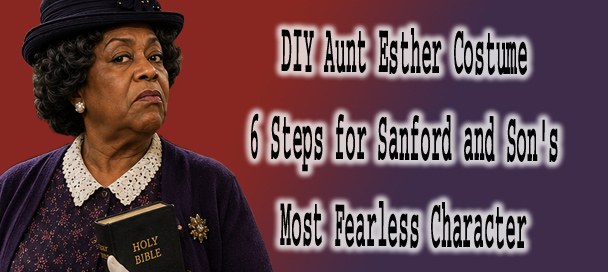
A complete DIY Aunt Esther costume featuring a dark church dress, modest church hat, Bible, structured purse, and the righteous stern presence that made LaWanda Page's Sanford and Son character one of American television's most beloved and fearless figures.
LaWanda Page was already a legend before most of America knew her name. Born Alberta Peal in Cleveland and raised in St. Louis, she had spent decades performing in nightclubs billed as the Bronze Goddess of Fire, an act that included eating fire and lighting cigarettes with her fingertips. Her stand-up material was raw, fearless, and deeply adult, the kind of blue comedy that built a devoted following in clubs through the late 1960s and early 1970s. In those circles, she was known as the Queen of Comedy, even if mainstream America had not yet caught up.
The DIY Aunt Esther costume draws from one of American television's most beloved and culturally significant supporting characters, Aunt Esther Anderson, portrayed by LaWanda Page on Sanford and Son from 1973 through 1977 and in the subsequent spinoff Sanford in 1981. LaWanda Page brought decades of stand-up comedy experience to the role, creating a devout, Bible-carrying churchwoman of complete conviction that stood in direct contrast to the raunchy blue comedy material of her stand-up career, a contrast that made her performance one of the more remarkable achievements in 1970s American television. Redd Foxx insisted that Page be given the role, threatening to leave the show if producers did not comply, and the character of Aunt Esther became one of the most popular sitcom characters of the decade.
That changed in 1973 when her childhood friend Redd Foxx, already starring in Sanford and Son, insisted that Page join the show as Aunt Esther. The producers were reluctant. Foxx was not. He threatened to leave the show if Page was not given the role, telling the producers that the night LaWanda's first episode airs, there will be dancing in the streets in every ghetto in the United States.
He was right. Aunt Esther became one of the most popular television characters of the 1970s, and the contrast between who LaWanda Page was on stage and who she was on screen made the achievement even more remarkable. The woman who had built a career on raunchy, expletive-filled stand-up played a devout, Bible-carrying Baptist churchwoman with such complete conviction that audiences never saw the seam.
Aunt Esther Anderson was Fred Sanford's sister-in-law, the sister of his late wife Elizabeth, and she made no secret of the fact that she had disapproved of Fred from the beginning and had not revised that opinion in the years since. She arrived at the Sanford house with her Bible in hand and her judgment already formed, and what followed was some of the sharpest and most committed comic sparring in American sitcom history.
Fred insulted her appearance with a creativity and a commitment that the audience found irresistible. Esther told him to watch it, sucka and called him a fish-eyed fool and a heathen and meant every word with the righteous certainty of a woman who had seen the light and was prepared to describe in detail exactly what Fred looked like standing outside it.
What made Aunt Esther more than a comic foil was the genuine depth LaWanda Page brought to the character. Esther loved her nephew Lamont without reservation. She helped her church with the kind of devotion that was never played for laughs. When episodes required her to be vulnerable or kind, Page delivered that with the same precision she brought to the confrontations. She held her own against Redd Foxx in every scene they shared, which was not a small thing, and the audience responded to it every time she walked through that door.
A DIY Aunt Esther costume works because the visual is specific, the character is beloved, and the presence section practically writes itself for anyone willing to commit to the righteous indignation and the purse. The Bible is the prop. The church hat and the dark dress are the foundation. What you bring to the expression and the delivery is the whole costume.
👗 Step 1: Create the Base
The foundation of a DIY Aunt Esther costume is a dark church dress, and the specific color of that dress varied across Esther's appearances on the show in a way that actually works in the reader's favor. She wore deep, dark tones throughout, moving across a range that included off-reds, deep purples, dark navy, and some light floral patterns in colors that read as old lady church appropriate rather than any single signature shade.
That variation means the thrift store is your friend here, because you are not hunting for one specific item. You are hunting for a modest, below-the-knee dress in any of those tones that reads as something a devout 1970s churchwoman would wear to Sunday service and then keep on for the rest of the day because she was not going anywhere that required a change of clothes.
The silhouette should be modest and covered. A dress with long or three-quarter sleeves is correct. A neckline that does not dip is correct. Something that flows to the knee or below is correct. Thrift stores carry exactly this style of garment in abundance, particularly in the plus size sections where the cut and the coverage tend toward exactly the right register. Look for dark florals, solid deep purples, muted burgundies, and dark navy with any kind of subtle pattern. The more the dress reads as something that has been worn to many church services and several confrontations with junkyard owners, the better it is for this costume.
A sweater or cardigan worn over the dress adds the second layer that Esther frequently carried and completes the modestly covered silhouette. A dark or neutral cardigan in brown, gray, or a color that coordinates with the dress without being an exact match is the right choice. Thrift stores will have these at minimal cost. The fit should be relaxed and the length should hit at or below the hip.
Comfortable shoes or low-heeled church pumps in black or dark brown complete the base. Esther was not wearing anything impractical. She was dressed for church and for whatever Fred Sanford required her to deal with on any given day, and both of those situations called for sensible footwear.
Find other Easy DIY Costume Ideas Here
🧵 Step 2: Add the Details
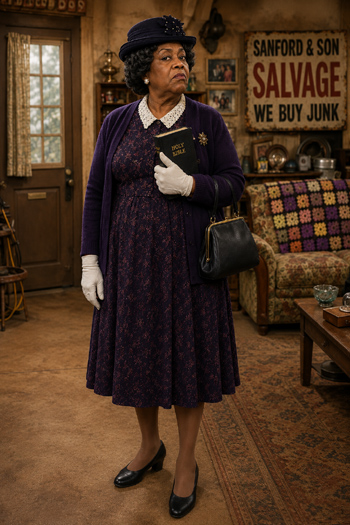
A complete DIY Aunt Esther costume featuring a dark church dress, modest fitted church hat, short gray wig, Bible, and large structured purse inspired by LaWanda Page's iconic portrayal of Aunt Esther Anderson across five seasons of Sanford and Son on NBC.
The church hat is the piece that completes the silhouette from the top and it should be chosen with Esther's specific style in mind. Her hats were modest and proper, the kind of hat a devout churchwoman of her generation and background would have worn with care and dignity. Not wide-brimmed, not dramatically oversized, not theatrical. A fitted church hat with some structure to it, in a color that coordinates with the dress, is exactly right. Dark colors work best. Black, navy, dark purple, and deep burgundy all fit within the range of what Esther wore across the show's run.
Church hats in this style are findable at thrift stores, estate sales, and vintage clothing vendors, and the search is usually rewarding because they were made in quantity during exactly the era the show was set in. Online retailers that specialize in church hats and formal occasion headwear carry options at a range of price points. Look for something with a small decorative element, a fabric flower, a simple ribbon, or a modest pin, that adds the finishing touch without tipping into costume territory. Esther's hats were always dignified. They were the hats of a woman who took her Sunday appearance seriously.
Optional gloves in white or dark cotton add another layer of period-correct church formality that elevates the whole look. They should be short, wrist-length gloves rather than long evening gloves. Thrift stores and vintage accessories vendors carry these at minimal cost and they read correctly the moment they are on.
💄 Step 3: Makeup and Hair
The makeup for a DIY Aunt Esther costume is modest, warm, and appropriate for a woman of faith who takes care of her appearance without making a production of it. A warm foundation applied evenly, a soft blush in a muted rose or coral, and a warm neutral or soft pink lip are all that is needed. The eye makeup is minimal. A light brown or neutral shadow on the lid and a defined but restrained liner complete the face without drawing attention away from the expression, which is where all the real work of this costume happens.
The hair should read as set and church-appropriate, styled in the manner of a woman who maintains her appearance with regularity and intention. A short wig in a natural, close-set style is the right choice. Esther's hair was modest and proper beneath the church hat, and the wig should match that quality. Costume shops and online retailers carry short gray wigs in natural textures. When fitting the wig, make sure it sits naturally at the hairline and does not ride back on the head. The church hat will sit over it and cover the crown, which helps with fit and with concealing any edge that does not blend perfectly.
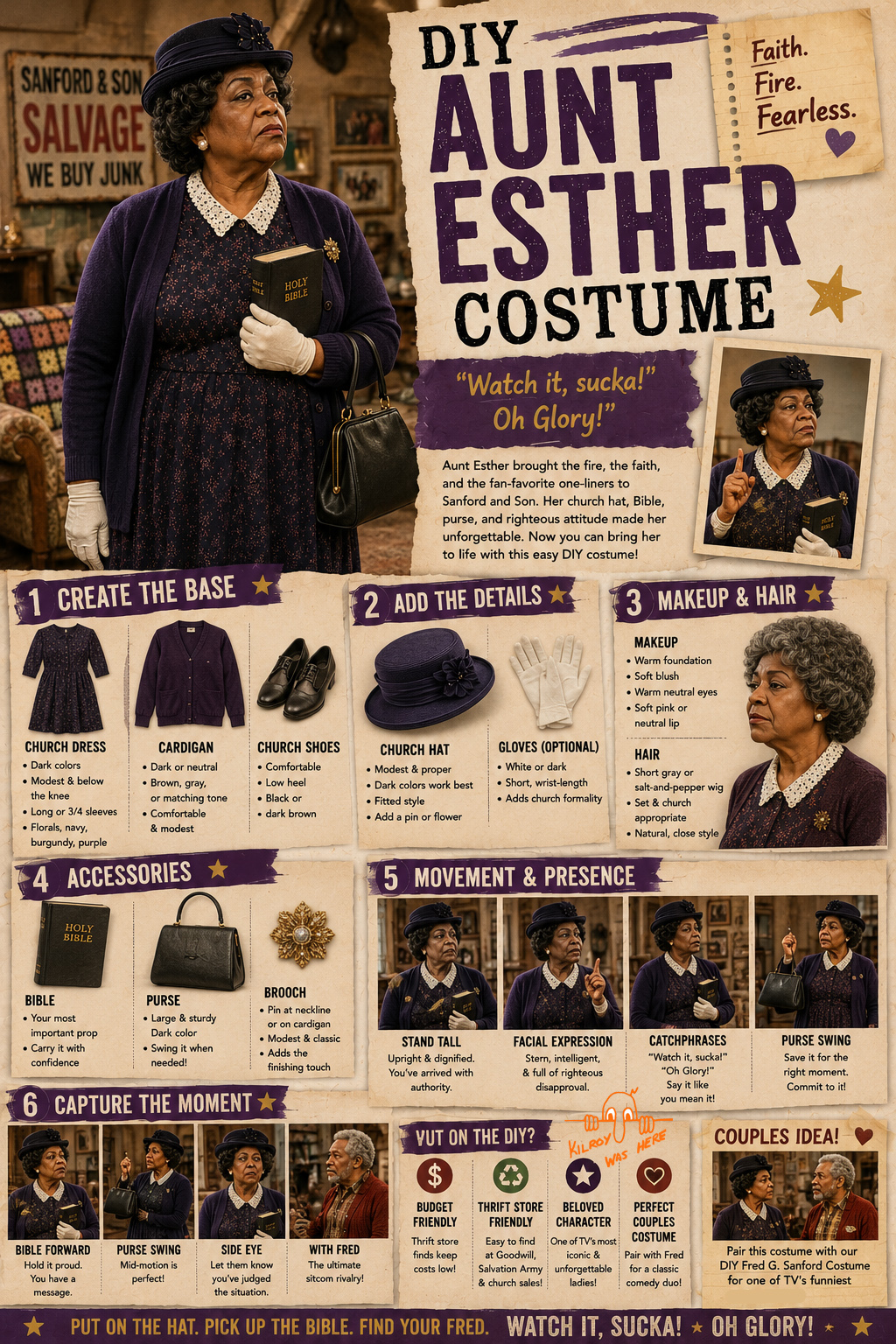
Click Image for full Infographic of the DIY Aunt Esther costume
🎀 Step 4: Accessories
The Bible is the single most important accessory in this costume and it should be treated as a strong recommendation rather than an optional item. Aunt Esther was always armed with the Bible. It was present in every scene, carried with the confidence of someone who considered it both a spiritual guide and a conversational authority. A worn, well-used Bible carried in one hand or tucked under one arm is exactly right. It does not need to be new. In fact, a Bible that looks like it has been carried to many services and consulted frequently is more accurate to the character.
The purse is the second essential accessory and it deserves its own mention because it is not simply something Esther carried. It was something she deployed. When Fred pushed far enough, when the insults crossed whatever line Esther had set for that particular visit, the purse came into play, swung in Fred's direction with a force and a commitment that communicated exactly how seriously she took the situation.
A large, structured handbag in a dark color, something with enough weight to it that swinging it in someone's direction would register as a meaningful gesture, is the right choice. Thrift stores will have options at minimal cost. Carry it on your forearm when not in active use. Let it move when the moment calls for it.
A simple brooch pinned at the neckline or lapel of the cardigan adds the church-appropriate decorative touch that completes the costume at the collar. Estate sales and thrift store jewelry sections carry these at very low prices. Choose something modest and period-correct rather than anything oversized or theatrical.
🕺 Step 5: Movement and Presence
Aunt Esther's physical presence is built on righteousness, and that is the word to hold onto before walking into any room in this costume. She did not enter a space tentatively. She arrived with the full authority of a woman who had assessed the moral situation in advance and had already determined that improvements were needed. The posture is upright and dignified, the posture of someone who attends church regularly and sits in the same pew and holds herself accordingly whether she is in that pew or standing in a junkyard telling Fred Sanford exactly what she thinks of him.
The Bible goes in one hand and stays there. It is not a prop to be set down or forgotten. It is a presence piece, and holding it gives every gesture and every expression an additional weight of moral authority that the character carried in every scene. When making a point, raise it slightly. When delivering a verdict on someone's behavior, let it be visible. Esther quoted it regularly and carried it always, and the costume should reflect that at all times.
The facial expression is stern but not blank. There is intelligence behind it and there is feeling behind it, the feeling of a woman who has strong opinions about right and wrong and is not shy about sharing them with anyone in range. Practice a look that communicates that you have already judged the situation, found it wanting, and are deciding in real time how much effort the correction deserves. The eyebrows do significant work in this expression. A slightly raised inner brow combined with a level, steady gaze communicates Esther's particular quality of contained disapproval more effectively than any single gesture.
The purse swing is the signature physical moment and it should be saved for the right provocation rather than used constantly, because the comedy of it comes from the escalation. Esther arrived with dignity. She attempted to conduct herself with the decorum appropriate to a churchwoman. And then Fred said something that crossed whatever line remained, and the purse came into motion with the commitment of someone who had decided that this particular situation called for a physical response. Practice the swing. Make it broad. Make it committed. Esther never did anything halfway when Fred pushed her far enough.
The catchphrases are the verbal signature of the costume and they should be used with the same timing and commitment that LaWanda Page brought to them. Watch it, sucka is the warning, delivered with a level, steady tone that communicates that the warning is genuine and the consequence of ignoring it is already being planned. Oh Glory is the exit line, called out as Esther leaves the scene with her dignity intact and her point made. Both should be delivered without irony and without hedging. Esther always meant exactly what she said.
If there is a Fred Sanford accompanying you, the dynamic between the two of you is the whole performance. Let him insult you. Take a beat. Let the expression travel across your face from dignity to controlled outrage to the specific look of a woman who is about to reach for her purse. Then reach for it. The audience will know exactly what is happening and will respond accordingly.
📸 Step 6: Capture the Moment
For photography, the DIY Aunt Esther costume benefits from a setting that connects to either the church or the confrontation, and both are achievable with minimal effort. A plain dark wall or a simple indoor setting with warm light reads as appropriate for the character's dignity and keeps the focus on the face and the costume rather than the background.
Warm indoor light suits this costume well. Position yourself near a window or a warm lamp source that illuminates the face clearly and gives the dark dress the depth it needs to read properly in the frame. Overhead or cool light will flatten the costume and work against the warmth of the character's palette.
The Bible-forward pose is the strongest single image this costume can produce. Stand upright with the Bible held in one hand at chest height, the church hat properly in place, the expression of someone who has arrived with a message and intends to deliver it. That image reads as Aunt Esther immediately and completely to anyone who watched the show.
The purse-swing pose is the second essential photograph and it should be shot mid-motion rather than posed statically, because the energy of the gesture is what makes it recognizable. Swing the purse, hold the expression of righteous escalation, and let the photographer catch it in motion. That photograph will need no caption.
If Fred Sanford is in the frame, shoot the two of you facing each other with matching expressions of theatrical outrage and mutual contempt. That image closes the loop on one of television's great comic relationships and will produce an immediate reaction from anyone who sees it.
🏆 Why Go DIY? Wrap-Up
Building a DIY Aunt Esther costume from a thrift store church dress and a dark hat means assembling something that costs almost nothing and carries the weight of one of the most remarkable performances in American sitcom history. LaWanda Page created a character in complete contrast to everything she was known for in her stand-up career, and she did it with such total commitment and such genuine skill that the audience never questioned it for a moment. That is a significant achievement, and it deserves to be honored with the same commitment when the costume is worn.
Aunt Esther mattered because she was fully realized. She was not simply the woman who showed up to insult Fred and get insulted back. She was a churchwoman of genuine faith, a loving aunt, a woman of strong moral conviction who happened to express that conviction at a volume and a frequency that Fred Sanford found exhausting and the audience found irresistible. LaWanda Page held all of those qualities simultaneously without letting any one of them collapse the others, and the result was a character that has outlasted the show itself in the affection of everyone who watched it.
This costume pairs naturally with a DIY Fred G. Sanford costume for anyone planning a couples or group costume. Fred and Aunt Esther are one of the great comic pairings in American television, and putting the two costumes together in the same room produces exactly the dynamic the show produced every time both characters were in the same scene.
Put on the hat. Pick up the Bible. Find your Fred. Watch it, sucka.
🕸️ Related Costumes to Try
DIY Grace Jones Costume
DIY Madea Costume
DIY Crazy Eyes Costume
DIY Half Man Half Woman Costume
Black and White Church Hat
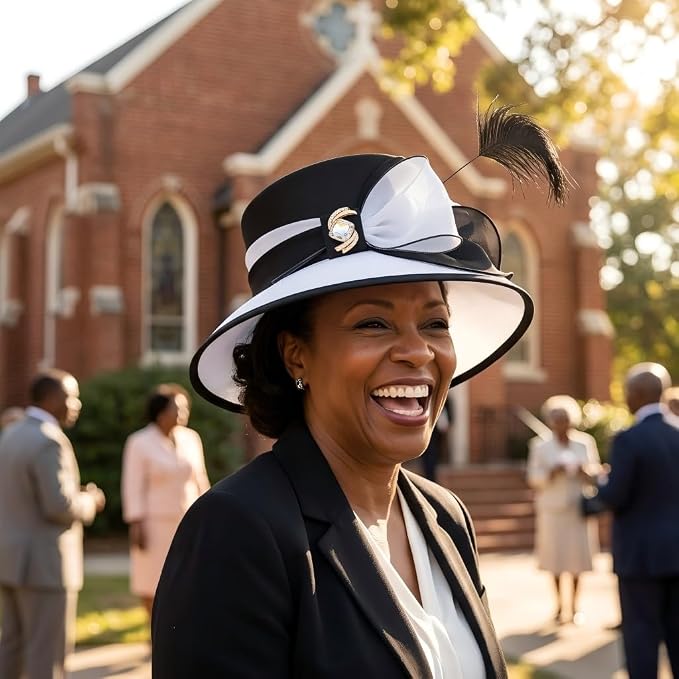
Black and White Church Hat for a DIY Aunt Esther Costume
Product Description:
A proper church hat is one of the signature pieces of a DIY Aunt Esther Costume. This elegant black and white hat captures the dignified Sunday style worn by Aunt Esther on Sanford and Son. It adds the finishing touch that makes the character instantly recognizable.
Key Features:
• Classic black and white church hat design
• Wide brim with decorative accents
• Lightweight and comfortable to wear
• One size fits most adults
• Perfect for Halloween, cosplay, television characters, and themed parties
Why This Works:
Aunt Esther's church attire was as memorable as her sharp comebacks. Pair this hat with a conservative church dress, white gloves, sensible shoes, and a Bible prop to create a convincing DIY Aunt Esther Costume that fans of the classic sitcom will recognize immediately.
Buy on Amazon
Further Reading & Resources
📺 See: Sanford and Son: The Complete Series
🔍 More: LaWanda Page - Wikipedia
ML Lamp is the owner of Kilroy Was Here. After his 20 years of working in Las Vegas in the entertainment promotions field, Mr. Lamp retired in 2002 from his job to pursue his passion for collectibles. Now as a guest speaker and author he’s living the dream, and sharing his warmth with You.