🎤 DIY Grace Jones Costume: How to Dress Like Music’s Most Commanding and Unforgettable Icon
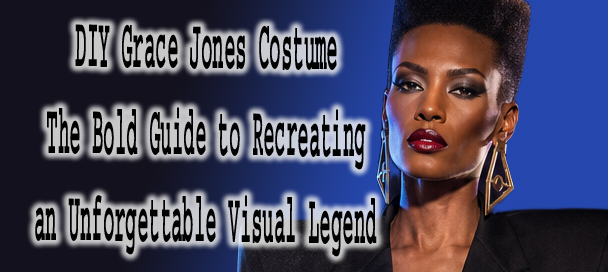
There is a short list of performers who do not simply occupy a stage but restructure the atmosphere around them by being present in it. Grace Jones is on that list and there is nobody else quite like her on it. Born in Jamaica, raised in Syracuse, and launched into the cultural stratosphere through the Paris fashion world and the New York disco scene of the late 1970s, Grace Jones became something that existing categories could not comfortably contain. She was a model, a recording artist, a film presence, and a visual force whose influence on fashion, music, and performance has never fully stopped radiating outward.
The DIY Grace Jones costume draws from the visual identity of one of popular culture's most original and enduring icons, Grace Jones, whose Nightclubbing era of the early 1980s produced one of the most recognizable silhouettes in music and fashion history. Grace Jones built her image across recording, modeling, and film work including appearances in Conan the Destroyer in 1984 and A View to a Kill in 1985, establishing a presence that influenced fashion, music video aesthetics, and performance art across the decades that followed. Her flat-top hairstyle, strong-shouldered tailoring, and geometric makeup approach became cultural reference points that remain immediately identifiable to audiences across generations.
The Nightclubbing era of the early 1980s is where the costume lives most specifically. The 1981 album and the visual identity built around it crystallized everything that made Grace Jones iconic into a single, immediately recognizable silhouette. The flat-top. The strong shoulders. The angular makeup. The absolute refusal to soften any edge for anyone's comfort. That image became one of the defining visual statements of the decade and it has not dated in any meaningful way because it was never chasing a trend in the first place. It was setting one and then moving on before the trend could catch up.
Her reach extended well beyond music. In 1984 she appeared in Conan the Destroyer opposite Arnold Schwarzenegger, playing Zula with a ferocity and a physical presence that made every other performer in the frame work harder just to stay visible. A year later she appeared in A View to a Kill as May Day, the Bond villain henchwoman who became one of the most memorable characters in the entire franchise, not because of the script but because Grace Jones brought something to the role that no script could have provided. She was magnetic in the specific way that very few performers ever achieve, the kind of magnetic where you stop watching everything else the moment she appears.
A DIY Grace Jones costume is built on silhouette, geometry, and a quality of presence that rewards genuine commitment. The clothes are findable. The makeup is achievable. The hair requires a plan but not a miracle. What this costume asks of the person wearing it is the willingness to move through a room with intention and to hold an expression that communicates complete self-possession. That is the whole costume. Everything else is framework.
This is a costume that works because Grace Jones worked. She built every visual element of her public image with deliberate intelligence, and recreating it is an act of genuine appreciation for one of the most original artists of the past fifty years.
👗 Step 1: Create the Base
The foundation of a DIY Grace Jones costume is a black tailored blazer with strong shoulders, and the shoulders are not a detail. They are the point. Grace Jones's silhouette during the Nightclubbing era was built on the exaggerated shoulder line that transformed the human form into something architectural, something that suggested angles and structure rather than softness and curve. The blazer you choose needs to deliver that quality, and it will not deliver it if the shoulders are natural and unpadded.
Thrift stores from the 1980s onward produced an enormous volume of structured blazers with shoulder pads already built in, and many of them are still circulating through secondhand shops at low prices. Look specifically in the women's suiting section and the men's blazer section of Goodwill and similar stores. A men's blazer in a size larger than you would normally wear will often give you the shoulder width and the strong structural line that the costume requires.
Try it on and look at the shoulder seam. It should sit at or slightly past the normal shoulder point. If the blazer has existing shoulder pads that are insufficient, additional shoulder pads available at fabric and craft stores can be pinned or sewn inside the lining to build more volume. This single alteration will change the entire reading of the costume from across a room.
The blazer should be black and fitted through the body below the shoulders. If the thrifted option is too boxy through the torso, a tailor can bring in the side seams inexpensively, or you can do it yourself with a few hand stitches on the inside seam that are easily removed later. The contrast between the wide strong shoulder and the lean body below it is what creates the silhouette, and that contrast is everything.
Black leggings or slim black pants complete the base below the blazer. The leg line should be clean and unbroken from hip to ankle. No wide leg, no taper that fights with the upper silhouette. The leg is meant to be a simple vertical that lets the shoulder structure do its work above. Any retailer carrying basic black leggings will have what you need, and the fit matters more than the source.
Find other Easy DIY Costume Ideas Here
🧵 Step 2: Add the Details
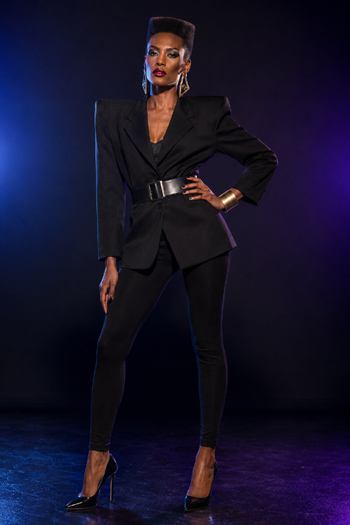
The wide belt worn at the waist over the blazer is a recommended addition rather than a true optional, because it does specific structural work that strengthens the whole costume. It creates a defined waist point between the strong shoulder and the lean leg, which gives the silhouette a third geometric element and makes the overall look more complete. A wide black belt in leather or faux leather, worn snug at the waist over the closed blazer, is the right choice. The width should be substantial enough to read as a design element rather than a functional accessory. Thrift stores carry wide belts in abundance and this is an easy and inexpensive find.
The geometric earrings are the jewelry piece that matters most in this costume and they should be chosen with the overall angular quality of the look in mind. Square, triangular, or strongly geometric shapes in gold or black work correctly. Long dangling geometric shapes that move when you turn your head add visual interest and connect to Grace Jones's broader jewelry aesthetic during this period. Thrift stores and vintage jewelry vendors are good sources, as are craft stores if you want to assemble something specific from components.
A gold cuff bracelet worn on one wrist adds warmth and contrast against the all-black base. It should be substantial enough to read from a distance. A single wide cuff worn alone reads with more authority than several stacked thinner pieces in this particular costume, because the look is built on bold singular statements rather than accumulation.
💄 Step 3: Makeup and Hair
The flat-top is the most recognizable element of this costume after the shoulder silhouette, and it is worth understanding what you are working toward before making any decisions about approach. The Nightclubbing era flat-top was precisely what the name suggests. The hair was cut and shaped so that the top surface was flat and level, rising from the sides at a sharp angle and presenting a geometric horizontal plane at the crown. It was not a rounded afro. It was not a soft natural shape. It was a deliberate architectural statement made from hair, and it was maintained with the same care and precision that the rest of Grace Jones's image received.
For readers whose natural hair texture will hold a flat-top shape, a visit to a barber or stylist experienced with this cut before the event is the most accurate and satisfying route. The cut should be tight on the sides and shaped to a flat, level surface on top. A light application of a shaping product will help maintain the geometry through an evening.
For everyone else, a flat-top wig is the practical solution and the category has improved considerably. Look specifically for a flat-top wig rather than a general short natural hair style, because the flat horizontal surface at the crown is specific and a generic short style will not read correctly from any distance. The wig should be black, the sides should be close-cropped, and the top should present that characteristic level plane. Costume shops and online retailers carry options. When fitting the wig, make sure it sits naturally at the hairline and does not ride back on the head. That single fit issue is what separates a convincing result from an obvious one.
The makeup captures the spirit of Grace Jones's angular face painting rather than replicating any single specific look, because her makeup changed across performances and album cycles while always maintaining the same geometric philosophy. The approach is architectural. Everything has a line and that line has a direction.
Start with a full coverage foundation applied evenly across the face. The base should be smooth and matte, because everything built on top of it depends on a clean surface. From there, use a dark contour shade, a deep brown or cool gray, to carve strong shadows beneath the cheekbones, along the temples, and down the sides of the nose. The contouring should be blended but definite, creating shadow rather than suggesting it.
The eye makeup should lean toward a bold single-color statement on the lid rather than a blended gradient. A strong black or deep color applied with a flat brush across the entire lid and extended slightly past the outer corner in a sharp horizontal line captures the graphic quality of her makeup without requiring specialized face painting skills.
The brow should be defined and strong, following its natural shape but filled in with more pigment and more precision than everyday wear. The lip is bold and complete, in a deep red, true red, or strong nude that photographs with contrast. Line and fill before applying the lipstick to give it staying power through an evening.
🎀 Step 4: Accessories
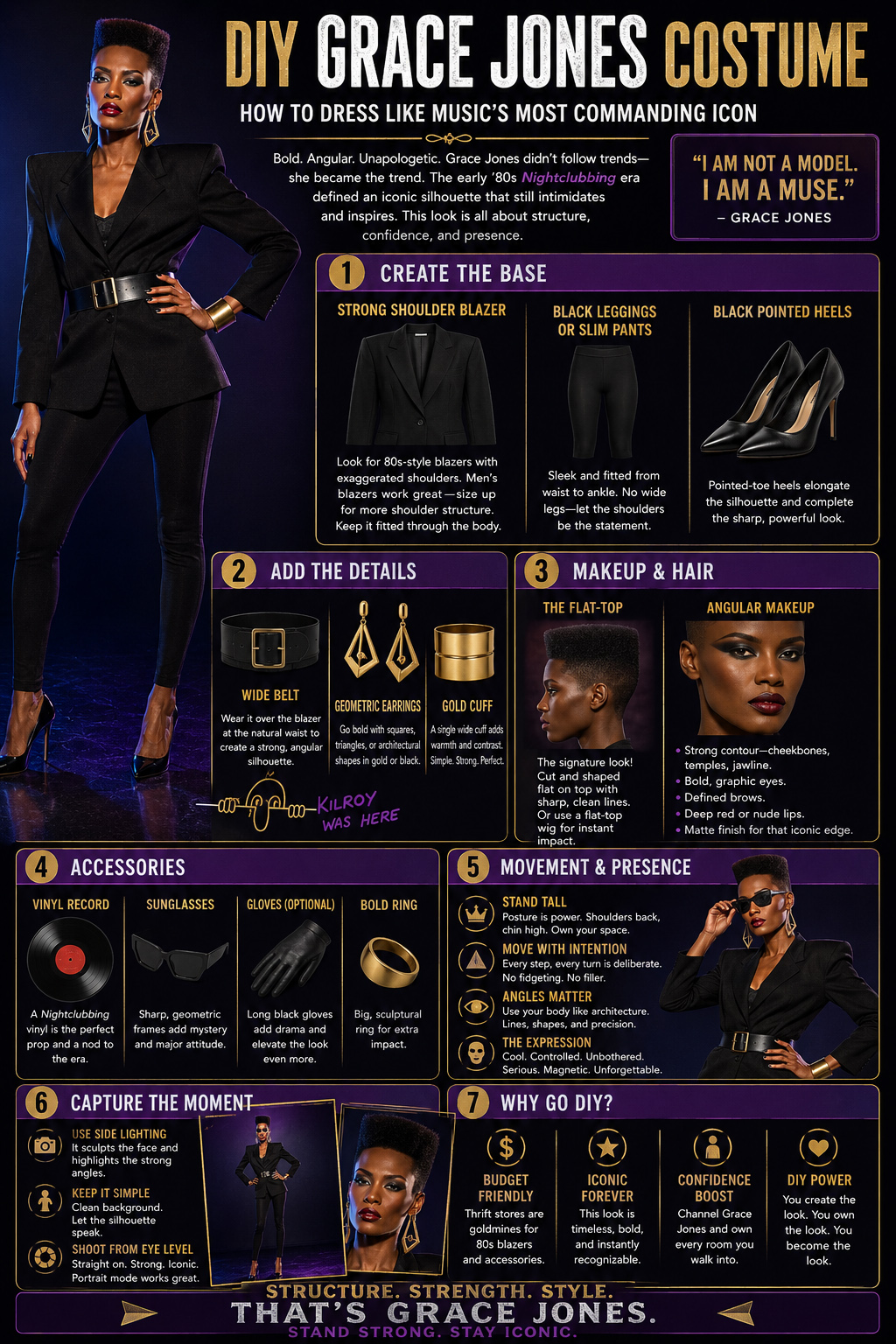
The accessories in this costume are already covered across the previous sections, and that is appropriate because Grace Jones's look was not built on accumulation. It was built on selection. Every piece she wore meant something and nothing was there without a reason.
The geometric earrings, the gold cuff, and the wide belt are the three accessory elements worth carrying, and they should be worn with the same intentionality the rest of the costume demands. Nothing added for the sake of adding. Nothing removed because it felt like too much. The costume has a specific visual logic and the accessories are part of that logic rather than decoration applied to it.
If you want one additional element that connects to the album era specifically, a vinyl record carried or held casually in one hand is an immediately readable prop that places the costume in its exact cultural context. A secondhand vinyl record costs almost nothing at a thrift store and photographs beautifully as a prop against the all-black costume.
🕺 Step 5: Movement and Presence
Grace Jones moved like someone who had decided exactly where she was going before she stood up, and every step confirmed that decision. This is genuinely one of the most specific and achievable movement profiles in this entire series of costumes, because the instructions are simple even if the execution requires practice.
Stand completely straight. Not military straight, not rigidly straight, but the straight of someone who has never once considered slouching because slouching simply did not occur to her as an option. The shoulders, already doing architectural work in the blazer, need a spine beneath them that matches their commitment. Drop your shoulders back and down, lift the crown of your head, and let the silhouette do what it was built to do.
Every movement should be deliberate. Grace Jones did not gesture casually or shift her weight out of habit. When she turned, she turned. When she raised a hand, it arrived at its destination and stayed there until she decided to move it again. Practice standing still, which is harder than it sounds, and then practice moving from stillness to a new position with a single clean transition. No intermediate fidgeting. No preparatory shuffles. Still, then moved, then still again.
The poses should have angles. A straight-on stance with arms at the sides reads as presence. A turned shoulder with the head remaining forward reads as intention. A single arm raised or extended reads as a statement. Grace Jones understood that the human body is capable of becoming a geometric object when the person inside it decides to treat it that way, and her entire visual identity was built on that understanding.
The expression is neutral to serious. Not unfriendly, not aggressive, simply the face of someone who is fully present and completely unimpressed by anything that might be trying to impress her. Practice a resting expression that is still and level without being blank. The eyes should be engaged and focused. The mouth should be relaxed and closed. The jaw should be level. Hold it without effort, because effort shows, and Grace Jones never showed effort.
Do not smile for photographs unless you have decided to smile. A deliberate smile held for exactly the right moment is a choice. A reflexive smile because a camera appeared is a habit, and habits are not part of this costume.
📸 Step 6: Capture the Moment
For photography, the DIY Grace Jones costume demands clean, strong light and a simple background that lets the silhouette read without interference. A plain white or light gray wall is ideal. A dark wall also works if the blazer has enough contrast to separate from it. What does not work is a busy background that competes with the geometric quality of the costume, because the costume is built on clarity of line and anything that muddles that line undermines the whole image.
Side lighting from a single window source will carve the shoulder structure and the makeup contouring in a way that overhead or frontal light will not. Position yourself so the light source is at roughly a forty-five degree angle to your body and let it do the work. The shadows it creates will deepen the shoulder architecture and give the face the kind of contrast that Grace Jones's actual promotional photography was built on.
Shoot from straight on rather than from above or below. The silhouette is the subject of the photograph and it should be captured at eye level where it reads most honestly. Portrait mode will separate you from the background cleanly. Hold the still, deliberate expression. Let the camera come to you rather than performing toward it.
A photograph taken in profile showing the flat-top and the shoulder line together in a single frame is worth getting, because that specific combination of shapes is the most architecturally complete image this costume can produce and it will read immediately to anyone who knows the reference.
🏆 Why Go DIY? Wrap-Up
Building a DIY Grace Jones costume from a thrift store blazer and a well-chosen wig means engaging with a visual language that Grace Jones herself built from deliberate and intelligent choices across decades of work. The shoulder structure, the flat-top, the geometric makeup, none of it happened accidentally. It was designed by someone who understood that image is a form of communication and who decided exactly what she wanted to communicate before she stepped in front of any camera or onto any stage.
Grace Jones mattered and continues to matter because she refused every category that was offered to her and built her own instead. She was too angular for conventional beauty standards, too aggressive for easy pop consumption, too original for simple classification. She responded to all of that by becoming more precisely herself with every passing year, and the image she built in the process became one of the most influential visual statements in twentieth century popular culture.
When you put on that blazer and stand up straight and hold that expression and let the silhouette speak before you say a word, you are doing something in the tradition of an artist who understood that presence is a skill and that confidence is a choice made before you walk through the door. Grace Jones made that choice every single time. Now so do you.
Stand straight. Hold the line. Do not smile until you mean it.
🕸️ Related Costumes to Try
DIY Crazy Eyes Costume
DIY Stewardess Costume
DIY Voodoo Priestess Costume
DIY Half Man Half Woman Costume
Further Reading & Resources
📺 See: Grace Jones - The Movie Database (TMDB)
🔍 More: Grace Jones - Wikipedia