🔧 DIY Fred G. Sanford Costume: How to Dress Like Sanford and Son’s Most Lovably Cantankerous Junkman

There are sitcoms that entertain, and then there are sitcoms that change the landscape of what American television is willing to show and who it is willing to center. Sanford and Son premiered on NBC on January 14, 1972, and did both of those things simultaneously. Created by Norman Lear and Bud Yorkin and based on the British series Steptoe and Son, the show placed a predominantly Black cast at the center of a primetime Friday night lineup and proceeded to dominate the ratings for five consecutive seasons. It was not a modest success. It was one of the highest-rated shows on American television, period, competing directly with and frequently beating everything else the networks put against it.
The DIY Fred G. Sanford costume draws from one of American television’s most culturally significant and beloved sitcoms, Sanford and Son, which premiered on NBC on January 14, 1972, and ran through 1977 as one of the highest-rated shows in American primetime television. Redd Foxx brought decades of stand-up comedy experience to the role of Fred G. Sanford, creating a character of extraordinary richness and comic precision that earned him Emmy nominations and made the show a landmark in the representation of Black life and culture in American television.
What the show meant culturally was significant and worth saying plainly. Sanford and Son arrived four years after the assassination of Martin Luther King Jr., in a television landscape that had made tentative steps toward representation but had not yet produced anything quite like this. The show was set in the Watts neighborhood of Los Angeles, it was written largely by Black writers, and it centered the lives and relationships of Black characters with a specificity and a humor that did not condescend and did not explain itself to a white audience. It simply existed, fully and on its own terms, and the audience found it in enormous numbers.
At the center of all of it was Fred G. Sanford, played by Redd Foxx with a brilliance that made the character one of the great comic creations in American television history. Foxx was already a legendary stand-up comedian before the show, known for a raw and fearless style that had built him a devoted following for years. He brought all of that intelligence and timing to Fred, and what he created was a character of extraordinary richness.
Fred was cheap, scheming, manipulative, and frequently wrong about almost everything. He was also funny in a way that made you root for him anyway, and underneath the complaints and the cons was a man who had built something from nothing and loved his son even when he could not say it directly.
Redd Foxx received Emmy nominations for the role and the show ran from 1972 through 1977, producing one of the most quoted and referenced catalogs of catchphrases in sitcom history. You big dummy. The Elizabeth? I’m coming to join you, honey. The accumulated weight of five seasons of Fred G. Sanford telling the world exactly what he thought of it at full volume and without apology.
A DIY Fred G. Sanford costume works because the visual is specific and immediately recognizable and because the character behind it is one of the most genuinely funny and rewarding to inhabit in this entire series. The cardigan and the plaid shirt and the suspenders establish who you are. What you do with the slow walk and the pointed finger and the hand over the heart does the rest.
👗 Step 1: Create the Base
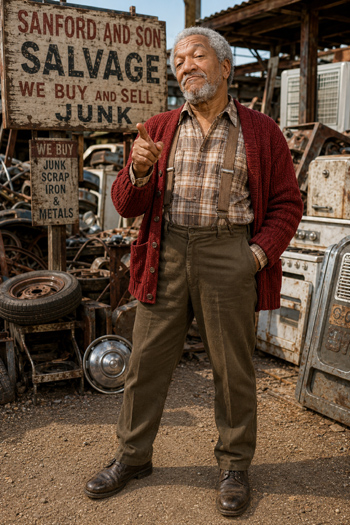
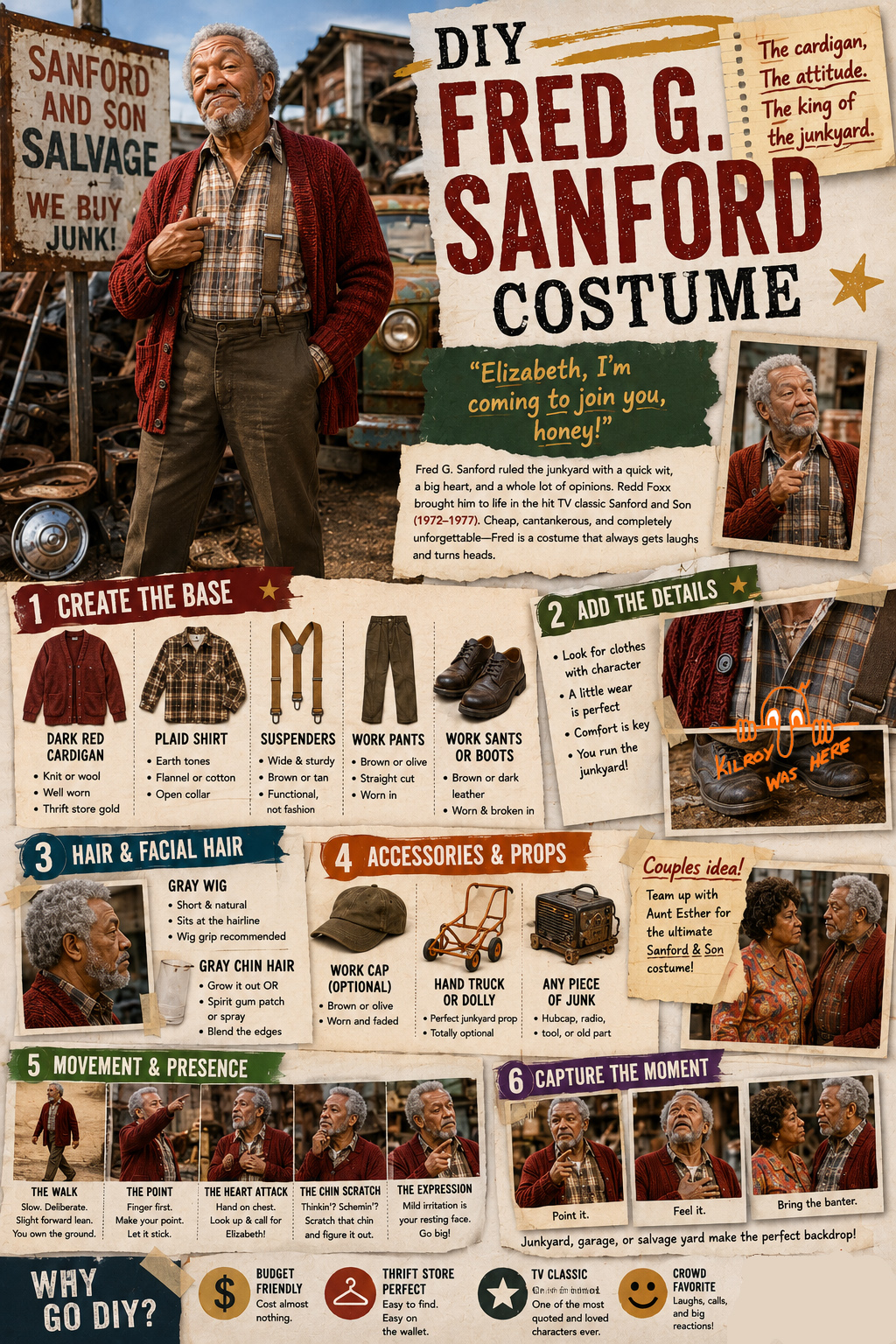
The foundation of a DIY Fred G. Sanford costume is built from the specific clothing of a man who runs a salvage yard in Watts and has been wearing variations of the same outfit for thirty years without significant complaint or revision. Every piece communicates working class practicality and a complete indifference to fashion, worn with the unselfconscious comfort of someone who has never once considered whether his clothing was making the right impression.
The dark red knit cardigan is the anchor piece and it should be exactly that. A dark, warm red in a knit fabric with some weight to it. Not a fashion cardigan, not a fitted style, but the kind of substantial, slightly worn cardigan that belongs to a man who reaches for it every morning without thinking because it has always been there and it is always warm enough. Thrift stores are the honest and correct source for this piece. The used quality of a secondhand cardigan is not a drawback. It is the whole point. Look for something with a little age to it, a button front, and a fit that is relaxed through the body without being enormous.
The plaid shirt goes underneath the cardigan and should be visible at the collar and cuffs. A flannel or cotton plaid in earth tones, browns, greens, oranges, and tans works correctly. The plaid should be a working shirt rather than a fashionable one. Again, thrift stores will have exactly this in abundance at minimal cost. The collar should be worn open at the top, no tie, no formality, just the collar of a man who is at work and has been at work since before most people were awake.
The suspenders are the detail that pulls the whole upper body together and they should be worn over the plaid shirt and under the open cardigan so they are visible when the cardigan falls open. Wide suspenders in brown or tan are the right choice. They should clip or button to the waistband of the pants rather than being the decorative kind that do not actually hold anything up. Fred’s suspenders were functional. They were doing a job.
Brown or olive work pants complete the base below the waist. Straight cut, worn in, the kind of pants that have seen a junkyard and show it in the way fabric shows years of honest use. Work shoes or boots in brown or dark leather finish the look at the floor. Thrift stores are the right source for both. The more worn the boots look, the more accurate they are.
Find other Easy DIY Costume Ideas Here
🧵 Step 2: Add the Details
The details on a DIY Fred G. Sanford costume are about earned wear and specific character rather than theatrical construction. Every piece should look like it has been owned for years and used regularly and has developed the kind of character that only time and use can produce.
The cardigan is worth distressing slightly if your thrift store find is in too good a condition. A gentle pass with a fine sandpaper block along the elbows and cuffs will soften the fabric and add the kind of wear that reads correctly from a distance. Do not overdo it. Fred was not in rags. He was in working clothes that had been worked in, and the distinction matters.
The overall silhouette should read as a man who is comfortable in his own skin and his own clothes and has no interest in anyone else’s opinion of either. Fred Sanford dressed for the junkyard and for himself, in that order, and the costume should carry that quality in every piece.
💄 Step 3: Makeup and Hair
The gray wig is the piece that completes the character’s face from the top down and it should be chosen with Fred’s specific hair in mind. Fred Sanford’s hair was gray, natural, and worn close to the head without any particular styling ambition. A short gray wig in a natural texture rather than a sleek or processed style is the right choice. Costume shops and online retailers carry options in this range. When fitting the wig, make sure it sits naturally at the hairline and does not ride back on the head, because that single fit issue is what separates a convincing result from an obvious one at any distance.
The gray hair under the chin is the second element of Fred’s facial appearance and it should be addressed with the same practical honesty used in earlier articles in this series. If you can grow a short gray chin beard or goatee, do it. A few days of growth in the right color range is all that is needed. If your facial hair grows in a color other than gray, a light application of temporary gray hair color spray available at costume shops will bring it into the right range for an evening.
For readers who cannot grow facial hair or prefer not to, a spirit gum chin beard piece is the workable solution. Spirit gum facial hair pieces are available at costume shops and online retailers in gray tones. Apply the spirit gum to the chin area according to the package instructions, press the piece into place, and hold it firmly for the full recommended setting time. A light dusting of translucent powder along the edges where the piece meets the skin will help blend the join and extend the wear through the evening.
Keep the spirit gum remover accessible because removing a spirit gum piece without the proper solvent is an unpleasant experience that Fred G. Sanford himself would have had strong opinions about.
The makeup beyond the hair is minimal. A clean, natural face is correct. Fred was not wearing anything on his face except the accumulated expression of a man who has seen everything, found most of it irritating, and developed strong opinions about all of it.
🎀 Step 4: Accessories
The accessories for this costume are few and specific. Fred was not an accessory person. He was a junkyard person, and the distinction is significant.
A small hand truck or dolly carried or positioned nearby in a photograph is an optional prop that places the character in his exact professional context and reads immediately to anyone who knows the show. If that is not practical for an evening event, a piece of junk, a small broken object carried casually, communicates the same thing with less logistical commitment.
A worn baseball cap in brown or olive is worth considering as an additional piece that Fred wore occasionally and that adds another layer of working authenticity to the overall look. Thrift stores carry these in abundance and the more worn the cap looks the more correctly it reads.
One additional thought worth including here. Fred G. Sanford and Aunt Esther are one of the great comic pairings in sitcom history, and this costume works beautifully as one half of a couples or group costume with a DIY Aunt Esther costume as the companion piece. If you are planning a couples costume, the dynamic between Fred and Aunt Esther, trading insults with complete commitment and mutual theatrical outrage, is the kind of performance that will entertain a party for an entire evening. A future companion article on the DIY Aunt Esther costume will cover that side of the pairing in full.
🕺 Step 5: Movement and Presence
Fred G. Sanford is one of the great physical comedians in American sitcom history and Redd Foxx built a very specific physical vocabulary for the character that is observable, learnable, and genuinely enjoyable to inhabit for an evening.
The walk is slow and deliberate with a slight forward lean, the walk of a man who has been on his feet in a junkyard for decades and has arrived at a pace that suits him and does not particularly suit anyone who is trying to get somewhere quickly. Each step should land with a quality of settled authority, as if the ground is his property and he knows it, because in his mind it always is. Move at roughly sixty to seventy percent of your natural pace and let the forward lean come from the hips rather than the shoulders so it reads as habitual rather than performed.
The pointing finger is the primary gesture and it should be deployed with confidence and frequency. Fred pointed when he was making a point, which was constantly, and when he was disagreeing with something, which was also constantly. Extend the index finger, hold it toward whoever or whatever you are addressing, and let it sit there while you speak. The finger should arrive before the words and stay after them. It communicates that what follows is not a suggestion.
The exaggerated facial expressions are the element that most rewards practice in a mirror before the event. Fred’s face traveled across a wide range in a short time. Mild irritation was the baseline. From there he could move to outrage, to wounded dignity, to theatrical disbelief, and back to irritation in the space of a single exchange. Practice moving between those registers with the kind of broad, committed expressiveness that Redd Foxx brought to every scene. Nothing subtle. Nothing held back.
The heart attack is the single most famous physical bit in the show’s run and it is worth executing correctly when the moment presents itself. One hand goes to the chest over the heart. The other reaches upward toward the sky. The head tilts back slightly. The expression shifts from whatever it was to the specific look of a man who is certain his time has come. Hold the position for a beat, address the ceiling directly, and deliver the line with complete sincerity. Elizabeth, I’m coming to join you, honey. The comedy comes entirely from the commitment. Fred always meant it, every single time, and Redd Foxx played it that way without a trace of winking at the audience.
The chin scratch is a smaller gesture worth adding to the rotation. Fred scratched his chin when thinking, when scheming, and when pretending to think while actually scheming, which covers a significant portion of the show’s runtime. Use it during pauses in conversation as a signal that something is being worked out, because something usually is.
Talk with the confidence of someone who owns the junkyard, which Fred always did regardless of whether the evidence supported that confidence. Act like every opinion you have is a settled fact that the universe has simply not yet caught up to. Call anyone who disagrees with you a big dummy with the affectionate contempt of a man who means it kindly even when he does not mean it kindly at all.
📸 Step 6: Capture the Moment
For photography, the DIY Fred G. Sanford costume benefits from an outdoor or industrial setting that connects to the character’s environment. A backyard with some clutter visible in the background, a garage setting, or any outdoor space that reads as working rather than decorative will feel immediately right for the character.
Warm afternoon light suits this costume well. The earth tones of the cardigan and the work pants read best in warm light that picks up the brown and red in the clothing and gives the overall image the kind of tonal warmth that the show’s visual atmosphere carried throughout its run.
The pointing finger pose is the strongest single image this costume can produce. Stand with the slight forward lean, one finger extended toward the camera, the expression of mild irritation that is Fred’s resting state, and let the wig and the cardigan and the suspenders do their work in the frame. That image needs no caption for anyone who watched the show.
The heart attack pose is the second essential photograph. One hand on the chest, one hand reaching upward, head tilted back, looking at something above the frame with the expression of a man making his final dramatic appeal to a higher power and to Elizabeth specifically. Shoot it from a slightly lower angle to give the upward reach its full visual authority. That photograph will communicate the character completely to anyone who sees it.
If you have an Aunt Esther accompanying you, the two of you facing each other with matching expressions of theatrical outrage is the third photograph worth getting and the one that will produce the strongest reaction from anyone who knows the show.
🏆 Why Go DIY? Wrap-Up
Building a DIY Fred G. Sanford costume from a thrift store cardigan and a plaid shirt and a pair of worn work boots means assembling something that costs almost nothing and carries the weight of one of the most significant and beloved sitcoms in American television history. The pieces are simple. The character they represent is not, and honoring that character with genuine commitment to the walk and the point and the Elizabeth bit is worth the effort every time.
Fred G. Sanford mattered because Redd Foxx made him matter, and because Norman Lear gave Redd Foxx the space and the material to do something genuinely extraordinary with a character who could have been a simple comic type and became instead one of the great fully realized people in American sitcom history. Cheap, cantankerous, scheming, and completely lovable. A man who built something from junk and called it his and meant it with everything he had.
Sanford and Son mattered because it showed up in 1972 and dominated American primetime television with a Black cast and a Black neighborhood and a Black sensibility and did not apologize for any of it and did not need to. It was simply one of the best shows on television, and the audience knew it, and the ratings confirmed it every Friday night for five seasons.
When you put on that cardigan and adopt that lean and point that finger and clutch that chest and look up at the ceiling and tell Elizabeth you are on your way, you are doing something in the tradition of one of the great comic performances in American television. Fred would tell you that you are probably doing it wrong. He would be wrong about that. He was wrong about a lot of things. He was always worth listening to anyway.
🕸️ Related Costumes to Try
DIY Emmett Kelly Hobo Clown Costume
DIY Madea Costume
DIY Zombie Mechanic Costume
DIY Witch Doctor Costume
Further Reading & Resources
📺 See: Sanford and Son: The Complete Series
🔍 More: Redd Foxx | Biography, Comedy, Sanford and Son, & Facts