🎃 Vintage Halloween Collectibles and Why Collectors Can’t Get Enough of Them
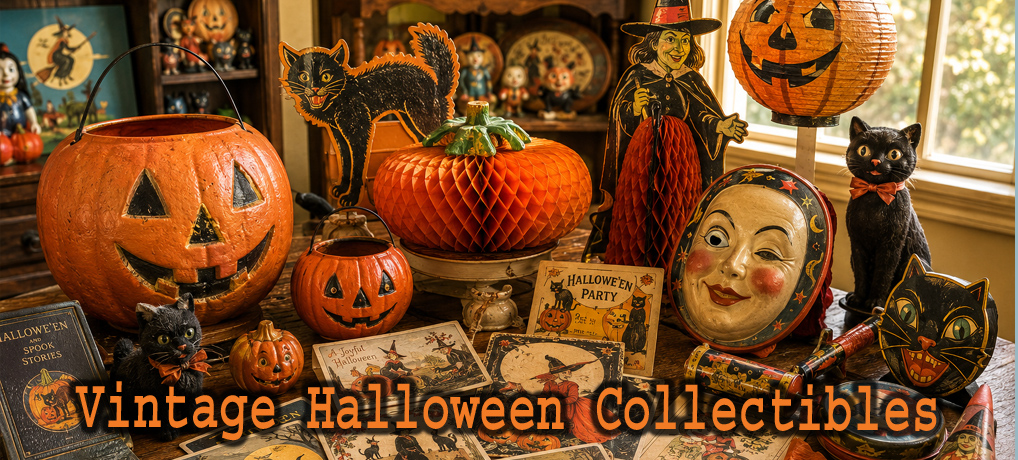
Here is something worth thinking about the next time you walk through an antique mall in October: most of what you are looking at was never meant to survive. The paper jack-o-lantern hanging from the ceiling was meant to be used once and thrown away. The tin noisemaker was a party favor that cost three cents. The cardboard skeleton on the wall was a decoration, not an heirloom. And yet here it is, eight decades later, still grinning at you from across the aisle.
Vintage Halloween collectibles occupy a category all their own in the collecting world. Unlike Christmas ornaments, which were carefully wrapped and stored and handed down through generations with deliberate sentiment, Halloween items were consumable. They were used hard, left out in the weather, played with by children, and discarded without ceremony. The ones that survived did so almost by accident, tucked into an attic box or forgotten in the back of a closet, and that survival is exactly what makes them so fascinating and so valuable today.
The heyday of vintage Halloween collectibles runs roughly from the 1910s through the 1960s, with a second wave of collectible plastic and blow mold pieces extending through the 1990s. Everything on this list is actively collected, actively traded, and actively appreciated by a growing community of enthusiasts who understand that these objects are not just decorations. They are artifacts of how American culture celebrated its spookiest holiday, year by year, decade by decade, in a way that can never quite be replicated.
Here are twenty-five categories and specific pieces that deserve a place in any serious Halloween collection.
Why Vintage Halloween Collectibles Are So Popular
The short answer is nostalgia, but that undersells what is actually happening in the vintage Halloween market. Nostalgia is the entry point. The deeper drivers are rarity, craftsmanship, and the particular pleasure of owning something that almost did not make it.
Halloween is unique among American holidays in that its decorating tradition was built almost entirely around disposable materials. Christmas had glass ornaments and ceramic figurines built to last. Easter had porcelain and fine fabric. Halloween had paper, tin, and papier-mache, all of it designed for one season’s use. When those items survived, they survived by chance rather than intention, which means the surviving population is genuinely small. A German papier-mache pumpkin candy container from 1920 that has made it to the present day in good condition is not merely old. It is a statistical improbability. Collectors understand that.
The artwork on vintage Halloween pieces also rewards close attention in a way that modern Halloween decoration rarely does. The color palette of early twentieth-century Halloween imagery, those warm oranges and deep blacks and surprising greens, was applied by skilled commercial artists working in a tradition that treated holiday ephemera as a legitimate creative medium. A Beistle die-cut from 1929 is not just a decoration. It is a small piece of commercial art made with genuine craft, and it looks like nothing produced today.
The market has responded accordingly. Interest in vintage Halloween collectibles has grown steadily since the 1990s, with online auctions dramatically expanding both the buyer pool and the price ceilings. Items that sold for a few dollars at estate sales twenty years ago now command serious money from serious collectors. That trajectory shows no sign of reversing.
Collecting Fortune Teller & Séance Items – Crystal Balls, Cards & Occult Curiosities
Vintage Halloween Postcards
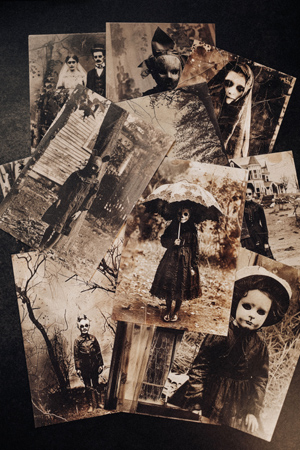
If you want to begin a vintage Halloween collection with something beautiful, affordable, and endlessly varied, start with postcards. The golden age of Halloween postcards runs from roughly 1905 through the 1920s, a period when sending elaborately illustrated holiday greeting cards was a mainstream American social practice. Millions of cards were printed, mailed, and received. Millions more were thrown away. The ones that survived are now among the most actively traded pieces in the entire vintage Halloween market.
The most desirable postcards are the embossed German-made examples printed before World War I. Germany was the world leader in postcard printing during this era, and the quality of their embossed Halloween cards, with their raised surfaces, rich ink colors, and elaborate imagery, remains unmatched. The imagery on these cards is its own study: anthropomorphic vegetables, witches riding improbable vehicles, black cats performing human activities, children in elaborate costumes, and jack-o-lanterns with expressions ranging from cheerful to genuinely sinister.
Artist attribution matters significantly to postcard collectors. Cards signed by Ellen Clapsaddle, whose warm and detailed illustrations of Halloween children remain beloved, and Frances Brundage, known for her rosy-cheeked children in elaborate Halloween scenarios, command premiums over unsigned examples. Publisher marks also matter. John Winsch postcards, Raphael Tuck and Sons cards, and cards from the Tuck series are all specifically sought. Understanding how to date vintage Halloween postcards through their postmarks, publisher codes, and printing techniques transforms postcard collecting from a casual hobby into a genuine detective pursuit, and that is part of the fun.
Comic postcards from the 1910s and 1920s, with their broad humor and exaggerated imagery, represent a more affordable entry point and have their own devoted collector base. A good comic Halloween postcard from this era tells you something true and funny about how people thought about the holiday a century ago, and that kind of cultural window is part of what makes the whole category worth pursuing.
Die-Cut Halloween Decorations
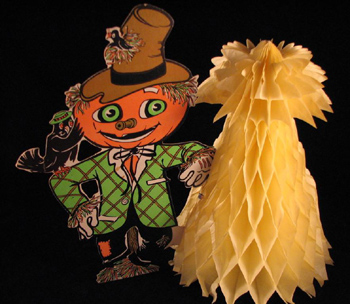
The Beistle Company of Shippensburg, Pennsylvania is the name that every serious vintage Halloween collector knows, and it deserves to be known by a great many more people. Founded by Martin Luther Beistle in 1900, the company began producing Halloween decorations in the early 1920s and by 1921 had a catalog of over a thousand designs. The company imported the technology to produce honeycomb tissue from Europe and became the dominant force in American Halloween decoration for decades. Over one thousand different designs were produced ranging from witches and black cats to skeletons, bats, owls, and jack-o-lanterns in every conceivable pose and expression.
Vintage Beistle die-cuts are among the most actively collected pieces in the Halloween market, and for good reason. The artwork on these cards, printed on thick embossed cardstock and designed to be displayed on walls and windows, represents the visual vocabulary of Halloween as it existed from the 1920s through the 1960s. A Beistle witch, a Beistle skeleton, a Beistle dancing cat: these images defined what Halloween looked like in American homes for two generations, and they remain immediately recognizable today.
German-made die-cuts produced before World War II represent a separate collecting category and a significant step up in both rarity and price. These were produced in homes and small workshops, often hand-decorated, in small quantities, and the rise of the Third Reich ended their production permanently. A genuine pre-war German Halloween die-cut in good condition is a genuinely rare object, and the market treats it accordingly.
Jointed die-cuts, in which a skeleton or witch or cat is assembled from multiple pieces connected by small brass brads, are particularly popular because they can be posed and because they represent a more elaborate level of production. Honeycomb centerpieces, in which a flat die-cut figure opens accordion-style to reveal a three-dimensional honeycomb tissue body, are among the most spectacular and most sought-after pieces in the entire category.
One practical note for collectors: Beistle has produced reproductions of many of its vintage designs under its Vintage Beistle line. These are attractive and affordable, but they are not the originals. Authentic vintage Beistle pieces are printed on heavier cardstock, show genuine age-appropriate yellowing and wear, and typically have copyright marks and publisher information consistent with their era. When in doubt, turn the piece over. The back tells you more than the front.
Vintage Halloween Masks
The mask is one of the most primal Halloween objects, and the history of Halloween masks in America is a study in the collision of folk tradition, commercial manufacturing, popular culture, and childhood memory that makes vintage Halloween collecting so endlessly interesting.
Paper masks, produced from the 1910s through the 1940s, represent the earliest widely collected category. These were cheap, cheerful, and fragile, printed on thin cardboard with elastic strings that rarely survived more than a few wearings. Finding one in good condition today is a genuine discovery. The imagery ranges from traditional Halloween characters to political figures, animals, and characters from early film and radio.
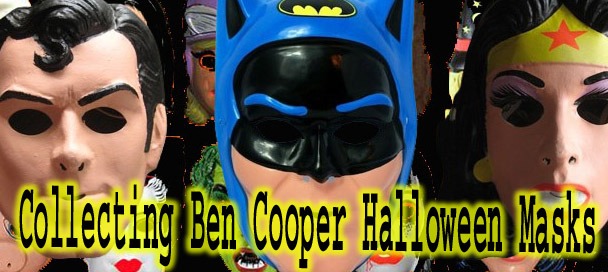
The Ben Cooper and Collegeville costume companies defined Halloween for generations of American children from the 1930s through the 1980s. Their vacuum-formed plastic masks, in bright day-glo colors with roughly painted features, cover an astonishing range of licensed characters: Disney heroes and villains, Hanna-Barbera characters, Star Wars heroes and villains, superhero after superhero, plus the classic Halloween monsters: Dracula, Frankenstein’s monster, the Wolfman, the Mummy. The masks were accompanied by a thin plastic or nylon smock printed with an image of the character, packaged together in a window-front display box that is itself now collectible.
Don Post Studios occupies a higher tier of the mask collecting world. Founded in 1939 and responsible for creating monster masks for Hollywood films including the original Planet of the Apes, Don Post produced latex and rubber masks of extraordinary quality compared to the mass-market costume companies. A vintage Don Post mask in good condition, with original paint and no significant cracking or shrinkage, is one of the finer objects in vintage Halloween collecting.
Condition is everything in mask collecting, and the challenges are real. Latex degrades, cracks, and shrinks. Elastic rots. Paint flakes. Paper masks yellow, tear, and lose their elastic. A mask in genuinely excellent condition commands a significant premium over the same mask with typical age issues, and the difference between displayable and exceptional can be dramatic.
Collecting Ben Cooper Halloween Masks – Vintage Frights from the Golden Age of Trick-or-Treating
Jack-o’-Lantern Candy Containers
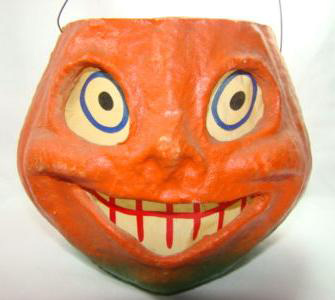
The candy container is the object that best captures the essential character of vintage Halloween collecting: something made to be used up, thrown away, or given to a child who would inevitably damage it, that somehow survived to become a treasure. German-made papier-mache jack-o-lanterns from the 1910s through the 1930s are the gold standard of the category, produced in small workshops, hand-painted, and exported to America in quantities that seemed large at the time but look impossibly small in retrospect.
These pumpkins were functional candy containers, with removable tops that allowed candy to be placed inside and distributed to trick-or-treaters or used as party favors. The best examples have remarkable faces, ranging from warm and cheerful to genuinely unsettling, painted in orange and black with details that reflect the individual hand of the craftsperson who made them. Finding one with its original insert intact, original finish, and no significant damage is a genuine event.
Composition pumpkins, made from a mixture of sawdust, glue, and other materials pressed into molds, represent a slightly later American-made variant of the category. They lack the warmth of the German papier-mache examples but have their own appeal, particularly in their variety of faces and sizes. Hard plastic candy containers from the Rosbro and E. Rosen companies, produced in the 1940s and 1950s, are more durable than their predecessors and more available on the market, making them an excellent entry point for collectors beginning to explore this category.
The classic orange plastic trick-or-treat bucket, that humble jack-o-lantern pail that held a generation’s worth of Halloween candy, now has its own collector community. Early examples from the 1950s and 1960s, with their simple molded faces and wire handles, represent the category in its purest form, and finding one in excellent condition without cracks, fading, or handle damage is more challenging than it sounds.
Vintage Halloween Noisemakers
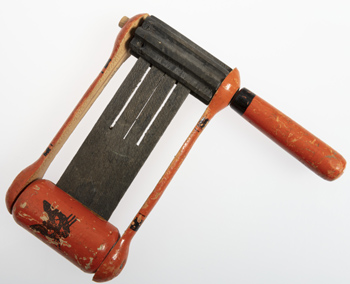
There is something specifically joyful about vintage Halloween noisemakers that separates them from almost every other category of Halloween collectible. These were toys. They were carried by children on trick-or-treat nights. They were spun and rattled and clacked and blown until they either broke or were confiscated by a parent who had endured enough. The artwork on them is spectacular. And finding them in excellent condition today is a genuine challenge because excellent condition was actively worked against by their entire purpose.
The primary manufacturers of vintage Halloween noisemakers were T. Cohn, Kirchhof, US Metal Toy, and J. Chein and Company, all of them producing tin-lithographed pieces in America from the 1910s through the 1960s. German and Japanese manufacturers also produced significant quantities during various periods. The range of types is impressive: ratchets, clackers, tambourines, horns, rattlers, bells, whistles, and frying pan types that clang when shaken. The artwork on the tin surfaces covers the full Halloween vocabulary of witches, black cats, owls, pumpkins, ghosts, skeletons, bats, and devils, printed in the flat, bold colors of commercial tin lithography at its best.
Early 1930s tin-lithographed noisemakers are the most valuable examples in the category, and the most difficult to find in collectible condition. The tin itself was not thick, the moving parts wore quickly, and the printing could fade or chip with handling. A 1930s T. Cohn ratchet noisemaker in excellent condition is a piece that serious collectors pursue actively.
Paper-over-cardboard horns, built from recycled textile factory cones covered in lithographed paper, represent a different and particularly charming variant of the noisemaker tradition. These horns, which could be both blown and spun to produce their ratchet sound, were made from genuinely recycled materials before recycling was a marketing concept. Finding one with its paper artwork intact, its wooden mouthpiece present, and its cone undamaged is a specific and rewarding hunt.
Halloween Blow Molds
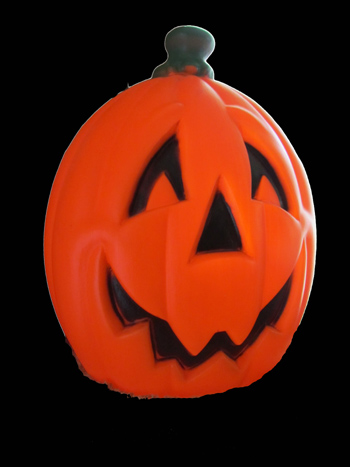
If you grew up in America between the 1960s and the 1990s, you know exactly what a blow mold is, even if you have never heard the term. It is the glowing plastic jack-o-lantern on the front porch. It is the illuminated witch on the neighbor’s lawn. It is the light-up ghost in the window that you could see from two houses away on a dark October night. Blow molds are the most powerfully nostalgic objects in vintage Halloween collecting because they were not ephemeral. They were meant to be used year after year, and many of them were, until they faded, cracked, or were left behind in a house move.
The companies that defined the blow mold era were Empire Plastics, General Foam Plastics, and Union Products, all of them pioneering the process of inflating molten plastic into hollow molds to create lightweight, durable decorations designed for internal illumination. Empire’s glowing jack-o-lanterns, General Foam’s large light-up ghosts, and Union Products’ classic designs remain the most actively sought pieces in the category. Rarer figures command more serious attention: the 1960s Empire Witch on Broom, the General Foam Grim Reaper, and various Frankenstein and Dracula figures from multiple manufacturers have become genuinely competitive collecting targets.
The current market for vintage Halloween blow molds has expanded significantly in recent years as collectors who grew up with these pieces on their own front porches have reached the stage of life where they want them back. A blow mold that sat unused in an attic for thirty years and emerged in excellent, fully functional condition is worth considerably more than it would have been a decade ago, and that appreciation trend shows every indication of continuing.
Condition factors to watch in blow mold collecting include fading of the painted details, crazing or cracking of the plastic, damage to the light socket and cord inside, and the presence or absence of the original base or stake. A blow mold with original working light, unfaded paint, and no plastic damage is in a different collecting category than the same figure with typical age issues.
Collecting Blow Molds: Essential Guide for a Timeless Hobby
Vintage Halloween Costume Boxes
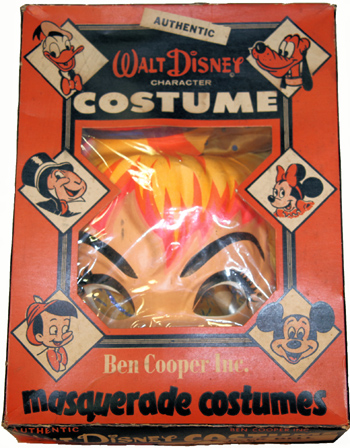
The complete boxed Ben Cooper or Collegeville costume is one of the most satisfying objects in all of vintage Halloween collecting, partly because it represents something genuinely complete: the mask, the costume, and the box, assembled exactly as they were when a child’s parent pulled it off the shelf at Woolworth’s or JCPenney or the local five-and-dime and brought it home for Halloween night.
Ben Cooper Incorporated, founded by Ben Cooper himself as a theatrical costume company in the 1930s, became the dominant force in the Halloween costume market from the 1950s through the mid-1980s. Collegeville Flag and Manufacturing Company was its most significant competitor. Together they produced an astonishing range of licensed characters that reads as a cultural history of American popular culture: every major Disney character, every Hanna-Barbera cartoon, every Universal Monster, every superhero, every major television character, plus a full range of traditional Halloween figures.
Ben Cooper’s licensing agreements meant that whatever was capturing children’s imaginations in any given year was likely available as a Halloween costume, which is why vintage Ben Cooper boxes function today as a kind of catalog of American pop culture from 1950 to 1985.
The boxes themselves are a significant part of the appeal. Illustrated with full-color artwork depicting the character in dramatic poses, often with generic Halloween backgrounds of bats and pumpkins and full moons, they represent commercial illustration at its most enthusiastic. The window in the front of the box, through which the mask could be seen before purchase, adds a display dimension that makes a wall of boxed Ben Cooper costumes one of the most visually striking things a Halloween collector can assemble.
Completeness is everything in this category. A costume with its original box commands approximately forty percent more than the same costume without the box. A boxed costume with the original paper insert and all components in excellent condition commands more still. Conversely, even an empty box in good condition has its collector market, because the artwork on the box is often the most beautiful part of the entire package.
The Thrill of Collecting Aurora Monster Models
Halloween Board Games and Toys
Vintage Halloween toys and games represent one of the more specialized corners of the collecting world, partly because Halloween was never as dominant a toy category as Christmas, and partly because children’s toys are subject to conditions of use that make excellent examples genuinely rare. A Halloween board game from the 1930s that has been played many times will show it. A Halloween board game from the 1930s in excellent, unpunched condition is a different object entirely.
Paper dolls with Halloween themes, produced primarily in the 1930s and 1940s, are among the most delicate and most sought-after pieces in this category. A Halloween paper doll set with all its costumes intact and uncut represents a survival story that collectors appreciate. Wind-up tin toys with Halloween themes, produced primarily by German and Japanese manufacturers in the mid-twentieth century, are particularly prized: a working wind-up Halloween toy in excellent condition with original box is a significant find.
Halloween-themed puzzles from the 1930s through the 1950s, in both wood and cardboard versions, have their own collector community. The wooden examples are more durable and more valuable, particularly the die-cut wooden puzzles with irregular piece shapes that were characteristic of the premium end of the market. Cardboard puzzle boxes with their original Halloween artwork are themselves worth preserving even when the puzzle inside is incomplete.
Gurley Novelty Company Halloween candles, produced from the 1940s through the 1960s in the shapes of witches, pumpkins, black cats, ghosts, and devils, occupy a pleasant middle ground between toy and decoration. They were never meant to be lit, which is why the most valuable examples are completely unlit, with all their original paint and no wax loss. Finding a set of Gurley Halloween candles in their original box, all figures present and unmelted, is a specific and genuine pleasure.
Vintage Halloween Advertising
Vintage Halloween advertising materials occupy the intersection of two major collecting fields: Halloween ephemera and advertising collectibles. The resulting market draws enthusiasts from both communities, which helps explain why genuinely rare pieces can command serious attention.
Candy company store displays from the 1930s through the 1960s are among the most striking pieces in this category. These large cardboard displays, designed to sit on candy store and drug store counters and promote Halloween-themed candy packaging, were used for a single season and discarded. The artwork on the better examples is extraordinary: bold color, excellent commercial illustration, and the specific visual language of mid-century Halloween that feels immediately and warmly familiar to anyone who has spent time with this material.
Window cards, the smaller poster-format advertising pieces designed to be placed in store windows, cover an enormous range of products and businesses: candy companies, costume makers, movie theaters promoting their Halloween programs, and local businesses of every description advertising seasonal sales. The movie theater window cards, promoting double features of horror films in October, have a particular crossover appeal to both film memorabilia and Halloween collectors.
Trade magazine advertisements, the full-page and double-page spreads that candy and confectionery companies placed in industry publications to promote their Halloween offerings to retailers, are a more specialized but rewarding collecting category. These were never designed for public display at all, which means surviving examples represent a genuinely different window into how the Halloween industry marketed itself to the people selling its products.
Product packaging with Halloween themes, from candy wrappers to cereal boxes to soap wrappers, is another growing category within vintage Halloween advertising. Major brands including Hershey, Brach’s, and various regional candy companies produced seasonal Halloween packaging from the 1950s onward, and complete examples in excellent condition attract both candy wrapper collectors and Halloween enthusiasts.
How to Spot Reproductions
The vintage Halloween market has a reproduction problem, and every collector should understand it before spending serious money. The good news is that most reproductions can be identified with a combination of knowledge, attention, and the willingness to slow down and look carefully before committing to a purchase.
Paper and cardboard items are the most commonly reproduced category in vintage Halloween collecting, and the tells are usually visible on close inspection. Authentic vintage paper items show aging that is consistent across the entire piece: the yellowing of age is even and pervasive, not applied to edges while leaving the center pristine. The printing on vintage pieces shows the characteristic registration variations and ink qualities of earlier printing technology. Modern reproduction printing is too sharp, too even, and too bright. Embossing on vintage pieces has a specific feel and depth that mass-production reproduction struggles to replicate convincingly.
Papier-mache and composition items are reproduced less frequently because they are more difficult and expensive to fake convincingly, but they do appear in the market. Authentic pieces show aging in the paint and surface that is genuinely integrated into the object, not applied on top of it. The weight and feel of authentic papier-mache from the early twentieth century is distinctive, and handling many genuine examples before spending significant money on a single piece is the most reliable protection against paying original prices for reproduction quality.
Beistle reproductions deserve specific attention because Beistle itself has produced reproduction lines of its vintage designs, making the identification challenge more complex. The company’s Vintage Beistle line uses designs that are identical or nearly identical to the originals. The differences are in the paper weight, the printing quality, and the absence of genuine aging. When a piece of vintage Beistle appears in the market, check the copyright information, compare the paper weight and printing quality to known originals, and look for the specific yellowing and wear patterns that genuine age produces and artificial aging cannot quite duplicate.
The single most reliable protection against buying reproductions is knowledge. Read Mark B. Ledenbach’s Vintage Halloween Collectibles guide, which is considered the authoritative reference for the field. Spend time on collector forums and Facebook groups where experienced collectors share their knowledge freely and will often help identify specific pieces. Handle as many genuine examples as possible before spending significant money. And when a deal looks too good to be true, it almost always is.
Where to Find Vintage Halloween Collectibles
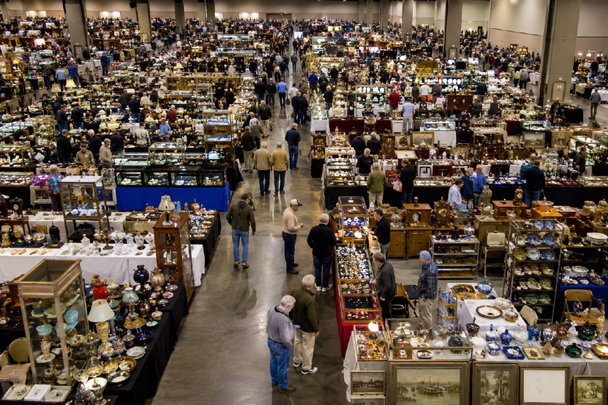
The hunt is half the pleasure of vintage Halloween collecting, and the venues for that hunt are more varied and more accessible than they have ever been.
Estate sales remain one of the most reliable sources for genuine vintage Halloween material, particularly in regions with older housing stock and established family histories. The items that survived in attics and basements for eight decades are most likely to surface at estate sales, where they have not yet been pre-sorted by dealers who know their value. Going early matters at estate sales, but going at all is the essential first step.
Antique malls in areas with strong collecting communities often have dealers who specialize in vintage Halloween and maintain rotating stock through the fall season. Building relationships with dealers who know what you are looking for can provide access to pieces before they reach the floor.
Online auctions, particularly eBay, have both expanded and complicated the vintage Halloween market simultaneously. The expanded buyer pool has pushed prices upward on the most desirable pieces. But the sheer volume of material listed means that patient, knowledgeable buyers can still find underpriced pieces that have been misdescribed, poorly photographed, or simply listed at the wrong time of year. October is the worst time to buy vintage Halloween on eBay because every other collector is looking simultaneously. December through February is considerably better.
Antique shows and collector conventions focused on Halloween and holiday collectibles bring together serious dealers and serious buyers in a concentrated environment that rewards attendance. The show environment allows for handling and comparison that online purchasing cannot replicate, and the community connections made at shows are themselves a significant part of the collecting experience.
Facebook Marketplace and collector-specific Facebook groups have become increasingly important venues for vintage Halloween sales, often at prices below the eBay market because the sellers are sometimes motivated by the desire to find a good home for a piece rather than to maximize price. The Halloween collector community on Facebook is active, knowledgeable, and generally welcoming to new collectors who approach with genuine interest.
If you happen to find yourself in Southwest Iowa this fall, Kilroy Was Here Shop in Shenandoah IA carries vintage Halloween collectibles when the season rolls around. It is worth a visit before October gets away from you.
The Most Valuable Vintage Halloween Collectibles Worth Knowing
Before closing, five categories that consistently represent the top tier of the vintage Halloween market and why they command the attention they do.
German papier-mache candy containers from the 1910s through the 1930s sit at the top of the market for good reason. They are genuinely old, genuinely rare, genuinely hand-crafted, and genuinely beautiful. A pumpkin or devil or cat-face candy container in excellent condition with original paint and intact construction is an object of real historical and artistic significance, and the market reflects that.
Pre-World War I embossed German Halloween postcards, particularly artist-signed examples from publishers like Raphael Tuck and Sons and John Winsch, represent the pinnacle of the postcard category. The combination of age, artistic quality, and the specific cultural window they provide into early twentieth-century Halloween makes them perennially desirable.
Vintage Beistle die-cuts in excellent condition, particularly the large jointed figures and the honeycomb centerpieces from the 1920s and 1930s, are among the most actively sought pieces in the paper decoration category. The 1930s fifty-five inch jointed skeleton is a benchmark piece that serious collectors pursue specifically.
Complete boxed Ben Cooper and Collegeville costumes in excellent condition, particularly rare licensed characters and early examples from the 1950s and early 1960s, represent the peak of the costume box category. A costume featuring a character with limited production, in its original box with all components present and in excellent condition, can surprise buyers who do not follow this market closely.
Rare blow mold figures from Empire Plastics and General Foam, particularly the 1960s Empire Witch on Broom and the General Foam Grim Reaper, are the pieces that blow mold collectors discuss the way serious baseball card collectors discuss key rookie cards. Finding them in excellent, working condition is a specific goal that drives collecting decisions and trade conversations year-round.
Why Vintage Halloween Collectibles Keep Getting Better With Time
The market for vintage Halloween collectibles is not going to stop growing. The reasons are structural. The supply of genuine vintage material is finite and declining as pieces are damaged, lost, or absorbed into permanent collections. The community of collectors is growing as each new generation discovers the category and brings new enthusiasm and new purchasing power to it. The nostalgia factor compounds with time, as the blow molds and Ben Cooper costumes and tin noisemakers of mid-century America move further into the past and acquire the particular emotional weight that only genuine historical distance can produce.
But the deeper reason is simpler than market mechanics. These objects are genuinely beautiful. They were made by people who cared about their craft, printed and painted and pressed and assembled with attention and skill, and they carry that attention in ways that modern Halloween decoration almost never does. Holding a German papier-mache pumpkin from 1920, looking at its particular face, feeling its particular weight, understanding that it has been held by hands you will never know in Octobers you cannot imagine, is not merely a collecting experience. It is a connection to the long history of human beings who found a way to make the dark and the cold and the dying year into something worth celebrating.
That connection is what vintage Halloween collectibles ultimately offer, and it is why they keep getting better with time.
LED Glass Display Cabinet

Product Description:
After spending years building a collection of Vintage Halloween Collectibles, you’ll want a safe and attractive way to display it. This glass display cabinet features four spacious shelves, locking glass doors, and adjustable LED lighting that beautifully showcases everything from vintage blow molds and candy containers to die-cut decorations, postcards, and Halloween figurines while helping keep dust away.
Key Features:
• Four spacious display shelves for collectibles of various sizes
• Clear glass doors provide excellent visibility while helping reduce dust
• Adjustable LED lighting with white, warm, and blue color modes
• Brightness controls let you customize your display
• Ideal for displaying vintage Halloween decorations, antiques, action figures, memorabilia, and other collectibles
Why This Works:
Displaying your Vintage Halloween Collectibles behind glass not only makes the collection look more like a museum exhibit, but it also helps protect fragile paper decorations, rare candy containers, and vintage blow molds from dust and accidental damage. The built-in LED lighting highlights every detail, turning your Halloween collection into a true conversation piece all year long.
Buy on Amazon