Step Inside the Mid-Century Kitchen
The refrigerator is humming. The percolator is bubbling. The clock on the wall ticks with the particular confidence of a clock that has absolutely nowhere to be.
There is a Formica table with chrome legs pushed against the window. Curtains hang over the sink. A recipe box sits on the counter next to a ceramic canister set. The dish rack holds a casserole dish in a pattern you have seen before but cannot quite name.
And somewhere in this room, there is a drawer.
You already know this drawer. You have opened it in your grandmother's kitchen, your aunt's kitchen, some kitchen you can half-remember from childhood. It is the drawer that nobody ever fully cleaned out. It is the drawer that collected everything.
This is the mid-century kitchen, and we have already pulled into the vintage gas station and checked into the mid-century motel. Now we are standing in the room where the real action happened.
Open the drawer. Let's see what Grandma was hiding in there.
Spreaders, Pounders and the Kitchen Drawer Nobody Threw Away
Right. Here we are.
The first thing you notice is that there are a lot of things in here that require explanation. Not because they are mysterious objects. Because you have probably forgotten they exist.
The butter spreader came first. A flat, slightly flexible blade with a rounded tip. Not quite a knife. Not quite a spatula. Its entire purpose was butter, cream cheese, and peanut butter, and it performed that purpose without complaint for decades. Sandwich spreaders followed the same principle with a slightly longer blade for reaching the corners of the bread without tearing it. These were considered essential equipment in most mid-century kitchens. Today they are in a drawer somewhere waiting to be rediscovered.
The meat pounder is the heavyweight of this section, literally. It went by several names. Meat tenderizer. Meat mallet. That heavy thing with the bumpy side. The purpose was straightforward. Tougher cuts of meat needed physical persuasion before cooking. You persuaded them. The wooden-handled cast iron versions were serious tools. The aluminum versions with the patterned faces were the workhorses of the postwar kitchen. Either way, nobody left one in a drawer by mistake.
The hand-cranked egg beater deserves its own section and will get one. But here in the drawer it sits alongside the rotary can opener, the cherry pitter, the apple corer, the strawberry huller, the nut cracker, and approximately six different peelers in various states of sharpness. There is a flour sifter with a squeeze handle that worked beautifully when new and developed character over time. There is a grater with four sides and strong opinions about knuckles.
There is also a garlic press, a melon baller, a butter curler, a pastry blender, and something that nobody in the house can identify with certainty but nobody has thrown away either. It has been in there since 1962. It is still in there.
The mid-century kitchen drawer was a museum of single-purpose tools. Each one solved exactly one problem. The kitchen equivalent of buying the right tool for the job, multiplied by forty years of accumulation.
The Hand-Cranked Egg Beater Before Everything Had a Motor
The hand-cranked rotary egg beater was one of the great kitchen tools of the twentieth century. It was also one of the most satisfying objects ever designed for a drawer.
The mechanism was elegant. Two gears connected a handle to two wire whisks. Turn the handle, the whisks rotated in opposite directions, and whatever was in the bowl got beaten. Eggs, cream, batters, sauces. It required no electricity, no cords, and no instruction manual. You just turned the handle.
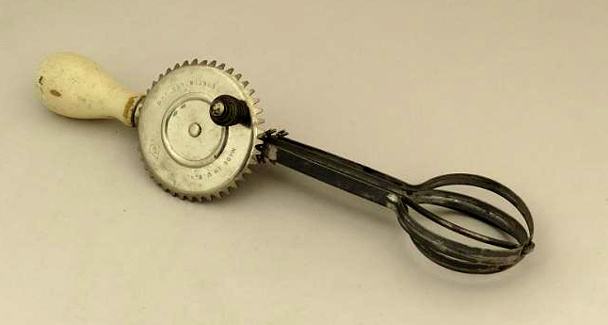
Handheld rotary style egg beater or food mixer, sheet metal and wood. Large crankwheel mounted on upper framework, set vertically between two smaller cog wheels which enable the mixing motion when cranked by the crank grip, an attached coiled wire handle.
The Dover Egg Beater, named for the Dover Stamping Company that manufactured a popular early version, became so common that the name Dover beater was used generically for decades. By the mid-twentieth century, dozens of manufacturers were producing rotary beaters in various sizes and configurations. They came in green, red, black, and natural wood. They rusted if you looked at them sideways near water and lasted thirty years if you dried them properly.
Electric hand mixers began appearing in American kitchens in the late 1940s and became increasingly affordable through the 1950s. By the 1960s, the hand-cranked beater was on its way to honorary retirement in the back of the drawer. The electric mixer did the same job faster and without requiring you to hold the bowl steady with your elbow.
Speaking of kitchen tools in unexpected places. In the 1981 film Stripes, Bill Murray's character turns an assortment of ordinary kitchen utensils into one of the movie's funniest improvised scenes. P.J. Soles recalled that the scene was originally supposed to be filmed outdoors, but pouring rain forced the production inside at around three in the morning. Murray opened the refrigerator, pulled out a carrot, and started improvising. From there came the spatula, rolling pins, an ice cream scoop and the famous “Aunt Jemima Treatment.” What began as a weather problem became one of the movie's most memorable scenes and proof that kitchen utensils sometimes have uses their manufacturers never anticipated.
The Percolator Was the Sound of Morning
Coffee in the mid-century kitchen was not silently produced by pushing a button.
It announced itself.
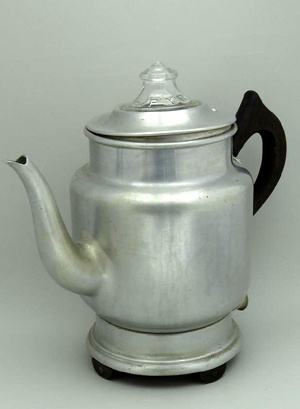
Wear-Ever Electric Percolator Upright spout, ear-shaped wooden handle
The stovetop percolator had been around since the 1800s, but it reached its cultural peak in the American kitchen of the 1940s and 1950s. Water in the bottom chamber heated and was forced up through a tube, over a basket of ground coffee, and back down again. Repeatedly. The process produced a distinctive bubbling, percolating sound that was as much a part of morning as the alarm clock.
The glass knob on top let you watch the coffee darken as it brewed. This was considered important information. Pale coffee meant it was not ready. Dark coffee meant it was ready or possibly had been percolating since Tuesday.
Electric percolators became standard household appliances through the 1950s. The chrome ones from companies like Sunbeam and General Electric became design objects as much as kitchen tools. They sat on the counter rather than on the stove, which freed up burner space and added a certain gleaming authority to the room.
The sound of a percolator is one of those sensory memories that people describe immediately when they talk about their grandparents' kitchens. Not the taste of the coffee, although that was distinctive too. The sound. That particular rhythm of bubbling that meant morning had officially started and someone was paying attention to it.
Drip coffee makers began replacing percolators in American kitchens through the 1970s. They were quieter, more consistent, and produced coffee that many people considered better. The percolator did not go quietly. It went into the cabinet, then into the estate sale, and eventually into the collection of the person who remembers what morning used to sound like.
The Pressure Cooker That Scared Half the Family
Every mid-century kitchen that had a pressure cooker also had a family legend about the pressure cooker.
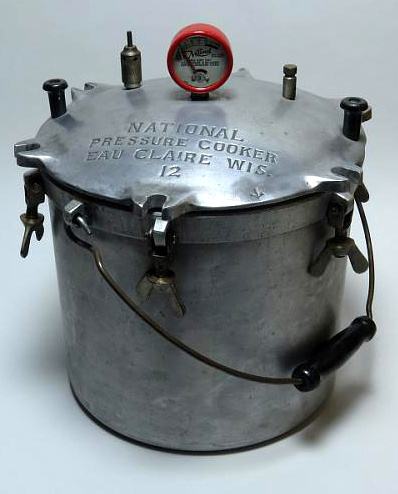
NATIONAL/PRESSURE COOKER/EAU CLAIRE WIS./12
The stovetop pressure cooker worked by trapping steam inside a sealed pot, raising the internal temperature above the normal boiling point of water, and cooking food significantly faster than conventional methods. A pot roast that required three hours in a regular pot could be ready in forty-five minutes. Dried beans that needed overnight soaking could be cooked from dry in under an hour.
The weight on top, sometimes called a jiggler, regulated the internal pressure by rocking and releasing steam at intervals. The sound it made while cooking was somewhere between a hiss and a rattle. It was not a subtle sound. It was the sound of a pot that meant business.
The family legends mostly involved someone opening the lid without releasing the pressure first. Or leaving the pot unattended on a high flame. Or the time Uncle Someone was absolutely certain the pressure had released and it had not quite finished releasing. These stories were told with enormous enthusiasm at family dinners and grew in dramatic detail with each retelling.
Actual documented pressure cooker accidents did occur, particularly with older or poorly maintained equipment. Modern pressure cookers have multiple safety mechanisms and a very good safety record. The mid-century versions were more straightforward in their engineering and required more attentive operation.
But it is important to note that millions of pressure cookers were used every day in American kitchens throughout the postwar era without incident. Grandma was not defusing a bomb every time she made pot roast. She was making pot roast. She just did it with appropriate respect for the equipment, which is more than could be said for Uncle Someone.
Electric Skillets Put Dinner Right on the Counter
The electric skillet was the appliance that moved dinner off the stove and onto the counter, the table, or wherever it needed to be.
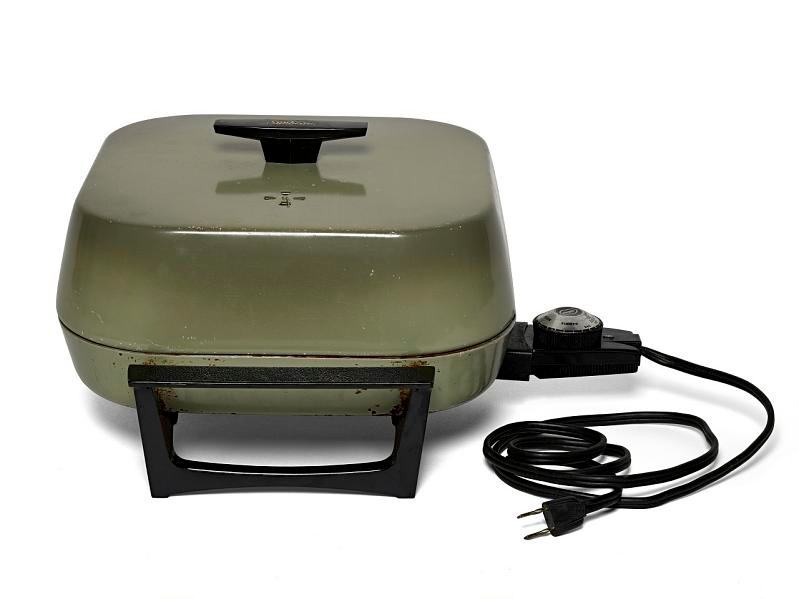
Electric frying pan Sunbeam Corporation
These large rectangular or square electric frying pans appeared in American kitchens in the early 1950s and became genuine household staples through the 1960s and 1970s. They operated independently of the stove. You plugged them in, set the temperature dial, and cooked. The removable cord meant cleaning was straightforward. The temperature control meant you could maintain a consistent heat that the stove burners sometimes made difficult.
The cooking range for an electric skillet was broad. Pancakes for the whole family on a Sunday morning. Fried chicken in batches large enough to feed a crowd. Pot roasts braised low and slow while something else occupied the stove. The electric skillet was particularly popular for entertaining because it could keep food warm at the table without anyone having to get up and check on it.
Sunbeam, Presto, and General Electric produced some of the most widely used models. A good electric skillet from the 1960s can still cook a pancake today, which says something about how these tools were built compared to many of their modern equivalents.
Pyrex, CorningWare and the Dishes Everyone Recognized
There is a specific bowl that you can describe to someone who grew up in America between 1950 and 1980 and they will know exactly what bowl you mean before you finish the sentence.
Pyrex opalware mixing bowls were introduced in the primary colored set in 1945. The four-bowl nesting set in yellow, green, red, and blue became one of the most recognizable pieces of kitchenware in American history. Corning Glass Works followed with pattern after pattern through the 1950s and 1960s. Gooseberry arrived in 1957, with its berries and leaves on pink and white grounds. Butterprint came the same year, featuring the rooster and Amish couple design in turquoise and white that collectors now call the Amish pattern. Spring Blossom Green ran from 1972 through 1979. Autumn Harvest was introduced in 1979 and ran until 1986, its wheat stalks on rust-colored backgrounds becoming one of the last patterns before the line was discontinued.
CorningWare's Blue Cornflower pattern was introduced in 1958 and became instantly recognizable. The white pyroceramic dishes with their blue cornflower design went from freezer to oven to table without complaint. They were sold as practical cookware and became accidental heirlooms.
Collectors today pursue specific patterns, specific colors, and specific sizes with the same intensity that other people pursue vintage baseball cards or first edition books. The pink Gooseberry 404 bowl can commands serious prices in excellent condition. The rarer promotional patterns from the late 1950s can stop a serious collector mid-stride at an estate sale.
If you want to go deeper into this particular rabbit hole, the reference books on collecting vintage Pyrex are the right starting point.
Discover Pyrex Price Guide

Discover Pyrex Price Guide for Mid-Century Kitchen collectors
Product Description:
No Mid-Century Kitchen collection feels complete without classic Pyrex. This comprehensive price guide explores one of America's most collectible kitchen brands, helping you identify patterns, understand values, and learn the fascinating history behind the colorful mixing bowls, casserole dishes, refrigerator sets, and bakeware that filled millions of homes throughout the twentieth century.
Key Features:
• Covers collectible Pyrex patterns, styles, and values
• Helps identify vintage bowls, casserole dishes, baking dishes, and kitchenware
• Explores the history of Pyrex from its introduction in 1915 onward
• Valuable resource for antique shoppers, flea market hunters, and collectors
• Excellent reference for decorating or restoring a vintage Mid-Century kitchen
Why This Works:
If you've enjoyed our Mid-Century Kitchen articles, this guide is an outstanding companion. Whether you're hunting for colorful Primary mixing bowls, Butterprint, Pink Daisy, Gooseberry, or Spring Blossom pieces, the book helps you recognize collectible patterns while learning why vintage Pyrex remains one of the most popular kitchen collectibles in America.
Buy on Amazon
Tupperware Left the Kitchen and Took Over the Living Room
Earl Tupper introduced his line of polyethylene plastic storage containers in 1946. They were practical, lightweight, and airtight in a way that no food storage container had been before. They sat in department stores and barely sold. Shoppers picked them up, turned them over, and put them back down without understanding what made them different.
The problem was the seal. You had to see someone demonstrate it to understand it. You had to hear the burp when the lid released to know what you were getting.
A saleswoman named Brownie Wise figured this out. She had been selling Tupperware independently through home demonstrations and was moving more product than any retail store in the country. Earl Tupper noticed her sales figures and demanded to know her secret. It was the Tupperware party, she told him. In 1951, convinced by her results, Tupper pulled Tupperware from every store shelf in America. The home party became the company's exclusive distribution method. Wise was made vice president of Tupperware Home Parties Inc.
By 1954, Tupperware sales reached twenty-five million dollars. Wise became the first woman to appear on the cover of Business Week magazine. Roughly twenty thousand people were involved in the Tupperware sales network as dealers, distributors, and managers.
The Tupperware party was not just a sales mechanism. It was a social event. A host invited friends and neighbors into her living room. There were refreshments. There were games. There were demonstrations of the patented burping seal that made the containers airtight. The host earned free products based on sales. The guests went home with containers. The network expanded through personal relationships rather than advertising.
For many women in the 1950s and 1960s, the Tupperware party represented one of the few flexible ways to earn income while managing a household. The model that Wise pioneered was adopted directly by Mary Kay, Pampered Chef, and a long list of companies that followed. She was fired by Earl Tupper in 1958, shortly before he sold the company, and written almost entirely out of the official history for decades.
The plastic bowls are still in the cabinet. Brownie Wise deserves more credit than she got.
The Recipe Box Was Grandma’s Search Engine
Before you could ask the internet how to make pot roast, you opened a small metal or wooden box and flipped through index cards.
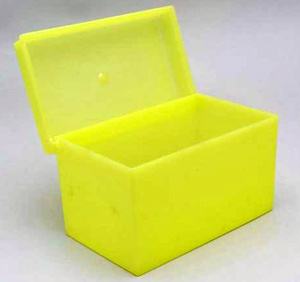
Yellow recipe box Made by Tupperware
The recipe box was the organizational center of the mid-century kitchen. It held handwritten index cards in varying states of legibility. It held recipes clipped from newspapers and magazines and stuck in with the cards. It held pages torn from community cookbooks, promotional pamphlets from appliance manufacturers, and cards copied by hand from relatives at family gatherings.
The stained ones were the good recipes. A card covered in evidence of use, butter fingerprints on the edges, a splash of something across the instructions, tells you more about a recipe than five star ratings and three hundred comments ever could. It tells you this was made. It was made often enough to leave marks.
Church cookbooks and community cookbooks were the supplementary system. Every church auxiliary, every school parents organization, every neighborhood group seemed to produce one eventually. These were not curated publications. They were collections of what people actually cooked, submitted by name, organized loosely by category, and printed in quantities that made them essentially impossible to find today in good condition.
A recipe box from a mid-century kitchen can contain fifty years of a family's actual food history. What they ate on weeknights. What they made for holidays. What someone's mother made that everyone agreed needed to be written down before it was lost. The handwriting changes over the decades if you look closely enough. Different pens. Different hands. The same box.
The Mid-Century Kitchen Had Its Own Color Palette
The mid-century kitchen did not come in stainless steel and white.
It came in pink. It came in turquoise. It came in yellow and soft blue and colors that today we would describe as unexpectedly confident.
The 1950s kitchen embraced pastels with genuine enthusiasm. Pink appliances were not unusual. Turquoise refrigerators were considered high style. Maime Eisenhower Pink was a real and documented design influence. The 1950s American kitchen was optimistic about color in a way that contemporary kitchen design mostly is not.
The transition began in the mid-1960s. General Electric introduced Avocado as an appliance color in 1966. Harvest Gold followed in 1968. Coppertone brown arrived around the same time. By the early 1970s, these earth tones dominated kitchen appliance production. A household deeply committed to the palette might have an avocado refrigerator, avocado range, avocado dishwasher, and an avocado wall phone, all coordinated. This was not considered excessive. It was considered well-designed.
The Formica countertops completed the picture. Formica laminate in boomerang patterns, geometric prints, and solid colors covered the counters of mid-century kitchens across the country. Chrome edging on the counters and the table. Vinyl chairs in colors that coordinated with the appliances. Linoleum floors in patterns that matched the curtains.
The canister set stood on the counter as a matching unit of four. Flour. Sugar. Coffee. Tea. The labels were either printed on the canisters or written on paper inserts behind small windows. They came in ceramic, metal, and glass in colors and patterns that coordinated with the kitchen. A complete matching canister set in good condition is one of the first things a mid-century kitchen collector looks for at an estate sale, because sets rarely survived intact. Someone always used one differently than the others, or dropped one, or decided the coffee canister worked better somewhere else. A complete set in its original pattern is genuinely harder to find than it sounds.
The mid-century kitchen had opinions about color. Every single one of those opinions is now instantly recognizable as belonging to a specific decade, which is exactly how design works when it commits fully to a moment.
The Wall Clock, Kitchen Phone and Things That Never Left the Room
The mid-century kitchen was not just where food was prepared. It was the information center of the house.
The wall clock was the central instrument. Not a digital display. An actual clock with hands, often with a starburst frame or a design that matched the kitchen's color scheme. It told you when to start dinner. It told the kids when they needed to be home. It told everyone when lunch was late and whose fault that was.
The kitchen telephone was mounted on the wall with a cord that reached approximately to the table and not quite to the sink. This was a design consideration that nobody had fully thought through. The person washing dishes and the person trying to have a private conversation were in permanent conflict over the phone cord. This conflict produced countless family negotiations that have never been adequately documented by historians.
The wall calendar from the insurance company or the local hardware store served as the family scheduling system. Appointments written in. School events noted. The dentist circled in pen because dental appointments deserved a circle.
The grocery list lived on a notepad magnetted to the refrigerator or pinned to the wall near the phone. It was added to continuously throughout the week by whoever noticed something was running low. Milk. Bread. The specific brand of peanut butter that everyone in the house had strong feelings about.
The bread box sat on the counter with the quiet authority of something that had earned its place. It was not decorative. It was functional in the most direct sense. Bread kept in a bread box stayed fresh longer than bread left on the counter or put in the refrigerator, which made it go stale faster. The mid-century bread box came in metal, wood, and chrome-trimmed versions. It usually matched nothing else in the kitchen and fit perfectly anyway. Roll-top lids. Hinged lids. Slide-out fronts. Every family had a slightly different version and every version did exactly the same job without complaint.
A radio on the counter provided news and music. In many homes it was on most of the day, not as background noise but as company. The kitchen radio was a member of the household in the same informal way that the family dog was a member of the household.
Cookbooks Told America What Dinner Was Supposed to Look Like
The Betty Crocker Picture Cookbook, first published in 1950, was the most influential cookbook of the mid-century American kitchen. It was not the only one. But it set the visual and organizational standard that everything else was measured against.
The photographs in mid-century cookbooks showed food in a specific and aspirational way. The casseroles gleamed. The gelatin molds held their shapes with architectural confidence. The roasts looked like illustrations of roasts rather than actual roasts. The vegetables had colors that real vegetables occasionally achieved and often did not.
Appliance manufacturers were enthusiastic contributors to the cookbook tradition. A new refrigerator came with a recipe booklet. A pressure cooker came with a small cookbook specific to pressure cooking. Electric skillets, stand mixers, and blenders all arrived with their own promotional recipe collections, each designed to ensure that the customer used the product in the ways the manufacturer had envisioned.
The rise of convenience foods changed what cookbooks were teaching. Campbell's condensed soup appeared in recipes alongside homemade stock. Jell-O became a legitimate ingredient in savory as well as sweet dishes. Canned vegetables and packaged mixes made their way into recipes published by serious publishers alongside traditional from-scratch preparations.
This was not a failure of culinary standards. It was an accurate reflection of how American home cooks were actually cooking, and cookbooks that ignored the convenience foods on American shelves were cooking for an imaginary kitchen rather than the real one. Speaking of branded foods and their role in American life, if you have not read our piece on how candy corn went from a product called Chicken Feed to a Halloween institution, that story is over here.
When Convenience Started Emptying the Kitchen Drawer
Nobody threw the meat pounder away because they hated the meat pounder. They just stopped needing it quite as much.
The food processor arrived in American home kitchens in the mid-1970s with the introduction of the Cuisinart. It could chop, slice, shred, puree, and blend. It could do in thirty seconds what several of the drawer's dedicated single-purpose tools had done in five minutes each. The dedicated tools did not disappear immediately, but they went to the back of the drawer.
The microwave oven moved from commercial to residential use through the 1970s and spread rapidly through American kitchens during the 1970s and 1980s. It did not replace conventional cooking. It supplemented it in ways that changed the rhythm of the kitchen entirely. Reheating leftovers took two minutes instead of twenty. This was not a small change. It was a fundamental reorganization of how time worked in the kitchen.
Electric can openers replaced hand-cranked ones without anyone noticing it had happened. Disposable packaging meant fewer containers needed to be stored. Prepared and frozen foods reduced the range of ingredients that needed to be processed from scratch.
None of these changes were bad. People adopted them because they were useful. The mid-century kitchen drawer filled up over decades because every specialized task required a specialized tool. The modern kitchen drawer is less full because many of those tasks are now handled differently, which is a reasonable trade and not a cultural tragedy.
The objects that remain in those old drawers are the ones that had no good replacement. The meat pounder is still the meat pounder. The flour sifter is still the flour sifter. The cherry pitter is still the only thing that pits cherries without making everything red.
Collecting Mid-Century Kitchenware Today
The vintage kitchen is one of the most active areas in American collecting today, and the range of what people pursue is considerably broader than most people outside the field realize.
Pyrex is the category that most people know about. The market for vintage Pyrex patterns is serious and specific. Pattern matters. Color matters. Size matters. Condition matters enormously. A pink Gooseberry mixing bowl in excellent condition with no chips or crazing is a different object from the same bowl with wear. Complete sets of nesting bowls in any pattern command premiums over individual pieces. The rarer the pattern, the more the condition matters.
Advertising pieces are a different and broader category. Recipe booklets from appliance manufacturers. Promotional calendars from grocery brands. Point-of-sale displays from kitchenware companies. These paper ephemera were designed to be used and discarded, which means surviving examples in good condition are genuinely scarce.
Electric percolators in excellent working condition from major manufacturers attract both kitchenware collectors and people who simply want to use them. The chrome Sunbeam percolators from the late 1950s are particularly sought after for both reasons.
Wall clocks with their original starburst or atomic age designs are collected as both functional objects and as mid-century design artifacts. Recipe boxes with their original contents intact are a category of their own, valued not for the box but for what is inside it.
The line between something being old, something being nostalgic, and something being collectible is not always clear. Condition, pattern rarity, completeness, and provenance matter. An ordinary Butterprint casserole dish from the 1960s is a pleasant find. A complete set of Butterprint in excellent condition with original box is a different proposition entirely.
For serious collectors and serious reference, the guide books on vintage kitchen collecting are where the real depth lives.
Hot Kitchen & Home Collectibles: 30s, 40s & 50s
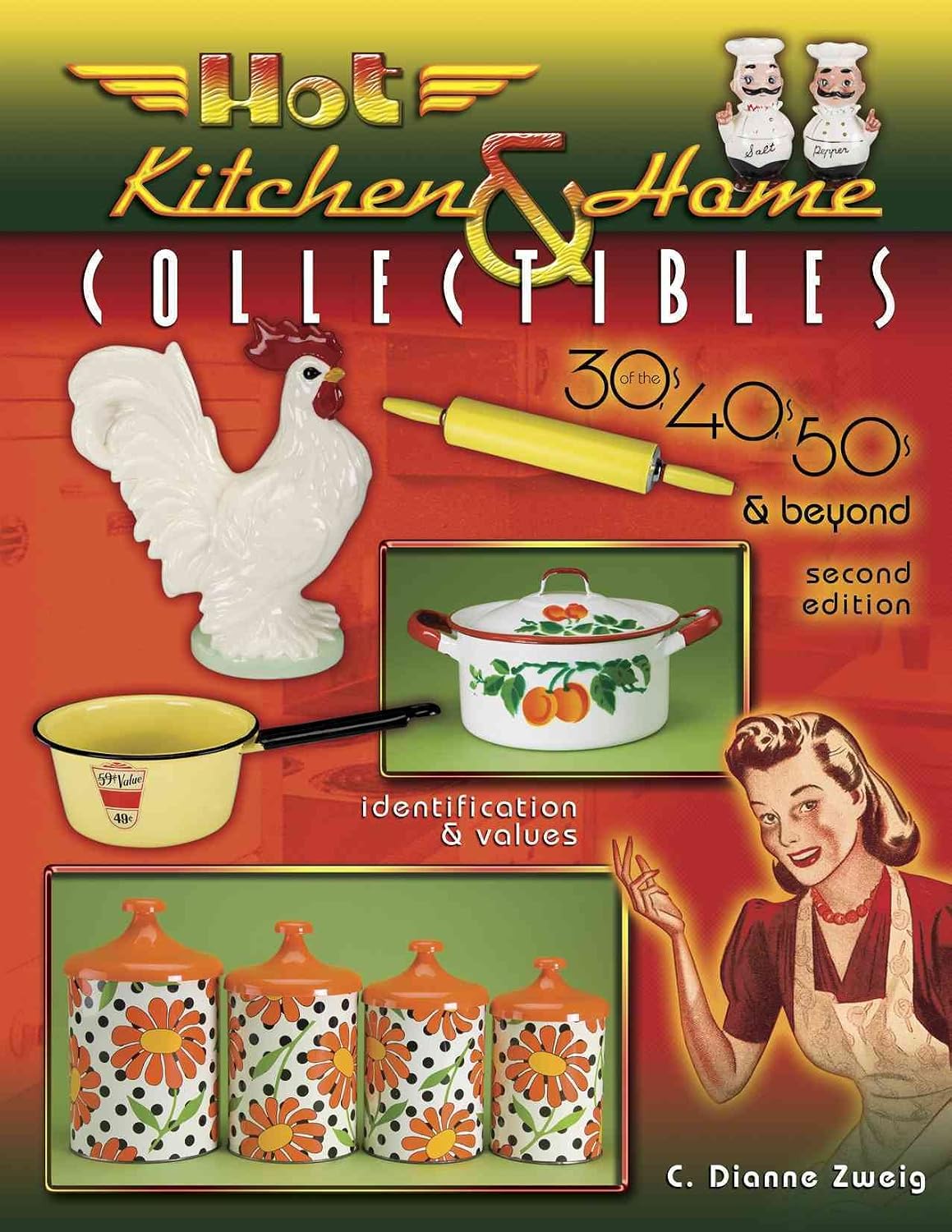
Hot Kitchen & Home Collectibles: 30s, 40s & 50s for Mid-Century Kitchen collectors
Product Description:
If you're fascinated by the charm of the Mid-Century Kitchen, this beautifully illustrated collector's guide belongs on your bookshelf. Author C. Dianne Zweig explores the colorful kitchens and homes of the 1930s, 1940s, and 1950s through hundreds of photographs featuring everything from vintage kitchenware and textiles to advertising, appliances, recipe booklets, and household décor. It's both a nostalgic trip through America's past and an excellent reference for collectors.
Key Features:
• Over 500 full-color photographs of vintage kitchen and household collectibles
• Covers kitchenware, pottery, linens, sewing items, laundry products, advertising, magazines, and more
• Includes 304 pages of collector information and historical background
• Written by respected vintage collectibles author C. Dianne Zweig
• Excellent reference for collectors, decorators, antique shoppers, and lovers of retro Americana
Why This Works:
If you've enjoyed our Mid-Century Kitchen features, this book offers a deeper look into the everyday objects that defined American homes during the 1930s through the 1950s. Whether you're decorating a retro kitchen, identifying flea market finds, or simply enjoying vintage Americana, it's an entertaining resource packed with colorful photographs and fascinating collectibles.
Buy on Amazon
Why the Mid-Century Kitchen Still Feels Like Home
The mid-century kitchen was not trying to be memorable. It was just trying to get dinner on the table.
The percolator was not a design object. It was a coffee maker that happened to be beautiful. The recipe box was not an archive. It was a practical system for not losing the card with the pie crust recipe. The Pyrex bowls were not collectibles. They were the bowls. The ones that went in the oven and came to the table and got washed and went back in the cabinet and did it again the following Sunday.
The mid-century kitchen worked. It worked for the people who cooked in it every day, who knew where everything was without looking, who could reach for the meat pounder in the dark and find it in exactly the right spot in exactly the right drawer.
The objects that survive from that kitchen carry the weight of all that ordinary use. A battered aluminum meat tenderizer from someone's grandmother's kitchen has been in someone's hands during a thousand meals. A stained recipe card has been read and followed and read again until the ink started to fade. A Pyrex bowl has held batter and served casserole and spent forty years in a cabinet and now sits on a shelf somewhere looking exactly like it did when it was bought.
Those objects did not become meaningful because they were extraordinary. They became meaningful because they were present. Because they were part of the particular texture of particular afternoons and particular kitchens and particular people who are not here anymore but whose recipe boxes are.
That is what the mid-century kitchen was. That is why it still feels like home.
One More Look Around the Mid-Century Kitchen
The coffee has finished percolating. The last cup was poured twenty minutes ago and the pot is sitting on the burner doing what percolators do when nobody is watching them.
The recipe card goes back into its box, behind the divider marked Casseroles, in front of the divider marked Desserts. The index tabs are worn at the corners from years of being found in the dark.
The meat pounder goes back in the drawer. It goes in sideways, the way it always goes in, because it has never quite fit properly but nobody has ever done anything about that. The door closes with the particular sound that drawer has always made.
The clock on the wall marks the hour. The kitchen phone hangs silent on its hook. The avocado refrigerator hums with the low confidence of an appliance that has outlasted several kitchen trends and does not expect this to be its last.
This room was ordinary for the people who lived in it. It is only remarkable now because of how completely it has disappeared, and how completely it has stayed with the people who remember it.
Close the drawer. Whatever you thought "Spreaders to Meat Pounders" meant when you clicked, that's between you and your browser history. 😂
ML Lamp is the owner of Kilroy Was Here. After his 20 years of working in Las Vegas in the entertainment promotions field, Mr. Lamp retired in 2002 from his job to pursue his passion for collectibles. Now as a guest speaker and author he’s living the dream, and sharing his warmth with You.