The Skull 1965 Review: A Terrifying Collector's Worst Nightmare
My Rating: ⭐ ⭐ ⭐ ⭐ ☆ 4.4/5
Every serious collector has a holy grail. For Dr. Christopher Maitland, it is a piece no sane person should ever want to own. Welcome to The Skull 1965 review, a look at one of the strangest and most stylish horror films Amicus Productions ever made. Peter Cushing plays a scholar of the occult who simply cannot resist one more acquisition. Christopher Lee plays the friend who knows exactly why he should.
The Skull 1965 Review
The Skull opened in Britain on August 25, 1965, and Paramount Pictures handled its American release. It was only the second horror feature from Amicus, following Dr. Terror's House of Horrors earlier that year. The studio was still finding its voice, and this film showed it could do more than anthologies.
Freddie Francis directed. Milton Subotsky wrote the screenplay, adapting a short story by Robert Bloch called The Skull of the Marquis de Sade. Subotsky also produced the film with his partner, Max Rosenberg.
The hero, if you can call him that, is Dr. Christopher Maitland. He is a respected writer and researcher who specializes in demonology and the occult. His London home is stuffed with strange books, statues, and relics. He studies evil from a safe academic distance, or so he believes.
Maitland buys most of his oddities from a shady dealer named Anthony Marco, played with greasy charm by Patrick Wymark. Marco does not ask many questions about where his goods come from. Maitland does not ask many questions about where Marco finds them. It is a comfortable arrangement until Marco walks in with something truly special.
The supporting cast is excellent. Jill Bennett plays Maitland's wife. Nigel Green plays a police inspector, and Patrick Magee plays a police surgeon. Michael Gough, George Coulouris, and Peter Woodthorpe all turn up in smaller roles. It is a very British gallery of familiar faces.
The Ultimate Forbidden Collectible
The film opens with a grisly prologue set in 19th century France. A phrenologist robs the fresh grave of the Marquis de Sade, the notorious writer whose name gave us the word sadism. He takes the head home and boils away the flesh to study the skull beneath. It does not end well for him.
That prologue is rooted in real history. De Sade died in 1814 at the asylum at Charenton, outside Paris. His remains were later exhumed, and his skull was removed for phrenological study. What happened to it after that has fueled rumors ever since.
Back in modern London, Marco first offers Maitland a rare book bound in human skin about de Sade's life. Then he returns with the real prize. He claims to have the skull itself. Maitland is skeptical, fascinated, and hooked all at once.
Maitland soon learns the skull has a history. It once belonged to his friend and fellow collector, Sir Matthew Phillips. It was stolen from Phillips, and he has no wish to see it again. He tries to warn Maitland that the skull carries something far worse than bad luck.
Maitland does not listen. Collectors rarely do. The rest of the film follows what happens when a scholar of evil brings evil home and puts it on a shelf.
Peter Cushing Makes Obsession Believable
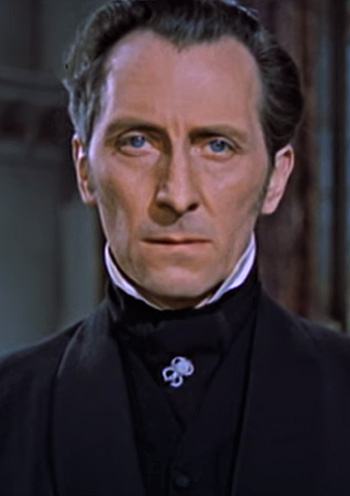
The premise of The Skull is admittedly a little silly. A skull that floats through the air and controls people could easily become a joke. Peter Cushing is the reason it never does.
Cushing had a rare gift for taking strange material completely seriously. He plays Maitland as an intelligent, cultured man who prides himself on his rational mind. That makes his slow collapse much more disturbing. We watch a careful scholar lose his grip, one quiet step at a time.
His early scenes are full of small, believable details. He handles books like precious objects. He examines artifacts with the hunger of a true collector. When Marco names his price, Cushing lets you see the battle between good sense and pure want.
The final act asks even more of him. For long stretches, Cushing barely speaks. He moves through his house as if sleepwalking, fighting an invisible pull. Much of his performance is in his eyes and posture.
Many actors would have overplayed it. Cushing keeps everything small and tense. By the end, you completely believe that this decent man has been taken over by something ancient and cruel.
Christopher Lee Knows When to Walk Away
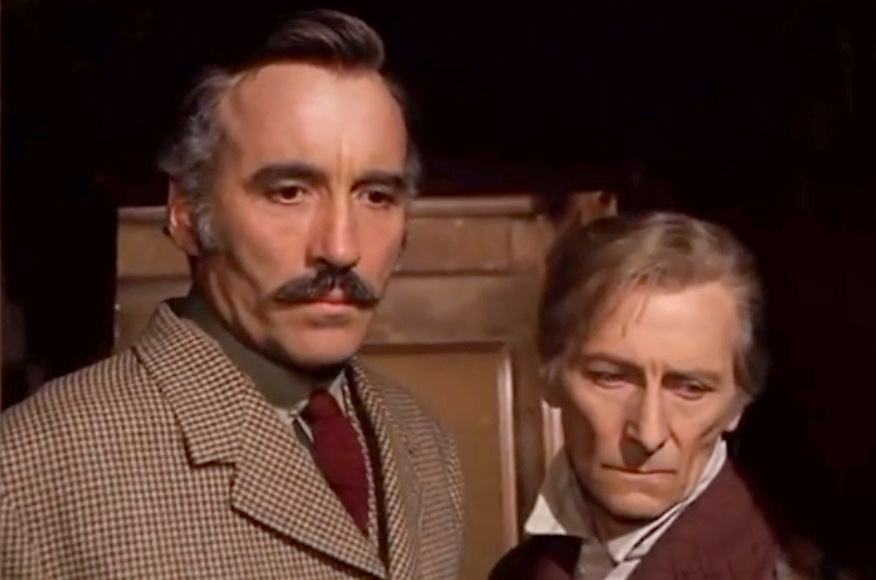
Christopher Lee's role as Sir Matthew Phillips is smaller than Cushing's, but it is crucial. He is the voice of experience. He has owned the skull, felt its influence, and survived to warn others.
Lee plays Phillips with calm authority and a hint of shame. He knows what the skull made him do, and he does not want to talk about it. When he finally explains, the tone of the film darkens noticeably.
It is a pleasure to see Lee cast against his usual type. By 1965 he was famous as Hammer's Dracula and as a string of menacing villains. Here he plays a respectable gentleman, warm and worried about his friend.
The scenes between Cushing and Lee are the heart of the film. The two men were close friends in real life, and their easy rapport shows. They talk like old club members comparing hobbies, until the conversation turns to the skull.
Phillips represents the choice every collector faces. He was lucky enough to lose the skull, and wise enough not to chase it back. His warning gives the movie its moral. Some things are not worth owning at any price.
When Collecting Turns Dangerous
Plenty of horror films feature cursed objects. Few understand collectors as well as this one. That theme gives The Skull 1965 review its most interesting angle.
Maitland does not want the skull for money or power. He wants it because it is rare, famous, and dangerous. He wants it because no one else has it. Anyone who has chased a rare record, a first edition, or a one of a kind antique will recognize that feeling.
The film also shows the grey areas of collecting. Maitland knows Marco deals in stolen goods. He buys anyway, because the item matters more to him than its history. That small compromise opens the door to everything that follows.
There is a fine line between owning something and being owned by it. The Skull takes that idea literally. The more Maitland possesses the skull, the more the skull possesses him.
As a shop owner, I see harmless versions of this every week. A customer spots the one piece they have hunted for years, and their eyes light up. The Skull asks what happens when that piece hunts you back. For collectors, it is a surprisingly personal kind of horror.
Freddie Francis Behind the Camera
Freddie Francis was one of the finest cinematographers Britain ever produced. He won an Academy Award for shooting Sons and Lovers, and he would later win a second Oscar for Glory. In the 1960s, he spent much of his time directing horror films for Hammer and Amicus.
The Skull may be his most visually inventive picture. It was shot in widescreen Techniscope, and Francis uses every inch of the frame. Rooms feel cavernous. Shadows pool in corners. The skull often sits quietly in the background, waiting.
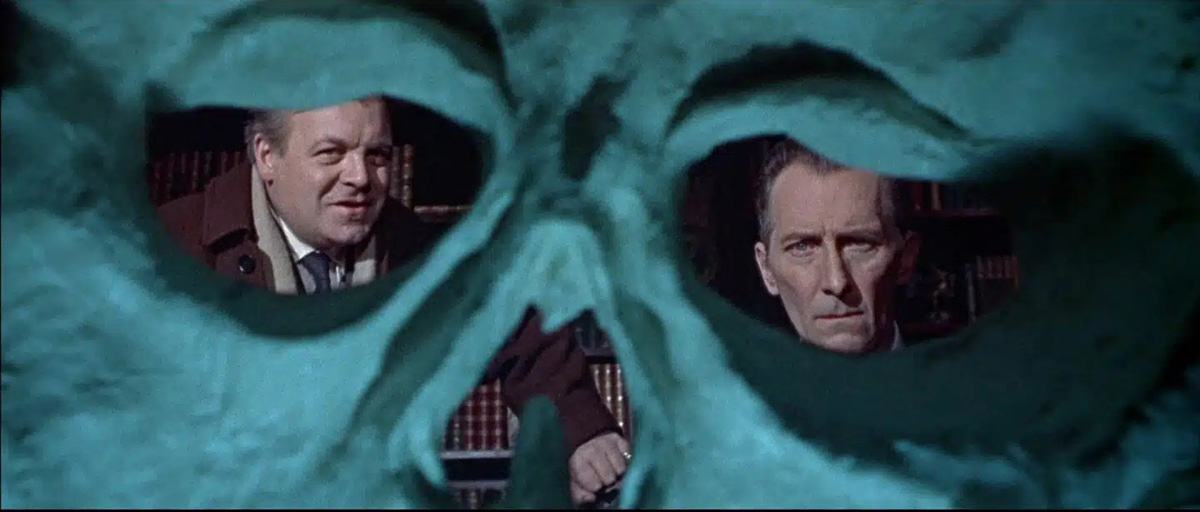
His most famous trick is the skull's point of view. Several shots look out through the eye sockets of the skull itself, framed by bone. It is a bold, slightly gimmicky effect, but it makes the skull feel alive and watching.
Francis also stages a surreal nightmare sequence that feels unlike anything else in British horror of the period. It is disorienting, theatrical, and odd. It shows Francis pushing well beyond standard haunted house fare.
The final stretch is the boldest of all. For much of the last twenty minutes, there is almost no dialogue. Elisabeth Lutyens' eerie score and the camera carry the story. Some viewers find it slow. Others find it hypnotic. Either way, it was a daring choice.
Francis reportedly rewrote much of Subotsky's script once filming began. Whatever he changed, the result has a confident visual style that keeps the thin story moving.
Robert Bloch Beyond Psycho
Most people know Robert Bloch as the author of Psycho. His 1959 novel became Alfred Hitchcock's landmark film in 1960. Bloch was far more than a one book wonder, though.
He wrote hundreds of short stories for pulp magazines, many of them steeped in the occult and the macabre. The Skull of the Marquis de Sade was first published in 1945, long before Psycho made him famous. It is a lean, nasty little tale with a simple hook.
The Skull began a long partnership between Bloch and Amicus. He soon wrote screenplays for the studio, including The Psychopath and The Deadly Bees. He then supplied the stories for anthologies such as Torture Garden, The House That Dripped Blood, and Asylum.
Bloch's style suited Amicus perfectly. His stories favored clever setups, twisted morals, and endings with a sting. They rarely needed big budgets or elaborate monsters.
Some critics argue the original story was better suited to a short anthology segment than a full feature. It is a fair point, and the film does stretch its premise. Still, Bloch's core idea is strong enough to carry it, especially with Cushing and Lee doing the heavy lifting.
Why Watch The Skull Today?
The simplest reason is the cast. Any film that pairs Peter Cushing and Christopher Lee is worth a look. Here they play friends rather than enemies, which makes their scenes together especially enjoyable.
The premise is wonderfully direct. There is one object, one obsessed man, and one warning that goes unheeded. Modern horror often buries its ideas under layers of mythology. The Skull keeps things lean.
The atmosphere also holds up. Francis fills the film with deep shadows, rich color, and unsettling angles. Even the slower stretches look gorgeous. It is a great choice for a dark October night with the lights turned low.
It is also a fascinating piece of horror history. This was one of the films that helped Amicus build its reputation as a rival to Hammer. Fans of the later Amicus anthologies will enjoy seeing where that story began.
Finally, it has a hook every collector will understand. If you have ever wanted something a little too much, The Skull will feel uncomfortably familiar. That personal edge is what keeps this The Skull 1965 review recommending it nearly sixty years later.
The Skull on Physical Media
The Skull has had a busy life on home video. For years it was hard to see properly, since television and VHS versions often cropped its wide Techniscope frame. That cropping hurt a film that depends so heavily on composition.
Legend Films released a widescreen DVD in the United States, which finally let viewers see the full picture. In Britain, Eureka issued a Region B Blu-ray that came with a booklet essay by Vic Pratt.
Kino Lorber Studio Classics released a Region A Blu-ray and DVD on March 14, 2017. That edition included a new audio commentary by film historian Tim Lucas. It also carried video pieces with horror experts Jonathan Rigby and Kim Newman, plus a Trailers From Hell segment with Joe Dante.
Availability changes over time, so check carefully before you buy. Some editions go out of print, and prices can jump when a title becomes scarce. Used copies turn up at shops, shows, and online auctions, especially around Halloween.
Collectors should also watch for original 1965 posters and lobby cards. The striking skull artwork makes them popular display pieces. In France, the title on some promotional materials was changed at the last minute after legal action by the Sade family. Those altered pieces are a fun curiosity for poster hunters.
Final Thoughts 4.4/5
This one earns a 4.4 out of 5 from Kilroy. Wrapping up The Skull 1965 review, the strange premise still works, mostly because everyone involved treats it with complete conviction.
Peter Cushing gives one of his most committed performances as a man consumed by his own collection. Christopher Lee adds weight and warmth as the friend who got away. Freddie Francis makes the whole thing look far richer than its budget.
The film loses points for a thin story that sometimes feels stretched. The nearly silent final act will test some viewers' patience. Even so, the atmosphere and the two horror legends carry it over the rough spots.
For collectors, the message lands with a chill. Not every rare find belongs on your shelf. Sometimes the smartest thing a collector can do is walk away.
ML Lamp is the owner of Kilroy Was Here. After his 20 years of working in Las Vegas in the entertainment promotions field, Mr. Lamp retired in 2002 from his job to pursue his passion for collectibles. Now as a guest speaker and author he’s living the dream, and sharing his warmth with You.