🎞️ F.T.A. Review: Jane Fonda and Donald Sutherland’s Lost Antiwar Road Show
My Rating: ⭐ ⭐ ⭐ ⭐ ☆ 4.2/5
This F.T.A. review goes back to 1971. That year, Jane Fonda and Donald Sutherland built a traveling comedy show for soldiers tired of the Vietnam War. They took it to the towns outside American bases across the Pacific. A small film crew followed them. The movie that came out of it played for about a week in 1972 and then vanished for decades.
F.T.A. Review: Jane Fonda’s Antiwar Answer to Bob Hope
For years, Bob Hope brought the USO show to the troops.
Jokes.
Pretty girls.
Big band numbers.
A pat on the back for the mission.
In 1971, a group of Hollywood actors decided to bring the troops a very different kind of show.
No pat on the back.
No support for the mission.
Just skits, songs, and a message a lot of GIs had been waiting to hear.
Somebody was on their side.
F.T.A. was directed by Francine Parker and produced by Parker, Jane Fonda, and Donald Sutherland. American International Pictures released it in July 1972. It runs 96 minutes. IndieCollect restored it in 4K, and Kino Lorber brought it back in 2021 in virtual cinemas and on Blu-ray.
This F.T.A. review stays spoiler free.
What Does F.T.A. Stand For?
Officially, the show was called Free the Army.
Nobody in uniform believed that.
The Army’s old recruiting slogan promised Fun, Travel and Adventure.
Soldiers had their own version.
The F stands for Fuck.
The T stands for “the.”
The A stands for the Army.
The show’s theme song, “The Lifer’s Song,” plays games with the letters. The audience always knew exactly what they meant, and they shouted it back.
That tells you a lot about the mood in the room.
The Show Bob Hope Never Would Have Booked
The idea started with Dr. Howard Levy.
Levy was a former Army doctor who spent 26 months at Fort Leavenworth. His crime was refusing to train Green Beret medics headed to Vietnam.
Once he was out, he wanted to reach soldiers who felt the way he did.
He pitched the idea to Jane Fonda.
She said yes.
Alan Myerson of The Committee, the San Francisco improv troupe, signed on to direct the stage show.
The first performance happened in March 1971 in Fayetteville, North Carolina, right outside Fort Bragg.
The venue was the Haymarket, one of the antiwar GI coffeehouses that had popped up near military bases.
It held fewer than 500 people.
Not exactly the Hollywood Bowl.
The show later played Lincoln Center in New York and picked up a special citation at the Obie Awards.
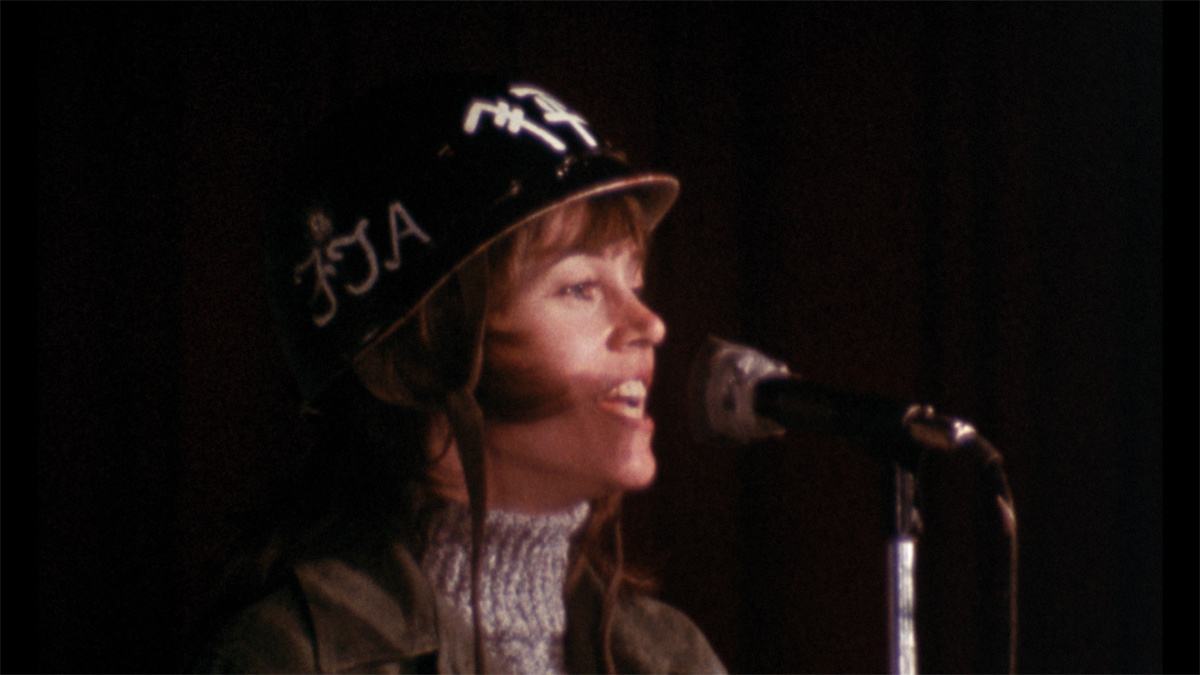
Jane Fonda Takes the Stage
By the time this tour hit the Pacific, Jane Fonda was one of the biggest stars in Hollywood.
She had just made Klute.
A few months after the tour ended, she won the Academy Award for Best Actress for it.
And here she is in jeans, no makeup, singing and doing skits in rented halls.
Fonda is clearly the engine of the whole operation.
She talks with soldiers, plays characters, and keeps the show moving.
Whatever you think of her politics, she was all in.
She also made a big change before the tour went overseas.
The early stateside cast included Peter Boyle, Elliott Gould, and Howard Hesseman. Fonda felt that lineup was too white and too male.
So the cast that reached the Pacific looked a lot more like the troops in the audience.
Donald Sutherland Brings the Deadpan
Donald Sutherland was coming off M*A*S*H, Kelly’s Heroes, and The Dirty Dozen.
In other words, he had already played plenty of soldiers.
He had also just played the title detective opposite Fonda in Klute.
Here he gets to make fun of the brass in person.
Sutherland is tall, calm, and dry as toast.
He doesn’t need to shout to get a laugh.
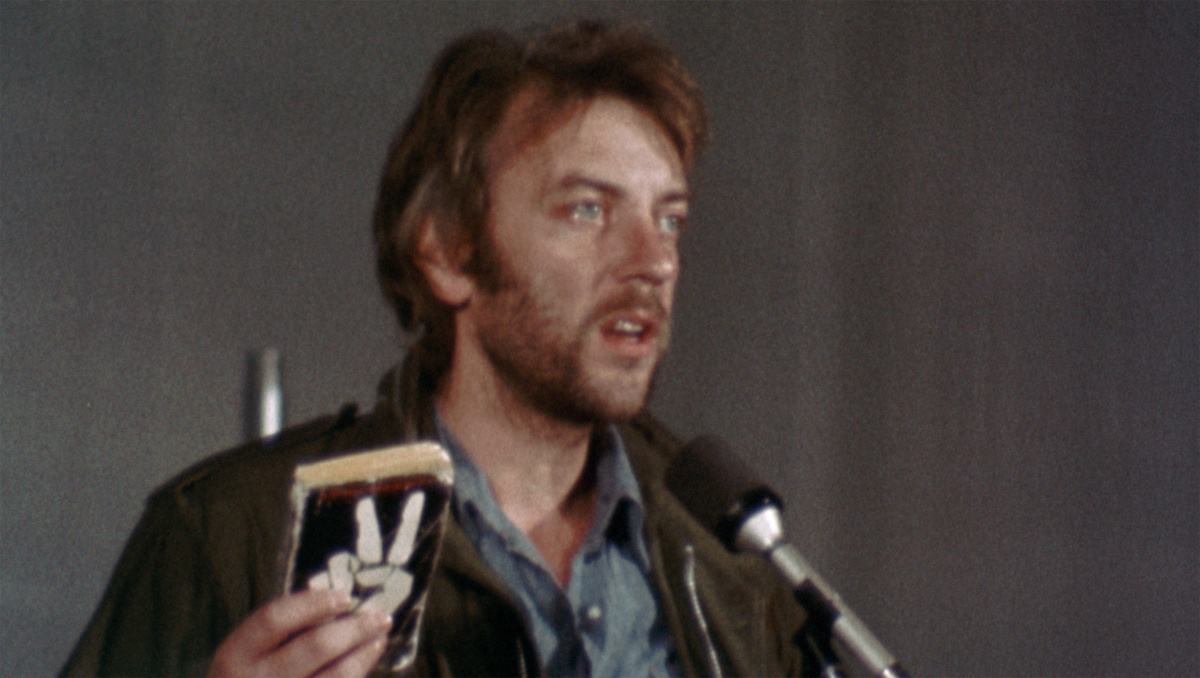
He also gets the show’s most serious moment. Every performance included Sutherland reading from Dalton Trumbo’s antiwar novel Johnny Got His Gun.
When he reads, the room goes quiet.
Sutherland passed away in June 2024, which makes this rediscovered footage feel even more valuable now.
The Rest of the Troupe
Fonda and Sutherland get the poster.
The rest of the cast does a lot of the heavy lifting.
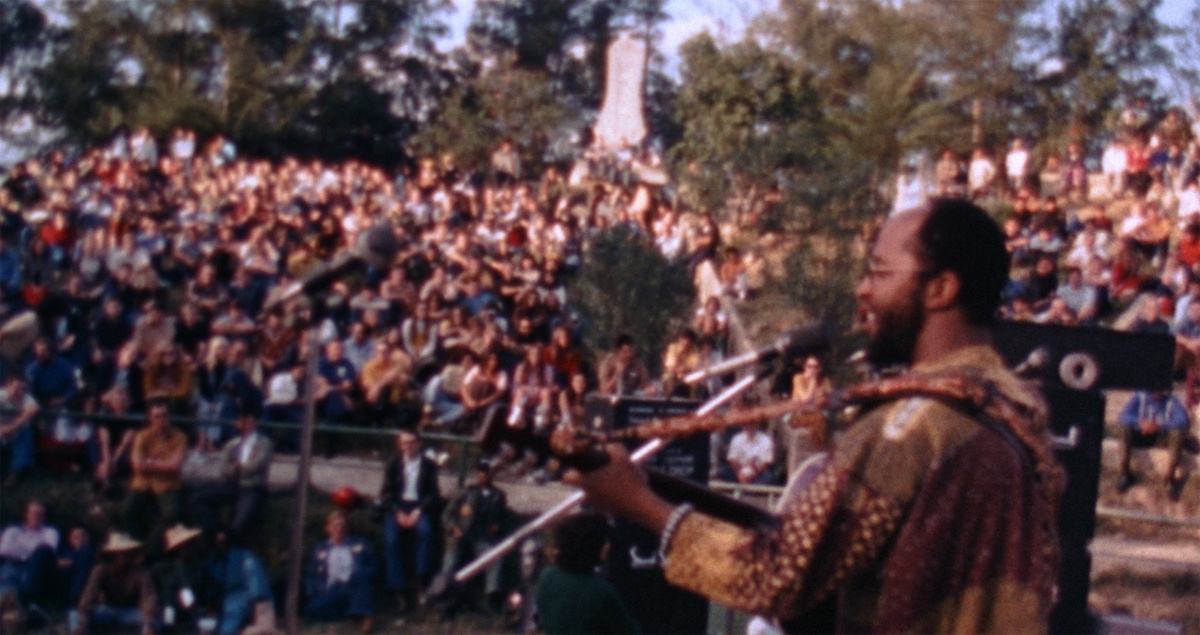
Folk singer Len Chandler brings the Greenwich Village protest song tradition to the stage.
Holly Near sings with a voice that cuts right through a crowded hall. She later built a long career in folk and women’s music.
Rita Martinson handles some of the film’s strongest ballads.
Pamela Donegan, a poet and activist, delivers one of the most memorable songs in the movie.
Michael Alaimo, an actor and one of the show’s writers, joins in on the sketches.
And then there’s Paul Mooney.
Yes, that Paul Mooney.
The same comic who later wrote with Richard Pryor and turned up on Chappelle’s Show.
Peter Boyle, part of the earlier stateside shows, is also credited.
The Pacific Tour
The film follows the troupe across the Pacific in late 1971.
Hawaii.
The Philippines.
Okinawa.
Japan.
The tour opened over Thanksgiving in Honolulu. More than 4,000 people showed up, including about 2,500 GIs.
In the Philippines, the troupe played near Clark Air Base, in Baguio, and in Olongapo City outside Subic Bay Naval Base.
The Baguio show drew more than 5,000 people.
Outside Yokosuka Naval Base in Japan, about 1,400 people packed in. Roughly 500 of them were GIs.
The final stretch ran into late December, including a freezing show in Misawa with a broken heater.
Show business is glamorous.
The Military Was Not Amused
None of these shows happened on base.
The Army and Navy did not want them anywhere near the troops.
Base access was denied or ignored nearly everywhere the troupe asked.
Back in Fayetteville, the city refused to rent its auditorium. A federal judge overruled the city, which then demanded a $150,000 insurance policy.
Soldiers who attended risked trouble with their commanders.
Military intelligence reportedly photographed the audiences.
When the troupe landed in Tokyo, Japanese immigration held them for about three and a half hours before letting them in.
Nobody was rolling out a red carpet.
That tension gives the film a jolt you don’t get from a typical concert movie.
The Soldiers Get the Microphone
Here’s what surprised Kilroy most.
F.T.A. isn’t only about the celebrities.
Francine Parker spends a lot of time with the troops.
Marines who oppose the war.
Black GIs talking about racism in the ranks.
An Air Force woman who enlisted right out of high school.
Sailors from the USS Coral Sea, where about a thousand crew members signed a petition against the war.
These are young men and women speaking plainly about their own lives.
Those interviews are the most valuable thing in the movie.
The camera also wanders outside the venues. You see bars and brothels near the bases, Filipino pro-democracy demonstrations, and Okinawan musicians criticizing the American presence.
It’s a time capsule of the world around the bases, not just the stage.
The Comedy Is Rough Around the Edges
Let’s be honest.
Not every sketch lands.
Some of the humor is broad.
Some of it is very much 1971.
A few bits probably killed in a packed hall full of frustrated GIs and fall flat on a TV screen fifty years later.
But watching the audience is half the fun.
When the crowd roars, you understand exactly why these jokes mattered at the time.
The Music Holds It Together
When the comedy wobbles, the music steadies the ship.
Len Chandler, Holly Near, Rita Martinson, and Pamela Donegan give the show its heart.
The songs are simple, direct, and built for a crowd.
Some are funny.
Some are angry.
A few are genuinely moving.
If you collect protest-era folk records, this movie is a goldmine of live performances you won’t find anywhere else.
Shot on the Run
This is not a polished Hollywood production.
Fonda later called it “a spit and a prayer production.”
The film was shot on 16mm by a small crew that included Eric Saarinen and Juliana Wang. It was blown up to 35mm for theaters.
The camera follows the troupe through airports, crowded halls, backstage rooms, and city streets.
Sometimes the footage is rough.
Sometimes the sound is muddy.
That rawness works in the movie’s favor.
It feels like you snuck in the back door.
A Movie That Vanished After One Week
Here’s where the story gets strange.
F.T.A. opened in July 1972.
That was within days of Fonda’s trip to Hanoi.
That trip, and the photo of her sitting on a North Vietnamese anti-aircraft gun, made her one of the most controversial people in America.
American International Pictures pulled the movie after about a week.
The studio said it planned to rerelease it when colleges reopened.
That never happened.
Most prints were destroyed.
Francine Parker later claimed AIP chief Sam Arkoff got a call from the White House. Nobody has ever proved that.
Either way, the movie disappeared.
Lost for Decades
For more than thirty years, F.T.A. was mostly a rumor.
People who had seen it remembered it.
Almost nobody else had the chance.
Then filmmaker David Zeiger used footage from the show in his 2005 documentary Sir! No Sir!, about the GI antiwar movement.
Zeiger also restored the original film.
In 2009, it finally screened again at the American Cinematheque in Los Angeles and the IFC Center in New York. The Sundance Channel aired it on February 23, 2009.
For collectors, that’s the kind of comeback story we love.
The 4K Restoration Brings It Back
The best version yet arrived in 2021.
IndieCollect handled a new 4K restoration with a grant from the Hollywood Foreign Press Association.
There was a problem.
Four of the ten original 16mm negative reels were missing.
So the team worked from a 35mm master positive, scanned it at 5K, and built a 4K master.
Kino Lorber opened it in virtual cinemas on March 5, 2021. The Blu-ray followed on May 4, 2021.
The disc includes an introduction by Fonda, an archival interview, and the full Sir! No Sir! documentary as a bonus.
That’s a pretty generous package for a movie that almost didn’t survive.
A Movie You Can’t Separate From the Controversy
This is one of those films where the history around it matters as much as the footage.
F.T.A. is openly one-sided.
It was made by people who opposed the war, for soldiers who opposed the war.
It doesn’t try to present the other side.
And Fonda’s Hanoi trip still angers many Vietnam veterans to this day. She has said publicly that she regrets the anti-aircraft gun photo.
Some viewers will see brave entertainers supporting troops who felt ignored.
Others will see celebrities undermining soldiers in the middle of a war.
Plenty of veterans who served in that era hold each of those views.
Kilroy’s take is simple.
Watch it as a historical document.
Decide for yourself.
Does F.T.A. Still Work Today?
As a comedy show, it’s uneven.
As a time capsule, it’s terrific.
You see Hollywood stars at the height of their fame doing something no studio would ever approve.
You hear soldiers speaking honestly about race, war, and the military.
You see the towns that grew up around American bases in Asia.
And you get a front row seat to one of the strangest tours in show business history.
That’s the real story behind this F.T.A. review. The jokes have aged, but the footage hasn’t lost its punch.
Who Should Watch F.T.A.?
Watch it if you’re interested in the Vietnam era, 1970s documentaries, Jane Fonda, Donald Sutherland, or protest music.
It’s also a must for anyone curious about the GI coffeehouse movement and the soldiers who spoke out from inside the ranks.
Vietnam veterans may find it either moving or infuriating.
Probably both.
Either way, it’s worth seeing a film that somebody once tried very hard to make disappear.
Final Thoughts 4.2/5
This one earns a 4.2 out of 5 from Kilroy. Wrapping up this F.T.A. review, the film stands as a raw, rowdy, and fascinating record of a tour few people ever saw. The comedy wobbles, but the soldiers’ voices make it essential history.
“A fearless, fascinating time capsule that brings a buried chapter of Vietnam history roaring back.”
ML Lamp, Kilroy Was Here Shop
F.T.A. is not a polished movie.
It was never meant to be.
It’s a road trip with a camera, a handful of stars, and a crew of folk singers and comics.
And thousands of young soldiers far from home.
Some of the jokes have faded.
The faces in the crowd haven’t.
Those GIs are the real stars of this movie.
And after spending decades in the dark, they finally get to be seen again.
Bob Hope packed his shows with stars and pinups, but he never had an audience shouting the title back at him.