Local Horror Hosts: The Shocking Nights When Every City Had Its Own Monster
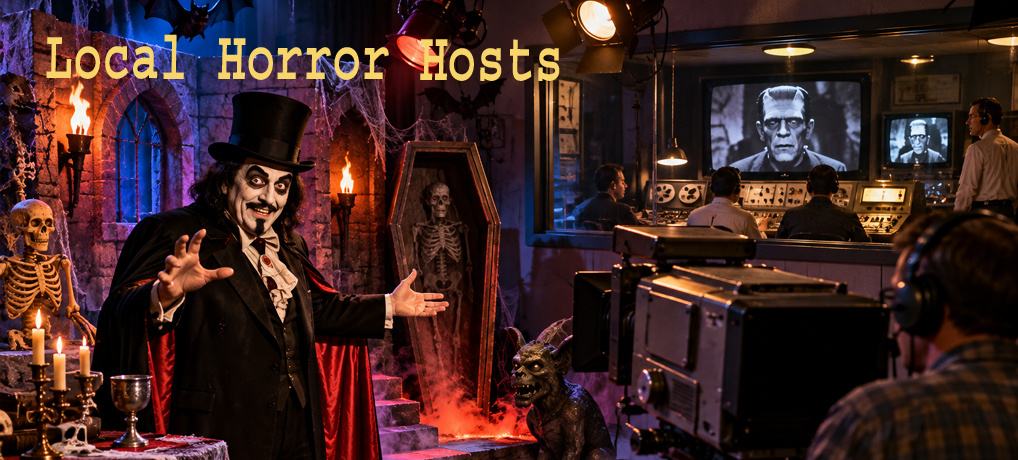
Local horror hosts once turned an ordinary Saturday night into something a whole city could share. A costumed personality on a local station would introduce an old monster movie and crack jokes between commercial breaks. In the process, that personality became a hometown celebrity. Two viewers in different cities could watch the exact same film that same week and come away with completely different memories. Everything depended on whichever ghoul, vampire, or mad scientist their own station had put on the air. This look at local horror hosts traces how the format began. It also covers why it spread so widely and why it eventually faded from most American television markets.
Before cable and streaming flattened every market into the same handful of national channels, television was fundamentally a local business. A station in Cleveland answered to Cleveland viewers and Cleveland advertisers. A station in Indianapolis did the same for its own audience. That local structure meant a station could build a character nobody outside its broadcast range would ever see. Local horror hosts became one of the strangest, most memorable products of that system.
These personalities rarely started as horror specialists. Many were staff announcers, weathermen, or disc jockeys asked to fill dead airtime with whatever cheap, campy content the station had on hand. Old horror films fit that need perfectly. They were inexpensive to license and familiar enough to draw an audience. They were also flexible enough to support a host cracking jokes over the material without ruining it. A station rarely set out to build a lasting local celebrity. It simply needed someone willing to show up in costume and talk over old footage, and the character often grew from there almost by accident.
Vampira Shows Television How to Host a Horror Movie
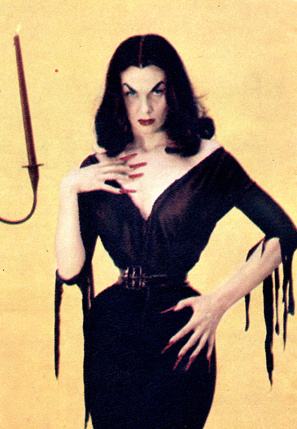
Television's first true horror host arrived years before the format had a name. Maila Nurmi created the character Vampira for Los Angeles station KABC-TV, and The Vampira Show premiered on May 1, 1954. Nurmi had won a costume contest at a Hollywood masquerade ball the previous year, dressed as a character inspired by a Charles Addams cartoon. A television producer spotted her and offered her the hosting job soon after.
Each episode opened with Vampira gliding through a fog filled corridor before letting out a piercing scream directly into the camera. She then introduced that night's film while reclining on a skull encrusted Victorian couch, trading in ghoulish puns and conversation with her pet spider, Rollo. The show earned Nurmi an Emmy nomination for Most Outstanding Female Personality in 1954. It also established nearly every element later hosts would borrow. The campy costume, the direct address to camera, and running commentary on a film taken far too lightly all trace back to this one show.
The Vampira Show only lasted about a year before cancellation in 1955, but its influence outlived its short run by decades. Nurmi later sued Cassandra Peterson, creator of Elvira, in 1989, arguing Peterson had copied her character. Nurmi lost the case, though the lawsuit itself underlined just how much Vampira had shaped everything that followed.
 DIY Vampira Costume – 5 Bold & Bewitching Tribute to Horror History
Screen Gems Opens the Crypt in 1957
The format needed one more ingredient before it could spread nationwide, and that arrived in 1957. Screen Gems packaged 52 older Universal horror titles into a syndicated bundle called Shock Theater and offered it to local stations across the country. A Philadelphia producer reportedly considered the films themselves too weak to broadcast on their own. That pushed the station toward hiring a host to dress the movies up with jokes and character bits.
That decision proved enormously consequential. Stations that bought the Shock Theater package suddenly had access to a full library of Dracula, Frankenstein, and Wolf Man films at once. Station managers across the country reached similar conclusions about how to present them. Rather than simply running the movies straight, nearly every station built its own local character to introduce them.
Every Station Needed Someone to Introduce the Movie
This created a genuinely strange broadcasting moment. A weatherman in one city might suddenly become a caped ghoul on Friday nights. A staff announcer in another city might climb into a fake coffin every week for the same reason. Stations needed a personality who could fill airtime between segments and react to the movie in real time. That gave viewers a reason to tune in beyond the film itself, which had often already played in theaters decades earlier.
Philadelphia's WCAU debuted its own Shock Theater host on October 7, 1957, played by actor John Zacherle under the character name Roland. Zacherle had previously played an undertaker on the station's live western series, and that morbid streak translated easily into his new horror role. The show became so popular that Roland once jokingly asked viewers to mail in a few human hairs for a pillow. The station received 23,000 replies.
 DIY Morgus the Magnificent Costume 6 Sinister Steps Wild Haired Scientist
Zacherley Turns the Host Into the Attraction
Zacherle moved to WABC-TV in New York the following year, where his character name shifted slightly to Zacherley. He recorded the novelty single Dinner With Drac in 1958, and it climbed into the national top ten. That proved a local horror host could occasionally break out of a single television market entirely. Zacherle became known within the industry as the Cool Ghoul, a nickname reportedly coined by fellow Philadelphia broadcaster Dick Clark.
What made Zacherle different from many hosts who followed was how completely he embodied his character rather than simply narrating around it. Viewers tuned in as much for Roland and Zacherley themselves as for whatever film happened to be playing that week. The host had become the real draw of the broadcast.
Cheap Sets Were Part of the Fun
Success on this scale did not require an expensive production. Most local horror hosts worked with whatever a station's prop closet and budget could provide. A cardboard laboratory set, a fog machine, a rubber spider dangling from visible fishing line, and a coffin built from spare lumber were often enough. Viewers rarely seemed to mind the visible seams, and in many cases the cheapness became part of the appeal rather than a flaw to hide.
This do it yourself quality gave each local production its own distinct personality. A station with a bigger budget might build an elaborate crypt set. A smaller station made do with a single dark corner of a studio and some dry ice. Either approach worked, since the host's performance carried far more weight than the physical production ever did.
The Commercial Break Became the Show
Commercial breaks became just as important as the movie itself on many of these programs. Hosts filled that time with skits, viewer mail segments, and jokes built around local references specific to their own city. A host in Indianapolis could reference a local landmark or a regional sponsor in a way a national program never could. That deepened the sense that this broadcast belonged to this particular audience.
Every City Had a Different Monster
Ernie Anderson took this local specificity furthest with his character Ghoulardi, who hosted Shock Theater on Cleveland's WJW-TV from 1963 to 1966. Rather than playing a traditional ghoul or vampire, Anderson built Ghoulardi as a beatnik hipster. The character openly mocked the films he was supposed to be presenting. He peppered his commentary with invented slang and set off firecrackers on camera between segments.
Ghoulardi's popularity reached remarkable heights for a purely local program. At its peak, the show reportedly captured 70 percent of the late night television audience in the Cleveland market. Fans sent as many as 1,000 pieces of mail a day. The Cleveland Police Department at one point attributed a 35 percent drop in Friday night juvenile crime to the show. Teenagers, the reasoning went, were staying home to watch rather than getting into trouble outside.
Every city that adopted the format tended to produce a genuinely different monster. Chicago's WBKB-TV introduced Marvin, played by Terry Bennett, starting in December 1957. Marvin played a demented beatnik character who performed mock experiments on his unseen wife, known only as Dear. Her face never appeared on camera throughout the show's run.
Indianapolis took a more traditional approach with Sammy Terry, created by Bob Carter for station WTTV starting in 1962. Sammy Terry rose from a coffin each Friday night, accompanied by a toy spider named George. The character's name itself was simply a play on the word cemetery. Carter continued playing the role for decades, and his son Mark eventually took over the part.
These regional differences meant that two viewers in different states might describe a completely different experience despite watching essentially the same category of program. One city might get a hipster cracking wise about bad science fiction, while another got a formal, cloaked ghoul playing his role with theatrical seriousness. The films rotated through the same syndication packages nationwide, but the personality wrapped around them never did.
Kids Stayed Up Because They Were Not Supposed To
For an entire generation of kids, staying up to watch a local horror host was itself a small act of rebellion. These programs aired well past normal children's bedtimes, often starting at eleven at night or later. Regular children's programming had long since ended for the evening by that hour.
That late hour became part of the appeal rather than an obstacle to it. Sneaking downstairs after parents assumed a child was asleep gave the whole experience a forbidden quality. So did negotiating to stay up just this once for a special Friday broadcast, a thrill no afternoon cartoon could match. Decades later, adults who grew up with these programs often describe the ritual of staying up for their local host with real affection. Many remember that ritual more fondly than the movies themselves.
Why Local Horror Hosts Began Disappearing
The format that had thrived through the late 1950s and 1960s began losing ground steadily through the decades that followed. Station ownership consolidated across many markets. Corporate owners increasingly favored cheaper, standardized programming over locally produced content with a single city's personality baked into it.
Syndicated programming played a major role in this shift as well. As the 1960s wore on, studios began offering packages of older television shows at low cost. Those packages undercut what it took to produce and staff a live local broadcast. Simple economics made this an easy decision for station managers. That held true even when it meant losing a beloved local character built up over years of Friday and Saturday broadcasts.
Cable television compounded the problem once it reached wide adoption. Dedicated movie channels, and eventually entire networks built around horror content, gave viewers direct access to genre films. No local host was needed to curate or introduce anything. The specific, hometown quality that had made these programs special became less necessary once national alternatives were available at any hour.
Shrinking local production budgets finished what consolidation and syndication started. Producing a live weekly show still required a studio, a crew, and a performer willing to commit to a weekly character. That was true even for a low budget show built from cardboard sets and borrowed props. As stations cut local programming across the board, horror hosts were often among the first casualties.
Elvira Takes the Local Formula National
The format did not disappear entirely, and Cassandra Peterson's character Elvira showed how it could survive by moving beyond a single market. Peterson won the hosting role on Los Angeles station KHJ-TV in 1981 for a program called Movie Macabre. She built the character Elvira from a Valley girl type persona she had developed with the improv troupe The Groundlings.
Unlike most earlier hosts, Elvira gained national syndication rather than staying confined to Southern California. That wider reach let the character build recognition on a scale local hosts from earlier decades had rarely achieved. It eventually led to feature films and a level of mainstream fame no strictly local personality could match.
Svengoolie Proves the Idea Never Really Died
Chicago's Svengoolie offers a different survival story, one built on continuity rather than national expansion from the start. Jerry G. Bishop originated the character in 1970 on WFLD. Rich Koz had written for Bishop beginning in 1973. He eventually took over the role himself, first as Son of Svengoolie starting in 1979. He later became Svengoolie in his own right beginning in 1994 on WCIU.
Svengoolie's reach expanded dramatically in 2011. The character moved to the Chicago based MeTV that year and became available to a national audience for the first time. The show retained its local, low budget charm, corny jokes, and genuine affection for old genre films. That proved audiences still wanted exactly what local horror hosts had always offered, decades after most stations had abandoned the format.
 DIY Svengoolie Costume 7 Easy Steps Rubber Chicken Trowing Horror Host
What We Lost When Television Stopped Being Local
What television lost when local production faded was not simply a handful of costumed personalities. It lost an entire structure built around identical raw material. The same old monster movies, syndicated to hundreds of stations, became something distinct and locally meaningful in each market that broadcast them. A kid in Cleveland and a kid in Indianapolis could watch films from the exact same syndication package. Each one grew up with completely different childhood memories attached to those same movies.
That kind of regional variation has largely disappeared from modern television. Identical national programming now reaches every market across the country at the very same moment. Local horror hosts remain a genuine piece of forgotten Americana precisely because of that lost variation. Television once had room for a different monster in nearly every city. Each one grew out of a station's limited budget and one performer's willingness to put on a cape every Friday night.
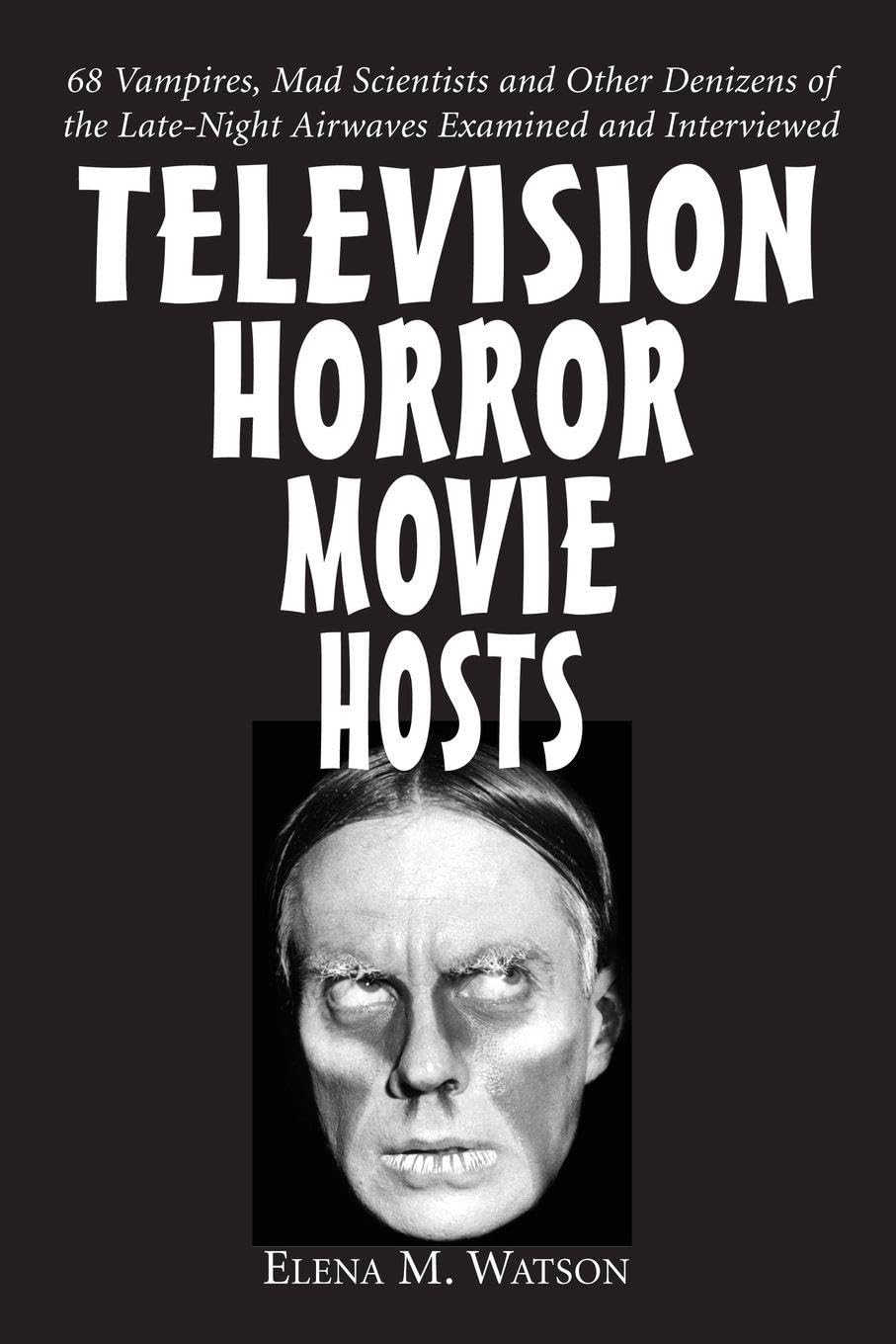
Television Horror Movie Hosts
Product Description:
Long before streaming put thousands of horror movies one click away, Local Horror Hosts turned late-night television into an event. Television Horror Movie Hosts by Elena M. Watson explores the personalities who introduced old monster movies, cracked jokes between commercial breaks, performed homemade comedy sketches, and became local celebrities to generations of horror fans.
Key Features:
• Explores the history of television horror-movie hosting
• Packed with factual information about horror hosts and their programs
• Includes numerous black-and-white photographs and rare images
• Covers a unique chapter in regional television and horror history
• Excellent reference for horror-host fans, television historians, and collectors of spooky Americana
Why This Works:
If our article on Local Horror Hosts brought back memories of staying up late to watch a monster movie introduced by some wonderfully strange character from a local TV studio, this book takes the story much further. It's a natural companion to the article and a chance to discover hosts from other cities whose viewers remember them just as fondly. For fans of forgotten television, classic monsters, and regional pop culture, this is exactly the kind of book that can send you down a very entertaining rabbit hole.
Buy on Amazon