🎅 Department Store Santa: The Wonderful Christmas Tradition Before the Mall
Long before Santa sat in the middle of a shopping mall, he lived upstairs at the department store. You rode the escalator past housewares and ladies’ coats. You followed the signs to Toyland. Then, at the end of a long line, there he was. The department store Santa was one of the great rituals of an American childhood, and for many families it was the moment Christmas truly began.
Before Santa Moved Into the Mall
Today a visit with Santa can feel like one more errand. Park the car, grab a pretzel, wait in line and buy the photo package. It was not always that way. For most of the twentieth century, seeing Santa meant going downtown to a grand department store built like a palace of goods.
Those stores were the original home of the retail Santa. They had the space, the toys and the crowds. They also had something the corner shop never could offer. A child could meet the real Santa Claus, or at least a very convincing one. The setting made it feel like the North Pole had moved to Main Street.
The department store Santa became so familiar that many people assume he was always there. In fact, he had to be invented. His story begins more than a century ago with a few clever merchants and one big hearted store owner in Massachusetts.
Sears Wish Book: The Amazing Christmas Catalog Kids Loved
The First Department Store Santas
Several stores have claimed the title of first. One of the earliest stories comes from Philadelphia. According to HISTORY, a confectioner and dry goods merchant named James Parkinson hired a man to play Kris Kringle in his store in 1841. By 1846, at least three other Philadelphia merchants had their own Santa Claus.
Macy’s has its own claim. The New York store says Santa first became part of its holiday season in 1861. That year, Macy’s advertised itself as the home of Santa Claus. Skeptics point out there is little evidence of a live Santa in the store at that early date, but the claim is part of the legend.
The name most often credited with launching the tradition is James Edgar. He was a Scottish immigrant who ran a dry goods business called ThefBoston Store in Brockton, Massachusetts. Edgar loved children and enjoyed dressing in costume. He had already greeted shoppers as a clown, a sea captain and even George Washington.
In December 1890, Edgar took the train to Boston and had a Santa suit tailored just for him. Then he walked the aisles of his own store in full costume, seeking out children to talk with. The effect was immediate. Families lined up outside, and some traveled from Boston, Providence and even New York to see him.
Other merchants noticed. By the turn of the century, the department store Santa had become an established tradition. Edgar kept playing Santa in the Decembers that followed. When he died in September 1909, Santa had a place in stores all across the country.
Edgar is often called the first known department store Santa, and he remains a hometown hero in Brockton. Children there still play in the James Edgar Playground, donated to the city by his daughter Eva. He was also named to the International Santa Claus Hall of Fame. Not bad for a dry goods merchant with a homemade idea.
When Seeing Santa Became a Christmas Outing
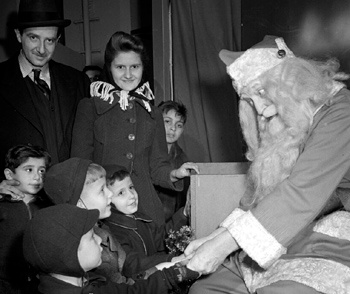
For families of the 1940s, 1950s and 1960s, visiting Santa was rarely a quick stop. It was a full day downtown. Kids put on their best coats and polished shoes. Parents planned lunch at the store’s tearoom or a nearby diner. Some families rode the bus or streetcar into the city just for the occasion.
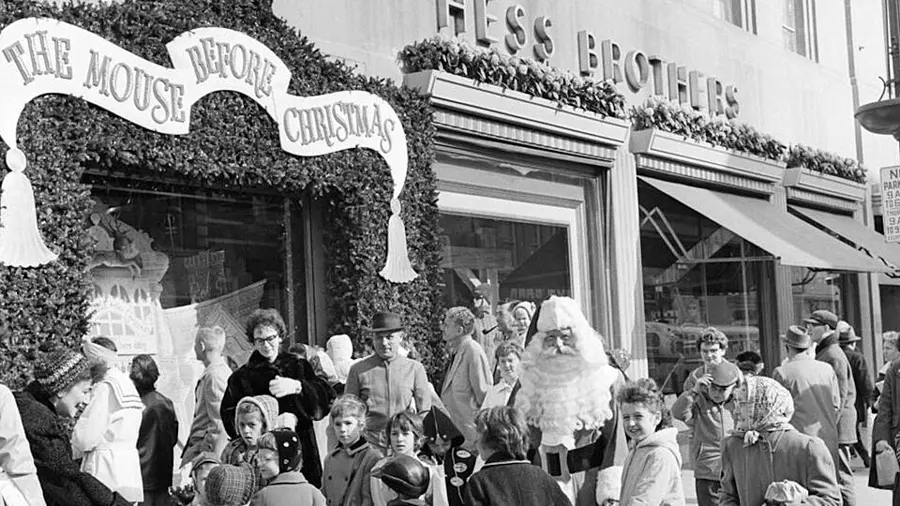
The trip had its own rhythm. First came the decorated store windows on the sidewalk. Next came the crowded aisles inside, filled with the smell of perfume, popcorn and new merchandise. Finally came the long ride up to the toy floor, where Santa waited at the end of the line.
That sense of occasion made the visit special. Santa was not just someone you bumped into between errands. He was the reason for the trip. A kid knew the day was coming, counted down to it and remembered it for years.
Stores also made sure Santa’s arrival felt like big news. Department stores began holding holiday parades to welcome him. Gimbel’s held one in Philadelphia in 1920. Hudson’s followed in Detroit in 1923, and Macy’s started its New York parade in 1924. Each parade ended with Santa heading to the store, ready for business.
Some stores went even further to stage his arrival. Santa stunts were common in the years after the war. In 1953, Santa reportedly arrived by helicopter at Butler Bros. Department Store in San Francisco. Kids who saw that never forgot it.
Santa Takes Over the Toy Department
Early department store Santas did not always have a throne. Some simply roamed the store as greeters. Others sat among the toys or appeared in a live window display. Over time, though, stores built Santa a setting worthy of his reputation.
By the middle of the century, the visit often happened in a full Christmas village. There were cotton snowbanks, glittering trees and a painted backdrop of the North Pole. Helpers dressed as elves kept the line moving. Santa sat in a big carved chair, sometimes beside a fireplace or a mountain of wrapped packages.
The setting was not an accident. Santa sat right in the middle of the toy department. Every child who waited in line passed shelves of dolls, trains, games and bicycles. By the time a kid reached Santa, the wish list had often grown much longer.
Stores also took the job of Santa seriously. In 1937, Charles W. Howard founded the first school for Santas in Albion, New York. He had worked as a store Santa himself and was unhappy with the shabby suits and poor manners he saw. Department stores began sending their Santas to his school for training. By 1956, he had graduated more than 500 Santas.
World War II changed the job for a while. With so many men overseas, women briefly filled in as department store Santas. In 1943, Blumstein’s department store in Harlem hired a Black Santa, reportedly the first retailer in the country to do so. By 1946, at least one store on Chicago’s South Side had its own Black Santa as well.
What Are You Asking Santa For?
After all that waiting, the actual visit lasted only a minute or two. For a small child, those minutes felt enormous. Your turn finally came. An elf waved you forward. Suddenly you were standing in front of the most famous man in the world.
Some kids marched right up and climbed on his lap like old friends. Others froze. The carefully rehearsed list vanished from memory. Santa would lean in and ask the big question. “What would you like for Christmas?” A child who had talked about one toy for weeks might suddenly whisper something completely different.
Santa also had a few standard questions. Have you been good this year? Do you listen to your mom and dad? Are you going to leave cookies out? Most kids answered yes to everything, whether it was strictly true or not.
Then came a candy cane, a small gift or a pat on the head, and the visit was over. It was quick, but it mattered. For a few moments, a child had spoken directly to Santa Claus and been heard.
The Santa Photograph Becomes Part of Christmas
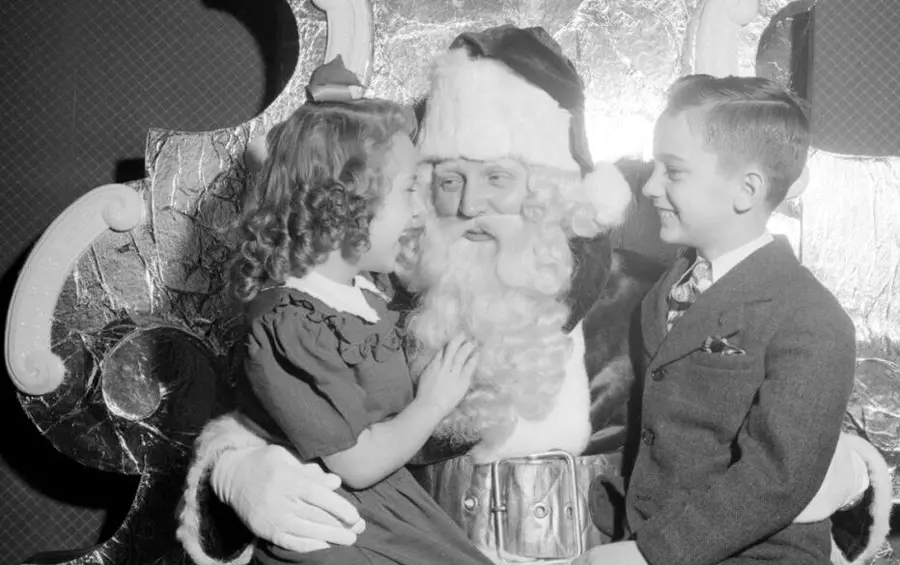
Children were photographed with Santa as early as the 1930s, but the photo business really took off in the 1940s. Much of the credit goes to a Seattle newspaper photographer named Art French.
In 1943, the Frederick & Nelson department store in downtown Seattle moved its Santa into a sidewalk display window. French worked at the Seattle Post Intelligencer across the street. He watched the children climb onto Santa’s lap and saw an opportunity. Soon he set up a photo concession right beside Santa.
Parents loved it. According to HISTORY, French sold the pictures for a dollar apiece. Accounts say he earned about $10,000 in a single holiday season. By early 1946, he had quit the newspaper to run Santa photos as a full time business.
The Seattle operation even offered sound. For an extra cost, families could buy an audio recording of the visit. One surviving example captures a child singing “Jingle Bells” right along with Santa.
Other photographers followed. Studios such as Kiddie Kandids in the Midwest began photographing children with Santa in the early 1940s. Before long, the Santa photo was a standard part of the visit across the country. Families bought a print, often in a simple card frame, and carried it home like a prize.
The Kids Who Wanted Nothing to Do With Santa
Not every Santa photo shows a happy child. Plenty of them show the opposite. For every grinning kid on Santa’s knee, there seems to be a toddler screaming like the house is on fire.
It is easy to understand why. A small child is handed to a large stranger with a huge white beard. The lights are bright, the line is noisy and Mom keeps saying, “Smile!” Some kids decided Santa was simply not worth the risk.
Those photos have become treasures in their own right. One university archive keeps a collection of 1940s and 1950s department store Santa portraits. Its own description notes children in various emotional states sitting on Santa’s lap. That polite phrase covers everything from shy to completely terrified.
Then there are the awkward photos. Big brothers too old to be there, glaring at the camera. Babies asleep through the whole thing. Siblings squeezed onto one knee, each looking a different direction. And now and then, a Santa whose beard does not quite hide his own exhausted expression.
From Downtown Department Stores to Shopping Malls
After World War II, America moved to the suburbs. Department stores followed their customers, first by opening smaller branch stores. Then came the shopping malls, anchored by two or three big department stores and a central court in between.
Santa made the move too. Southdale in Edina, Minnesota, opened in 1956 as the country’s first indoor shopping mall. It hosted a Winter Wonderland that very first year. Santa’s Workshop and Winter Wonderland settings have been part of malls ever since.
Hollywood helped cement the link between Santa and the store. Miracle on 34th Street, released in 1947, put a kindly Kris Kringle to work at Macy’s in New York. Charles W. Howard, the Santa school founder, served as a consultant on the film. He also played Santa in the Macy’s Thanksgiving Day Parade from 1948 to 1965.
The setting changed, but the basic visit stayed remarkably similar. A line, a chair, a few nervous moments and a photograph to take home. In a sense, every mall Santa is still a department store Santa at heart.
The Old Santa Photos We Never Threw Away
Most families have a stack of photos they could live without. The Santa pictures are different. They survive moves, basement floods and decades of spring cleaning. They end up in albums, on refrigerators and in frames that come out every December.
Part of the reason is the timeline they create. A Santa photo taken year after year shows a child growing up one Christmas at a time. The baby in the first picture becomes a toddler, then a grinning kid, then a reluctant preteen. Placed side by side, they tell a family story no other photo can.
Those old prints also capture a lost world. Look closely and you can see the store’s decorations, the fashions of the day and the style of that particular Santa. Some frames even carry the name of the store, and many of those stores no longer exist. A simple souvenir has quietly become a historical document.
For collectors and families alike, vintage Santa photos are worth keeping. Check the back of the folder for a store name or date. Store them flat, away from heat and sunlight. If you have relatives in the pictures, write down names and years now, while someone still remembers them.
Why Department Store Santa Still Matters
The department store Santa began as a sales idea. Merchants wanted families in the store, and Santa brought them there. There is no point pretending otherwise.
Yet something happened along the way. The idea outgrew the cash register. James Edgar walked his aisles because he loved making children happy. Charles W. Howard trained Santas because he believed kids deserved a good one. Millions of parents waited in long lines simply to see a child’s face light up.
That is how an advertising idea became a family tradition. The stores changed, the malls came and many of the grand downtown buildings disappeared. The moment itself stayed the same. A child, a man in a red suit and a wish whispered out loud.
So the next time you pull out an old Santa photo, take a closer look. Behind the cotton snow and the cardboard frame is a small piece of American history. The department store Santa is still with us every December, one nervous little visitor at a time.