🐰 Easter Bunny History in Songs, TV and Essential Ads

Easter Bunny history in American pop culture stretches back further than most people realize, rooted not in a single invention but in a gradual accumulation of folk tradition, commercial opportunity, and seasonal entertainment. The rabbit as a symbol of spring and renewal has roots in European custom, particularly German immigrant tradition, where a hare called Osterhase was said to leave colored eggs for children. That tradition crossed the Atlantic and quietly settled into American domestic life through the nineteenth century, but it took the entertainment industry of the twentieth century to truly fix the Easter Bunny as a cultural fixture.
Easter Bunny history in American pop culture developed gradually through the nineteenth and twentieth centuries, drawing on European folk tradition before being absorbed into the commercial and entertainment industries that shaped modern holiday observance. The figure of a rabbit delivering decorated eggs derived from German immigrant custom, specifically the Osterhase tradition, which entered American domestic life well before broadcasters or advertisers took notice. Its role was functional within seasonal celebration, providing a child-oriented character parallel to Santa Claus that could anchor gift-giving, candy marketing, and holiday entertainment.
The character evolved without a single author or origin point. Unlike Santa Claus, who was consolidated through a fairly traceable literary and commercial lineage, Easter Bunny history is diffuse and collaborative. Greeting card companies, candy manufacturers, department stores, and eventually broadcasters each contributed a layer. By the postwar era, the white rabbit with a basket of eggs had become a recognizable shorthand for the holiday across virtually all American media.
The most revealing fact about the Easter Bunny as a cultural figure is how little central authorship shaped it. No single poem, film, advertisement, or broadcast special holds the same consolidating authority over the character that Moore’s A Visit from St. Nicholas holds over Santa Claus. The Easter Bunny became an American institution through sheer repetition across independent commercial channels, each borrowing an image that no one owned and returning it to the seasonal rotation slightly more familiar than before.
🐣 Songs and the Shaping of a Character
No discussion of Easter Bunny history in popular music can avoid “Here Comes Peter Cottontail,” the song that did more than any other single piece of entertainment to define the character’s personality for American children. Written by Steve Nelson and Jack Rollins, the same team behind Frosty the Snowman, the song was recorded by Gene Autry in 1950, reached the top of the charts, and became a seasonal standard that radio stations still rotate today.
The Peter Cottontail song borrowed its commercial instincts from the Christmas music machine that had been perfected through the 1940s. Autry had already scored with “Rudolph the Red-Nosed Reindeer” in 1949, and the studio recognized the appeal of pairing a beloved performer with a holiday character. The formula transferred neatly. Easter Bunny songs as a category expanded from there, with novelty recordings, children’s albums, and animated specials generating their own accompanying music through subsequent decades. None of those later songs matched the cultural permanence of the Autry recording, but collectively they reinforced the character’s musical presence in the seasonal calendar.
Easter Bunny origin stories in folk song and poetry had existed before the commercial era, often embedded in church-adjacent spring verses, but these were informal and regional. References to the Osterhase tradition in American print appeared through the nineteenth century, helping document how German immigrant communities had carried the egg-laying hare custom into American domestic life well before commercial entertainment took any interest in it. The 1950 recording changed the scale entirely.
Discover more Easter Articles Here
Here Comes Peter Cottontail held the number one position on the Billboard Best Sellers in Stores chart for three weeks in the spring of 1950, making it one of the few non-Christmas holiday songs to reach the top of a national sales chart.
🐇 Television and the Animated Easter Bunny
Easter Bunny history in television began modestly, with variety show appearances and seasonal sketch comedy. It found a more durable form in animated specials produced for network broadcast. Rankin/Bass Productions, the studio responsible for the claymation Christmas specials that defined holiday television for a generation, turned to Easter in 1971 with “Here Comes Peter Cottontail.”
The special was a stop-motion feature based loosely on the book “The Easter Bunny That Overslept” by Priscilla and Otto Friedrich. Vincent Price voiced the villain January Q. Irontail, Danny Kaye voiced the narrator figure Seymour S. Sassafras, and Casey Kasem, already known as the voice of Shaggy in Scooby-Doo since its 1969 debut, provided the voice of Peter Cottontail. The special aired on ABC and has been rebroadcast regularly in the decades since.
That production made explicit what the 1950 song had implied: the Easter Bunny was a full character with a story, an antagonist, and a seasonal mission. It placed Easter Bunny TV shows in the same narrative tradition as Christmas specials, complete with moral stakes, a bumbling hero, and a resolution timed to the holiday. The special drew on Easter Bunny origin materials loosely, constructing a mythology rather than documenting one, but audiences received it as a kind of authoritative Easter narrative.
Other Easter Bunny TV shows followed, some animated, some live-action adjacent, several produced for cable as the landscape expanded in the 1980s and 1990s. The Rankin/Bass special remained the touchstone. Easter Bunny history in the television medium did not develop the same sprawling library that Christmas accumulated, partly because Easter’s date varies annually, complicating scheduling, and partly because the commercial ecosystem around Easter, while substantial, never reached Christmas scale. The specials that did emerge tended to be lighter and shorter, oriented toward young children rather than general family audiences.
The Rankin/Bass special Here Comes Peter Cottontail was produced using a process the studio called Animagic, a stop-motion technique developed in Japan through a partnership with Tadahito Mochinaga, who had built his career producing animated propaganda films during World War Two.
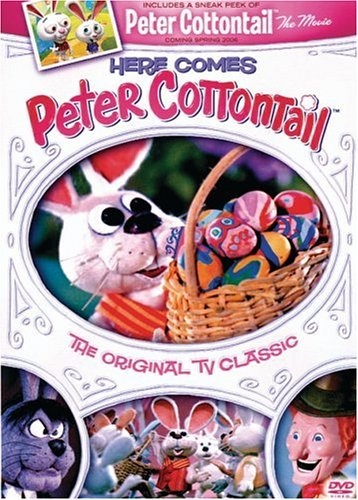
Here Comes Peter Cottontail DVD
Product Description:
Celebrate with the most famous Easter Bunny of all time in the original holiday special, Here Comes Peter Cottontail. It’s time to choose the next chief Easter Bunny, and Peter Cottontail really wants the job. Everyone in April Valley agrees he’s the best bunny for it, but someone else wants the top spot too. When evil Irontail’s terrible plans threaten to ruin the holiday for children everywhere, it’s up to Peter to restore the true magic of Easter. The Rankin/Bass production features groundbreaking Animagic stop-motion, narration by Danny Kaye, and unforgettable songs. Easter is on its way!
Bonus Content:
• Peter Cottontail the Movie
• Peter Cottontail Songs
• Storyboard Scenes
• Development Art
• Deleted Scenes
• Picture Slideshow
🥚 Advertising and Commercial Characters
The advertising dimension of Easter Bunny history is where commercial culture most visibly shaped the character’s public image. Candy manufacturers recognized the Easter Bunny’s potential early. The Cadbury Clucking Bunny campaign, which became a fixture in the United States through the early 1980s, produced one of the most memorable Easter commercials in American advertising history. The spot featured a parade of animals auditioning to be the Easter Bunny, with a rabbit ultimately winning the role, then sitting in a pastoral setting and clucking like a hen while Cadbury Creme Eggs appeared. The tagline framed the rabbit as the source of the candy eggs, neatly connecting the chocolate product to the holiday mythology.
That campaign ran for decades with variations, using celebrity voices and updated casting in later years, and it became so deeply embedded in seasonal advertising that many Americans associate it instinctively with Easter itself. Easter Bunny commercials of this era were not trying to create the character so much as borrow the cultural authority that already surrounded it. Advertisers understood that the Easter Bunny carried positive associations, particularly for young children, and that attaching a product to that figure during the seasonal window was efficient and effective.
Toy manufacturers, bakeries, grocery chains, and florists all cycled through Easter Bunny imagery in their seasonal promotions. The visual language was consistent: white rabbit, pastel colors, wicker basket, decorated eggs. Easter Bunny history in advertising reflects a consensus image that solidified during the 1950s and 1960s and remained largely stable. Santa Claus offers a useful contrast. His image is often credited to Coca-Cola advertising from the early 1930s, though historians note that illustrator Haddon Sundblom was working with a figure already partly shaped by earlier commercial art and the influence of Thomas Nast. The Easter Bunny’s commercial image settled into place through no comparable single moment, but through distributed industry usage accumulated over decades.
🐰 Easter Bunny Characters in Department Stores and Theme Parks
Department store appearances represent a parallel thread in Easter Bunny history, one that mirrors the Santa Claus mall tradition closely enough to suggest deliberate imitation. By the 1970s, it had become common practice for shopping malls across the country to install seasonal Easter Bunny characters in the weeks before the holiday. Children could have photographs taken with the costumed figure, and the setup generated foot traffic while reinforcing the holiday’s commercial associations.
These appearances varied considerably in production quality. Some department stores hired professional character performers and invested in high-quality costumes. Others produced experiences that ranged from charming to unsettling, which became a minor cultural joke embedded in popular memory. Easter Bunny origin mythology played no role in these appearances. The character simply showed up as a seasonal given, familiar enough to require no introduction, friendly enough to serve the promotional function.
Theme parks incorporated Easter Bunny characters into their seasonal programming as well, particularly those with existing character entertainment infrastructure. This integration treated the Easter Bunny as a peer to established branded characters, giving it a place in the rotation of seasonal meet-and-greet experiences without requiring any particular narrative justification.
The Easter Bunny made one of its earliest known American newspaper appearances in an 1879 edition of a Pennsylvania German community paper, described in the context of household egg-dyeing customs rather than gift delivery. Unlike Santa Claus, the Easter Bunny has never been assigned an official residence or origin city by any commercial or civic organization, leaving that dimension of the mythology permanently unresolved.
🌸 Regional Traditions and the Local Media Layer
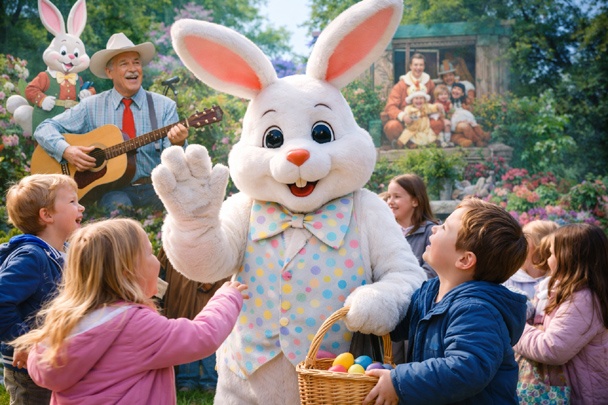
Easter Bunny history at the local level operated through a layer of regional media that national accounts tend to overlook. Local television stations ran their own Easter programming throughout the 1960s and 1970s, with children’s show hosts incorporating the character into seasonal segments. Easter egg hunts sponsored by local businesses often featured appearances by Easter Bunny characters coordinated through civic organizations, and local newspapers covered these events as community features.
Radio played a consistent supporting role. Stations programmed Easter Bunny songs during the weeks surrounding the holiday, with the Peter Cottontail song anchoring most rotations. Easter Bunny origin stories occasionally appeared in newspaper feature sections, usually framed as curiosities drawing on the German Osterhase background, which gave editors a piece of historical texture to fill seasonal space.
The cumulative effect of this local media activity was to embed the Easter Bunny in community life in a way that national coverage alone could not have accomplished. Easter Bunny history, at this granular level, is a story about repetition across many small platforms rather than a single broadcast event. The character was normalized through accumulation, returning each spring through enough channels and enough formats that its presence became simply part of what Easter meant in American life.
🗣️ Why It Still Matter
Easter Bunny history persists as a reference point because the character occupies a rare position in American commercial culture, recognizable enough to anchor major advertising campaigns and television programming, yet loosely defined enough that no single rights holder controls its image. That openness allowed the figure to be adapted freely across industries and generations, which is precisely why it remains viable as a seasonal cultural symbol while more rigidly defined holiday characters have faded or become legally complicated.
Further Reading & Resources
📖 Read: Easter Bunny History – The Pioneer woman
🔍 Explore: Easter Bunny History – Smithsonian Magazine