When the Horror Movie Came Off the Screen
In 1953, audiences were not merely buying a ticket to a Vincent Price horror movie. They were buying the chance to have the movie invade the theater.
Objects flew toward their faces. A paddle-ball man sent his ball directly at the audience. Can-can dancers kicked toward the seats. Behind all that spectacle was a wonderfully macabre story about a wax museum filled with figures that looked a little too convincing.
House of Wax 3D arrived in April 1953 and became one of the most successful films of the year. It was second only to The Robe at the box office. It grossed more than twenty-three million dollars against a production budget of approximately 680,000 dollars. It was shot in 28 days. And it was directed by a man who was blind in one eye and could not see the 3D effects he was creating.
That last detail tells you almost everything you need to know about why this film works. The gimmick helped sell it. The movie made people remember it.
House of Wax 3D sits at the intersection of several things worth exploring together. Old wax museums. Horror showmanship. Vincent Price. Theatrical gimmicks. And America's brief but passionate early-1950s love affair with three-dimensional film. All of it belongs here on Kilroy Was Here Shop, and all of it connects in ways the original audiences might not have fully appreciated at the time.
Before House of Wax: America’s Fascination with Wax Museums
The wax museum did not need a horror movie to be unsettling. It had been managing that on its own for centuries.
Marie Tussaud established her permanent exhibition in London in the early 1800s and brought with her a collection that included death masks she had personally made of French Revolution victims, including Marie Antoinette and King Louis XVI. Her Separate Room, displaying the more outrageous items, became known as the Chamber of Horrors by the 1840s. The name stuck. So did the concept.
American wax museums followed the same principle. A main floor of respectable historical and celebrity figures. A lower section, darker and more crowded, where the famous criminals lived. Murderers, executioners, scenes of punishment and death rendered in wax with considerable attention to detail. The museums sold themselves as educational. Their Chamber of Horrors sections sold themselves as something else entirely.
The appeal was specific and a little hard to explain. A wax figure is not frightening because it looks like a monster. It is unsettling because it looks almost like a person. The face has the right proportions. The eyes are the right color. The hands are positioned naturally. But nothing moves. Nothing breathes. The figure that looked so impressive from across the room becomes subtly wrong the closer you get to it.
Scientists now call this the uncanny valley. In 1953, visitors to wax museums just knew that standing next to certain figures made them uncomfortable in a way that was difficult to articulate.
Historical tableaux showed famous moments frozen in wax. Medical displays used anatomical figures to demonstrate things that polite society did not discuss openly. Celebrity figures let visitors stand beside royalty, presidents, and entertainment stars. And the Chamber of Horrors gave people a legitimate reason to look at the faces of killers without any of the usual social awkwardness.
House of Wax did not invent the creepy wax museum. It took something audiences already knew and pushed it firmly into horror.
Vincent Price Finds the Role That Changed His Horror Career

was already a well-established actor before House of Wax. He had appeared in Laura in 1944, Dragonwyck in 1946, and The Three Musketeers in 1948. He was known as a versatile character actor with a distinctive voice and an air of refined menace that he could dial up or down depending on what the role required.
He had appeared in a horror film before. His role in The Fly was still five years away. What House of Wax gave him was not his introduction to horror but his defining role within it.
Professor Henry Jarrod is introduced as an artist in the truest sense. His original wax museum celebrates beauty and history. His figures are crafted with genuine reverence for their subjects. When his financial partner Matthew Burke demands more sensational exhibits, more crime, more murder, more sensation to bring in larger crowds, Jarrod refuses. He did not build his museum for that purpose.
Burke's response is to burn the museum down and collect the insurance money.
That fire, and what Jarrod becomes after surviving it, is the film's central irony. The man who refused to build a Chamber of Horrors eventually creates exactly the sort of gruesome attraction he once resisted. He just uses a different kind of material for his new figures.
Price understood Jarrod completely. He played the character with a warmth in the early scenes that made the later transformation disturbing. You understood how the artist became the monster. You even sympathized with him a little, which made everything worse.
The Fire That Destroys Jarrod’s Wax Museum
The opening museum fire is one of the great sequences in 1950s horror cinema. Its power has nothing to do with 3D.
As the flames spread through Jarrod's creation, the wax figures begin to melt. The faces go first. Features that were carefully sculpted to capture human expression and dignity begin to slide, to distort, to lose the human form that made them recognizable. What looked like a historical tableau becomes something horrible.
There is a specific reason this image works as well as it does. A melting wax figure occupies a brief and terrible middle ground between looking like a statue and looking like a burning person. The audience's brain processes what it sees and cannot quite categorize it. The discomfort that comes from that inability to categorize is not manufactured by camera tricks or jump scares. It is produced by the image itself.
Jarrod is apparently trapped inside when the museum collapses. Burke leaves him for dead. The audience understands that a man with severe burns who survives what Jarrod survived is not going to emerge looking the same as he went in.
That understanding is what the rest of the film is built upon.
The New Wax Museum Has a Much Darker Attraction
Years later, Jarrod reappears with a new museum. This one gives the public exactly what Burke always wanted. Crime. Murder. Sensation. Death. The Chamber of Horrors is the main attraction, and it is very popular.
The film's central question arrives slowly. The new figures look extraordinarily lifelike. Suspiciously lifelike. And there is a noticeable resemblance between Jarrod's newest wax figures and recently murdered people whose bodies have not been recovered.
The old wax museum question, the one every visitor to every wax museum has ever asked, is does that look real? House of Wax takes that question and gives it the worst possible answer.
The Chamber of Horrors becomes the joke's punchline. Audiences who had stood in the real Chamber of Horrors sections of American wax museums, admiring how lifelike the figures looked, suddenly had a reason to think about exactly what it would take to make a figure that lifelike.
That is the horror that lives underneath the 3D effects. It would have worked without the glasses.
The Makeup Behind the Face of House of Wax
Jarrod moves through his new museum wearing a smooth mask over the damaged face beneath it. The contrast between the beautiful wax surfaces of his creations and what lies under his own is the film's most uncomfortable visual idea.
The makeup work on Price was handled by Gordon Bau, the head of the Warner Bros. makeup department. The damaged face revealed in the film's climax required prosthetic appliances to create the scarring and distortion that Jarrod's injuries would have left. The effect was achieved through practical means, applied directly to Price each day before filming, and removed at the end of the shoot.
The mask that covers Jarrod's face through most of the film is smooth and expressionless. It presents a normal human face to the world while concealing what the fire created underneath. The thematic connection to his wax figures is not subtle. Jarrod covers his own face the same way he covers his victims. Beautiful surfaces hiding what lies beneath is the film's visual language from beginning to end.
For collectors, the masks and prosthetic pieces from this era of practical horror makeup represent a significant category of film memorabilia. Molds, production photographs, and promotional materials connected to the early horror makeup tradition are sought after. The craftsmanship that created Jarrod's face in 1953 belongs to the same lineage of practical effects artistry that produced the Don Post masks and later high-end latex prosthetics that serious collectors pursue today. The physical, handmade quality of that work is exactly what makes surviving examples valuable.
How House of Wax 3D Put Horror in the Audience’s Lap
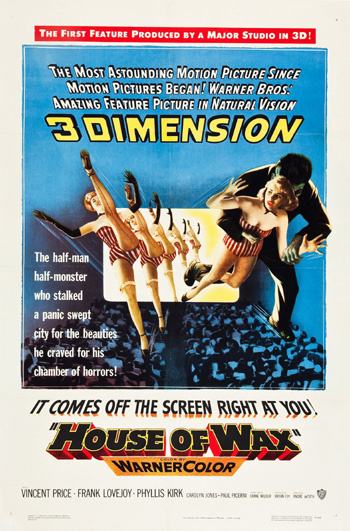
House of Wax 3D used a system called Natural Vision, developed by Milton and Julian Gunzburg. It was the same system that had been used for Bwana Devil, the independent 3D film whose surprise commercial success in late 1952 convinced Warner Bros. to make their own three-dimensional picture as quickly as possible.
The principle behind Natural Vision was straightforward. Human beings see depth because their two eyes are positioned slightly apart and each receives a slightly different image. The brain processes the two different images and interprets the difference as spatial depth. Natural Vision recorded two slightly offset images simultaneously, one for each eye, using two cameras mounted side by side.
In the theater, two synchronized projectors threw both images onto a silver screen simultaneously. Audience members wore polarized glasses that filtered each image to the correct eye. The brain did the rest, interpreting the offset images as depth and producing the illusion of three dimensions extending outward from the screen.
House of Wax was filmed beginning January 19, 1953. It was completed in 28 days, under its scheduled time and well under its original budget. Jack Warner was pleased enough with the result that he sent director Andre de Toth a case of Jack Daniel's when the production wrapped.
The film premiered on April 10, 1953, at the New York Paramount. It grossed over half a million dollars in New York alone in its first weeks. It was the first color 3D feature produced by a major American studio and the first 3D film with stereophonic sound presented in a regular theater.
The Paddle-Ball Man Who Had Almost Nothing to Do with the Movie
Reggie Rymal plays a barker outside Jarrod's new museum at its grand reopening. He stands on the street with a paddle ball toy, bouncing the ball on its elastic string directly toward the camera, repeatedly, with tremendous enthusiasm, for longer than the plot requires.
He is not advancing the story. He is demonstrating the attraction that the audience paid to see.
The paddle ball sequence is blatant showmanship of the best kind. The film temporarily sets aside its own narrative to look directly at the audience and send something flying toward their faces. Rymal plays the whole sequence with such cheerful commitment that audiences applauded it at original screenings and still find it memorable today.
William Castle would have understood the thinking immediately. You paid to see something come off the screen. Here it comes. Enjoy it. Now back to the horror.
The sequence also establishes the museum's public face before the film shows what is inside it. The barker is drawing a crowd with innocent showmanship. The museum he is promoting contains something considerably less innocent. That contrast is part of what the scene is doing beyond the 3D demonstration, even if most audiences were too busy ducking from the paddle ball to notice.
Why Early 3D Movies Kept Throwing Things at You
The paddle ball sequence was not unusual for early 3D filmmaking. It was practically required.
The Natural Vision system could create depth. Objects in the far background could appear to recede deeply into the screen. Foreground elements could hover in the space between the screen and the audience. The total range of apparent depth was impressive.
But subtle depth did not sell tickets. Objects flying toward the audience's faces sold tickets.
Early 3D directors understood this perfectly. So their films featured weapons pointed toward the camera. Characters reaching their hands directly outward. Objects thrown into the foreground with great velocity. Can-can dancers kicking toward the seats. The shadow of a character that appeared to leap off the screen and run toward the audience.
House of Wax contains all of these. The can-can sequence was included specifically because it produced spectacular 3D effects. The shadow that seems to spring from the audience and run toward the screen was described by the film's production notes as one of the most startling effects in the picture.
These moments were the proof of concept that audiences had come to see. They were also, when the film played without 3D projection, the moments that felt slightly odd. A performer reaching directly toward the camera for no narrative reason makes perfect sense in 3D. In flat projection it just looks strange.
Hollywood’s Great 3D Craze of the 1950s
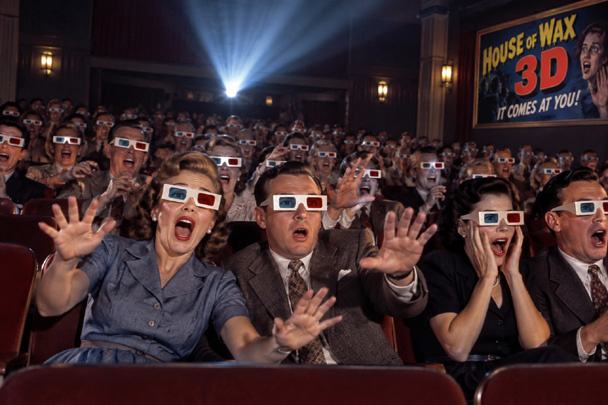
House of Wax did not arrive in a vacuum. It arrived in the middle of a full-scale industry scramble to find something that television could not offer.
American television sets had been spreading rapidly through living rooms since the late 1940s. By 1953, millions of American families had a screen at home. They did not have to leave the house or buy a ticket to see entertainment. The movie theater industry was losing customers and looking for reasons to bring them back.
The answer had to be something television could not provide. Size was one answer, which drove the development of widescreen formats including Cinerama and CinemaScope. Depth was another, which drove the 3D craze. Smell was attempted through Smell-O-Vision and Smellorama, with considerably less success.
The 3D craze began with Bwana Devil in November 1952 and moved quickly through the studios. By mid-1953, every major studio had 3D films in production or release. The output covered a remarkable range. The Creature from the Black Lagoon was filmed in 3D. Alfred Hitchcock directed Dial M for Murder in 3D. MGM filmed the musical Kiss Me Kate in 3D. Three Stooges comedies appeared in 3D.
The craze peaked fast. House of Wax was part of the wave at its height. By late 1953 and into 1954, the wave was already receding.
The Projection Booth Could Make or Break the Illusion
The Natural Vision system required two projectors running in perfect synchronization. Both projectors had to throw their images onto the screen at exactly the same moment, frame by frame, throughout the entire film.
If the synchronization drifted even slightly, the 3D effect broke down. The image doubled rather than combining. The audience experienced eyestrain and headache rather than depth. Angry customers wanted refunds.
The silver screens required for polarized 3D projection were highly directional. They reflected the polarized images correctly only if the viewer was sitting directly in front of the screen. Audience members in the side sections of the auditorium often could not experience the effect properly regardless of how well the projection was aligned.
Polaroid released a Tell-Tale Filter Kit specifically to help projectionists identify and correct synchronization problems. Fingerprints on the polarized filters used in the projection booth could compromise the effect. Both projectors needed regular maintenance and the prints themselves had to be kept in matching condition. If one print was repaired and the other was not, the synchronization could shift.
This was not a simple technology to operate at scale across thousands of theaters. Exhibitors who struggled with the technical requirements were not enthusiastic about continuing to use the system once a simpler alternative appeared.
Theaters Sold House of Wax as an Event
The advertising for House of Wax 3D belongs in a category of its own.
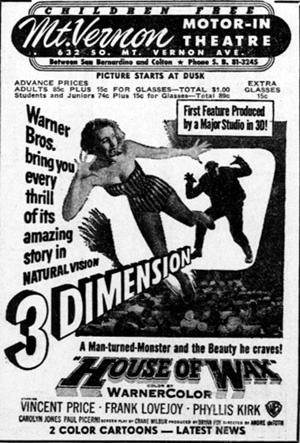
Original newspaper advertisements made maximum use of capital letters and exclamation points. UNLIKE ANYTHING YOU'VE SEEN BEFORE. The ultimate dimension in TERROR. Nothing that has gone before can compare with this. You've never been scared until you've been scared in 3-D.
Those ads were not wrong. For audiences who had never experienced Natural Vision 3D in a properly equipped theater, House of Wax was unlike anything they had seen before. The WarnerPhonic stereophonic sound system accompanying the film added another dimension to the experience. The combination of objects apparently flying toward the audience while sound surrounded them from multiple directions was a novelty in April 1953.
Lobby displays promoted the 3D system and its technology. The polarized glasses distributed to each audience member were themselves part of the marketing. You left the theater carrying proof that you had experienced something different. You could show the glasses to people who had not been. They became a conversation starter and an advertisement for the experience simultaneously.
The ticket price was approximately 45 to 50 cents. For that price, audiences received a horror film, a technological spectacle, and a souvenir pair of glasses. The theater was competing with the living room television set. On that particular value proposition, the theater was winning.
The 3D Craze Faded Almost as Quickly as It Arrived
By late 1953, the 3D craze was already in trouble. By the mid-1950s, it was essentially over for that generation of technology.
The exhibition problems were real and accumulating. Synchronization requirements were demanding. Silver screens were expensive and directional. Two projectionists were sometimes required where one had sufficed before. Prints wore differently in two-projector setups. The technical burden on theater operators was significant and the margin for error was small.
Audience enthusiasm was also cooling. The novelty of having objects fly toward your face had a natural lifespan. Once you had seen it, the experience was less surprising the second time. Films that used 3D for depth and atmosphere rather than constant foreground gimmicks were artistically stronger but sold less spectacularly on the novelty of the experience alone.
CinemaScope arrived in late 1953 with The Robe and offered theaters something appealing. A single projector. No special glasses required. A wide panoramic image that was impressive and difficult to replicate on a small home television screen. The Modern Miracle You See Without Glasses, as the advertising put it, addressed almost every practical objection to 3D in a single phrase.
Studios and exhibitors moved toward widescreen. The first wave of 3D cinema ended. The technology did not disappear. It returned briefly in the early 1980s with Friday the 13th Part 3 and Jaws 3D before fading again. The current generation of digital 3D represents the third major wave. The pattern of a craze followed by practical objections followed by decline has repeated itself across each generation of the technology.
House of Wax Survived After the Gimmick Faded
Here is the important distinction. Most films made primarily to showcase a gimmick do not outlive the gimmick. House of Wax did.
The film was re-released in 1972 in 3D using Chris Condon's single-strip StereoVision format with a full advertising campaign. It was re-released again in 1981. It has been screened in 3D at repertory cinemas and film festivals in subsequent decades. Each revival found new audiences willing to put on the glasses for the experience of seeing it as it was originally intended.
But the film also found audiences who never saw it in 3D and remembered it anyway.
The reason is straightforward. Underneath the paddle balls and the can-can dancers is a strong Gothic horror story with a compelling central character, memorable production design, and a disturbing premise. The wax museum setting works because audiences already found wax museums unsettling. The fire works because melting wax figures are horrible to look at. The Chamber of Horrors works because the question it asks about the figures inside it has a terrible answer.
The Library of Congress added House of Wax to the National Film Registry in 2014. The citation noted that it helped introduce 3D visual effects to a wide audience. It did not need to note that the film had outlasted nearly every other 3D picture from the same era. That was evident from the fact that people were still watching it.
House of Wax (1953) 3D Blu-ray
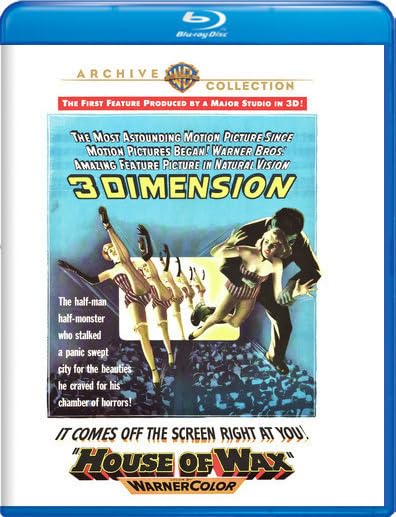
Product Description:
After exploring the history of House of Wax, there's no better way to experience this groundbreaking horror classic than on Blu-ray 3D. Starring the legendary Vincent Price, this landmark 1953 production became the first major Hollywood studio feature released in the Vision 3D process and remains one of the greatest achievements of the original 3D boom. This edition lets modern audiences enjoy the film with the depth and visual impact that thrilled moviegoers in the 1950s.
Key Features:
• Classic 1953 horror film presented in Blu-ray 3D
• Stars Vincent Price in one of his most iconic performances
• First 3D feature produced by a major Hollywood studio
• Includes the original 1933 classic Mystery of the Wax Museum as a special bonus feature
• Essential addition for classic horror, Vincent Price, and vintage 3D film collectors
Why This Works:
If our article inspired you to learn more about House of Wax, this is the definitive way to experience it. From the famous paddle-ball sequence to the beautifully photographed wax museum displays, the film demonstrates why audiences lined up to see 3D movies in the 1950s. The inclusion of Mystery of the Wax Museum makes this an outstanding collector's edition for fans of classic horror cinema.
Buy on Amazon
From House of Wax to William Castle and the Gimmick Era
House of Wax belongs to a broader tradition of theatrical horror showmanship that runs through American film history like a bright and slightly ridiculous thread.
The tradition predates the film. Spook Shows of the 1930s through the 1960s had been flying glowing skeletons over movie audiences and sending performers into theater aisles in the dark for years before House of Wax arrived. The idea of turning the theater into part of the horror experience was well established.
House of Wax contributed to that tradition by demonstrating, at major studio scale, that audiences would pay for horror that invaded their physical space. The 3D system was more sophisticated than a pulley and a plastic skeleton, but the underlying logic was identical. Make the audience feel like the movie has left the screen and entered the room with them.
William Castle would take theatrical horror gimmicks even further, turning skeletons, vibrating seats, special glasses, and insurance policies into part of the show. His Emergo for House on Haunted Hill, his Percepto buzzers for The Tingler, his Illusion-O ghost viewers for 13 Ghosts all belong to the same spirit of showmanship that made audiences duck from a paddle ball in 1953.
Neither Castle nor the makers of House of Wax invented the idea that going to the movies should be an event rather than a transaction. But both understood it better than most of their contemporaries, and both produced work that people still talk about because of it.
Why House of Wax Still Works Without the 3D Glasses
Most people watching House of Wax today are missing the theatrical experience that helped sell it in 1953. They are watching a flat image on a screen or a television. The paddle ball goes toward the camera and does not come at their faces. The can-can dancers kick toward the audience without reaching them.
And the film still works.
It works because Vincent Price understood Professor Jarrod completely and played him with complexity. It works because the wax museum setting taps into an unease that has nothing to do with 3D projection and everything to do with what wax figures look like up close. It works because the fire sequence is disturbing and the Chamber of Horrors delivers exactly the horror its name promises.
House of Wax 3D represents a specific and unrepeatable moment in American entertainment. Hollywood was frightened by changing habits and willing to experiment. A major studio made a horror film in a new technology, rushed it into production in 28 days, and watched it become the second highest-grossing film of 1953. The director could not see the 3D effects. The star secretly attended screenings and leaned forward to whisper at teenagers during the scary parts.
Nearly three-quarters of a century later, the glasses are gone. The silver screens have been replaced. The synchronized dual-projector setup exists only in restoration screenings at dedicated venues.
The wax museum remains. The Chamber of Horrors is still open. And Vincent Price is still waiting inside.