Muhammad Ali Forever Stamp: A Tribute to a Boxing Icon
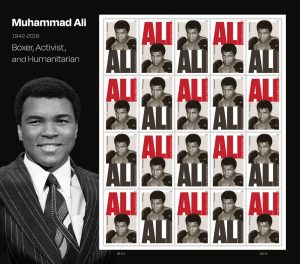
United States Forever Stamp featuring Muhammad Ali, based on a 1974 Associated Press photograph.
Muhammad Ali has been honored in many ways, but the Forever Stamp stands apart. It is small, ordinary by design, and meant to travel. That suits him. Ali was never contained by arenas or eras. He moved through American life the way a letter moves through the mail, passed from hand to hand, leaving an impression each time.
The Muhammad Ali Forever Stamp is a United States postal issue that formalized a widely published sports photograph into everyday circulation. Released as part of the Forever Stamp program, it uses a licensed Associated Press image from 1974 rather than a ceremonial portrait. The stamp functioned as standard postage while also preserving a specific moment from Ali’s boxing career. Its purpose was practical distribution, not tribute, placing a familiar image into routine public use.
Issued as a Forever Stamp, the design draws from an Associated Press photograph taken in 1974. It captures Ali in mid-career, alert and self-possessed. Not smiling. Not posing. Just present. For collectors of stamps and boxing history, it feels right. The image does the talking.
📌 Fun Fact
Ali’s famous rhyme was originally part of a longer spoken routine he used to unsettle opponents during press events, not a planned slogan.
The Life and Legacy of Muhammad Ali
Muhammad Ali Forever Stamp featuring a mid-career boxing image from 1974
Muhammad Ali’s life cannot be separated from his public voice, but it also cannot be reduced to it. He was born Cassius Marcellus Clay Jr. in Louisville, Kentucky, in 1942, a segregated river city that shaped his early sense of fairness and defiance. Boxing entered his life almost by accident, yet he took to it with rare speed. By his late teens, he was already marked as different. Faster hands. Quicker feet. A confidence that sounded like arrogance until it kept proving itself right.
The Olympic gold medal in Rome in 1960 made him visible, but it did not make him safe. He returned home to a country that celebrated his victory while still limiting his place in it. That contradiction stayed with him. When he turned professional, he spoke with a looseness that unsettled promoters and reporters. He predicted rounds. He rhymed insults. He refused to act grateful. When he took the heavyweight title from Sonny Liston, it was not just a championship change. It felt like a generational break.
Outside the ring, Muhammad Ali pushed even harder. His conversion to Islam and his rejection of his birth name were not publicity moves. They were personal decisions made public, and the response was fierce. When he refused military induction during the Vietnam War, he did so calmly, without apology. The consequences were immediate. His title was stripped. His license was pulled. For years, during what should have been his physical peak, he was forced to watch from the sidelines while others fought for belts that once belonged to him.
Those lost years altered him. When he returned to the ring, the speed that once defined him had dulled. He carried more weight. He fought closer to the ropes. Yet he learned to absorb punishment and to wait. This later version of Ali relied less on flash and more on timing, toughness, and nerve. The great fights of his second act were not clean exhibitions. They were exhausting tests. He endured Joe Frazier’s pressure. He outlasted George Foreman’s power. Victory came through patience as much as skill.
By the time his fighting days ended, Ali was no longer just a former champion. He had become a reference point. Fighters were measured against him. Activists invoked him. Even those who once opposed him began to soften their language. His illness in later years added another layer to his public image, one marked by dignity and quiet persistence.
In the end, Ali stood for more than titles or records. He represented the cost of conviction and the refusal to be reshaped by expectation. His style, in speech and movement, was his own. That independence, carried through triumph, exile, return, and decline, is what fixed his place in history.
📌 Fun Fact
Broadcaster Howard Cosell played a major role in shaping Muhammad Ali’s television image, often giving him uninterrupted airtime when other commentators would not.
Muhammad Ali Unforgettable Career
Ali’s career does read like a checklist of the impossible, but the shorthand only hints at what those fights demanded. Sonny Liston was not supposed to lose to anyone, much less a loud young contender who talked faster than he punched. Ali beat him once, then did it again under circumstances that only added to the controversy. Those wins changed the heavyweight division overnight. Power was no longer the final word. Speed, confidence, and nerve suddenly mattered just as much.
Then came the exile years, which broke the rhythm of what should have been a dominant reign. When Ali returned, the landscape had shifted. Younger men had taken his place. Joe Frazier was the embodiment of pressure and discipline, the opposite of Ali in style and temperament. Their three fights were not just boxing matches. They were grinding, personal affairs that took pieces from both men. Ali lost one, won two, and paid for every round. Those bouts stripped away any lingering sense that he was protected by talent alone.
The fight in Zaire against George Foreman stands apart, partly because it seemed so ill-advised. Foreman was stronger, younger, and demolishing opponents with ease. Ali entered the ring as a clear underdog. What followed was not bravado but calculation. He leaned back against the ropes, absorbed punishment, and waited. When Foreman slowed, Ali struck. The strategy looked reckless until it worked, and then it became legend.
What made Ali unforgettable was never just the outcome. It was the method. He talked before fights and backed it up often enough to make the talk matter. He moved with a looseness that mocked traditional footwork. He took risks that ignored expert opinion. When he lost, as he did against Frazier, he did not retreat into excuses. The losses stayed visible, part of the record, part of the story.
The 1974 photograph used for the stamp comes from this middle stretch, after innocence and before decline. Ali is no longer the quicksilver kid predicting knockouts with a grin. He is alert, guarded, and fully aware of what the sport has already taken from him. The face shows experience rather than defiance. That image carries weight because it reflects a fighter who has tested his ideas against reality and survived.
Frozen in that moment, Ali looks earned rather than celebrated. The image captures the cost behind the achievement, which is why it works. It does not promise the future or rewrite the past. It simply records a champion who knew exactly where he stood.
📎 Did You Know?
The phrase “Float like a butterfly, sting like a bee” was first used by Muhammad Ali in early 1964 and quickly became one of the most quoted lines in sports history, long before it appeared on merchandise or memorabilia.
Muhammad Ali Forever Stamp the Joy of Collecting
Muhammad Ali Stamps in January 2026
For stamp collectors, Forever issues carry a quiet appeal. They are functional. They are not tied to a denomination that fades with inflation. You can keep them or use them, and either choice feels valid.
This Ali stamp sits comfortably alongside sports legends, yet it does not shout. The AP image gives it weight. There is no cartooning, no forced heroics. Just a man who knew exactly who he was.
Boxing collectors approach it from another angle. It is a sanctioned, widely distributed artifact that still feels personal. You do not need a display case or gloves to handle it. You peel it. You stick it. You send it out into the world.
That is the pleasure of this stamp. It belongs to everyone, but it still feels specific. Like Muhammad Ali himself, it refuses to fade quietly.
Why It Still Matters
The Muhammad Ali Forever Stamp endures because it does not attempt to summarize a life or celebrate a career. It preserves a single, widely recognized image and allows repetition to do the work of memory. Like the broadcasts and photographs that shaped Ali’s public identity, the stamp remains relevant through continued circulation rather than symbolic reverence.
ML Lamp is the owner of Kilroy Was Here. After his 20 years of working in Las Vegas in the entertainment promotions field, Mr. Lamp retired in 2002 from his job to pursue his passion for collectibles. Now as a guest speaker and author he’s living the dream, and sharing his warmth with You.